
Mowing a lawn is one of the last genuinely manual chores left in a smart home — and for anyone with a hill, a complicated yard, or no free Saturdays, it’s the chore that never ends. Navimow, the robotic mower brand built by Segway, exists to delete it. These are wire-free robot mowers that map your yard themselves, navigate by satellite positioning, LiDAR and camera vision instead of buried boundary cable, dodge obstacles down to a fraction of an inch, and dock themselves when the battery runs low. The 2026 lineup spans fifteen residential models — from the $799 i105 for a small city lot to the $4,499 X390 for two and a half acres — plus a commercial Terranox line. It’s a serious catalog backed by a 3-year warranty, a 30-day return window, and a 4.2/5 “Great” Trustpilot score across roughly 546 reviews on the US store.
For homeowners paying $40–$60 a week for lawn service, the math gets interesting fast. But robot mowers aren’t appliances you unbox and forget, and Navimow has real limitations worth knowing before you spend four figures — edge cutting that still needs a trimmer, mapping that occasionally fights you, and a service record that looks very different depending on which side of the Atlantic you buy from. This 2026 review walks through Navimow’s full range and US pricing, the EFLS and LiDAR+ navigation technology, head-to-head comparisons against Mammotion and Husqvarna, what owners actually complain about, and which model fits which yard.
Navimow Review 2026: Segway’s Wire-Free Robot Mowers From $799 to $4,499
Overview and Background
Navimow is the robotic lawn mower division of Segway — the company most people still associate with self-balancing scooters, but which has spent two decades building consumer robotics, batteries and drive systems. That heritage matters, because a robot mower is essentially an outdoor autonomous vehicle: it needs traction control, weatherproofing, precise positioning, obstacle perception and battery management. Navimow Inc. operates from Nashua, New Hampshire, with separate regional storefronts across Europe, the UK, Australia and Canada.
The brand’s technical foundation is EFLS — the Exact Fusion Locating System — Segway’s approach to centimeter-level positioning without a boundary wire. Traditional robot mowers required trenching a perimeter cable around the lawn, a full day of work redone every time you reshaped a flowerbed. Navimow’s pitch was that satellites and cameras could replace it. The company states it serves more than 40 countries with around 400,000 users, and markets itself as the world’s number one wire-free robotic mower brand by unit sales volume, citing Euromonitor International data for 2024–2025 researched in March 2026 — a vendor-commissioned claim rather than an independently audited statistic, so treat it as directional.
2026 was Navimow’s biggest product year to date. At CES in January it unveiled a near-total lineup refresh: the flagship X4 series for large hilly properties, the H2 series with triple-fusion navigation for complex yards, the i2 AWD for small lots with slopes, and the i2 LiDAR for yards choked with tree canopy. The common thread is the removal of the local RTK antenna — the pole-mounted reference station earlier models needed in the garden — in favor of Network RTK, which pulls correction data over cellular. Alongside the residential range sit Terranox, a commercial mower line, and NavimowFleet for managing machines across grounds and golf courses.
Why Navimow Stands Out in 2026
Wire-free setup, now without an antenna either: The first wave of wire-free mowers still asked you to plant a satellite antenna on a mast with clear sky view and route its cable back to the dock. Navimow’s 2026 models lean on Network RTK instead, delivering positioning corrections over cellular at no extra charge with the data included. Where coverage exists, setup collapses to placing the charging station, connecting Wi-Fi, and letting the machine map. A postcode checker on the site confirms coverage before you order, and every unit still ships with the physical antenna as a fallback.
Class-leading slope capability: The X4 series climbs 84% grades — roughly 40 degrees — via four-wheel drive, a balanced center of gravity, independent front suspension and an articulated rear axle. That is steeper than almost anything else in the residential category, and it’s the spec that rules most competitors out of terraced gardens, drainage banks and hillside properties. Even the small i2 AWD manages 45% (24 degrees), up from roughly 30% for its predecessor.
Xero-Turn steering that doesn’t shred your lawn: This is the engineering reviewers consistently single out. Most AWD robot mowers pivot like a tank — locking wheels on one side while the other spins — grinding a divot into the turf at every turn. The X4 uses an eccentric front-wheel steering system where the wheels articulate, turning tightly without dragging rubber across grass. On a lawn mowed daily, that difference compounds enormously over a season.
Sensor fusion matched to your yard’s specific problem: Rather than betting on one navigation technology, Navimow sells different sensor stacks for different failure modes. Pure RTK is superb in open sky and useless under a mature oak; LiDAR sees under canopy but has no absolute position reference; cameras get blinded by low sun. The H2 and i2 LiDAR models run EFLS LiDAR+, blending solid-state LiDAR, Network RTK and vision and switching modes in around 20 milliseconds. The X4 runs EFLS 3.0, pairing Network RTK with 360-degree visual SLAM and visual-inertial odometry.
Obstacle avoidance built around real yard hazards: VisionFence on the flagship models combines 360-degree RGB cameras with time-of-flight sensing to recognize 200+ object types. The H2 detects objects as small as 0.4 inches, identifies over 20 animal types, and slows automatically from about three feet away when it sees one — meaningful if you have hedgehogs, pets or small children. Three-directional bumpers act as the physical backstop when perception fails.
A model for almost every yard size and budget: Few competitors field fifteen residential SKUs. The range starts at $799 for an eighth of an acre and climbs to $4,499 for 2.5 acres, with branches for budget flat lawns (i1), slopes on small lots (i2 AWD), heavy tree cover (i2 LiDAR), complex mid-size yards (H2) and large difficult properties (X3, X4). You buy for your actual problem instead of overpaying for capability you’ll never use.
Support terms above the category norm: A 3-year warranty is unusually generous for outdoor robotics — many rivals offer two, some only one. Add a 30-day return policy, free shipping over $99, a rewards program, and an active community with a Facebook group and regular Reddit AMAs with product managers, and Navimow looks like a company planning to stay rather than a marketplace brand cashing in on a trend.
Key Features and Technology
Understanding a Navimow means understanding four systems working together: how it knows where it is, how it avoids hitting things, how it moves and cuts, and how you control it. Each is implemented differently across the product tiers, which is why picking the right series matters more than picking the right price.
EFLS Positioning and Network RTK
Standard consumer GPS can be off by several feet — nowhere near precise enough to keep a spinning blade inside a lawn boundary. RTK, or real-time kinematic positioning, compares the mower’s satellite readings against correction data from a fixed reference point, tightening accuracy to centimeters. Traditionally that reference point was an antenna in your own garden. Network RTK draws the same corrections from a regional network over cellular, which is why 2026 models can skip antenna installation in covered areas — access and the data it consumes are included at no cost. Where the network doesn’t reach, the bundled antenna does the same job; it just needs a broad, unobstructed view of sky away from buildings and trees.
EFLS LiDAR+ Triple Fusion
Satellite positioning has one incurable weakness: it needs sky. Under dense canopy, between tall buildings, or in a narrow side yard, the signal degrades and the mower wanders. The H2 series and i2 LiDAR models add a solid-state LiDAR turret that maps the yard geometrically in three dimensions regardless of satellite conditions. The system runs LiDAR, Network RTK and vision simultaneously, handing off between them in roughly 20 milliseconds. In open lawn RTK provides absolute position; under trees LiDAR carries navigation while RTK contributes what it can. For yards that defeated the previous generation of robot mowers, this is the most important upgrade in the 2026 range.
Drive Systems, Cutting Decks and Weatherproofing
The flagship X430 is substantial at roughly 33.5 × 24 × 13.8 inches and about 64 pounds — closer to a small utility vehicle than a household gadget. It carries a 17-inch dual-deck cutting system with twelve blades, cutting height adjustable from 0.75 to 4 inches, and rated throughput near 5,400 square feet per hour, running about 110 minutes per charge and recharging in roughly 90. Mower and station are IP66-rated, with the power supply and camera at IP67. Noise sits around 60 dB(A) — quiet enough to converse beside and to schedule overnight. The i-series machines are far smaller at roughly 21.5 × 15.2 × 11.2 inches, about 24 pounds, with a 7.1-inch cutting width. The H2 adds a 100W peak cutting motor with a six-blade anti-clogging disc, zero-edge cutting within about two inches of a wall, and passage clearance as narrow as 2.3 feet.
The Navimow App and Smart Home Integration
Mapping happens two ways. Auto-mapping lets the mower trace the perimeter itself after you drive it onto grass with on-screen joysticks — fast and reliable where edges are clearly defined. Manual mapping asks you to drive the full boundary, recommended where your lawn blends into a neighbor’s, where leaves or bare soil obscure the edge, or near pools and tight gaps. Once mapped, you can adjust boundaries, mark no-go islands, create channels between zones, set per-zone cutting heights, and schedule jobs including night mowing. Most models support Alexa and Google Assistant, the X4 adds Apple Find My, and anti-theft GPS tracking is standard.
Pricing, Plans, and Package Structure
Navimow sells hardware outright — no subscription is required to mow, and there is no software paywall on core features. Pricing is organized by coverage area first, navigation technology second. The table below lists the US residential lineup published on navimow.com; regional stores in Europe, the UK, Canada and Australia carry different model numbers and local pricing.
| Model | Price (USD) | Coverage & Tech | Best For |
|---|---|---|---|
| Navimow i105 | $799 | 0.125 acre · RTK + vision | Small, flat city lots on a budget |
| Navimow i206 AWD | $999 | 0.15 acre · AWD, 45% slope | Small lots with banks or uneven turf |
| Navimow i110 | $1,099 | 0.25 acre · RTK + vision | Quarter-acre flat lawns, best value pick |
| Navimow i210 AWD | $1,299 | 0.25 acre · AWD + ESC | Quarter-acre yards with slopes and mud |
| Navimow H800-VF | $1,299 (from $1,899) | 0.2 acre · previous-gen H series | Discount hunters happy with last-gen tech |
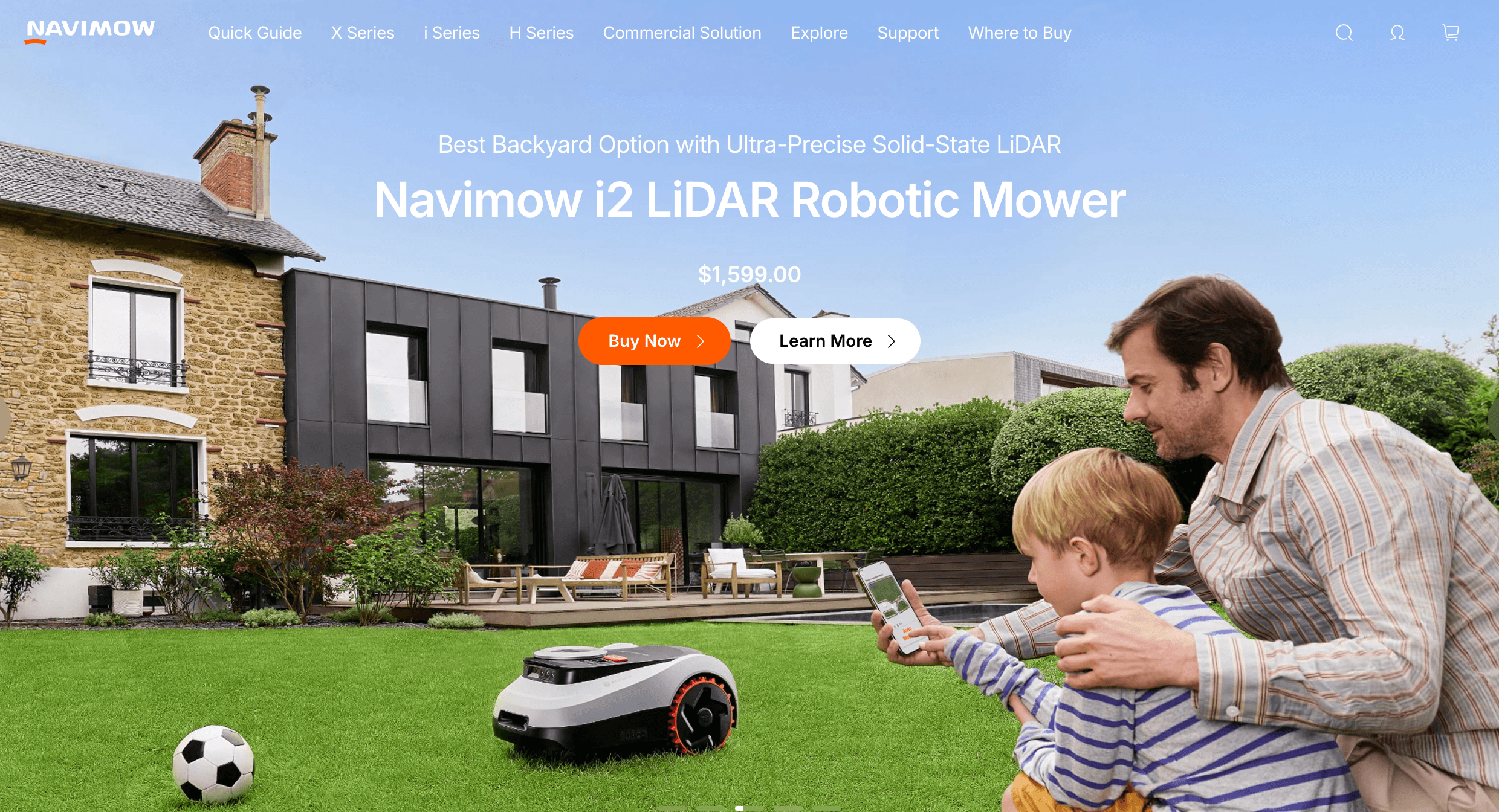
| Navimow i215 LiDAR | $1,599 | 0.37 acre · solid-state LiDAR | Heavy tree canopy or narrow corridors |
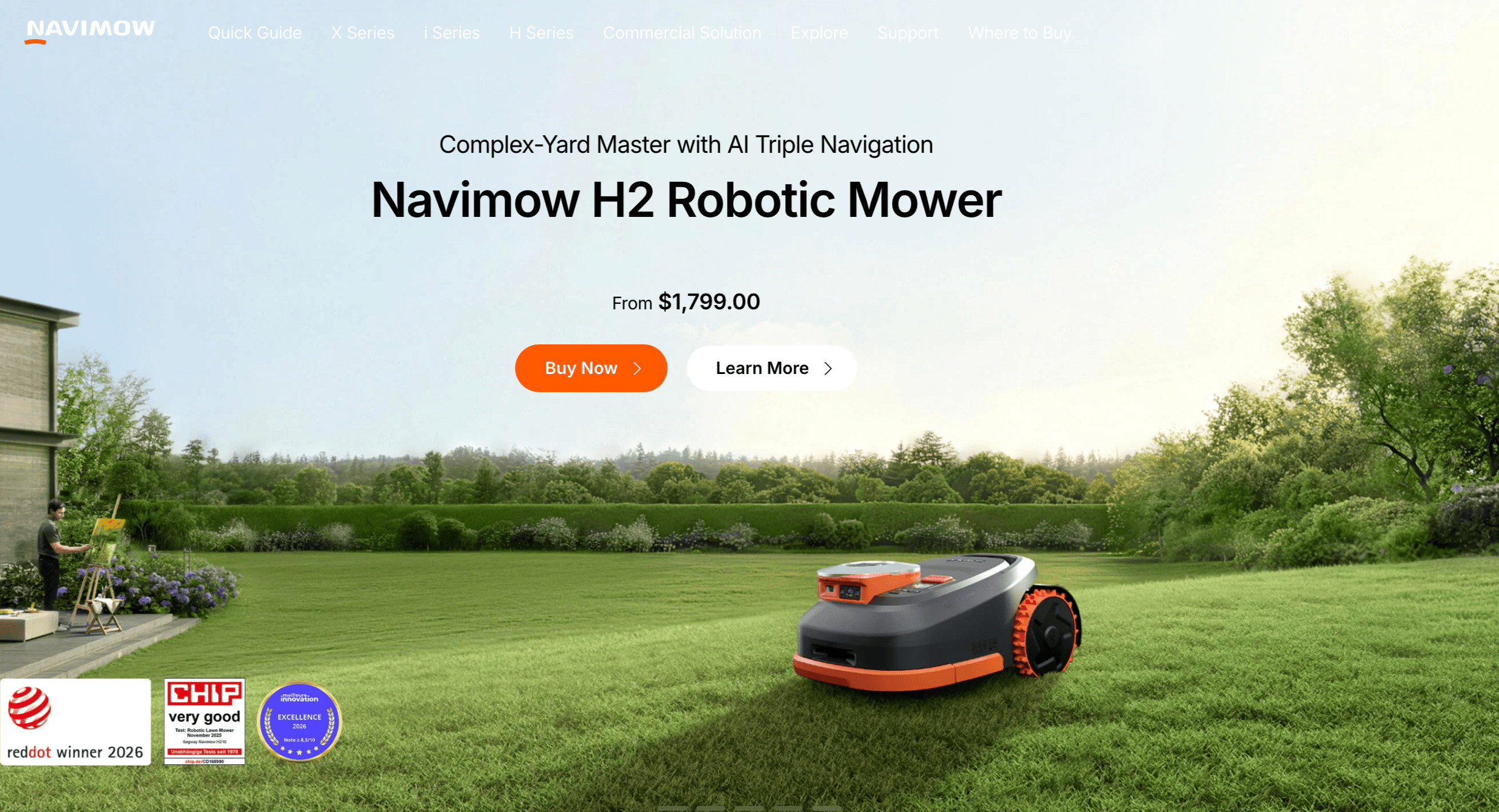
| Navimow H210 | $1,799 | 0.25 acre · EFLS LiDAR+ triple fusion | Complex small yards, animal safety priority |
| Navimow H220 | $2,199 | 0.5 acre · triple fusion, 10Ah | Half-acre yards with obstacles everywhere |
| Navimow X330 | $2,299 | 1.0 acre · X3 platform | Large flat-to-rolling lawns, value tier |
| Navimow X430 | $2,499 | 1.0 acre · 4WD Xero-Turn, 84% slope | Steep, complex acre properties |
| Navimow X350 | $2,799 | 1.5 acres · X3 platform | Bigger properties without extreme slopes |
| Navimow X450 | $2,999 | 1.5 acres · 4WD Xero-Turn, 12.8Ah | Flagship — large, steep, difficult land |
| Navimow X390 | $4,499 | 2.5 acres · X3 platform, 12.8Ah | Estate-scale lawns and small grounds |
| Key accessories | $23.99–$449.99 | Garages, MowGate, antennas, batteries | Weather protection and spare consumables |
Two ongoing costs are worth budgeting for. Connect+ cellular service runs roughly $32.90 per year after the included first year — optional, but most owners want remote access. Blades are consumables at about $23.99 per assembly, replaced once or twice a season by heavy users. Garages sheltering the dock run $199.99 to $349.99, and Navimow frequently bundles one free during promotions.
How Navimow Compares to Alternatives
| Factor | Segway Navimow | Mammotion LUBA 3 AWD | Husqvarna Automower |
|---|---|---|---|
| Entry price (approx.) | $799 (i105) | ~$749 (Yuka Mini), LUBA 3 from ~$2,099 | ~$620 (115H wired), EPOS from ~$1,550 |
| Flagship price (approx.) | $2,999 (X450) / $4,499 (X390) | ~$2,399 (LUBA 3 AWD) | ~$4,300 (440iQ), up to ~$5,900 (450XH EPOS) |
| Max slope | 84% (40°) on X4 — category leading | ~80% (38°) on LUBA 3 AWD | ~45% on premium models |
| Navigation | EFLS: Network RTK + vision, LiDAR+ on H2/i2 | Tri-fusion: 360° LiDAR + NetRTK + dual cameras | Boundary wire, or EPOS wire-free with RS1 station |
| Antenna required | No, where Network RTK covers (included free) | Depends on model and network coverage | EPOS needs the RS1 reference station |
| Turf-safe turning | Xero-Turn articulated steering, no tank pivots | AWD, differential-style turning on most models | Lighter machines, minimal turf stress |
| Cut quality reputation | Strong and consistent; edges need a trimmer | Good, with tall cutting heights for cool-season grass | Widely regarded as the category benchmark |
| Warranty | 3 years | Typically 2 years (varies by region) | 2 years plus a real dealer service network |
| Trustpilot (brand store) | 4.2/5 US store · 3.3/5 EU store | ~3.8/5 global · ~4.4/5 EU store | ~1.3/5 (corporate site, heavily service-skewed) |
| Best for | Steep, complex or heavily wooded yards, and buyers who want one brand covering every lawn size | Value-focused buyers on slopes who want maximum spec per dollar | Buyers prioritizing cut quality, long track record and local dealer support |
Navimow vs. Mammotion: These are the genuine head-to-head rivals in 2026, and the gap is narrower than either brand’s marketing suggests. Mammotion’s LUBA 3 AWD tends to undercut a comparable Navimow by a few hundred dollars with similar tri-fusion navigation and slope capability in the same ballpark. Navimow counters with the 84% slope ceiling, Xero-Turn steering that avoids tearing turf, a 3-year warranty, and more models at the small-yard end. Mammotion counters on price-per-square-foot and a larger reviewed install base. If your yard is genuinely steep and turf damage worries you, the X4 has the edge; if you want maximum capability per dollar and your slopes are challenging rather than extreme, Mammotion deserves a serious look.
Navimow vs. Husqvarna: Husqvarna has built robot mowers since 1995, and it shows in cut quality — still widely considered the industry benchmark — and in a dealer network where blade sharpening, warranty work and off-season storage are handled by a person nearby rather than a support chat. What it charges for that is significant: wire-free EPOS models sit well above comparable Navimows, and wired models require trenching cable. If you value proven reliability and a service relationship over specs and price, Husqvarna is the safer buy. If you want wire-free convenience, steep-slope capability and a lower sticker, Navimow wins on value comfortably.
Navimow vs. LiDAR-first brands: Ecovacs, Dreame and others have pushed LiDAR-led navigation hard, and for shaded suburban lots it genuinely beats satellite-only positioning. Navimow’s answer was to add LiDAR rather than replace RTK — the i215 LiDAR at $1,599 and the H2 series exist for canopy-heavy yards. Navimow no longer concedes shaded lawns to the specialists, but you must buy the right model. Choosing an RTK-only i110 for a yard full of mature trees is the most common way to end up disappointed with this brand.
Pros and Cons
What Users Love
The time it gives back is the recurring theme: Across hundreds of reviews the same sentiment repeats — owners reclaiming weekends, cancelling lawn services costing $40–$60 a week, and simply not thinking about the lawn. Several long-term owners report a year or more of use with lawns looking better than under weekly mowing, because daily light trimming keeps grass healthier than infrequent heavy cuts.
Slope and terrain performance genuinely delivers: This is where hands-on reviewers are most consistently impressed. Testers with tree roots, elevation changes, ruts and raised edges report the X430 crossing them without spinning, sliding or stalling — including a narrow gap beside a fence where a smaller Navimow had previously slipped in twice.
Setup is faster than most people expect: Where Network RTK is available, reviewers report going from box to first mow in about an hour including firmware updates. The app recognizes the mower immediately, Wi-Fi pairing takes minutes, and auto-mapping traces a usable perimeter with minimal driving. Multiple Trustpilot reviewers highlight that not needing the antenna was a deciding factor.
The app is capable without being overwhelming: Live position tracking, battery and coverage monitoring, large stop and return-home buttons, per-zone cutting heights, schedules, map editing and job reports are all present, and reviewers note the controls you need mid-job aren’t buried under menus.
Obstacle avoidance handles real yards: Testers deliberately leaving patio furniture, garden boxes, sticks, toys and pet waste in the mowing path report the machine routing around them rather than plowing through. The H2’s animal-detection slowdown and 0.4-inch detection threshold matter to anyone with wildlife or small children.
It’s quiet enough to be invisible: At roughly 58–60 dB(A) depending on model, these machines are quiet enough to converse beside and to run overnight without annoying neighbors — a stark contrast to a gas mower, and one of the most-cited quality-of-life improvements in owner feedback.
Limitations Worth Knowing
Edge cutting still isn’t solved: The most consistent complaint across every model tier and every reviewer. The cutting disc sits inboard of the chassis edge, so a strip along walls, fences and beds goes untouched. The H2’s zero-edge mode gets within about two inches and the X3 accepts an optional side trimmer module, but the honest expectation is that you’ll still walk the perimeter with a string trimmer every few weeks. One Trustpilot reviewer put it bluntly: the mower cuts well, but they still need a conventional mower for the boundary.
Mapping can be genuinely frustrating on awkward lawns: Auto-mapping works beautifully on clearly-defined lawns and badly everywhere else — Navimow itself warns against it where grass blends into a neighbor’s yard, where leaves or bare soil hide the edge, or near pools and drops. Owner reports range from flawless first-attempt maps to one reviewer needing close to twenty attempts before the map stuck.
Support and logistics quality varies sharply by region: This is the rating divergence buyers most need to see. The US-facing store carries a 4.2/5 Trustpilot score, but roughly 11% of those reviews are one-star — and the separate EU-facing storefront sits at about 3.3/5. European reviewers describe shipments stalled in customs for weeks, packages misrouted to the wrong country, support reachable only by chat with slow generic replies, and a dispute over a promotional price not honored on reorder. Refunds are reported as taking two weeks or more. Buying through a local dealer is the workaround multiple reviewers recommend.
The dock has real siting requirements: The charging station needs level ground with roughly 6.6 feet of clear space in front and about 1.6 feet either side, plus power within cable reach and — for RTK-dependent models — decent sky visibility. At least one owner returned their unit because no suitable spot existed. Measure before you buy.
Documentation is weaker than the hardware: Navimow ships pictogram-style printed instructions, and reviewers repeatedly say the illustrations don’t match what’s on screen for their model, or are simply hard to follow. Several owners fell back on YouTube videos to finish setup. For a four-figure purchase, the manual shouldn’t be the weakest part of the experience.
The flagships are big, heavy and expensive: The X430 weighs about 64 pounds and ships in a box most people can’t lift alone. Reviewers who otherwise rate it highly list “expensive” and “large and heavy” among their explicit cons. And where Network RTK isn’t available, you’re back to installing the antenna the wire-free pitch implied you’d avoid.
Entry models have real performance ceilings: The budget i-series is slow, front-wheel drive, and not powerful enough to chew through leaves or twigs. One reviewer rated the i105N 7.5/10, flagging mowing performance, an unintuitive control panel, and no Alexa or Google Assistant support. Fine machines for small flat lawns — but not scaled-down flagships.
Who Should Use Navimow
Owners of steep or terraced properties: Navimow’s clearest advantage. If part of your lawn is a bank or hillside that has ruled out every other robot mower, the X4’s 84% grade rating is close to the only residential answer short of a commercial machine — and Xero-Turn steering means it works that terrain daily without carving it up.
Anyone with a heavily wooded or shaded yard: Mature trees are the historic killer of RTK-based mowers. The i215 LiDAR at $1,599 and the H2 series exist for exactly this, using solid-state LiDAR where satellites can’t help. If your previous robot mower kept losing signal under the oak, this is the tier that fixes it.
Households currently paying for lawn service: At $50 a week over a 30-week season, lawn service costs about $1,500 a year. A $1,099 i110 or $1,299 i210 AWD covering a quarter acre pays for itself inside one season and carries a 3-year warranty. Even the $2,499 X430 breaks even in roughly two seasons on an acre.
People who physically can’t mow anymore: Injury, surgery, age or mobility limits turn a routine chore into a real problem, and it’s among the most common motivations reviewers describe. Nothing needs pushing, and the app lets a family member in another city manage the schedule remotely.
Smart-home owners adding another automated system: If you already run robot vacuums, smart irrigation and connected lighting, a Navimow slots in with Alexa and Google Assistant support, app scheduling, weather-adaptive mowing from forecast data, and GPS anti-theft tracking. The X4’s Apple Find My support is a nice touch.
Who should look elsewhere: If edges must be perfect without you ever touching a trimmer, no current robot mower — Navimow included — will satisfy you. If your lawn regularly grows long between cuts or you need to reclaim overgrown ground, buy a conventional mower. If cut quality and a local dealer relationship matter most, Husqvarna remains stronger. If you’re shopping purely on price-per-square-foot with moderate slopes, Mammotion and the LiDAR-first brands often deliver more machine per dollar. And in Europe, order through a local retailer rather than direct — the regional service complaints are frequent enough to take seriously.
Getting Started: Step by Step
- Measure your lawn and identify its hardest problem. Coverage rating comes first — buy for your actual square footage. Then identify the constraint: steep slopes point to the X4 or i2 AWD, heavy canopy to the i215 LiDAR or H2, obstacle-dense layouts to the H2, and simple flat lawns to the far cheaper i1 series. Use a clinometer app to measure your steepest grade rather than eyeballing it.
- Check Network RTK coverage and plan the dock location. Enter your postcode in Navimow’s coverage checker before ordering. Then find a station spot on level ground with about 6.6 feet clear in front and 1.6 feet either side, within reach of power, and — if you’ll need the antenna — with open sky nearby. This single decision determines how smoothly setup goes.
- Assemble the station and get a helper for the mower. The station arrives in two pieces; attach the upright contact section to the base, anchor it with the supplied ground nails, and peg the power cable well outside the mower’s route. Flagships weigh around 64 pounds, so lift with a second pair of hands.
- Pair in the app and let the firmware update finish. The app should detect the mower as soon as you tap “add device”; Wi-Fi pairing takes a couple of minutes. Expect firmware updates to add roughly twenty minutes — don’t start mapping until they’ve completed.
- Map carefully, and choose manual mapping if your edges are ambiguous. Drive the mower onto grass with the on-screen joysticks until the app confirms it recognizes turf, then let auto-mapping trace the perimeter. If your lawn merges into a neighbor’s, is obscured by leaves or bare soil, or sits near a pool, drop or narrow gap, use manual mapping — slower, but it produces a boundary you can trust. Then add no-go islands around flowerbeds and channels between zones.
- Set a conservative schedule, then tune it. Start with a moderate cutting height and mow frequently — these machines trim a little every day, and light daily cuts produce healthier turf than aggressive weekly ones. Watch the first few jobs, adjust boundaries where the mower hesitates, and only then add night mowing or per-zone height variations.
Tips for Getting Maximum Value
Mow conventionally once before the first robot run so the machine starts from a maintained baseline rather than fighting overgrowth — the fastest way to avoid a disappointing first impression. Keep a string trimmer in the shed and accept that perimeter work stays manual; treating the Navimow as your daily mower rather than your only lawn tool is the mindset that keeps owners happy. Buy the garage accessory if your dock sits in full sun or heavy rain, and watch for promotions, since Navimow regularly bundles one free and discounts previous-generation models like the H800-VF heavily. Cross-shop the same SKU at Lowe’s, Home Depot and Walmart, which frequently match Navimow’s MSRP while Amazon has listed the same machine higher. Keep a spare blade assembly on hand at around $24, change blades when the cut looks ragged, and clear heavy leaf fall before autumn runs. And decide deliberately whether Connect+ is worth roughly $33 a year once the included first year expires.
Future Outlook and Final Assessment
Robot mowers were among the fastest-growing categories at CES 2026, with nineteen companies showing new models, and the direction is clear: boundary wires are finished, local antennas are on the way out, and sensor fusion is replacing single-technology navigation. Navimow is well positioned for that shift — the 2026 refresh moved almost the entire range to Network RTK, added LiDAR where satellites fail, and pushed slope capability past any mainstream rival. Segway’s manufacturing scale and its expansion into commercial turf via Terranox and NavimowFleet suggest a company building infrastructure rather than chasing a fad.
The caveats are equally clear. Edge cutting remains an unsolved category-wide problem that marketing glosses over. Mapping on awkward lawns can consume an afternoon. Documentation lags well behind the hardware. And the gap between the US store’s 4.2/5 Trustpilot rating and the EU store’s 3.3/5 is not noise — it reflects a real regional difference in shipping and support that European buyers should weigh. Competition is intensifying too, with Mammotion pushing on price-per-spec and LiDAR-first brands owning shaded suburban lots. But on the jobs Navimow was built for — steep ground, complex layouts, wooded yards, and covering every lawn size under one brand and one app — it is among the strongest options available.
Conclusion
Navimow isn’t trying to be the cheapest robot mower or the one with the most perfect cut — it’s trying to be the one that works on yards other robots can’t handle, and it largely succeeds. Segway’s engineering shows where this category usually fails: 40-degree slopes, articulated steering that doesn’t chew up turf, and LiDAR fusion that keeps navigating under canopy where satellite-only machines get lost. Fifteen residential models from $799 to $4,499 mean you can buy for your specific problem, and a 3-year warranty with a 30-day return window makes the risk manageable. It won’t trim your edges, it won’t rescue an overgrown lawn, and European buyers should shop through a dealer — but for keeping a difficult lawn consistently and quietly cut, few brands do it better. Confirm Network RTK coverage for your postcode, verify current pricing across retailers, and Navimow can take the last manual chore off your weekend for good.
Ready to get your weekends back from the lawn?
Explore more honest reviews, tutorials and tech comparisons to find the right gear for the way you work, travel and live — at World Of Tech, where we make everything easy.
👉 Shop Navimow: https://worldoftech.space/navimow
👉 Our YouTube Channel: youtube.com/@world_tech79
👉 Our Facebook Fanpage: Facebook
👉 Our X (Twitter): @worldoftech79
Pricing, specifications and policy details in this review were verified against navimow.com and independent review sources (including Trustpilot and hands-on testing published by PCWorld, Tom’s Guide, Gizmodo, Expert Reviews and Notebookcheck) as of August 2026. Robotic mower pricing, model availability and Network RTK coverage change frequently and vary by region, so confirm current details on the official site before purchasing. Competitor prices are approximate and subject to change.