
If you’ve ever tried to scrape a modern e-commerce site, run a large-scale market research job, or feed an AI model real-time web data, you already know the real bottleneck isn’t code — it’s getting blocked. That’s the problem Novada is built to solve. It’s an all-in-one web data platform combining a 100M+ IP residential proxy network with a full scraping toolkit — Scraper API, SERP API, Web Unblocker, Browser API, and a free MCP server for AI agents — all drawing from a single shared credit balance. Built by Novada Labs GmbH, a Germany-headquartered proxy provider that’s grown quickly by undercutting the established giants on price (residential proxies from $0.85/GB versus $4–$8/GB at Bright Data and Oxylabs), Novada has positioned itself as the budget-friendly alternative for businesses that need real infrastructure without an enterprise contract.
For developers, growth marketers, AI teams and data-driven startups who need reliable web access without paying premium-tier rates, the pitch is compelling: a 100M+ IP pool across 195+ countries, unlimited concurrent sessions, and a whole stack of scraping tools sharing one wallet. But Novada is also a younger, smaller company than the category leaders, and an honest look means weighing that price advantage against a thinner independent track record and some real trade-offs around geo-targeting precision and support consistency. This 2026 review walks through Novada’s full product range — the proxy network, the scraping APIs, pricing across every tier, a head-to-head comparison against Bright Data and Oxylabs, the genuine pros and cons, and exactly who should (and shouldn’t) choose it.
Novada Review 2026: Is This Budget Proxy Network the Smart Alternative to Bright Data and Oxylabs?
Overview and Background
Novada is a proxy network and web-data platform operated by Novada Labs GmbH, a company headquartered in Germany that positions itself as a full-stack alternative to legacy proxy providers. Rather than selling raw IPs alone, Novada bundles residential, ISP, datacenter and mobile proxies together with a suite of managed scraping tools — Scraper API, SERP API, Web Unblocker, Browser API, a Video Data API and ready-made datasets — all billed from a single shared credit balance instead of separate accounts per product. The company reports a self-built pool of 100 million-plus real residential IPs (some Novada pages cite figures as high as 160 million) spanning more than 195 countries, and says it’s already used by thousands of businesses across data collection, AI training, e-commerce intelligence, and ad verification.
The company is led by CEO Deng Pan and, per Crunchbase, runs a lean team of roughly 11–50 people — small compared to a decade-old incumbent like Oxylabs (300+ employees). That’s consistent with Novada’s positioning as a newer, faster-moving challenger: the brand describes itself as having “5+ years of expertise,” which places its founding around 2020–2021, and it has been actively expanding its enterprise footprint, exhibiting at industry events like the AsiaBerlin Summit and building out AI-specific use cases as demand for LLM training data has grown. One honest caveat worth flagging upfront: Novada’s own pages list two different German headquarters addresses (Frankfurt am Main on some legal pages, Düsseldorf on others) — a minor inconsistency that’s worth noting rather than glossing over.
What separates Novada from a plain proxy reseller is the breadth of its stack under one roof. Beyond rotating and static residential, ISP, datacenter and mobile proxies, it ships a free MCP (Model Context Protocol) server so AI agents can pull live web data directly, a growing datasets marketplace for teams that don’t want to scrape at all, and managed APIs that handle CAPTCHA-solving and JavaScript rendering automatically. The through-line across the whole platform is price: Novada consistently undercuts Bright Data and Oxylabs on headline per-GB rates, which is the central reason it’s drawn attention from budget-conscious scraping teams and AI startups in 2026.
Why Novada Stands Out in 2026
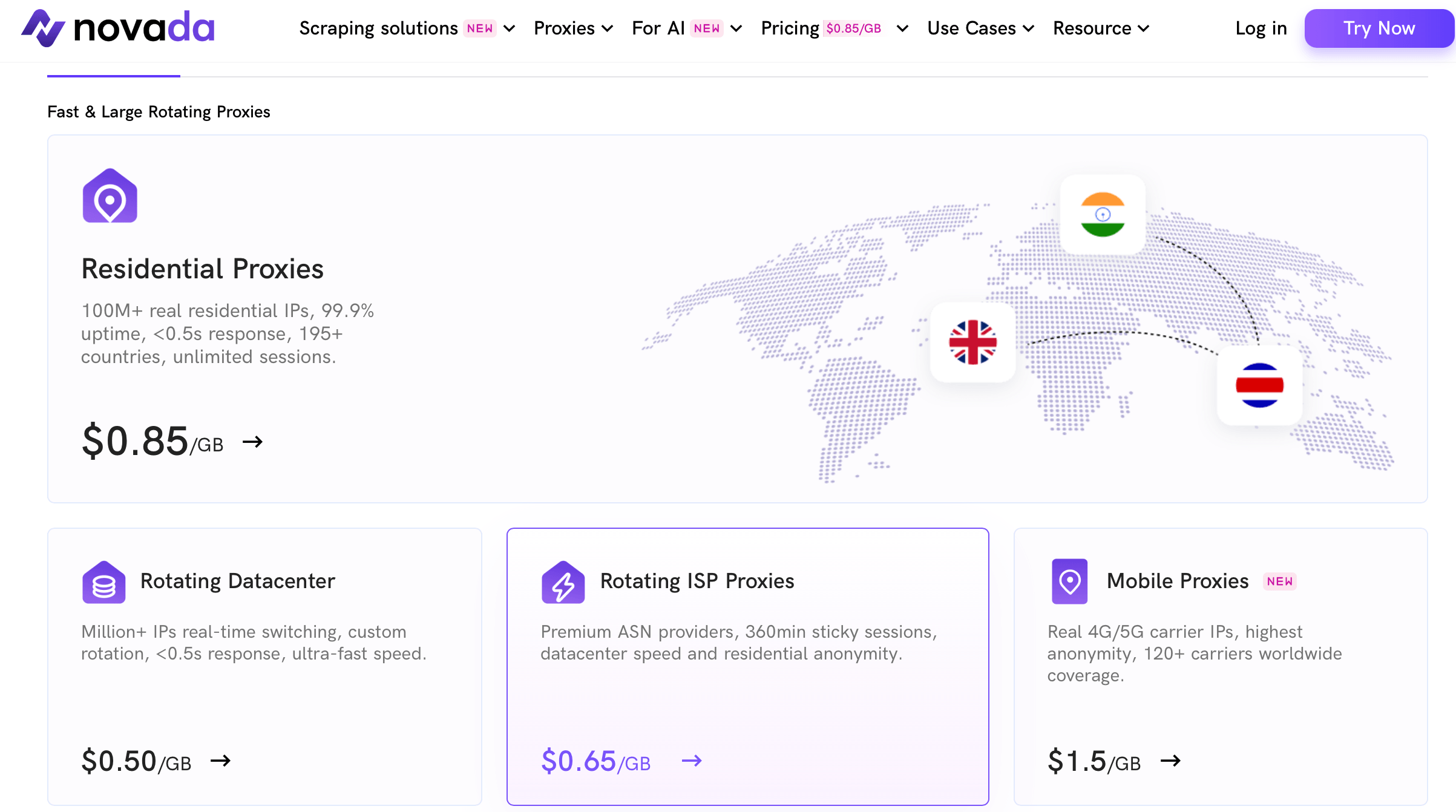
Aggressive pricing against the category leaders: This is Novada’s biggest single selling point. Residential proxies start at $0.85/GB, versus roughly $4–$8.40/GB pay-as-you-go at Bright Data and Oxylabs. Rotating datacenter starts at $0.50/GB and rotating ISP at $0.65/GB — a meaningful discount across the board that adds up fast at scale.
One shared credit balance across every tool: Instead of juggling separate wallets for proxies, Scraper API, SERP API and Browser API the way many competitors require, Novada pools all Scraping Solutions under a single credit balance. That’s a genuine convenience for teams running mixed workloads.
A free MCP server built for AI agents: Novada MCP lets AI agents access live web data in real time with a one-line integration — a forward-looking feature that plugs directly into the current wave of agentic AI tooling, and it’s offered free rather than as a paid add-on.
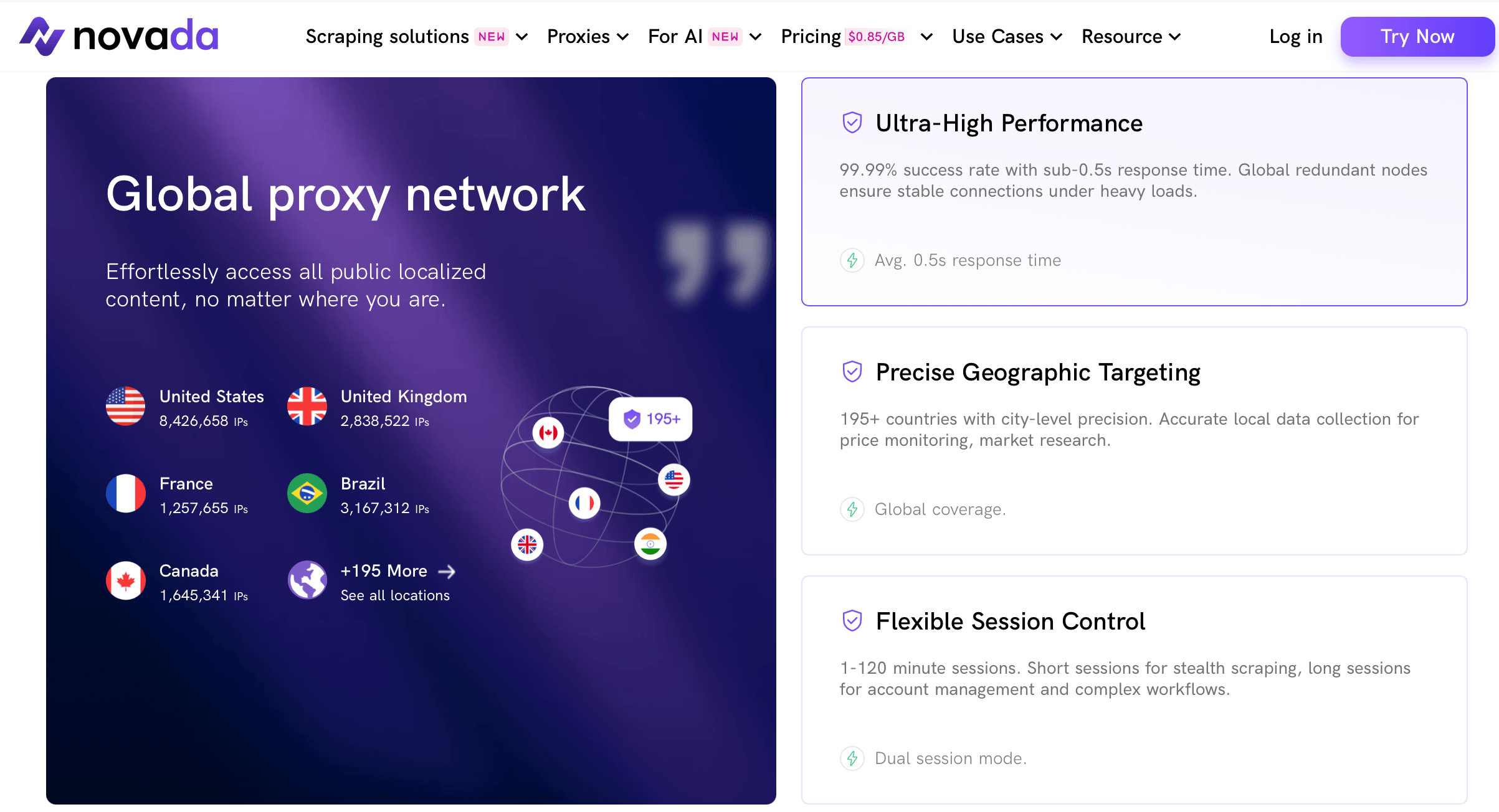
Genuinely broad global coverage: With 100M+ residential IPs across 195+ countries and free city-level targeting included (a feature some competitors charge extra for), Novada covers the geographic breadth most scraping and localization projects need without add-on fees.
A complete scraping stack, not just proxies: Scraper API, SERP API, Web Unblocker and Browser API cover everything from raw IP access to fully managed, CAPTCHA-solving, JavaScript-rendering scraping — useful for teams that don’t want to build and maintain their own anti-bot logic.
Unlimited concurrency and flexible sessions: Rotating and sticky sessions (1–120 minutes) are supported with no hard concurrency cap on the residential network, which matters for high-volume, parallelized scraping jobs.
A low-friction entry point: New users get a $10-for-10GB residential proxy offer to test the network before committing, and self-serve signup (with a “no credit card required” option) lowers the barrier compared to providers that push straight to a sales call.
Key Features and Technology
Novada’s product line is wide, but it organizes cleanly into a handful of pillars. Here’s how the platform actually breaks down.
The Proxy Network: Residential, ISP, Datacenter and Mobile
The core product is Novada’s rotating residential proxy network — 100M+ real IPs sourced from residential devices across 195+ countries, with rotating sessions (a new IP per request) or sticky sessions held for up to 120 minutes. Rotating ISP proxies sit between residential and datacenter, combining ISP-level speed with residential-style trust and 6-hour sticky sessions. Rotating and dedicated datacenter proxies serve high-volume, low-anonymity-requirement jobs at the lowest per-unit cost, and mobile proxies (2M+ real 3G/4G/5G IPs) target app testing and ad verification scenarios that specifically need carrier-grade IPs. Static ISP and IPv6 options round out the lineup for teams that need a fixed, dedicated IP instead of a rotating pool.
The Scraping Suite: Scraper API, SERP API, Web Unblocker and Browser API
Beyond raw proxies, Novada ships managed tools for teams that don’t want to build their own scraping infrastructure. Scraper API handles structured data collection from search engines, e-commerce sites and social platforms with built-in anti-bot bypassing. SERP API focuses specifically on search-engine results (Google, Bing, Yahoo and more) for real-time structured SERP data. Web Unblocker auto-bypasses CAPTCHAs and JavaScript-rendering challenges to get instant access to blocked pages. Browser API provides a hosted, remote browser that simulates real user interaction for the toughest anti-bot targets. All four draw from the same shared credit balance as the proxy network.
Novada MCP and AI/LLM Data Tools
Novada MCP is a free Model Context Protocol server that lets AI agents call Novada’s proxy and scraping capabilities directly, positioned for the current wave of agentic AI workflows where a model needs to fetch live web data mid-task. Alongside this, Novada markets its infrastructure specifically for AI training data collection — text, image and video datasets gathered at scale for language models, sentiment analysis and computer vision — plus a growing Datasets marketplace of ready-to-use, pre-collected data for teams that would rather buy structured data outright than run their own scraping pipeline.
Compliance, Security and IP Sourcing
Novada states its residential IPs are obtained through legitimate channels with user consent and verified through KYC procedures, and claims GDPR/CCPA compliance along with SSL/TLS encryption, DDoS protection and 24/7 security monitoring. The company frames itself around an “ethical sourcing” model rather than the peer-to-peer SDK-bundling approach some cheaper proxy networks use — though, as with most proxy providers’ compliance claims, this is self-reported and worth independent diligence if your use case is compliance-sensitive.
Pricing, Plans, and Package Structure
Novada uses consumption-based pricing rather than flat SaaS tiers — you pay per GB for residential, ISP-rotating, datacenter-rotating and mobile proxies, and per IP for static ISP and dedicated datacenter. Scraping solutions (Scraper API, SERP API, Web Unblocker) are billed per 1,000 results, and Browser API per GB. All Scraping Solutions share a single credit balance. The rates below are Novada’s published starting prices as of August 2026; actual cost per GB typically drops at higher committed volumes, and enterprise/custom plans are available on request.
| Product | Starting Price | What It Is | Best For |
|---|---|---|---|
| Residential Proxies | From $0.85/GB | 100M+ real residential IPs, 195+ countries | General-purpose scraping & unblocking |
| Rotating ISP Proxies | From $0.65/GB | Residential trust with datacenter speed, 6-hr sticky | Stable, faster sessions on a budget |
| Rotating Datacenter Proxies | From $0.50/GB | High-speed datacenter IPs, 190+ countries | Large-scale, low-anonymity-need jobs |
| Mobile Proxies | From $1.50/GB | 2M+ real 3G/4G/5G carrier IPs | App automation & ad verification |
| Static ISP Proxies | From $1.18/IP | Native, dedicated ISP IPs | E-commerce & social media management |
| Dedicated Datacenter Proxies | From $0.72/IP | Exclusive, gigabit-speed dedicated IPs | Budget-friendly dedicated access |
| Scraper API / SERP API | From $0.90/1k results | Managed structured data & search scraping | Teams that don’t want to self-manage anti-bot logic |
| Web Unblocker | From $1.00/1k results | Auto CAPTCHA/anti-bot bypass | Instant access to heavily protected sites |
| Browser API | From $4.00/GB | Hosted browser, real-user interaction simulation | Complex, JavaScript-heavy automation |
How Novada Compares to Alternatives
| Factor | Novada | Bright Data | Oxylabs |
|---|---|---|---|
| Residential entry price | $0.85/GB | ~$4–$8.40/GB (approx.) | ~$4–$6/GB (approx.) |
| IP pool size | 100M+ (self-reported, up to 160M+) | 150M+ (some sources cite 400M+ monthly) | 175M+ |
| Country coverage | 195+ | 195+ | 195+ |
| Company maturity | ~5 years, 11–50 employees | Founded 2014, hundreds of employees | Founded 2015, 300+ employees |
| Independent review volume | Small (low double digits on Trustpilot) | Large, established track record | Large, ISO 27001/SOC 2 certified |
| Shared credit across products | Yes, all Scraping Solutions | No, billed per product | No, billed per product |
| Free MCP for AI agents | Yes | Limited/enterprise-oriented | Limited/enterprise-oriented |
| Best for | Cost-conscious scraping & AI-data teams | Enterprise scale, deepest tooling | Compliance-heavy enterprise use |
vs. Bright Data: Bright Data is the largest, most established name in the category, with the deepest tooling (Web Unlocker, Scraping Browser, dataset marketplace) and a long enterprise track record — but it’s priced accordingly, with residential proxies running roughly 5–10x Novada’s headline rate on pay-as-you-go. Bright Data makes sense when compliance documentation, SLAs and dataset breadth matter more than cost; Novada makes sense when the budget has to stretch further for comparable core functionality.
vs. Oxylabs: Oxylabs is the performance benchmark in independent tests (Proxyway’s benchmarks consistently rank it near the top) and carries ISO 27001/SOC 2 certification that matters for regulated industries. Its residential pricing starts around $4–$6/GB, still several times Novada’s rate. If your team needs certified compliance documentation for procurement, Oxylabs is the safer pick; if raw cost-per-GB and an all-in-one credit pool matter more, Novada is hard to beat.
vs. building your own scraper stack: Some teams try to avoid proxy costs entirely by self-hosting scrapers behind free or cheap datacenter IPs. That works until a target site’s anti-bot system flags the traffic — at which point residential IPs and a managed unblocker like Novada’s become the faster, more reliable path, even accounting for the per-GB cost.
Pros and Cons
What Users Love
Price-to-performance ratio: The most consistent praise across independent reviews and Trustpilot is that Novada delivers reliable, stable proxy quality at a noticeably lower price than the household names — several reviewers specifically say they switched after finding cheaper alternatives unreliable, and Novada held up.
Responsive customer support: Multiple independent reviewers and G2 feedback single out support responsiveness — quick answers to technical questions (SOCKS5 auth, session config) and, per Trustpilot reviews, smooth resolution when something doesn’t work as expected, including refunds handled professionally.
Stability under heavy concurrent load: Third-party stress testing (30,000 concurrent threads against major e-commerce targets over a 120-hour run) reported strong resilience with minimal timeout cascades — a good sign for teams running large parallel scraping jobs.
All-in-one convenience: Having proxies, Scraper API, SERP API, Web Unblocker and Browser API on one shared credit balance genuinely simplifies budgeting and account management for teams that would otherwise juggle several vendors.
Free city-level targeting: Precise geographic targeting is included at no extra cost on the residential network, where some competitors charge a premium for granular location filters.
Genuinely useful AI/LLM positioning: Between the free MCP server and dedicated AI-training-data use cases, Novada has built real tooling for the agentic-AI and LLM-data moment rather than bolting on a marketing label.
Limitations Worth Knowing
Thin independent review base: Novada’s Trustpilot profile carries only a small number of reviews (low double digits as of this review), and G2 feedback is similarly limited. That’s not disqualifying for a five-year-old company, but it does mean less independent signal than Bright Data or Oxylabs, both of which have years of higher-volume review history to check against.
City-level geo-targeting can lack precision: Several independent reviewers specifically note that while country and broad regional targeting works well, exact city-level accuracy sometimes falls short of what Bright Data or Oxylabs deliver — worth testing against your specific target locations before committing to volume.
No certified compliance stack (yet): Unlike Oxylabs’ ISO 27001/SOC 2 certification, Novada’s compliance claims (GDPR/CCPA, ethical sourcing, KYC) are self-reported without third-party certification visible on its public pages — a meaningful gap for regulated industries running formal vendor risk assessments.
Minor inconsistencies in company details: Novada’s own legal pages list two different German headquarters addresses across different sections of the site — a small thing, but the kind of detail that can raise questions during a procurement or compliance review.
Self-reported scale claims: Figures like “100M+ IPs,” “160M+ IPs” and “chosen by 8,000+ enterprises” appear across Novada’s own marketing pages without independent third-party verification. Treat these as directional rather than audited numbers.
Newer brand, shorter enterprise track record: At roughly five years old and with a lean 11–50 person team, Novada simply hasn’t accumulated the multi-year, high-volume enterprise deployment history that Bright Data (founded 2014) and Oxylabs (founded 2015) have. For mission-critical infrastructure, that history matters.
Who Should Use Novada
Budget-conscious developers and startups: If you need real residential proxy infrastructure but can’t justify Bright Data or Oxylabs’ enterprise pricing, Novada’s $0.85/GB entry rate makes it one of the most accessible ways to get genuine proxy quality without a five-figure annual commitment.
AI and LLM teams collecting training data: Between the free MCP server, AI-specific use cases, and datasets marketplace, Novada has built genuine tooling for teams gathering web-scale text, image and video data for model training or RAG pipelines.
Agencies running mixed scraping workloads: The shared credit balance across proxies, Scraper API, SERP API, Web Unblocker and Browser API is a real operational convenience for agencies juggling multiple client projects with varying tool needs.
Market researchers and e-commerce intelligence teams: Free city-level targeting and broad country coverage make Novada well-suited for competitor price monitoring, review aggregation and localized market research where budget matters as much as breadth.
Who should look elsewhere: Regulated enterprises that need ISO 27001/SOC 2 certification for procurement, teams whose workflows depend on pinpoint city-level accuracy in every target market, and organizations that prioritize a long, independently-verified enterprise track record over price will likely be better served by Bright Data or Oxylabs, even at several times the cost per GB.
Getting Started: Step by Step
- Sign up and claim the new-user offer. Register (Google sign-up is supported, no credit card required to start) and claim the $10-for-10GB residential proxy promotion to test the network on your own targets before committing budget.
- Pick the right proxy type for your workload. Choose rotating residential for general-purpose scraping and unblocking, rotating ISP for a speed/trust balance, datacenter for high-volume low-anonymity jobs, or mobile for app and ad-verification work.
- Get your credentials via the dashboard or API. Pull IP lists and configuration parameters from the proxy manager or the unified API, and integrate them into your scraper, browser extension, or fingerprint-browser setup.
- Configure your session type. Decide between rotating sessions (a new IP per request, best for stealth at scale) and sticky sessions (held up to 120 minutes, best for login flows, account management and multi-step workflows).
- Layer in managed tools where useful. If a target site fights back with CAPTCHAs or heavy JavaScript rendering, route those requests through Web Unblocker or Browser API instead of building custom bypass logic — both draw from the same credit balance as your proxies.
- Monitor usage and scale deliberately. Track GB/IP consumption in the dashboard, and only step up to a higher committed-volume tier once you have a stable usage baseline — Novada’s entry rates are already low enough that overcommitting early rarely pays off.
Tips for Getting Maximum Value
Start every new target site on the $10/10GB trial rather than committing to a monthly plan blind, and specifically test city-level geo-targeting accuracy against your real use case before scaling up, since that’s the one area independent reviewers flag as inconsistent. If your workload mixes proxy traffic with harder anti-bot targets, prototype with Web Unblocker or Browser API before writing custom bypass code — the shared credit balance means you’re not paying twice to experiment. Set a reasonable request rate and concurrent-connection limit rather than maxing out unlimited concurrency from day one, since aggressive scraping patterns are what trigger blocks regardless of proxy quality. For AI/LLM data pipelines, evaluate the free Novada MCP integration early if you’re building agentic workflows, since it removes a meaningful chunk of custom plumbing. And because per-GB rates already drop at higher committed tiers, track your actual monthly usage for a full cycle before locking in a plan size — right-sizing after the fact is cheaper than over-committing up front.
Future Outlook and Final Assessment
The proxy and web-data market in 2026 is being reshaped by two forces at once: AI companies’ insatiable demand for real-time, compliant training and RAG data, and increasingly sophisticated anti-bot systems that are pushing every serious scraping operation toward residential-grade IPs and managed unblocking tools. Novada is positioned squarely at that intersection — a full-stack, AI-aware platform priced well below the category’s historical leaders. If it keeps executing on price and reliability while building out its compliance certifications and independent review base, it has a credible path to closing the gap with Bright Data and Oxylabs over the next few years.
The honest caveats remain real, though: a review base that’s still small relative to the incumbents, geo-targeting precision that doesn’t always match the category leaders, no third-party compliance certification yet, and a company track record measured in years rather than decades. None of that makes Novada a bad choice — it makes it a smart budget-tier choice for the right workloads, with a level of enterprise polish that’s still catching up to price.
Conclusion
Novada isn’t trying to out-enterprise Bright Data or out-certify Oxylabs — it’s trying to give budget-conscious teams the same core capability (real residential IPs, managed scraping tools, AI-ready infrastructure) at a fraction of the cost, and on that job it largely delivers. A 100M+ IP network, a full scraping suite sharing one credit balance, free city-level targeting and a genuinely useful free MCP server for AI agents add up to a platform that punches well above its price point. It’s not the right call if your business needs certified compliance documentation or a decade of proven enterprise history, but for the vast majority of scraping, data-collection and AI-training workloads, few providers deliver more capability per dollar. Test it against your real target sites with the $10/10GB offer, confirm the current pricing on the official site, and Novada can meaningfully cut the cost of accessing the web at scale.
Ready to scrape smarter without the enterprise price tag?
Explore more honest reviews, tutorials and tech comparisons to find the right tools for the way you build, scale and automate — at World Of Tech, where we make everything easy.
👉 Shop Novada: https://worldoftech.space/novada
👉 Our YouTube Channel: youtube.com/@world_tech79
👉 Our Facebook Fanpage: Facebook
👉 Our X (Twitter): @worldoftech79
Pricing, specifications and policy details in this review were verified against novada.com and independent review sources (including Trustpilot, G2 and independent proxy-industry testing) as of August 2026. Proxy and web-scraping pricing changes frequently and often varies by committed volume, so confirm current rates on the official site before purchasing. Competitor prices for Bright Data and Oxylabs are approximate, sourced from third-party pricing analyses, and subject to change.