
If your bag is a graveyard of mismatched chargers, thin cables that die in six months, and a power bank that can barely top up a phone, AOHI is built around a simple pitch: buy fewer, more powerful charging products, and stop replacing them every year. The brand — full name AOHi, sold through its Shopify storefront at iaohi.com — makes GaN wall chargers, USB-C power banks rated as high as 310W, multi-port desktop charging stations, and reinforced fast cables, all aimed at people who charge laptops, phones and tablets from the same bag. AOHI isn’t a random dropshipping label; it’s the consumer-facing brand of Aohai Technology, a publicly listed Chinese charging manufacturer (stock code 002993) that has spent two decades supplying OEM chargers to names like Google, Amazon, Belkin, Xiaomi and DJI.
That manufacturing pedigree is AOHI’s real selling point: the same engineering group that builds chargers for major electronics brands packages its own high-wattage, GaN-based products and sells them directly to consumers, often at a discount to household names like Anker. For travelers, remote workers, and anyone juggling a laptop and multiple mobile devices, that translates into genuinely high-spec hardware — 240W+ power banks, 280W desktop stations, USB4 cables — at prices that undercut premium competitors before flash-sale discounts even apply. But a manufacturer turned direct-to-consumer brand comes with its own trade-offs: a young, thin independent review record, inconsistent customer-service reports, and pricing pages built around aggressive “was/now” discount framing that’s worth understanding before you buy. This 2026 review walks through AOHI’s product range — power banks, chargers, charging stations and cables — the company behind the brand, real pricing, how it stacks up against Anker and Baseus, the honest pros and cons, and exactly who should (and shouldn’t) buy in.
AOHI Review 2026: High-Wattage GaN Chargers and Power Banks From a Manufacturer, Not a Reseller
Overview and Background
AOHI is the independent consumer brand of Aohai Technology, a Chinese charging-industry manufacturer that says it was founded in 2004 and became the first company to complete an IPO in the charging sector in 2020. According to AOHI’s own “About Us” page, Aohai runs manufacturing bases in China, India and Indonesia, employs roughly 5,000 people, and works as a core charger supplier for global brands including Google, Amazon, Belkin, vivo, Xiaomi, OPPO, DJI, ASUS, Nokia and TP-Link — claiming a 14.5% share of the global charger market. Those are self-reported figures from the company and should be read as marketing claims rather than independently audited data, but the underlying business model — an established OEM manufacturer launching its own retail-facing line — is a genuinely different starting point from most charging-accessory startups that source from third-party factories.
The AOHI brand itself has grown through a mix of direct e-commerce (its Shopify storefront at iaohi.com) and crowdfunding: several flagship products, including the Starship power bank line and the modular “Future” cable system, launched first on Kickstarter and Indiegogo before moving to retail. That crowdfunding-to-retail pattern shows up repeatedly in independent tech coverage — Notebookcheck, PhoneArena and others have tracked AOHI’s Starship, Starship Pro and Future Adonis cable campaigns since 2023 — which suggests a real, iterating product pipeline rather than a one-off catalog. AOHI also runs its own affiliate program and ShareASale/FirstPromoter listings, and maintains active social presence on YouTube (@aohiofficial), Instagram and X.
The current catalog splits into four main lines: power banks (the Starship 240W, Starship Pro 20,000mAh/310W, and Black Warrior 25,200mAh/170W), GaN wall chargers and desktop charging stations (topping out at the new 280W 6-port AI PD3.2 station), fast cables (the Adonis USB4 2.0 line, rated up to 240W and 120Gbps/8K), and cases and tempered glass for phones. Every product ships with an 18-month warranty, longer than the 12-month standard many competitors offer, and AOHI backs that with a stated lifetime customer-support commitment.
Why AOHI Stands Out in 2026
It’s built by an actual charger manufacturer: Most accessory brands source hardware from third-party factories and slap on a label. AOHI’s parent, Aohai Technology, is a publicly traded, vertically integrated manufacturer that already supplies chargers to major consumer-electronics brands. That doesn’t guarantee every product is excellent, but it does mean the GaN and battery-cell engineering behind AOHI’s line comes from a company with real production scale rather than a rebrand.
Genuinely high wattage across the board: The flagship Starship 240W power bank pushes 140W per USB-C port; the newer Starship Pro claims 310W total from a 20,000mAh cell; the 280W desktop charging station is positioned as one of the highest-output GaN desktop hubs on the market, with a single port capable of a real 240W PD3.2 stream. Few competitors match this spread of high-wattage options across power banks, wall chargers and desktop stations at once.
Smart displays and app control: AOHI’s higher-end products lean into visibility rather than a plain LED. The Starship 240W has an LED display showing per-port wattage and charge state; the 280W desktop station goes further, with an LCD showing real-time power draw, port status and temperature, plus Wi-Fi and app control with Smart AI, Turbo and manual power-distribution modes.
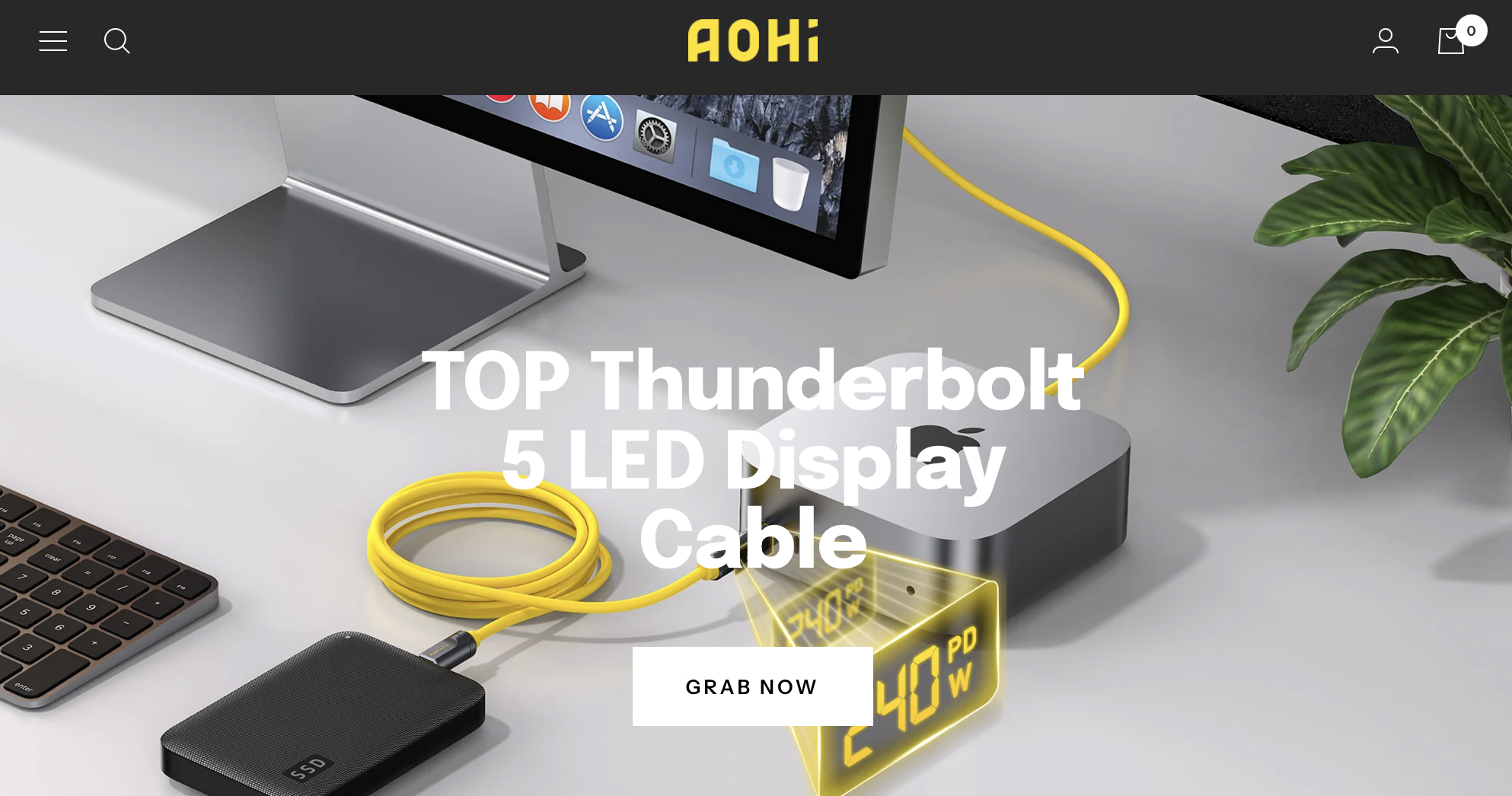
USB4 cables that actually push spec: The Future Adonis cable line supports USB4 2.0 at up to 240W, 120Gbps data transfer and 8K video over a single USB-C cable — a spec tier most budget cable brands don’t attempt, since it requires active-cable electronics rather than a simple wire.
Airline-compliant capacity, engineered around the 100Wh line: Both the Starship 240W (99.36Wh) and comparable rivals are deliberately capped just under the FAA/TSA 100Wh carry-on limit, so the headline wattage doesn’t come at the cost of being confiscated at security — a detail AOHI, like its competitors, is careful to spec correctly.
18-month warranty as standard: Most budget and mid-tier charging brands settle for a 12-month warranty. AOHI extends that to 18 months across its current product line, with the company stating it also offers ongoing customer support beyond that window.
Aggressive, frequent discounting: AOHI runs near-constant sitewide promotions and per-product discount codes (commonly 20–38% off “regular price”), which — used carefully — can put flagship hardware within striking distance of budget competitors. The catch, covered honestly in the Pricing section below, is that the “regular price” baseline itself needs scrutiny.
Key Features and Technology
AOHI’s catalog is broader than a typical single-product accessory brand. Here’s how the range actually breaks down by category.
Power Banks: Starship 240W, Starship Pro, and Black Warrior
The flagship Starship 240W packs 27,600mAh into a soda-can-sized 650g body, with two USB-C ports and one USB-A port sharing a combined 240W output (up to 140W per USB-C port individually). It supports PD3.1, PPS, QC, AFC and FCP protocols, uses automotive-grade cells with multi-layer overcharge/overheat/short-circuit protection, and — per AOHI’s own testing — can recharge an iPhone 16 roughly 3.7 times or take a MacBook Pro 16″ from empty to about 56% in 30 minutes. It also supports pass-through charging, so it can recharge itself while powering other devices. Independent lab testing from TechRadar (detailed in the Pros and Cons section) confirmed it fully charges a laptop in just over two hours and stays cool under sustained load, though the small onboard display was flagged as hard to read at a glance. The newer Starship Pro trades some capacity (20,000mAh) for even higher output — AOHI advertises 310W total across three ports with 180W self-recharge, aimed at users who prioritize charging speed over raw runtime. The Black Warrior 25,200mAh sits a tier below at 170W, a more affordable middle option for buyers who don’t need the full 240W ceiling.
GaN Chargers and the 280W Desktop Charging Station
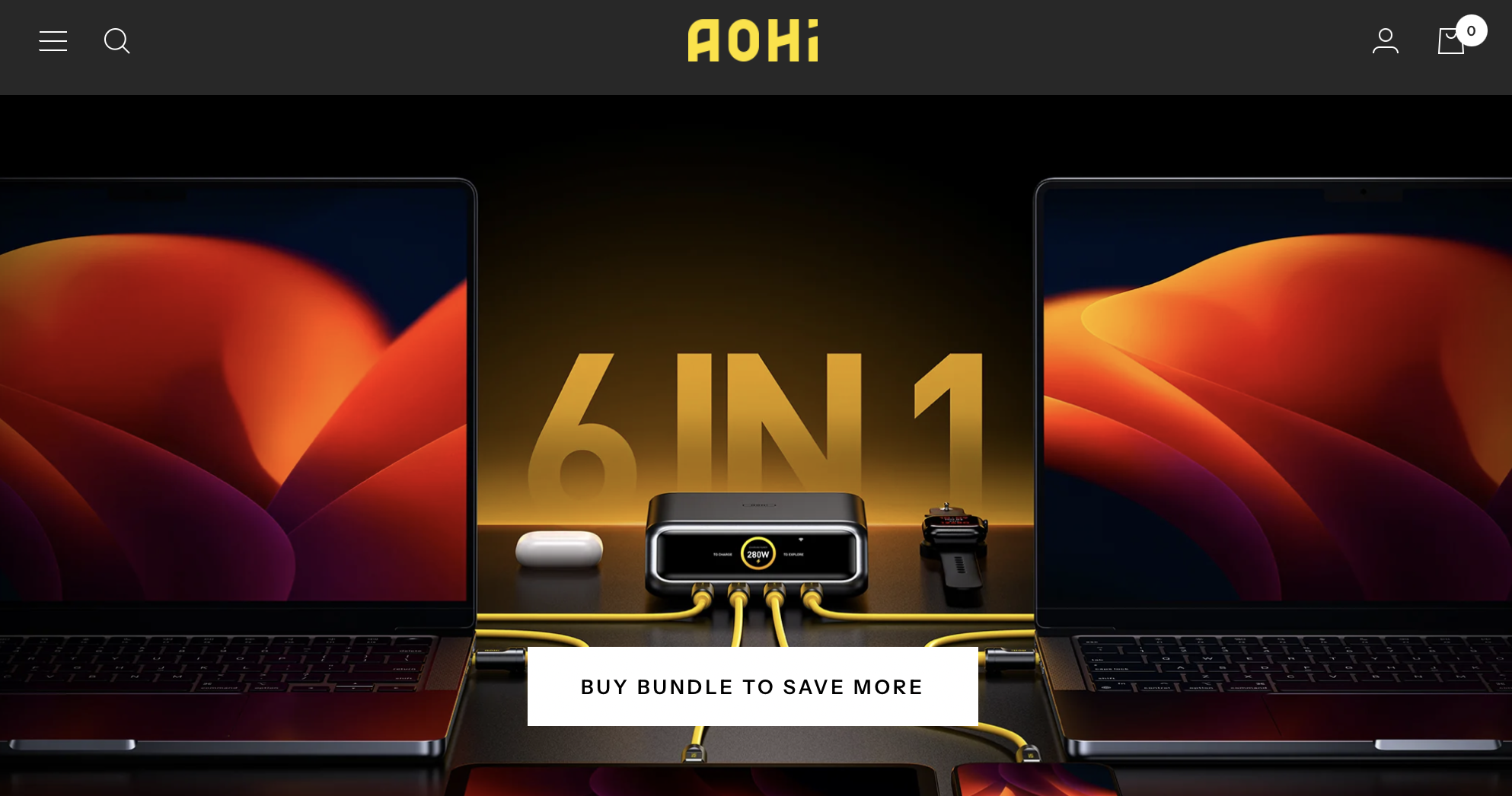
AOHI’s wall-charger range spans compact GaN plugs up to its newest flagship, The Future AI PD3.2 280W 6-Port Desktop Charging Station, sold in US, EU, UK and AU plug variants. It packs four USB-C and two USB-A ports behind GaN+ silicon, with one port capable of a genuine single-port 240W PD3.2 stream — enough to run two MacBook Pro 16″ units simultaneously across two of the four USB-C ports. It offers three operating modes (Smart AI balanced distribution, Turbo sustained full-power, and manual per-port control via an app), a real-time LCD showing wattage, temperature and port status, and Wi-Fi connectivity for remote monitoring and firmware updates. This is a desk-replacement device aimed squarely at people who currently run three or four separate wall adapters.
Adonis USB4 2.0 Cables and Case/Glass Accessories
The Future Adonis USB4 2.0 cable line is the accessory that generated the most independent buzz for AOHI — reviewers have specifically praised its build and connector quality among cable options, one describing it in unprompted feedback as among the most refined cable-solution designs they’d tested. It’s rated for 240W charging plus 120Gbps data transfer and 8K video output over a single USB-C cable, positioning it against premium options from Anker, Cable Matters and OWC. AOHI rounds out the catalog with phone cases and tempered-glass screen protectors, a smaller line that functions mostly as a bundle add-on rather than a standalone draw.
Pricing, Plans, and Package Structure
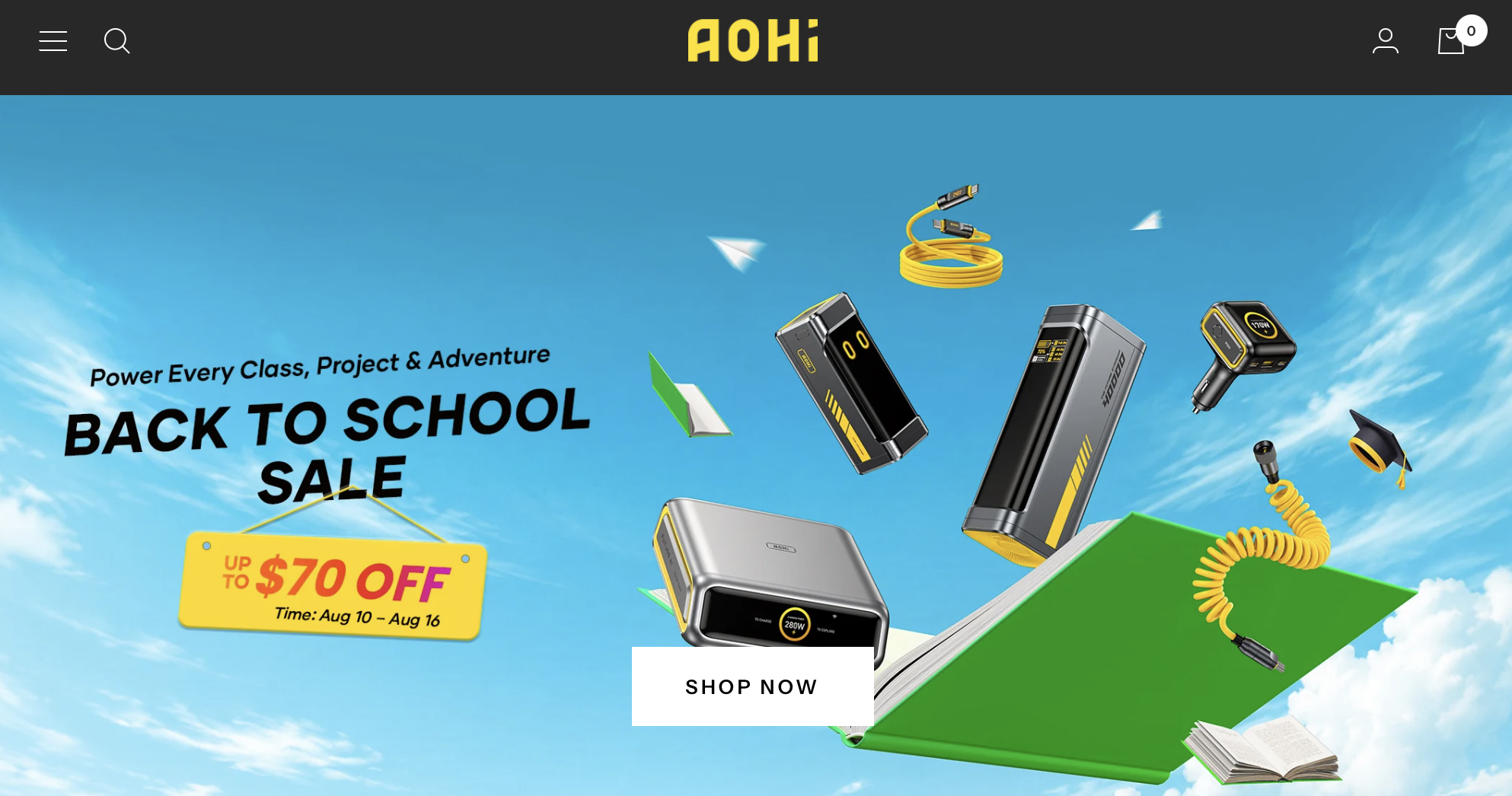
AOHI sells direct-to-consumer through its Shopify storefront, with per-product variants (cable length, plug region, bundle contents) affecting final price. Prices below reflect the “sale price” shown on iaohi.com at the time of writing, alongside the “regular price” the site lists as the pre-discount baseline — that regular price is worth treating skeptically, since it’s set by AOHI itself and the site runs near-permanent promotional pricing rather than occasional sales.
| Product | Price | What It Is | Best For |
|---|---|---|---|
| Starship 240W (27,600mAh) | From ~$119 (listed regular $169) | Flagship laptop-and-phone power bank, LED display | Travelers charging a laptop + phone from one bank |
| Black Warrior (25,200mAh, 170W) | From ~$79.99 | Mid-tier PD3.0 power bank with LED display | Buyers who want high capacity without paying for 240W |
| Starship 2-in-1 (40,000mAh, 140W) | From ~$149.99 (listed regular $259) | High-capacity power bank / power station hybrid | Multi-day trips, camping, or backup power needs |
| The Future AI 280W 6-Port Desktop Station | $169.99 (listed regular $239.99) | Desktop 6-port GaN+ station, app + Wi-Fi control | Home office desks running multiple laptops/devices |
| Adonis USB4 2.0 Cable (3.3ft/6.6ft) | From ~$49.99 (listed regular $79.99) | 240W / 120Gbps / 8K USB4 2.0 cable, LED display | Docking laptops or transferring large files at speed |
How AOHI Compares to Alternatives
AOHI’s closest direct comparison is the Anker Prime 27,650mAh 250W power bank, and the Baseus Blade2 line, both of which compete in the same “laptop-charging power bank” category as the Starship 240W. Competitor prices are approximate and change frequently — always confirm current figures before buying.
| Factor | AOHI Starship 240W | Anker Prime 27,650mAh | Baseus Blade2 (140W) |
|---|---|---|---|
| Capacity | 27,600mAh | 27,650mAh | 24,000mAh |
| Max output | 240W (140W per USB-C) | 250W (140W per USB-C) | 140W total |
| Approx. price | ~$119 | ~$149 | ~$99–130 (approx.) |
| Display | Small LED, per-port wattage (reviewers note it’s hard to read at a glance) | LCD panel, real-time stats, companion app | TFT color screen, app connectivity |
| Warranty | 18 months | 18 months | 12–18 months (varies by retailer) |
| Brand track record | OEM manufacturer, newer to direct-to-consumer branding | Category leader, extensive review history | Established budget-premium brand, wide catalog |
| Best for | Max wattage per dollar, single laptop + phone charge | Buyers who want the most-reviewed, safest bet | Slim, lightweight carry over raw wattage |
AOHI vs. Anker comes down to trust versus price: Anker has years of consistent independent reviews, a mature app ecosystem, and a more legible display, while AOHI matches its wattage and capacity for roughly $30 less, backed by the same 18-month warranty. AOHI vs. Baseus is more about priorities — Baseus’s Blade2 line trades peak wattage for a genuinely ultra-thin, light form factor, while AOHI’s Starship stays bulkier but pushes closer to laptop-charging-station levels of output.
Pros and Cons
What Users Love
Real high-wattage output at a competitive price: Independent lab testing from TechRadar confirmed the Starship 240W fully charges a laptop in just over two hours, stays cool throughout, and recharges itself in a similar window — genuine performance, not just a spec-sheet number.
Cable quality stands out: One professional reviewer working directly with AOHI called its Starship power bank and Adonis cable the most innovative, best-built cable solution they’d come across — unprompted, specific praise for build quality in a category where most products are functionally identical.
Solid, restrained industrial design: TechRadar’s reviewer noted the Starship’s build quality is good and its dimensions are “admirably restrained” given its output and capacity, with a design distinctive enough to stand out without looking gimmicky.
Extended warranty coverage: The 18-month warranty across the current lineup beats the 12-month standard many competitors still default to, and it applies uniformly rather than being reserved for flagship products only.
Broad, coherent product ecosystem: Power banks, wall chargers, a desktop station and USB4 cables all share the same design language and can genuinely replace several other brands’ worth of accessories on one desk or in one bag.
Limitations Worth Knowing
A thin, mixed independent review record: AOHI’s Trustpilot profile for aohi.com carries only a small handful of reviews — nowhere near the review volume of an Anker or Baseus — and the reviews present are genuinely split: alongside praise for cable and power-bank build quality sit specific complaints, including one detailed account of a faulty 140W charger and a difficult AliExpress dispute, and a separate report of a warranty claim on a cable being repeatedly deflected by customer service. With so few reviews, any single account carries outsized weight, so treat both the positive and negative reports as data points rather than a verdict.
TechRadar’s verdict was lukewarm on value: The same independent lab review that praised the Starship 240W’s build and thermal performance ultimately concluded that, considering the price, “many will be better off with something less powerful but less expensive” — a direct, professional assessment that the flagship power bank’s real-world value doesn’t fully match its spec-sheet ambition for most buyers.
Display and port count trail rivals: TechRadar specifically flagged the Starship’s onboard display as small, dim and hard to read at a glance despite packing in a lot of information, and noted only three total ports versus four on some similarly sized competitors.
Pricing framed around inflated “regular” prices: AOHI’s storefront runs near-constant discount codes off a “regular price” that functions as a marketing anchor rather than a price the product regularly sells at. This isn’t unique to AOHI, but buyers should compare live sale prices against named competitors rather than trusting the advertised discount percentage.
Newer to direct-to-consumer accountability: Being an OEM manufacturer is a strength for hardware engineering, but it doesn’t automatically translate into consumer-facing support infrastructure. The mixed warranty-service reports above suggest AOHI’s customer-service process is less mature than brands that have run direct-to-consumer operations for a decade or more.
Who Should Use AOHI
Travelers who charge a laptop and phone from one bag: The Starship 240W’s ability to hit a genuine full laptop charge plus phone top-ups from a single, airline-compliant power bank is a real convenience win for road warriors who don’t want to carry a separate laptop charger and phone charger.
Home-office setups replacing multiple wall adapters: The 280W desktop station’s ability to run two full-speed laptops off one hub genuinely reduces desk clutter for people currently juggling three or four separate power bricks.
Spec-focused buyers comfortable with a newer brand: If you’re chasing the highest wattage-per-dollar and are comfortable buying from a brand with a shorter consumer track record than Anker or Belkin, AOHI’s pricing makes the math attractive.
Anyone who wants a heavyweight cable that survives daily use: The Adonis USB4 line’s build quality has drawn specific, credible praise, making it a reasonable single-item purchase even for buyers who source everything else from a different brand.
Who should look elsewhere: buyers who prioritize a deep, verifiable review history and consistent customer-service track record over raw specs will likely be better served by Anker, which offers nearly identical performance for a modest premium backed by years of consumer trust. Anyone who’s had a bad experience with unresponsive warranty support from a smaller direct-to-consumer electronics brand before should weigh that history carefully, and light packers who value slimness over wattage will prefer Baseus’s Blade2 form factor.
Getting Started: Step by Step
- Identify your real wattage need. If you’re charging a phone and tablet, the Black Warrior’s 170W is plenty; if you regularly charge a 16″ laptop from empty, the Starship 240W or Starship Pro make more sense.
- Check the live sale price before buying. Visit the product page on iaohi.com and note the active discount code rather than trusting the crossed-out “regular price” as a real baseline.
- Confirm cable compatibility. High-wattage charging (100W+) requires a PD3.1-rated USB-C cable — use the one included in the box, or an AOHI Adonis cable, rather than an older or unrated cable that will bottleneck output.
- Register your warranty on delivery. Given the mixed customer-service reports noted above, keep your order confirmation and any product-registration email so you have a paper trail if you need to file a warranty claim.
- Test the pass-through / self-recharge feature early. If your model supports charging itself while powering another device, verify this works as expected in the first week, while you’re still within any short-window return policy.
- Set airline expectations correctly. Confirm your specific model’s Wh rating (all current AOHI power banks are spec’d under the 100Wh carry-on threshold) and keep the spec sheet or product page accessible on your phone in case airport security asks.
Tips for Getting Maximum Value
Get the most out of an AOHI purchase by treating the storefront’s promotional pricing as a starting point for negotiation rather than a fixed deal — discount codes rotate frequently, so it’s worth checking for a fresh code before checkout even if you’ve already found one. Buy the bundle that includes the matching Adonis cable rather than sourcing a third-party cable separately, since AOHI’s own high-wattage products are tuned to work reliably together and a mismatched cable is one of the most common reasons any high-wattage power bank underperforms its rated speed. If you’re buying the Starship 240W specifically for laptop charging, don’t expect the LED display to give you a precise readout at a glance — treat it as a rough status indicator rather than a primary monitoring tool, and check charging progress from your laptop’s own battery indicator instead. Finally, hold onto all order and warranty documentation from day one; given the mixed customer-service reports in independent reviews, a documented paper trail meaningfully improves your odds if you ever need to escalate a warranty claim.
Future Outlook and Final Assessment
AOHI’s trajectory — expanding from power banks into desktop charging stations, adding AI-assisted power distribution and app control, and continuing to push wattage ceilings with each new crowdfunding launch — suggests a brand investing seriously in its consumer line rather than treating it as a side project. Its parent company’s manufacturing scale gives it a genuine cost advantage that shows up directly in pricing versus Anker and other established players, and products like the Adonis cable have already earned specific, credible praise for build quality from people who tested competing options.
The gap AOHI still needs to close is trust infrastructure: a deeper, more consistent independent review record, and more visibly reliable customer service when something does go wrong. Those are solvable problems that mature over time as a brand’s customer base grows, but as of this review they’re real, and they matter more for a $100–170 purchase than for a $20 impulse buy.
Conclusion
AOHI earns its place in the high-wattage charging conversation on hardware merit: the Starship 240W genuinely charges laptops fast, the 280W desktop station is a legitimate desk-clutter fix, and the Adonis cable line has drawn real praise for build quality. What it hasn’t yet earned is the deep, trusted review history that Anker and Baseus have built over years — and buyers should factor that thinner track record, along with a few concerning individual warranty-service reports, into the decision alongside the attractive specs and pricing. For confident, spec-savvy shoppers willing to trade some brand-trust cushion for a lower price on comparable hardware, AOHI is a legitimate option worth shortlisting.
Ready to ditch the drawer full of mismatched chargers?
Explore more honest reviews, tutorials and tech comparisons to find the right gear for the way you work, travel and live — at World Of Tech, where we make everything easy.
👉 Shop AOHI: https://worldoftech.space/aohi
👉 Our YouTube Channel: youtube.com/@world_tech79
👉 Our Facebook Fanpage: Facebook
👉 Our X (Twitter): @worldoftech79
Pricing, specifications and policy details in this review were verified against iaohi.com and independent review sources including TechRadar and Trustpilot as of August 2026. Charging-accessory pricing and promotional discounts change frequently, so confirm current details on the official site before purchasing. Competitor prices are approximate and subject to change.