
Landing in Bangkok, Tokyo or Ho Chi Minh City and hunting for a local SIM card used to be part of the travel routine — a counter at the airport, a passport scan, a queue. TravelSim Asia was built to remove that step entirely. It’s a prepaid eSIM store, not an app: you pick a country on the website, pay, and get an installation link by email within minutes — no download, no account, no sign-up form standing between you and a working data connection. Covering 16+ destinations across Asia, from single-country plans starting at $0.99 to multi-country packs and a rugged 4-carrier setup in Japan, TravelSim Asia has grown into a genuinely useful pick for travelers who just want data to work without friction.
For backpackers, business travelers and digital nomads moving through Southeast and East Asia, the pitch is simple: buy before you fly, activate the moment you land, and skip both the roaming bill and the SIM-shop queue. But TravelSim Asia isn’t the only option in this space, and it isn’t perfect — there’s no unlimited-data tier, pricing swings noticeably between countries, and the brand is younger and smaller than household names like Airalo. This 2026 review walks through what TravelSim Asia actually offers, how its pricing and coverage stack up, where it beats app-based competitors like Airalo and Saily, and exactly who should (and shouldn’t) buy in.
TravelSim Asia Review 2026: The No-App eSIM Store That Gets You Online Before You Land
Overview and Background
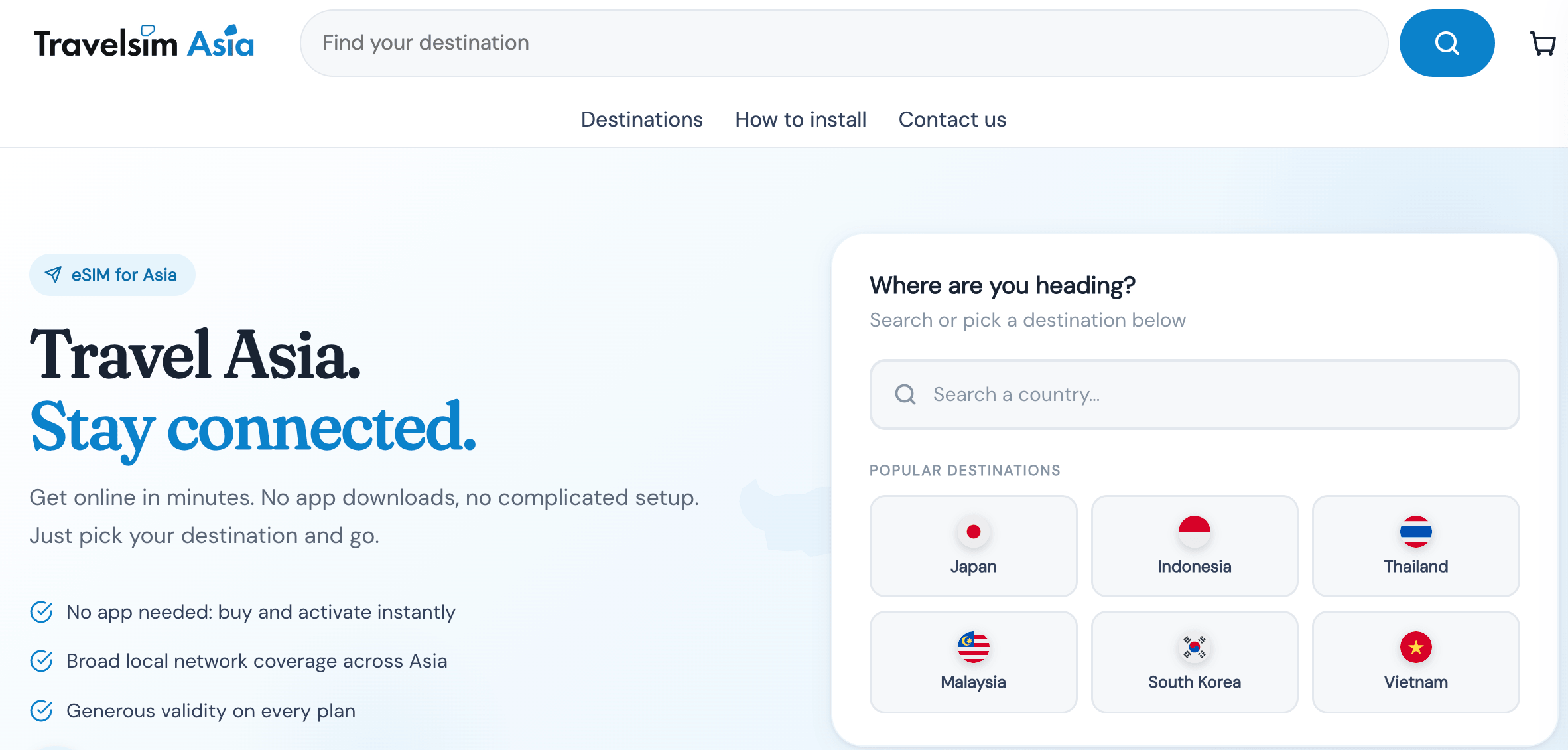
TravelSim Asia (travelsimasia.com) is a direct-to-consumer eSIM retailer built on Shopify and focused specifically on Asian destinations — Japan, Thailand, Vietnam, Indonesia, Malaysia, South Korea, the Philippines, Singapore, Cambodia, Laos, Hong Kong, China and the UAE among them, plus regional multi-country bundles. It isn’t a general-purpose travel-tech app with a login and a dashboard full of features; it’s closer to an old-fashioned online shop that happens to sell digital SIM profiles instead of physical ones. That narrow focus is the whole design philosophy: pick a destination, pick a data plan, pay, and get an activation link by email.
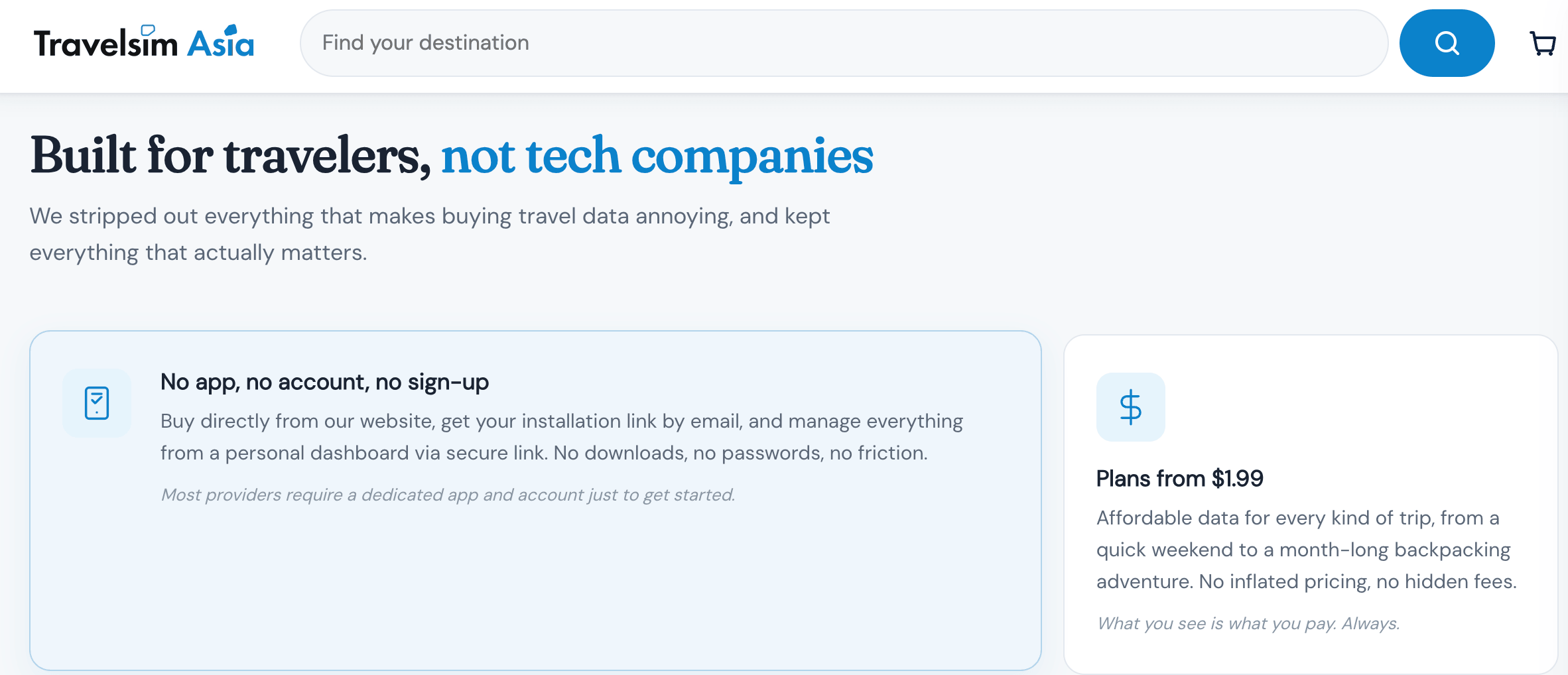
The core mechanic is deliberately minimal. There’s no mobile app to install and no account to create before you can even see pricing — a real departure from most of the eSIM marketplace, where Airalo, Saily and Holafly all expect you to download their app and register before you can buy or manage a plan. TravelSim Asia instead emails a tap-to-install link (or QR code) straight after checkout, along with a secure link to a personal web dashboard where you can watch data usage and top up without buying a whole new eSIM.
Every plan on the site is fixed-data — there’s no unlimited tier, no daily fair-use throttle, and no fine print about “unlimited” quietly turning into 1 Mbps after a few gigabytes. When you hit your GB allowance, the plan simply stops until you top up. Plans also come with a generous 180-day activation window, meaning you can buy weeks or months ahead of a trip and only start the clock when you actually connect to a local network. Site copy touts 16+ countries covered and figures for total customers connected that vary by page (more on that in the Limitations section below) — worth verifying independently rather than taking at face value.
Why TravelSim Asia Stands Out in 2026
No app, no account, genuinely: This is the single biggest differentiator versus Airalo, Saily and Holafly, all of which require an app download and a registered account before you can even browse plans. TravelSim Asia lets you check pricing and buy directly from a browser, then delivers the install link by email. For a one-off trip, that’s meaningfully less friction — and less of your data sitting in yet another company’s user database.
Entry prices among the lowest in the category: Malaysia and Singapore plans start at $0.99, Thailand at $1.99, and most Southeast Asian countries sit under $4 for an entry plan. For short trips or light data users, that undercuts most of the big-name competitors on a like-for-like small plan.
Unlimited hotspot and tethering on every plan: Several competitors cap or restrict tethering on their cheaper tiers. TravelSim Asia advertises no tethering limits across the board, which matters if you’re sharing a connection with a travel companion or using your phone as a laptop hotspot.
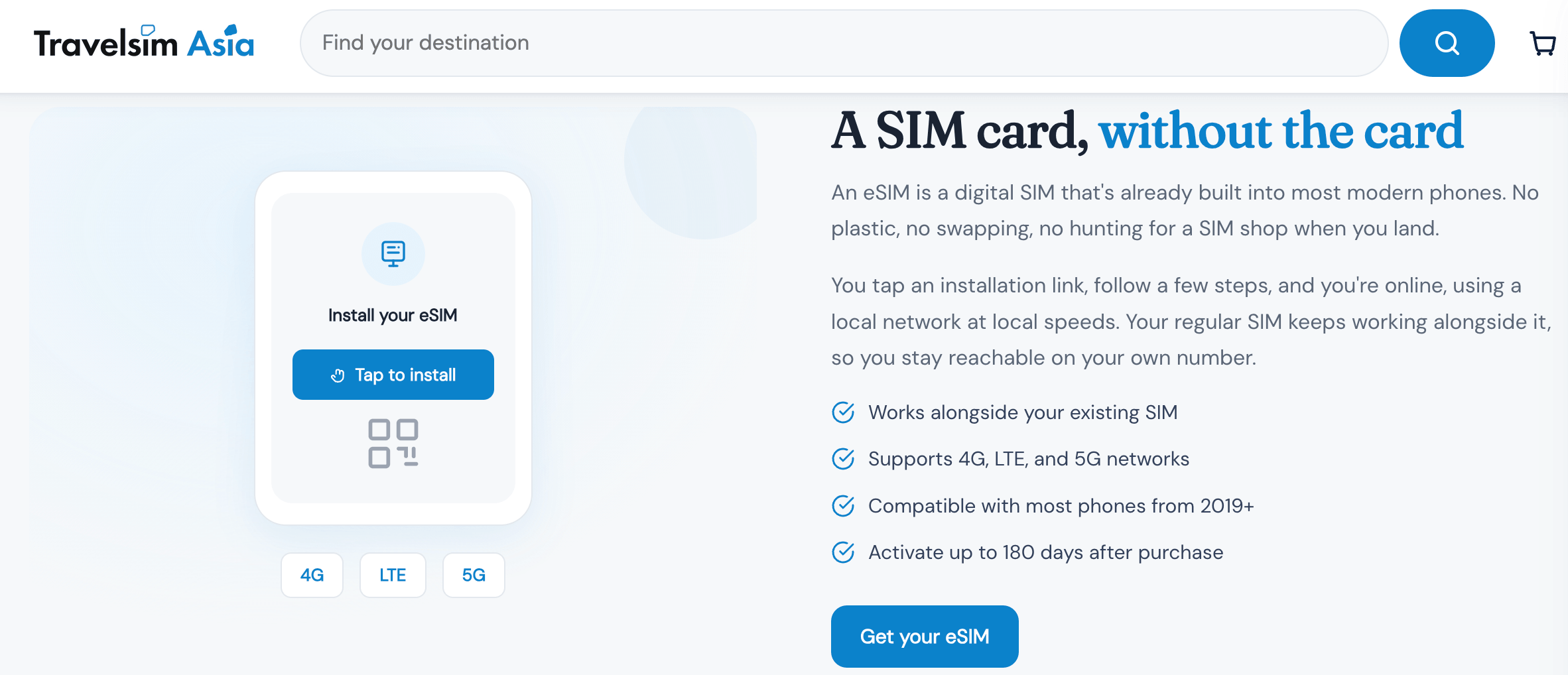
A genuinely long activation window: 180 days from purchase to first connection is well above what many competitors offer, some of which expire in 15–30 days. It means you can buy early, before prices potentially rise, and not worry about the eSIM going stale before your trip.
Four-carrier coverage in Japan: Independent testing has found TravelSim Asia’s Japan eSIM connects across NTT Docomo, KDDI au, SoftBank and Rakuten Mobile, automatically picking the strongest signal as you move. Most rival eSIMs ride just one or two of those networks, which is the practical difference between staying connected in Hokkaido or the Japanese Alps and losing signal there.
Transparent fixed-data pricing: Because there’s no unlimited tier to obscure a fair-use policy behind, what you buy is exactly what you get: a fixed GB allowance, at a fixed price, for a fixed validity window. No FUP throttling to decode, no daily caps hidden in the terms.
Dashboard top-ups without a new eSIM: Running low mid-trip doesn’t mean buying and re-installing a second eSIM profile. The same secure dashboard link lets you add data in seconds, which is a real convenience advantage over providers where a new plan means a fresh QR code.
Key Features and Technology
TravelSim Asia’s catalog is broad but organizes cleanly into a few product types. Here’s how the platform actually breaks down.
Single-Country eSIMs
The core product: a data-only eSIM tied to the local network of one country. Each destination shows a ladder of plans — usually 1GB up to 50GB, spanning 7 to 180 days validity — riding a named local carrier partnership (AIS/TrueMove H in Thailand, Vietnamobile/Vinaphone in Vietnam, and the four-carrier blend in Japan). Speeds are listed per country: several Southeast Asian markets run on 5G, while others, including Vietnam, are currently 4G-only.
Multi-Country and Regional Packs
For itineraries that cross borders, TravelSim Asia sells regional bundles: a 7-country Asia pack (Cambodia, Indonesia, Thailand, the Philippines, Malaysia, Singapore and Vietnam) from $5.99, a broader 20-country Asia pack from $17.99, and a fixed-price Malaysia + Thailand + Singapore combo at $10.99. This is where the no-app model pays off for multi-stop trips — one eSIM covers the whole route instead of juggling several separate installs.
Delivery, Activation and the Dashboard
After checkout, an installation link and instructions land in your inbox — TravelSim Asia advertises within 5 minutes, and independent write-ups confirm delivery is fast. You tap the link on your phone (or scan a QR code) to install, and the plan doesn’t start counting down until you first connect to a local tower. That 180-day activation window is one of the more generous in the category. A companion web dashboard, reached through the same secure link rather than a login, shows live data usage and lets you top up instantly without a new eSIM profile.
Speed, Hotspot and Network Partners
Network quality depends on which local carrier TravelSim Asia has partnered with in each market — Thailand rides AIS/TrueMove H at 5G, Vietnam rides Vietnamobile/Vinaphone at 4G, and Japan uniquely spans all four national carriers. Every plan supports hotspot/tethering with no stated data cap on how much you share, and every plan keeps your primary SIM active for calls and texts alongside the eSIM’s data connection.
Pricing, Plans, and Package Structure
TravelSim Asia is a one-time-purchase model with no subscription of any kind — you pay per eSIM, per trip. Pricing varies meaningfully by country, reflecting each local carrier’s wholesale data costs, so a 10GB plan in Thailand and the same 10GB in Vietnam are priced quite differently. The table below shows representative products; always check the live plan grid on the destination page before buying, since eSIM data pricing shifts often across the whole industry.
| Product | Price (USD) | What It Is | Best For |
|---|---|---|---|
| Thailand — 1GB / 7 Days | $1.99 | 5G data on AIS/TrueMove H, hotspot included | A short city break with light use |
| Thailand — 10GB / 30 Days | $10.49 | Month-long 5G data allowance | A standard two-to-four-week trip |
| Thailand — 50GB / 180 Days | $49.99 | Long-validity, high-data allowance | Extended stays or frequent return trips |
| Vietnam — 5GB / 30 Days (Popular) | $9.50 | 4G data on Vietnamobile/Vinaphone | A typical Vietnam sightseeing trip |
| Japan — from | $3.49 | 4-carrier network blend (Docomo/au/SoftBank/Rakuten) | Rural or mountain travel where coverage varies |
| Asia 7-Country Pack | From $5.99 | One eSIM for Cambodia, Indonesia, Thailand, Philippines, Malaysia, Singapore, Vietnam | Multi-country Southeast Asia itineraries |
| Asia 20-Country Pack | From $17.99 | Broader regional coverage across Asia | Long, multi-stop Asia backpacking routes |
| Malaysia + Thailand + Singapore | $10.99 flat | Single eSIM across three neighboring countries | Classic three-country Southeast Asia loops |
How TravelSim Asia Compares to Alternatives
| Factor | TravelSim Asia | Airalo | Saily |
|---|---|---|---|
| App / account required | No — web purchase, email delivery | Yes, app + account | Yes, app + account |
| Geographic focus | Asia-specialist, 16+ countries | Global, 200+ countries | Global, 150+ countries |
| Unlimited data option | No — fixed data only | Yes, on select destinations | Yes, customizable unlimited plans |
| Entry price (Thailand, 1GB range) | $1.99 / 7 days | ~$4.00 / 3 days | $2.99 / 7 days |
| Activation window | 180 days | Typically shorter, varies by plan | Typically shorter, varies by plan |
| Extra features | None — data only, kept simple | Referral credits, broad app ecosystem | Built-in ad/tracker blocker, VPN-adjacent tools |
| Brand track record | Newer, smaller review base | Long-established market leader | Backed by NordVPN’s parent company |
| Best for | Minimal-friction Asia-only trips | Frequent global travelers wanting one app | Privacy-conscious travelers, unlimited data |
vs. Airalo: Airalo is the biggest name in the category — a mature app, global coverage across 200+ countries, and unlimited plans on many popular routes. But it requires an account and generally sits at a higher entry price for short trips in Southeast Asia. If your travel spans multiple continents and you want one app for every country, Airalo’s breadth wins. For an Asia-only itinerary bought quickly from a browser, TravelSim Asia is often cheaper and simpler to set up.
vs. Saily: Saily, from NordVPN’s parent company NordSecurity, undercuts on some entry prices and offers customizable unlimited plans plus a built-in ad/tracker blocker — a real draw for privacy-focused travelers. It’s still an app-and-account product, though, and its unlimited tiers can cost more per day than TravelSim Asia’s fixed data once you do the math for a typical trip.
vs. Holafly: Holafly specializes almost exclusively in unlimited-data plans, priced by the day rather than the gigabyte — a genuinely good fit for heavy streamers or anyone using their phone as their only internet connection. That convenience comes at a premium, often several dollars per day, which makes it the most expensive option here for travelers who don’t actually need unlimited data. TravelSim Asia’s fixed-GB model will be cheaper for most trip lengths unless you’re a true heavy user.
Pros and Cons
What Users Love
Genuinely no app or account: The most consistently praised feature. Travelers repeatedly note how refreshing it is to buy a plan from a browser, get a link by email, and be online in minutes — no registration wall before you can even see prices.
Fast, reliable delivery: Reviewers on Trustpilot consistently describe smooth, quick installs — email arriving well within the promised window and setup taking only a couple of minutes.
Solid value for typical Southeast Asia data needs: Reviewers describe using the 10GB Thailand plan comfortably for two weeks of maps, messaging and social media, with coverage holding up while moving between cities.
Responsive customer support: Trustpilot responses from the company show a pattern of proactive follow-up on individual complaints — including reaching out directly to resolve signal issues — which several reviewers called out positively.
Unlimited tethering as standard: Being able to hotspot a laptop or share with a travel companion without a separate cap or fee is a repeated point of praise, especially compared to providers that meter or block tethering on cheaper plans.
Limitations Worth Knowing
No unlimited-data option, anywhere: Every plan is fixed GB. Heavy streamers, remote workers on video calls all day, or anyone planning to use the eSIM as their only home-office connection will burn through even the largest tiers and should look at Holafly or Saily’s unlimited plans instead.
Pricing is inconsistent between countries: A 10GB/30-day plan costs $10.49 in Thailand but $17.99 in Vietnam — the same data allowance, a meaningfully different price. Always check the specific destination’s plan grid rather than assuming pricing you saw for one country carries over to another.
Self-reported customer counts don’t match across pages: The homepage claims “4,000+ travelers connected,” the destinations page banner says “Trusted by 2,000+ travelers,” and a footer trust badge on other pages references “over 100k customers.” These figures are self-reported marketing claims that can’t be independently verified and don’t agree with one another — treat them as unverified rather than as hard data.
Smaller, newer review base than the market leaders: Trustpilot shows an “Excellent”-rated storefront, but with a review count only in the dozens as of mid-2026 — a fraction of Airalo’s or Saily’s review history. The signal is positive so far, but there’s simply less long-term data to judge consistency at scale.
No native app means checking usage requires the emailed link: There’s no home-screen widget or push notification for low balance — you have to revisit the dashboard link manually, which is easy to misplace if you don’t save it somewhere reliable.
No phone number, voice, or SMS: Like almost every travel eSIM in this category, this is data-only. If you need a local number for ride-hailing app verification or hotel bookings, you’ll still want a secondary local SIM or an app-based number service.
Refund and activation policy details need confirming before you buy: Third-party aggregator write-ups describe the eSIM as non-refundable once activated, which is standard across the eSIM industry but worth reading in TravelSim Asia’s own refund policy before checkout, since terms can change.
Who Should Use TravelSim Asia
Short-to-medium trip travelers in Southeast and East Asia: If your itinerary is squarely within TravelSim Asia’s covered countries and you need data for one to four weeks, the fixed-GB pricing is competitive and the setup is about as low-friction as it gets.
Anyone who dislikes app-account eSIM shopping: If registering for yet another app before you can even see a price feels unnecessary, the browser-to-email flow here is a genuine relief.
Multi-country Southeast Asia backpackers: The 7-country and 20-country packs, plus the fixed Malaysia + Thailand + Singapore combo, are built specifically for the classic overland Southeast Asia loop, saving the hassle of separate eSIMs per border crossing.
Visitors to rural or mountainous Japan: The four-carrier network blend genuinely matters outside Tokyo and Osaka, where single-carrier eSIMs can drop out.
Who should look elsewhere: Heavy data users, remote workers relying on the eSIM as a primary internet connection, or anyone doing constant video calls should look at Holafly’s or Saily’s unlimited plans instead. Travelers whose itinerary spans multiple continents will likely find Airalo’s single global app more convenient than juggling a regional provider for Asia and a separate one elsewhere. And anyone who wants a local phone number for verification codes or bookings will need a secondary solution alongside any data-only eSIM.
Getting Started: Step by Step
- Confirm your phone supports eSIM. Most iPhones from the XS/XR onward, Samsung Galaxy S20 and later, and Google Pixel 3 and later all work — check your phone’s cellular settings for an “Add eSIM” or “Add Mobile Plan” option, and make sure the phone is carrier-unlocked.
- Pick your destination and data size. Go to the country’s plan page, compare the GB tiers and validity windows, and choose based on your trip length — remember that longer validity windows (like the 50GB/180-day option) cost more up front but avoid buying twice on repeat trips.
- Check out without creating an account. Pay with a card, Apple Pay, Google Pay, PayPal or one of the other supported methods — no sign-up form required.
- Install from the emailed link. Within about 5 minutes, an installation link and instructions arrive by email. Tap the link on your phone (or scan the QR code) and follow the on-screen prompts — the whole process typically takes a couple of minutes.
- Activate when you land. The plan doesn’t start counting down until you first connect to the local network, so you can install before you fly and simply switch on data roaming for the eSIM line once you arrive — anytime within 180 days of purchase.
- Save your dashboard link and top up if needed. Keep the personal dashboard link somewhere easy to find (a notes app or pinned email) so you can check remaining data and add more instantly if you’re running low mid-trip.
Tips for Getting Maximum Value
Buy your eSIM a week or two before departure rather than at the airport — since installation doesn’t start the data clock, there’s no downside to getting it out of the way early, and it means one less thing to sort out on arrival. If your trip crosses multiple borders, actually run the numbers on the 7-country or 20-country pack against buying separate single-country eSIMs; for two or three stops the regional pack usually wins, but for a single-country trip a destination-specific plan is typically cheaper per gigabyte. Save the installation email and the dashboard link somewhere you’ll actually find them again — a screenshot or a pinned note works well, since there’s no app to fall back on if you lose the link. If you’re a heavy data user or plan to hotspot a laptop for work all day, size up deliberately: the fixed-data model means there’s no fair-use throttle to bail you out, only a hard stop when the allowance runs dry. And because tethering is unlimited on every plan, splitting one larger-GB eSIM between two travel companions can work out cheaper than each person buying a separate small plan.
Future Outlook and Final Assessment
The travel eSIM market in 2026 is crowded and increasingly commoditized — most providers ride the same handful of local carrier networks, so the real differentiation has shifted to buying experience, pricing transparency and activation flexibility. TravelSim Asia’s bet on removing the app-and-account requirement is a genuinely distinct position in a category where nearly every competitor has converged on the opposite model. As more travelers grow weary of registering for a new app for every trip, that simplicity looks like a smart, durable differentiator rather than a gimmick.
The honest caveats remain real: there’s no unlimited tier for heavy users, pricing isn’t uniform across every country in the catalog, and the brand’s review history is still comparatively short next to established players like Airalo. Those are worth weighing before you buy, especially for a first trip with this provider. But for the core job — simple, honestly-priced, fixed data across mainstream Asian destinations, delivered without an app — TravelSim Asia executes cleanly and is genuinely competitive with far bigger names in the category.
Conclusion
TravelSim Asia isn’t trying to be the biggest eSIM marketplace on earth — it’s trying to be the fastest, lowest-friction way to get data for a trip to Asia, and on that narrower goal it delivers. By skipping the app and the account entirely, keeping pricing fixed and transparent, and backing plans with a genuinely generous 180-day activation window, it solves the actual problem most travelers have: getting online the moment they land, without extra steps. It’s not the right call for heavy data users chasing an unlimited plan, and pricing is worth double-checking country by country before you commit. But for a straightforward trip through Thailand, Japan, Vietnam or the wider region, TravelSim Asia makes staying connected refreshingly simple.
Ready to get connected before you even land in Asia?
Explore more honest reviews, tutorials and tech comparisons to find the right gear for the way you work, travel and live — at World Of Tech, where we make everything easy.
👉 Shop TravelSim Asia: https://worldoftech.space/travelsimasia
👉 Our YouTube Channel: youtube.com/@world_tech79
👉 Our Facebook Fanpage: Facebook
👉 Our X (Twitter): @worldoftech79
Pricing, specifications and policy details in this review were verified against travelsimasia.com and independent review sources (including Trustpilot and third-party eSIM comparison sites) as of August 2026. eSIM pricing and coverage change frequently, so confirm current plan details on the official site before purchasing. Competitor prices are approximate and subject to change.