
Nothing quietly kills an email campaign faster than a list full of dead addresses. Bounce rates climb, spam filters take notice, and inbox providers start routing your perfectly good newsletters straight to junk — all because a chunk of your list was never valid to begin with. ZeroBounce exists to fix that before you hit send. It’s an email verification and deliverability platform that checks every address on your list, flags spam traps and disposable accounts, scores the recipients you can’t be 100% sure about, and — increasingly — helps you build and monitor your sender reputation once the list itself is clean. Backed by over a decade in the market, 60+ billion emails validated, 600,000+ customers, and a “5 stars, Excellent” reputation across more than 2,100 Trustpilot reviews, ZeroBounce has become one of the default names marketers reach for when a bounce problem needs solving fast.
For marketers, agencies, SaaS teams and anyone running cold outreach, the pitch is simple: stop paying to send email that never arrives. But ZeroBounce isn’t the cheapest tool in this category, its pricing structure takes a minute to understand, and a small number of users report friction around account handling and support response times — worth knowing before you commit. This 2026 review walks through what ZeroBounce actually does, its full toolset beyond basic validation, current pricing and credit structure, how it stacks up against NeverBounce and Kickbox, the genuine pros and cons, and exactly who gets the most value from it.
ZeroBounce Review 2026: Is This Email Validation Platform Still Worth the Premium?
Overview and Background
ZeroBounce is a US-based email validation and deliverability company, not a general marketing suite or a CRM add-on — it’s purpose-built around one core job: telling you, address by address, whether an email is safe to send to. Upload a list or verify addresses in real time through the API, and ZeroBounce checks syntax, domain and mailbox status, flags disposable, abuse and spam-trap addresses, and returns a clear status for each one. It’s the layer that sits between “I have a list” and “I’m confident sending to this list.”
The company has been operating for over a decade and has built genuine scale in that time: it reports validating more than 60 billion emails for over 600,000 customers, running its own proprietary data centers, and holding SOC 2 Type II and ISO 27001 certification alongside GDPR, HIPAA and CCPA compliance. It’s not a scrappy side-project verifier — it’s a platform enterprise teams trust with sensitive contact data, and it has the security paperwork to back that trust.
What separates ZeroBounce from a purely single-purpose bounce checker is the direction it has expanded in over the past few product cycles. Validation is still the core, but ZeroBounce has layered on AI-powered Email Scoring for uncertain “catch-all” addresses, an Email Finder for B2B prospecting, and a genuinely broader deliverability suite — Email Warmup, Inbox Placement Testing, Email Server Testing, Blacklist Monitoring and DMARC Monitoring — bundled together under a subscription called ZeroBounce ONE™. In effect, it has moved from “list cleaner” toward “full inbox-health platform,” which is the main thing to understand before comparing it to narrower rivals.
Why ZeroBounce Stands Out in 2026
99.6% validation accuracy, independently benchmarked: ZeroBounce publishes an annual benchmark comparing its accuracy against rivals and consistently lands near the top of the category. That number matters because a “valid” result that later bounces is worse than a slow result — it costs you reputation, not just time.
Genuinely strong catch-all handling: Catch-all domains — where a server accepts mail for any address without confirming a real mailbox — are the hardest problem in email verification, and most tools simply shrug and mark them “unknown.” ZeroBounce leans into this with its AI Email Scoring feature, ranking catch-all and uncertain addresses 1–10 by likelihood of reaching a real inbox, and reports one of the lowest “unknown” rates in the category at roughly 1.75%.
A real deliverability suite, not just a checker: Email Warmup, Inbox Placement Testing, Email Server Testing, 24/7 Blacklist Monitoring across 200+ databases, and DMARC Monitoring are all bundled into ZeroBounce ONE. Very few competitors match this breadth from a single vendor and dashboard.
Credits that never expire: On the Pay-As-You-Go plan, purchased credits sit in your account indefinitely — no annual “use it or lose it” clock, which several competitors (including NeverBounce’s PAYG credits) still impose.
Fast on the lists that matter most: ZeroBounce reports validating 250,000 addresses from popular domains (Gmail, G Suite, etc.) in under 10 minutes, and complex mixed-domain lists of the same size in roughly 2.3 hours — a meaningful speed advantage when a campaign is waiting on a clean list.
Deep integration coverage: With 40+ native integrations spanning Mailchimp, HubSpot, Salesforce, Klaviyo, Zapier, WordPress and more, ZeroBounce slots into most existing marketing stacks without custom development.
Credible, independently-earned reputation: A “5 stars, Excellent” Trustpilot standing across 2,100+ reviews, a 4.7/5 rating on G2 from 1,300+ reviewers, and press coverage from Forbes, Newsweek, Fast Company and Inc. back up the marketing claims with real third-party signal.

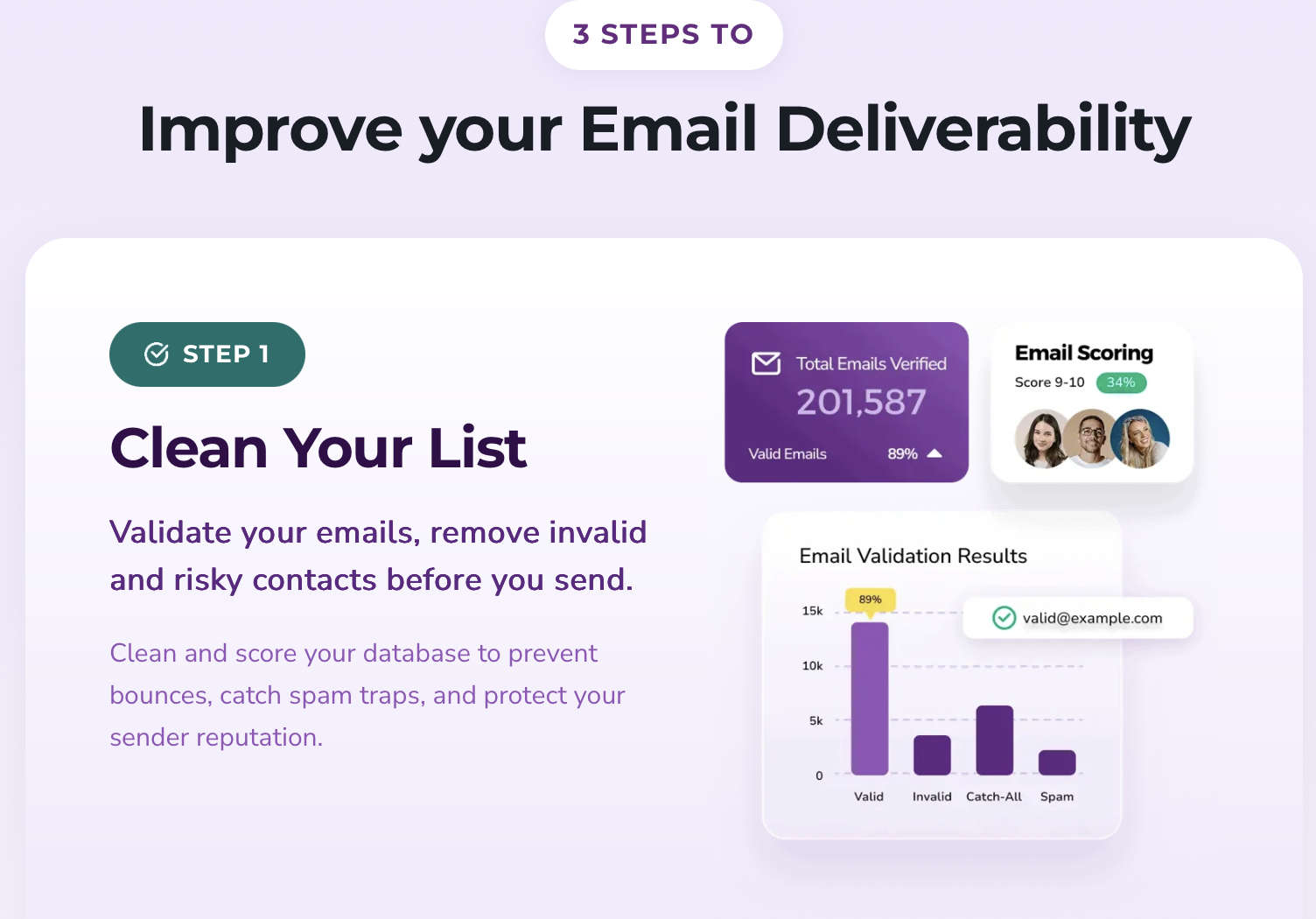
ZeroBounce validates each address with a reported 99.6% accuracy rate, cutting invalid, disposable and spam-trap emails out of your list before you send.
Key Features and Technology
ZeroBounce’s product line has grown well beyond a single validation button. Here’s how the platform actually breaks down, organized around its own three-step framework: clean your list, build sending reputation, monitor inbox health.
Email Validation (Bulk and Real-Time)
The core product. Upload a list (100-email minimum) or call the real-time API to check syntax, domain and MX records, and mailbox existence, then get back a clear status: valid, invalid, catch-all, spamtrap, abuse, disposable, do-not-mail or unknown. ZeroBounce validates addresses protected by Secure Email Gateways (SEGs) as well as standard catch-all domains, which is a genuine differentiator versus tools that simply skip them.
AI Email Scoring
For addresses that come back “catch-all” or otherwise uncertain, AI Scoring assigns a 1–10 rating predicting how likely the address is to reach a real, active inbox. Rather than throwing away every catch-all contact (which can be 4%+ of a list) or blindly mailing all of them, you can prioritize the higher-scored ones and treat the rest with more caution.
Email Finder and Activity Data
Email Finder discovers professional B2B email addresses from a name and company domain, then validates the result instantly (billed at 20 credits per successful match). Activity Data separately identifies which contacts have actually opened, clicked or engaged in the past 30–180 days, letting you prioritize genuinely active recipients over technically-valid-but-dormant ones.
Email Warmup, Inbox Placement and Server Testing
This is where ZeroBounce moves past pure validation. Email Warmup automates natural-looking sending and opening patterns to build trust with inbox providers for new or under-used domains. Inbox Placement Testing shows exactly where a campaign lands — inbox, promotions, or spam — across major providers before you launch. Email Server Testing checks SPF, DKIM, DMARC and DNS configuration to catch technical deliverability issues at the source.
Blacklist Monitoring and DMARC Monitor
Blacklist Monitoring scans your domain and IP against 200+ global spam blacklists (checked every 8 hours on ZeroBounce ONE), while DMARC Monitor tracks authentication activity and flags unauthorized senders spoofing your domain — useful for catching phishing abuse of your brand before it becomes a deliverability or trust problem.
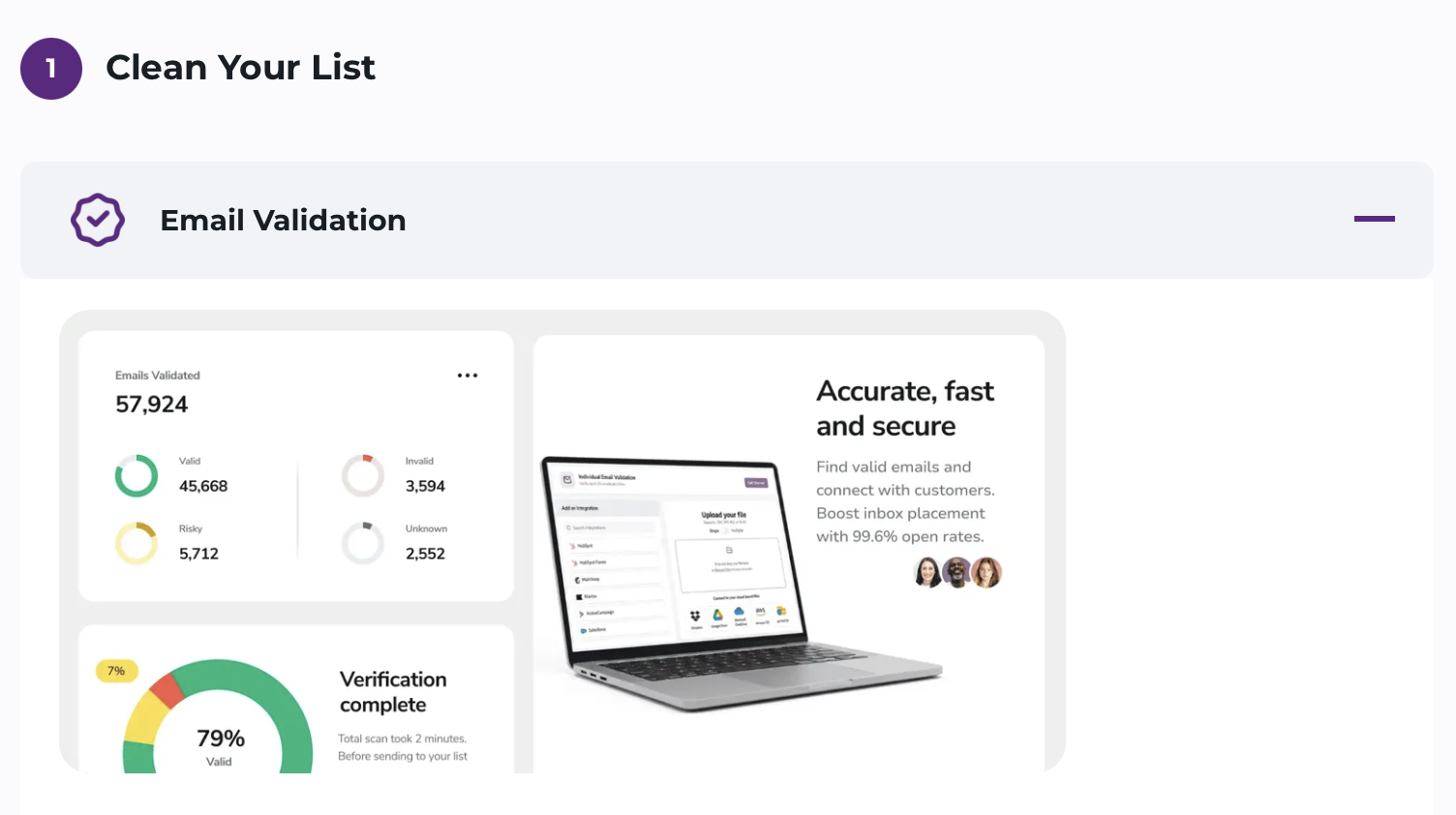
AI Email Scoring ranks uncertain and catch-all addresses 1–10 by likelihood of reaching a real inbox, instead of forcing an all-or-nothing decision on 4%+ of a typical list.
Pricing, Plans, and Package Structure
ZeroBounce runs a hybrid pricing model: a free tier for testing, flexible Pay-As-You-Go credits with no expiry, and the ZeroBounce ONE™ subscription that bundles validation credits with the full deliverability suite. There’s no long-term contract on any tier. Note on pricing accuracy: ZeroBounce’s live pricing page uses a dynamic, JavaScript-rendered slider rather than static listed rates, so the Pay-As-You-Go figures below are cross-referenced from multiple independent pricing trackers rather than read directly off a fixed table — they should be treated as approximate, and you should confirm the exact rate for your credit volume on the official pricing page before purchasing.
| Plan | Price (USD) | What It Is | Best For |
|---|---|---|---|
| Freemium | $0/mo | 100 validation credits/mo, 1 inbox test, 1 server test, 1 blacklist monitor, 10 Email Finder searches | Testing accuracy before committing |
| Pay-As-You-Go | ~$0.008–$0.01 per credit (approx.; entry purchases from roughly $18–$39, verify live rate) | One-time credit purchase for validation, scoring or Email Finder; credits never expire | Occasional or unpredictable list-cleaning needs |
| ZeroBounce ONE™ (Monthly) | From $99/mo | 10,000 validation/scoring credits, 250 warmup seeds/day, 100 inbox placement tests/mo, 1 DMARC domain, 100 server tests/mo, 10 blacklist monitors, 10,000 Email Finder searches/mo | Teams that want the full deliverability suite in one plan |
| ZeroBounce ONE™ (Annual) | ~20% off the monthly rate, billed yearly | Same ONE plan benefits at a discounted annual rate | Predictable, ongoing verification volume |
| Higher-Volume Tiers | Scales with credit volume (100K–1M credits) | Larger monthly credit blocks via the pricing-page slider | Growing lists and recurring campaigns |
| Enterprise | Custom (contact sales) | 1,000,000+ verifications/mo, sub-accounts, dedicated support, tailored onboarding | Large organizations with high-volume, ongoing sending |
How ZeroBounce Compares to Alternatives
| Factor | ZeroBounce | NeverBounce | Kickbox |
|---|---|---|---|
| Entry PAYG rate | ~$0.008–$0.01/email (approx.) | ~$0.008/email ($8/1,000) | ~$0.008/email flat |
| Credit expiry | Never expires (PAYG) | 12 months (PAYG) | Does not expire |
| Catch-all handling | AI Scoring 1–10, ~1.75% unknown rate | Basic catch-all flagging | Sendex quality score; limited catch-all resolution |
| Deliverability suite | Warmup, inbox test, server test, blacklist + DMARC monitor | Validation-focused; CRM automation via Clean+ | Validation-focused; developer-first API |
| Integrations | 40+ native integrations | 80+ native integrations | API-first; fewer native connectors |
| Third-party rating | Trustpilot “Excellent,” G2 4.7/5 (1,300+) | Generally strong; owned by ZoomInfo | G2 4.5/5 (~570 reviews) |
| Best for | Full inbox-health platform in one dashboard | Marketing teams living inside a CRM/ESP | Developers wanting a lean, flat-rate API |
vs. NeverBounce: Now owned by ZoomInfo, NeverBounce leans hard into CRM and ESP automation with 80+ native integrations and a Clean+ feature for ongoing list hygiene inside HubSpot, Salesforce and Mailchimp. Its entry PAYG pricing is close to ZeroBounce’s, but credits expire after 12 months — a real cost if your sending is irregular. ZeroBounce counters with non-expiring credits and a noticeably deeper deliverability toolkit beyond validation itself.
vs. Kickbox: Kickbox is the developer-first option — a clean API, flat-rate pricing around $0.008/email, and non-expiring credits, plus its own Sendex quality score. It’s a strong pick for engineering-led teams that just want reliable verification without a large dashboard. ZeroBounce pulls ahead once you need the surrounding deliverability suite (warmup, blacklist monitoring, DMARC) rather than validation alone, and third-party benchmarks generally place it ahead on high-volume pricing versus Kickbox.
vs. budget verifiers (MyEmailVerifier, DeBounce, Email List Verify): A newer wave of lower-cost verifiers undercuts ZeroBounce on raw price-per-credit, sometimes by more than half. If price-per-email is your only variable and you don’t need scoring, warmup or monitoring tools, those alternatives are worth a look. ZeroBounce’s case rests on accuracy, catch-all handling, and the breadth of what’s bundled around validation — not on being the cheapest line item.
Pros and Cons
4
What Users Love
Accuracy that shows up in real bounce-rate drops: Across Trustpilot’s 2,100+ reviews, the single most repeated theme is straightforward: users upload a list expecting the usual mix of false positives, and the results come back clean and consistent, with bounce rates measurably lower after cleaning.
Catch-all scoring is a genuine relief: Reviewers specifically call out the ability to score catch-all and uncertain addresses rather than simply discarding them, letting teams keep more of a hard-won list instead of writing off every “unknown” result.
Fast turnaround, even on large lists: Multiple reviewers running lists in the hundreds of thousands to millions of addresses describe fast, reliable processing without the platform choking.
Responsive support, most of the time: A recurring theme is praise for fast live-chat and email support (ZeroBounce cites a 20-second average live-chat wait and 17-minute average email reply), with several reviewers naming individual support staff by name.
Detailed, well-organized reporting: Reviewers appreciate that results come back in clearly separated files by category (valid, invalid, catch-all, spamtrap, etc.) alongside a combined file, making re-integration into an ESP straightforward.
Trusted at genuine scale: Teams sending hundreds of thousands of emails a day specifically cite ZeroBounce as core infrastructure for protecting sender and domain reputation, not just a one-off cleanup tool.
Limitations Worth Knowing
Not the cheapest option in the category: This is the most consistent critical theme across G2, Capterra and independent pricing trackers: ZeroBounce is reliable but priced at a premium versus budget verifiers, and the fluctuating credit-based model can be a drawback for teams with unpredictable send volumes.
Pricing page isn’t fully transparent at a glance: The live pricing page uses a dynamic slider rather than a static rate table, and independent third-party trackers report noticeably different entry-level PAYG figures depending on when they checked. Confirm your actual rate before a large purchase rather than relying on any single published number, including this one.
Interface can overwhelm new users: Several reviewers describe the feature-rich dashboard as “complicated” or “overwhelming” for people who aren’t advanced users, particularly once you move beyond basic validation into scoring, warmup and monitoring tools.
“Valid” results can still bounce on real-world sends: A minority of reviews describe cases where a meaningful share of “valid” results still bounced once actually mailed, particularly on catch-all-heavy lists — no verifier, ZeroBounce included, can guarantee zero bounces, and expectations should be set accordingly.
A minority report serious account-handling friction: Alongside the large majority of positive reviews, a small number of Trustpilot reviewers describe accounts being closed or credits withheld without what they felt was adequate explanation — worth being aware of, even though it does not reflect the typical experience.
Subscription credits don’t roll over: On ZeroBounce ONE, unused monthly credits are generally forfeited rather than carried forward, so over-subscribing relative to your actual monthly volume wastes money — size the plan carefully.
Beyond validation, ZeroBounce’s deliverability suite tracks blacklist status, DMARC authentication and inbox placement so issues get caught before they hurt a campaign.
Who Should Use ZeroBounce
Email marketers and growth teams: If you’re running regular campaigns and sender reputation directly affects revenue, ZeroBounce’s combination of accurate validation and ongoing deliverability monitoring (blacklist, DMARC, inbox placement) addresses the whole problem, not just the list-cleaning half of it.
Agencies managing multiple client accounts: Multiple API keys, sub-account support on Enterprise, and detailed per-category reporting make it practical to manage several clients’ list hygiene from one place.
B2B and cold outreach teams: The Email Finder plus validation combination, along with strong catch-all scoring for corporate domains that frequently use catch-all configurations, is a meaningful fit for sales and outbound teams building prospect lists.
High-volume senders protecting a domain: Teams sending hundreds of thousands of emails a day, where a single deliverability incident is costly, benefit most from the full ZeroBounce ONE suite rather than validation alone.
Who should look elsewhere: Solo users or small lists with a tight budget and no need for scoring, warmup or monitoring tools will likely find a leaner, cheaper verifier (Kickbox, MyEmailVerifier, or similar) a better fit for price alone. Teams that live entirely inside HubSpot or Salesforce and want the deepest possible native automation may also prefer NeverBounce’s larger integration library. And anyone expecting a verification tool to guarantee a zero-bounce campaign, regardless of vendor, should adjust that expectation before buying any tool in this category.
Getting Started: Step by Step
- Create a free account. Sign up with a business or premium domain to unlock 100 free monthly validation credits, plus one inbox test, one server test and one blacklist monitor to try before you pay.
- Run a small test list first. Upload a sample of a few hundred to a few thousand contacts (or use the free email verifier for single addresses) and review the category breakdown — valid, invalid, catch-all, spamtrap — before trusting it with your full database.
- Choose Pay-As-You-Go or ZeroBounce ONE. If your sending is irregular, buy credits as needed since they never expire. If you send consistently every month, compare the ONE subscription cost against your expected PAYG spend — the bundled deliverability tools often tip the math in ONE’s favor for active senders.
- Clean your full list. Upload the complete database or connect the real-time API to your signup forms so new addresses are checked the moment they’re collected, preventing bad data from entering your list in the first place.
- Score and segment catch-all results. Run AI Email Scoring on catch-all and uncertain addresses rather than discarding them outright, and set an internal cutoff (for example, only mail scores of 6+) to balance list size against risk.
- Layer on deliverability monitoring. Once your list is clean, add Blacklist Monitoring and an Email Server Test to catch technical or reputation issues before they tank a campaign, and consider Email Warmup if you’re launching on a new or recently inactive domain.
Tips for Getting Maximum Value
Validate at the point of signup, not just before a big send — routing your signup forms through the real-time API stops bad addresses from ever entering your database, which is far cheaper than periodic mass cleanups. Don’t treat every catch-all result as a lost cause: run AI Scoring on them and mail the higher-scored contacts rather than deleting the whole segment. Size your ZeroBounce ONE subscription to your actual average monthly volume rather than your peak month, since unused credits typically don’t roll over — buy top-up Pay-As-You-Go credits for the occasional larger send instead of over-subscribing every month. If you manage several brands or clients, take advantage of multiple API keys to keep usage and billing separated cleanly. And before a high-stakes campaign, pair validation with an Inbox Placement Test so you know not just that your addresses are real, but that your content is actually reaching the inbox rather than the spam folder.
Future Outlook and Final Assessment
Email deliverability has gotten harder, not easier, as Gmail and Yahoo tighten sender requirements and inbox providers get more aggressive about filtering unengaged or unverified senders. That shift favors platforms like ZeroBounce that treat validation as one part of a larger deliverability discipline rather than a standalone checkbox. The company’s continued investment in AI-driven detection — including newer capabilities like AI-managed mailbox detection — suggests it’s positioning itself for a future where distinguishing real human recipients from automated or synthetic ones matters as much as basic syntax and mailbox checks ever did.
The honest caveats remain: it costs more than bare-bones competitors, the pricing page takes some digging to fully understand, and a small minority of users report real friction around account handling. But within those bounds, ZeroBounce delivers one of the more complete, independently well-rated inbox-health platforms available in 2026 — and for teams where sender reputation is directly tied to revenue, that completeness is usually worth paying for.
Conclusion
ZeroBounce isn’t trying to be the cheapest email verifier on the market — it’s trying to be the most complete one, and on that goal it largely delivers. By combining accurate, well-benchmarked validation with genuine catch-all scoring and a real deliverability suite (warmup, inbox testing, blacklist and DMARC monitoring), it addresses the full lifecycle of getting into the inbox, not just the first step of confirming an address exists. It rewards teams that send regularly and take sender reputation seriously, and it’s a harder sell for anyone chasing the absolute lowest price-per-credit. Confirm your current rate on the live pricing page, start with the free tier or a small test list, and ZeroBounce can take a real, ongoing bounce-rate problem off your plate.
Ready to stop losing money on bounced emails?
Explore more honest reviews, tutorials and tech comparisons to find the right gear for the way you work, travel and live — at World Of Tech, where we make everything easy.
👉 Try ZeroBounce: https://worldoftech.space/zerobounce
👉 Our YouTube Channel: youtube.com/@world_tech79
👉 Our Facebook Fanpage: Facebook
👉 Our X (Twitter): @worldoftech79
Pricing, specifications and policy details in this review were verified against zerobounce.net and independent review/pricing sources (including Trustpilot, G2 and third-party pricing trackers) as of September 2026. ZeroBounce’s live pricing page renders dynamically and its Pay-As-You-Go rates are not published as a fixed table, so per-credit figures above are approximate — confirm current pricing on the official site before purchasing. Competitor prices are approximate and subject to change.