
If you are staring down the GRE, GMAT, SAT, TOEFL or any other standardized test and choking on the price of name-brand prep courses, you have probably already run into Magoosh. It is one of the most recognizable names in online test prep for a simple reason: it promises high-quality, video-based study tools for a fraction of what Kaplan or The Princeton Review charge, and it backs that promise with a score-improvement guarantee. Founded in 2009 by a group of Berkeley MBA students and named after the Old Persian word “magush” (one who is highly learned and wise), Magoosh has grown into a platform that claims to have helped over 10 million students across more than 185 countries, with hundreds of millions of practice questions answered and 13 million hours of video lessons watched. It carries a 4.8/5 “Excellent” rating on Trustpilot, and in 2025–2026 it added an AI tutor, AI essay scoring, and officially licensed ETS questions to its GRE course.
For self-motivated students, busy professionals and budget-conscious test-takers, the value proposition is immediate: serious, structured prep you can do anywhere, on any device, without draining your savings. But Magoosh isn’t the right fit for everyone, and an honest look reveals real trade-offs — there are no live classes, the verbal sections lag behind the math, and the practice pool can feel thin once you have worked through it. This 2026 review walks through Magoosh’s full lineup — the exams it covers, the video-and-AI feature set, the complete pricing structure across GRE, GMAT, SAT, ACT, MCAT, LSAT and more, head-to-head comparisons against Kaplan and The Princeton Review, the genuine pros and cons, and exactly who should (and shouldn’t) sign up.
Magoosh Review 2026: The Affordable, Video-First Test Prep That Punches Above Its Price
Overview and Background
Magoosh is an online test-preparation company based in the San Francisco Bay Area (it started in Berkeley, California). It isn’t a tutoring agency or a publisher of physical prep books — it’s a fully self-paced digital platform built around one idea: make effective test prep accessible, affordable and genuinely enjoyable. You pick your exam, sign up, and immediately get access to a library of video lessons, thousands of practice questions, full-length mock tests, study schedules, progress analytics and mobile apps. There are no classes to attend and no sessions to schedule. Instead, you study on your own time and, if you get stuck, you message Magoosh’s expert team and typically hear back within 24 to 48 hours.
The company was founded in 2009 by education entrepreneurs Hansoo Lee, Bhavin Parikh and Pejman Negin while they were studying for their MBAs, frustrated that good test prep was either expensive, boring, or both. More than fifteen years later, Magoosh covers a wide range of exams — the GRE, GMAT, SAT, ACT, LSAT, MCAT, TOEFL, IELTS and Praxis among them — and it has built genuine credibility in the space. It claims to have helped over 10 million students worldwide, carries a 4.8/5 “Excellent” score on Trustpilot across roughly 560-plus reviews, and is frequently ranked among the best budget GRE and GMAT courses by independent review sites. It isn’t the cheapest option on the market, but it consistently delivers far more than its price tag suggests.
What separates Magoosh from the old-guard prep giants is its lean, video-first, mobile-friendly approach — and, increasingly, its use of AI. Every practice question comes with a video explanation, the platform predicts your likely test-day score as you go, and recent additions include an AI tutor trained on Magoosh’s content, AI-powered essay scoring that grades your writing like a real exam rater, and AI-generated practice problems modeled on questions you got wrong. For the GRE specifically, Magoosh became the only prep course licensed to use eight full sections of official ETS practice questions — a meaningful credibility marker in a category where question realism matters enormously.
Why Magoosh Stands Out in 2026
Price that undercuts the big names by a mile: This is Magoosh’s defining advantage and the number-one reason students choose it. A full GRE course runs roughly $149–$179, while comparable self-paced courses from Kaplan (~$449) and The Princeton Review (~$499) cost three to four times as much, and their live options climb past $1,000. For students already postponing income to head to grad school, that gap is the whole decision.
A video explanation for every single question: Where many rivals offer text-only solutions, Magoosh records a video walkthrough for every practice question. For students who learn best by watching someone work a problem out loud, this is the platform’s single most-praised feature — it turns a wrong answer into a genuine lesson instead of a dead end.
A genuinely strong quantitative section: Across Trustpilot, G2 and GMAT Club, the most consistent praise is for Magoosh’s math instruction. Reviewers repeatedly say the Quant lessons teach concepts from the ground up — not just formulas to memorize, but where those formulas come from — which builds the kind of understanding that holds up under exam pressure.
AI tools that go beyond a gimmick: In 2025–2026 Magoosh layered in an AI tutor (a chatbot trained on its own lessons that explains whatever you don’t grasp), AI essay scoring that grades your writing like a real rater and returns targeted feedback, and AI-generated follow-up questions modeled on the ones you miss. It’s an unusually practical use of AI for a prep platform — extra help on demand without paying for a human tutor.
Officially licensed ETS questions for the GRE: Magoosh is the only GRE course licensed to include eight full sections of official ETS practice questions. Even independent tutors who are skeptical of third-party prep agree these are the most realistic GRE practice you can get — and having them built into the course is a real differentiator.
A score predictor students actually trust: Magoosh estimates your likely test-day score range based on your performance in the program, and a striking number of reviewers report that their real exam result landed almost exactly where the predictor said it would. That feedback loop helps students know when they are genuinely ready to sit the test.
Flexibility, mobile apps and a risk-free trial: The whole platform is built for busy lives — study anywhere on web or mobile, slot in a practice set between meetings, and review vocabulary on the dedicated Flashcard and Prep-on-the-Go apps. A 7-day free trial (no credit card needed on most courses) and a 7-day money-back guarantee mean you can test it properly before committing.
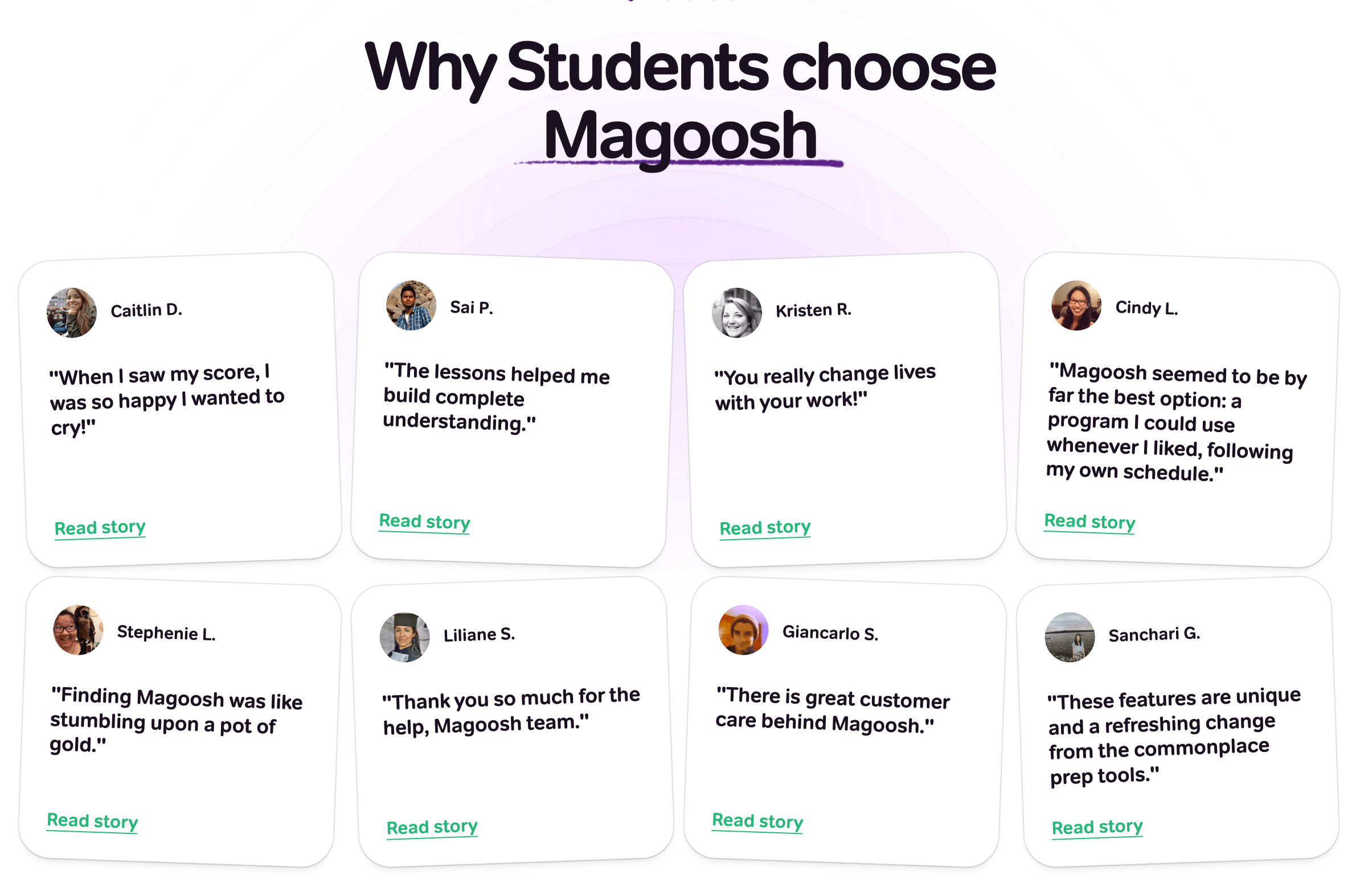
Magoosh pairs a video explanation for every question with study schedules, a score predictor and an AI tutor — serious, structured prep you can do on any device for a fraction of name-brand prices.
Key Features and Technology
Magoosh’s product is broad, but it organizes cleanly into a handful of pillars. Here’s how the platform actually breaks down.
Video Lessons and Question Explanations
The core of the experience. Each course is built from hundreds of short, focused video lessons taught by experienced instructors who break complex topics into digestible chunks — the GRE course alone includes 290-plus curated lessons. Crucially, every practice question is paired with its own video explanation, so when you miss something you see exactly how to approach it next time. The production style is deliberately simple (often whiteboard or slide-based rather than on-camera), which keeps lessons crisp but feels less polished than some premium competitors.
Practice Questions, Mock Tests and Customizable Quizzes
Magoosh provides large banks of practice questions ranked by difficulty, plus full-length, timed mock tests that mirror real exam conditions. You can build custom practice sessions targeting specific topics or difficulty levels, which makes it easy to drill your weak spots rather than grinding through random questions. Many reviewers note the questions run slightly harder than the real test — useful for building confidence, though a few find some items (especially verbal) more ambiguous than the official versions, which is why pairing Magoosh with official practice material is wise.
The AI Layer: Tutor, Essay Scoring and Smart Practice
Magoosh’s newest pillar. An AI tutor trained on its lessons answers your questions in plain language whenever a written explanation isn’t enough. AI essay scoring grades your analytical writing the way a real exam rater would and returns specific feedback to lift your score. And when you miss a question, the system can generate fresh, similar problems so you can practice the exact concept again. It’s genuinely helpful, though some users note the AI explanations can occasionally be shallow or get tripped up on older test formats — treat it as a strong assistant, not an infallible expert.
Study Schedules, Analytics and Score Predictor
To keep self-study on track, Magoosh offers ready-made study schedules (typically ranging from one week up to six months), a clean analytics dashboard that tracks time spent and pinpoints weak areas, and a score predictor that estimates your test-day range. The analytics and predictor draw consistent praise; the study schedules are more divisive — some students find them a helpful daily checklist, while others call them slow, over-reliant on Magoosh’s own content, or occasionally out of sequence with the lessons.
Mobile Apps, Flashcards and Admissions Support
Beyond the web platform, Magoosh ships highly rated mobile apps — a dedicated Flashcard app for vocabulary and a Prep-on-the-Go app for lessons and questions — so you can study from a phone or tablet anywhere. For graduate applicants, the GRE and GMAT courses offer optional Admissions bundles with an application tracker, guided essay-writing workshops, annotated personal statements, and resume and recommendation-letter guidance — turning a test-prep tool into a lightweight end-to-end admissions companion.
Pricing, Plans, and Package Structure
Magoosh keeps pricing refreshingly simple: there’s no ongoing subscription — each plan is a one-time purchase that grants access for a fixed window (commonly 1, 6 or 12 months) — and you can pay in full or in four interest-free installments. The headline rates below are Magoosh’s standard prices, but the brand runs frequent and sometimes steep promotions (coupon events around Black Friday, New Year and Back to School have advertised discounts well over 50%), so it is genuinely worth checking for an active coupon before you check out. All prices are in USD and were accurate at the time of writing.
| Plan | Price (USD, approx.) | What It Is | Best For |
|---|---|---|---|
| GRE Premium (1 month) | $149 | Full GRE course, official ETS questions, AI tutor, 290+ lessons | A focused final-month sprint |
| GRE Premium (6 months) | $179 | Same as above with a longer runway to study | Most GRE students (best value) |
| GRE Premium + Admissions | $219 | GRE Premium plus application tracker and essay support | Grad-school applicants |
| GMAT (GMAT Focus) | ~$199 (6 mo) / ~$249 (12 mo) | Full GMAT Focus course, video lessons, mocks, predictor | MBA applicants on a budget |
| SAT / ACT (self-study) | ~$129 (12 mo) | Digital-SAT/ACT lessons, 1,300+ questions, practice tests | High schoolers (12-month access) |
| SAT/ACT + On-Demand Classes | ~$399 (12 mo) | Self-study plus recorded on-demand class hours | Students wanting more structure |
| MCAT | ~$399 (12 mo) | Full MCAT course with lessons, questions and tests | Pre-meds (widely called a bargain) |
| LSAT | ~$199 (+ LSAC LawHub fee) | Self-paced LSAT prep (no live classes) | Budget-focused law applicants |
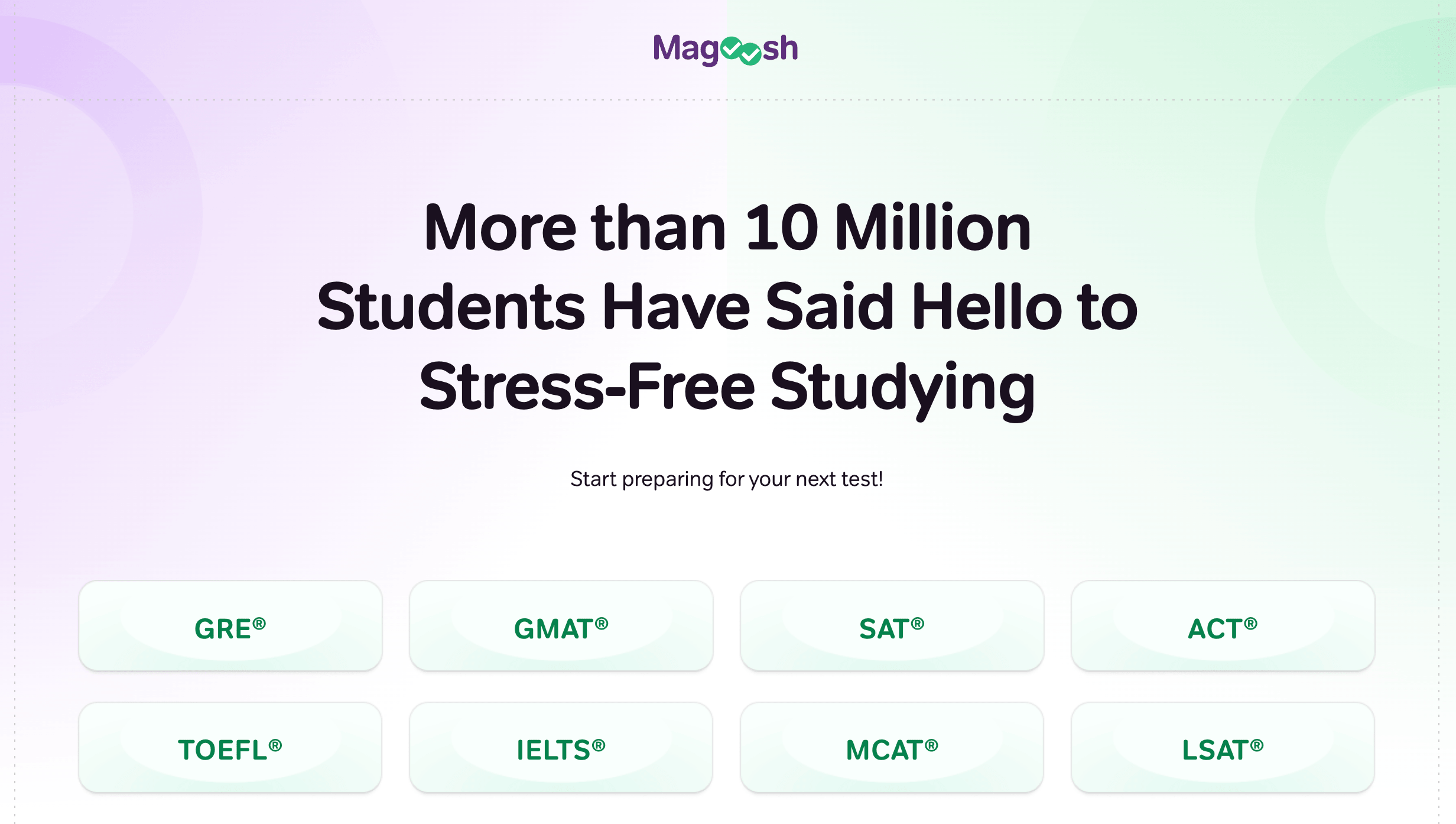
With one-time plans from around $129–$219 and frequent coupons, Magoosh typically costs a fraction of Kaplan and The Princeton Review’s self-paced courses.
How Magoosh Compares to Alternatives
| Factor | Magoosh | Kaplan | The Princeton Review |
|---|---|---|---|
| Format | Self-paced only (no live) | Self-paced, live online, tutoring | Self-paced, live online, tutoring |
| GRE self-paced price | ~$149–$179 | ~$449 (6 mo) | ~$499 (4 mo) |
| Live class option | No | Yes (~$999–$1,100) | Yes (~$1,200+) |
| Practice volume | Solid, can run thin on re-do | Very large Qbank (5,000+) | Large (2,500+) + 8 tests |
| Standout strength | Value, video explanations, AI, ETS questions | Volume, GRE Channel, Test Day Experience | Polished videos, strong score guarantees |
| Free trial / refund | 7-day trial, 7-day refund | Limited trial | 14-day trial, 7-day refund |
| Best for | Budget self-studiers and video learners | Volume-driven prep and live structure | Guarantee-seekers wanting polish |
vs. Kaplan: Kaplan is the heavyweight — a far larger question bank (5,000-plus), the live GRE Channel with near-daily streamed sessions, and the unique Official Test Day Experience that simulates real exam conditions. But its self-paced course costs roughly three times Magoosh’s, and its live and tutoring tiers run well over $1,000 and $2,500 respectively. If you want maximum practice volume or live instruction and can afford the premium, Kaplan wins; if you want excellent core teaching at a fraction of the cost, Magoosh is the smarter value.
vs. The Princeton Review: The Princeton Review’s video lessons are arguably the most polished in the category — an on-camera instructor working through a transparent digital whiteboard — and its higher-tier courses carry the strongest score-improvement guarantees on the market (a guaranteed 162+ or +6 per section on some plans). That polish and those guarantees come at a steep price, with self-paced near $499 and guaranteed-score courses past $2,000. Magoosh can’t match the production values or the live guarantees, but for most self-studiers it delivers 80% of the substance at 30% of the cost.
vs. official material and ultra-budget options: Magoosh’s biggest “competitor” is arguably free or near-free study. Official ETS, GMAC and College Board practice is the most realistic prep you can do, and tools like GregMat offer extremely cheap GRE coaching that many students swear by. The honest play for most people isn’t either/or: use Magoosh’s videos and analytics to build understanding and structure, then validate readiness on official practice tests. Used that way, Magoosh earns its keep — used as a total replacement for official material, it leaves value on the table.
Pros and Cons
What Users Love
Unbeatable value for money: This is by far the most common praise across Trustpilot, G2 and Reddit. Students repeatedly point out that Magoosh delivers high-quality prep at a small fraction of Kaplan or Princeton Review prices — one Redditor noted a refund of just $179 versus competitors charging $449 to over $1,000.
Outstanding math instruction: The Quant lessons earn near-universal acclaim. Reviewers love that the math videos teach concepts from the root level — showing where formulas come from rather than just handing them over — which builds real, durable understanding.
Video explanations for every question: For visual learners, this is the killer feature. Being able to watch an expert work through any missed question turns practice into genuine learning and is the reason many students choose Magoosh over text-only rivals.
An accurate, confidence-building score predictor: A recurring theme in reviews is the predictor’s reliability — students report their actual exam score landing right inside the range Magoosh forecast, which helps them sit the test at the right time instead of guessing.
Flexible, mobile, and easy to use: Busy professionals and students with packed schedules love that they can study anywhere, on any device, in whatever blocks of time they have. The interface is clean and the progress tracking makes it easy to see exactly what to work on next.
Genuinely useful AI help: The newer AI tutor and AI essay scoring get strong early feedback — students appreciate on-demand explanations and instant, specific writing feedback without paying for a human tutor.
Low-risk to try, with a real guarantee: The 7-day free trial and 7-day money-back guarantee make it easy to test, and the score-improvement guarantee (with conditions) gives retakers a genuine safety net — reviewers confirm refunds are honored when the criteria are met.
Limitations Worth Knowing
No live classes or scheduled tutoring: This is the number-one limitation. Magoosh is purely self-paced — there are no live group sessions and no real-time one-on-one tutoring built into the standard plans. If you need accountability, structure or live interaction to stay motivated, this is a poor fit.
The verbal sections lag behind the math: A consistent critique, especially on the GMAT, is that the verbal content feels dated and thinner than the excellent Quant material. Advanced learners chasing top-percentile verbal scores often find it insufficient and need to supplement elsewhere.
Practice questions can run out and repeat: Several reviewers note the question pool isn’t as deep as Kaplan’s, so heavy users start seeing the same questions again — which dulls their usefulness once you’ve worked through the bank. More full-length tests would also help.
Question realism isn’t perfect: Independent tutors point out that some Magoosh questions — particularly verbal reading-comprehension inferences and unusually calculation-heavy math — don’t perfectly mirror official exam logic. The platform is best paired with official ETS, GMAC or College Board practice, not used as the only source.
Dated interface and simple video style: The UI feels older than some rivals (one common request is a dark mode), parts of the verbal video library haven’t been refreshed in a while, and the slide/whiteboard production — while clear — lacks the on-camera polish of premium competitors.
Study plans and fine print need care: The built-in study schedules can feel slow, over-weighted toward Magoosh’s own content, or occasionally out of order with the lessons. And the policies reward attention: the refund window is only 7 days, installment plans commit you to the full price even if you pause, and the score guarantee has strict eligibility conditions you must meet exactly to claim.
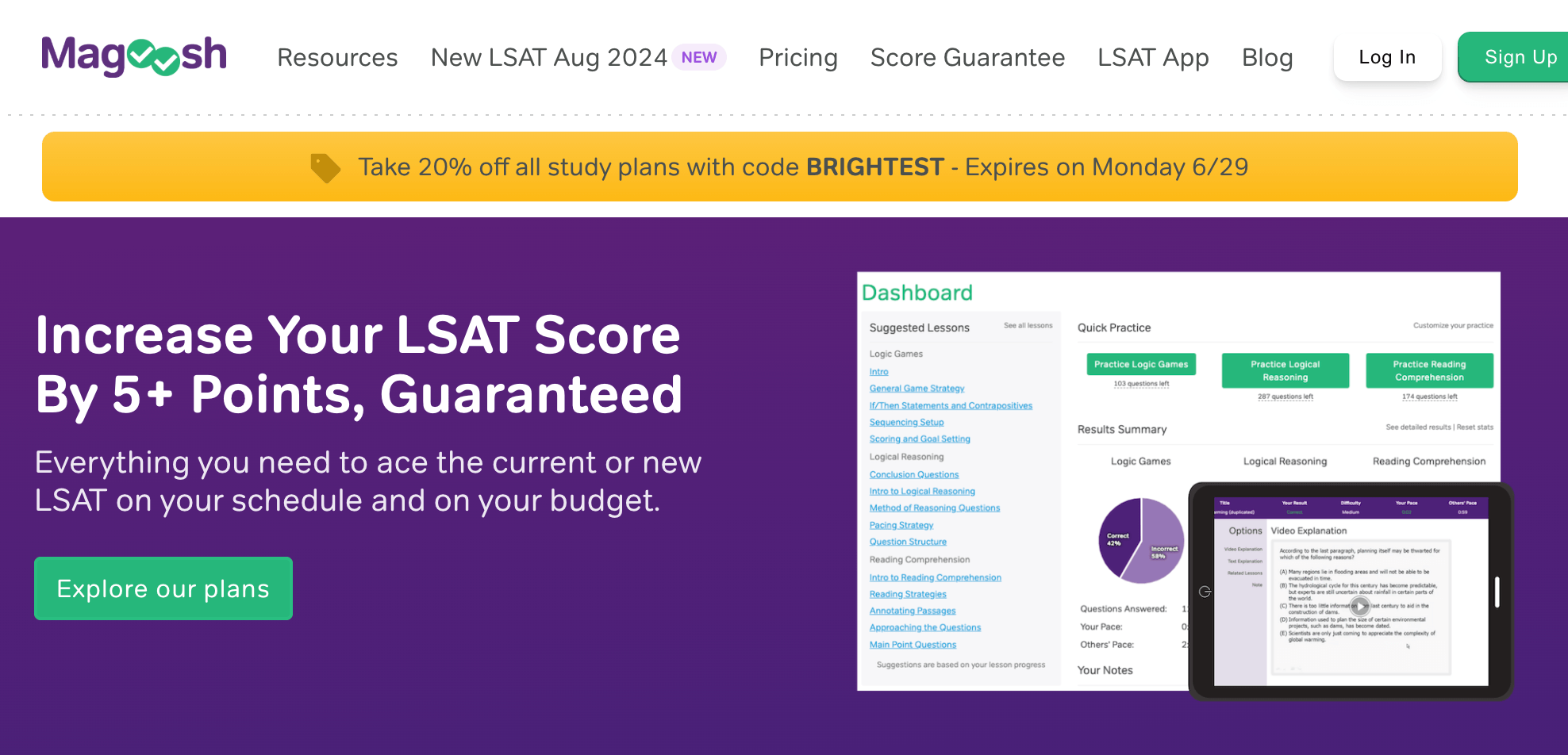
Magoosh’s web platform and mobile apps let self-directed learners fit serious test prep into a busy schedule, anytime and anywhere.
Who Should Use Magoosh
Self-directed, independent learners: This is Magoosh’s sweet spot. If you are disciplined, can manage your own study time, and prefer to work at your own pace without a class schedule dictating your week, Magoosh gives you the materials and tools to do it well — and cheaply.
Video learners: If you absorb concepts best by watching someone explain and work through them — rather than reading dense text — Magoosh’s video-for-every-question model is built precisely for you.
Busy students and working professionals: A huge share of reviewers are people juggling jobs, families or full course loads who needed to sneak in practice between other commitments. The mobile apps, short lessons and flexible schedules make Magoosh ideal for fitting prep into a packed life.
Budget-conscious test-takers and retakers: If you want quality prep without a four-figure bill, Magoosh is one of the best values in the category. And because it offers a money-back score-improvement guarantee, it’s especially appealing if you’re retaking an exam to lift an existing score.
Who should look elsewhere: Students who need live instruction, real-time accountability, or one-on-one tutoring will be happier with Kaplan or The Princeton Review’s live tiers. Advanced learners targeting elite verbal scores, and anyone who wants the deepest possible practice bank, will want to supplement Magoosh with official material or a higher-volume course. And if you struggle to stay motivated without external structure, a self-paced platform — however good — may not be enough on its own.
Getting Started: Step by Step
- Start the free trial first. Head to magoosh.com, pick your exam (GRE, GMAT, SAT, ACT, MCAT, LSAT, TOEFL or IELTS) and start the 7-day free trial — no credit card needed on most courses. Use it to test the teaching style, interface and question quality before you spend anything.
- Choose the right plan length. Match the plan to your timeline: a 1-month plan for a final-stretch sprint, or a 6-month plan if you want breathing room (usually the best value). Grad applicants should weigh the Admissions bundle for application and essay help. Hunt for an active coupon before you pay — Magoosh discounts are frequent and generous.
- Take a diagnostic and set your target. Sit an initial practice test to establish your baseline, then set a realistic target score for your programs. If you’ve taken the real exam before, submit your prior official score at sign-up to stay eligible for the money-back score guarantee.
- Build a schedule and work the videos. Pick one of Magoosh’s study schedules (or build your own), then move through the video lessons section by section. Watch the explanation video for every question you miss — that’s where the real learning happens — and lean on the AI tutor when a written answer isn’t enough.
- Drill weak spots and track progress. Use customizable quizzes to target your weakest topics and difficulty levels, check the analytics dashboard to see where you’re improving, and watch the score predictor climb toward your goal as you go.
- Validate readiness on official material. Before test day, confirm you’re ready by taking official ETS, GMAC or College Board practice tests in addition to Magoosh’s mocks. When your real-practice scores and the predictor agree you’ve hit your target, book the exam with confidence.
Tips for Getting Maximum Value
Treat the free trial as a real audition and the coupon search as mandatory — between the two, you can confirm fit and pay well below the standard price almost every time. Lean hardest on what Magoosh does best: watch every question-explanation video, and use the Quant lessons to build math understanding from the ground up rather than memorizing formulas. Pair the platform with official practice from ETS, GMAC or the College Board so you’re training on the most realistic questions and using Magoosh’s videos and analytics to fix what those official questions reveal. If you’re chasing a top-percentile verbal score, plan to supplement with additional resources, since verbal is the platform’s weaker side. Use the customizable quizzes to attack your weak topics instead of grinding random questions, install the Flashcard and Prep-on-the-Go apps so a spare ten minutes always counts, and if you took the exam before, submit your prior score at sign-up to keep the money-back guarantee in play. Finally, read the fine print on refunds, installments and the score guarantee before you commit — knowing the 7-day window and the exact guarantee conditions up front is what separates a happy customer from a frustrated one.
Future Outlook and Final Assessment
The online test-prep market in 2026 is being reshaped by two forces — affordability and AI — and Magoosh sits right at the intersection of both. It helped pioneer the idea that high-quality prep didn’t need a four-figure price tag, and its 2025–2026 additions (an AI tutor, AI essay scoring, AI-generated practice and officially licensed ETS questions) show a company actively modernizing rather than coasting on reputation. With test formats continuing to shift — the shorter GRE, the GMAT Focus, the digital SAT — Magoosh’s biggest ongoing advantage is the speed and low cost with which it updates and the value it packs into each course.
The honest caveats remain: there are no live classes, the verbal content needs a refresh, the question bank can run thin for heavy users, and the platform works best alongside official practice rather than in place of it. Bigger-budget rivals like Kaplan and The Princeton Review still win on practice volume, live instruction and production polish. But within its lane — affordable, flexible, video-first self-study with increasingly smart AI support — Magoosh remains one of the best-value options available, and the 4.8/5 “Excellent” Trustpilot reputation reflects a large base of students who got real results without overspending.
Conclusion
Magoosh isn’t trying to be the most expensive, most feature-loaded course on the market — it’s trying to give independent learners genuinely good prep at a price almost anyone can manage, and at that job it’s remarkably effective. By pairing a video explanation for every question with strong math teaching, a trustworthy score predictor, increasingly capable AI help and officially licensed GRE questions, it removes the two biggest barriers to good test prep: cost and confusion. It rewards realistic expectations and a little self-discipline, and it isn’t the right call for students who need live structure or are chasing elite verbal scores — but for the budget-conscious, self-motivated majority, few platforms deliver more per dollar. Try the free trial, check for a current promotion, and Magoosh can make serious test prep both affordable and genuinely doable.
Ready to score higher without paying premium prices?
Explore more honest reviews, tutorials and tech comparisons to find the right tools for the way you study, work and learn — at World Of Tech, where we make everything easy.
👉 Try Magoosh: https://magoosh.com
👉 Our YouTube Channel: youtube.com/@world_tech79
👉 Our Facebook Fanpage: Facebook
👉 Our X (Twitter): @worldoftech79
Pricing, specifications and policy details in this review were verified against magoosh.com and independent review sources (including Trustpilot, G2 and hands-on reviewer testing) as of June 2026. Test-prep pricing, course content and promotions change frequently, so confirm current details on the official site before purchasing. Competitor prices are approximate and subject to change.