
If your desk, backpack and carry-on are still cluttered with three different laptop bricks, a phone charger and a tangle of cables, AOHI is one of the few brands actually trying to collapse that pile into a single smart ecosystem instead of just selling you another power adapter. Behind the AOHI name sits Aohai Technology, a 21-year-old charging manufacturer that has quietly built chargers for Google, Amazon, Xiaomi and DJI long before it ever put its own logo on a box.
That manufacturing pedigree is exactly what makes AOHI worth a closer look in 2026: a 280W AI-controlled desktop charging station, a genuinely novel 2-in-1 power bank and charging station, and a lineup of flight-legal high-wattage battery packs, all priced well below where the wattage would normally put them. This 2026 review walks through what AOHI actually gets right, where it still has to earn your trust, and which product in the lineup is worth your money.
AOHI Review 2026: The Smart Charging Ecosystem Redefining How You Power Everything
Overview and Background
AOHI (sold direct-to-consumer at iaohi.com) is the retail brand of Aohai Technology, a Shenzhen-listed charging manufacturer (stock code 002993) founded in 2004. AOHI itself isn’t a scrappy startup pretending to be a hardware company — it’s the consumer face of a company that was the first in the charging industry to go public, in 2020, and that has spent nearly two decades building chargers for other brands before selling its own. According to AOHI’s own account, the parent company now runs manufacturing bases across China, India and Indonesia, employs roughly 5,000 people worldwide, and works with a professional R&D team of more than 300 engineers holding 267 patents.
The scale behind the brand shows up in a few concrete numbers: a 7th factory, a $100 million investment covering 34,000 m², completed at the end of 2023; a CNAS-certified lab spanning 2,000 m² with more than 400 test machines, whose data has reportedly been accepted by UL, TÜV, IECEE and Intertek; and a second Indonesian factory covering over 35,000 m² with 1,100+ employees running MES-tracked automated lines. AOHI also states it works as a core charger supplier for household names including Google, Amazon, Belkin, vivo, Xiaomi, OPPO, DJI, ASUS, Nokia and TP-Link, and claims roughly 14.5% of the global charger market — figures that are self-reported by the company and worth treating as such, but that line up with AOHI’s genuinely deep product range rather than a single hero SKU.
On the retail side, AOHI’s lineup breaks into three families: GaN wall chargers (from compact 65W travel chargers up to a 280W AI-controlled desktop station), a growing line of high-wattage “Starship” and “Black Warrior” power banks built around 140–240W output, and the fast cables and cases that connect them. The current flagship — and the product front-and-center on the homepage — is the AOHI The Future AI PD3.2 280W 6-Port Desktop Charging Station, a smart, app-controlled hub built to replace an entire desk’s worth of individual chargers.
Why AOHI Stands Out in 2026
It’s a real manufacturer selling direct, not a reseller with a logo: Most “new” charging brands are simply relabeling a factory’s off-the-shelf design. AOHI is the factory. Owning the CNAS-certified test lab and the production lines behind its own patents means the company can iterate on protocols like PD3.2 and GaN+ faster than brands that have to wait on a supplier’s roadmap.
A genuinely smart 280W desktop hub: The AOHI The Future AI PD3.2 280W Desktop Charging Station isn’t just another multi-port brick. It puts a real 240W on a single USB-C port, adds a TFT display showing live wattage and temperature per port, and lets you switch between Smart AI, Turbo and manual App modes from a phone over Wi-Fi — a level of control most desktop chargers at this price simply don’t offer.
The 2-in-1 power bank and charging station concept: The 40,000mAh Starship is marketed as the world’s first power bank that doubles as a full three-port, 140W charging station — it can recharge itself from the wall while simultaneously feeding three other devices, which most rival power banks either can’t do at all or do only at a fraction of the speed.
Flight-legal capacity without giving up wattage: Both the Starship 240W (99.36Wh) and the Black Warrior 170W (90.72Wh) sit under the common 100Wh airline carry-on threshold while still pushing genuinely high per-port output — a combination that’s harder to find than the marketing makes it look, since most power banks that size either cut capacity or cut wattage to stay compliant.
GaN+ efficiency with layered protection: Every current-generation product in the lineup uses GaN or GaN+ semiconductors for smaller, cooler-running hardware, paired with what AOHI describes as automotive-grade battery cells and up to 15 layers of protection against overcurrent, overvoltage, overheating and short circuits.
Aggressive, near-constant discounting: Every flagship product on iaohi.com currently carries a 29–50% markdown plus a stackable coupon code shown on the product page itself, so the effective price you’ll actually pay is consistently well below the “regular price” printed on the listing.
A broad, connected ecosystem: Beyond the two flagship products, AOHI sells GaN wall chargers from 65W travel bricks to the 280W desktop station, car chargers, fast cables, and cases — enough range that you can standardize an entire household or office around one brand’s ports and cables.

AOHI’s flagship 280W desktop station puts 240W on a single USB-C port and adds app-controlled charging modes with a real-time TFT display — a genuine step up from a standard multi-port brick.
Key Features and Technology
AOHI’s catalog is wide, but nearly every product draws from the same handful of underlying technologies. Here’s how the platform actually breaks down.
Smart AI Desktop Charging (280W Station)
The AOC-C022 desktop station delivers up to 280W total across 4 USB-C and 2 USB-A ports, with USB-C1 alone capable of a real 240W using the PD3.2 protocol (up to 48V⎓5A, plus PPS 5–21V⎓5A). Three charging modes — Smart AI (auto power balancing), Turbo (sustained high-power output) and App Manual (per-port control) — are switchable through a Wi-Fi-connected smart app, and a built-in TFT display shows live wattage, port status, temperature and a 3-stage charging indicator, along with clock and weather widgets when it’s idle.
The 2-in-1 Power Bank and Charging Station
The Starship 40,000mAh (AOC-P010) is built around bidirectional power distribution: when its own output demand is lower than the power coming in from the wall, it automatically routes the surplus into recharging its 144Wh battery. In practice, that means it can act as a desktop charging station during the day and a travel power bank at night, with three USB-C ports (each up to 140W) and one USB-A port, and a full self-recharge in roughly 1.5 hours from a compatible 140W source.
High-Wattage, Airline-Legal Power Banks
The Starship 240W (27,600mAh, 99.36Wh) and Black Warrior 170W (25,200mAh, 90.72Wh) are both engineered to sit under the common 100Wh airline carry-on ceiling while still delivering 140W and 100W per USB-C port respectively — enough to take a MacBook Pro 16″ from 0% to roughly 50% in under 30 minutes on a compatible cable. Both use automotive-grade cells with 15 layers of protection, an LED or TFT status display, and PD3.0/PD3.1/PPS protocol support for broad device compatibility.
GaN+ Hardware and Protocol Support
Across the lineup, AOHI uses GaN or GaN+ semiconductors to keep high-wattage hardware compact and cooler-running than traditional silicon designs, and supports the current spread of fast-charging standards — PD3.0, PD3.1, PD3.2, PPS, QC, AFC, FCP and UFCS — so the same charger or power bank works across iPhone, Android, Steam Deck, Nintendo Switch and most USB-C laptops without needing a brand-specific charger for each device.
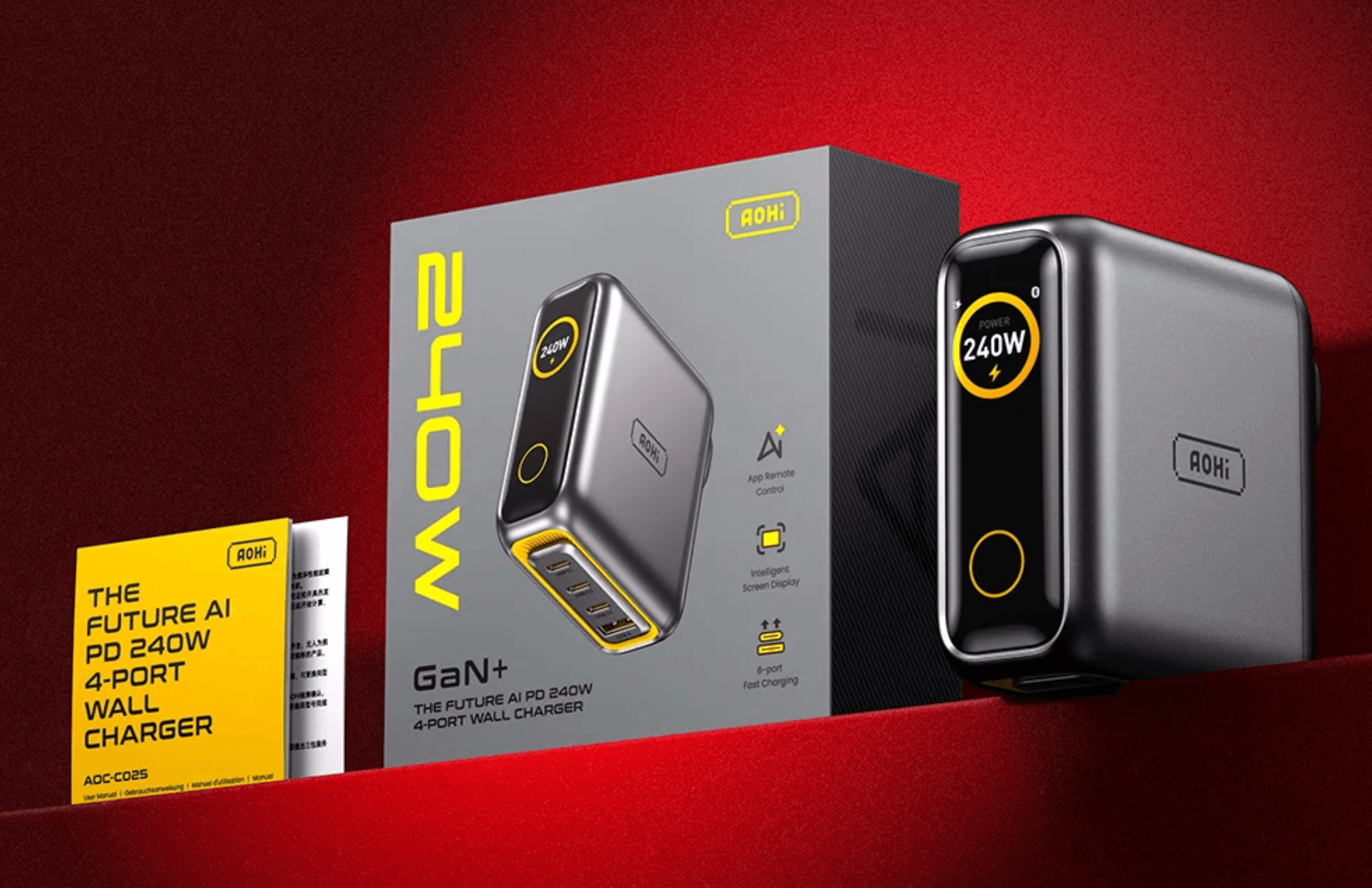
The Starship 40,000mAh is built to work both ways — a power bank on the move, or a desktop charging station that tops itself back up while it powers your other devices.
Pricing, Plans, and Package Structure
AOHI sells everything as a one-time purchase — there’s no subscription anywhere in the lineup — and the prices below are the live, discounted prices shown on iaohi.com at the time of writing, not the crossed-out “regular price.” Every listing also displays its own stackable coupon code at checkout, so the final total is typically a few dollars lower still. Free worldwide shipping (duties and taxes included) applies on orders over $40.
| Product | Price (USD) | What It Is | Best For |
|---|---|---|---|
| AOHI The Future AI PD3.2 280W Desktop Station | $169.99 (reg. $239.99) | 6-port GaN+ hub, 240W single-port, TFT display, app/Wi-Fi control | Home office & multi-device desks |
| AOHI The Future Starship 240W Power Bank | $109.00 (reg. $169.00) | 27,600mAh, 140W per USB-C port, airline-legal (99.36Wh) | Frequent flyers & laptop travelers |
| AOHI Starship 2-in-1 40,000mAh Power Bank & Station | $179.99 (reg. $259.00) | 40,000mAh, three 140W USB-C ports, self-recharges while charging others | Long trips, camping & multi-device households |
| AOHI Black Warrior 170W Power Bank | $79.99 (reg. $159.00) | 25,200mAh, 100W dual PD3.0/PPS ports, airline-legal (90.72Wh) | Budget-conscious laptop travelers |
| AOHI The Future AI PD 170W 3-Port Wall Charger | $99.99 (reg. $139.99) | Compact 3-port GaN wall charger with LED display | Single-outlet desk or travel setups |
| AOHI The Youth 65W GaN 3-Port Charger | ~$38.00 | Budget 3-port GaN charger with PPS 63W support | Students & minimalist everyday carry |
How AOHI Compares to Alternatives
| Factor | AOHI (280W Station / Starship 240W) | Anker (Prime Station / Prime Power Bank) | Ugreen (Nexode Station / Nexode 25000mAh) |
|---|---|---|---|
| Manufacturing model | Own factories & CNAS-certified lab (Aohai) | Mix of in-house and contract manufacturing | Primarily contract manufacturing |
| Flagship desktop station | 280W total, 240W single-port, app + TFT | ~250W total, 6–8 ports, app on select models | ~200W total, 8 ports, no app on most models |
| Flagship power bank | 27,600mAh, 240W total, 140W per port | ~20,100mAh, 220W total | 25,000mAh, 200W total (~145W real-world) |
| 2-in-1 bank/station option | Yes — Starship 40,000mAh | No direct equivalent | No direct equivalent |
| Approx. flagship-pair price | ~$280 at current discount | ~$350–400 combined | ~$225–280 combined |
| Independent review depth | Thin on Trustpilot; growing on-site & Amazon reviews | Extensive, years of D2C review history | Extensive, years of D2C review history |
| Best for | Highest raw wattage per dollar, newest specs | Buyers who want the deepest review history | Buyers who want a polished companion app |
vs. Anker: Anker’s Prime line is the safer, more established choice if independent review volume and years of customer-service track record matter most to you — it simply has far more reviews and history behind it. AOHI counters with a higher single-port ceiling (240W vs. Anker’s roughly 220W flagship bank) and a lower price at current discounts, plus the 2-in-1 Starship concept Anker doesn’t currently offer.
vs. Ugreen: Ugreen’s Nexode series is closely matched on specs and is also backed by a real manufacturer, with a more polished app experience on some models. AOHI generally undercuts Ugreen on price at its current discounts and pushes slightly higher wattage on its flagship power bank, but Ugreen still has the deeper independent review base to lean on if that’s your main concern.
vs. a generic no-name GaN charger: A $20 unbranded GaN brick from a marketplace listing will often claim similar wattage on paper, but won’t carry a certified test lab, a stated warranty period, or any real accountability if it fails. AOHI’s manufacturing history and 18-month warranty are the actual reason to pay more than the cheapest listing you can find.
Pros and Cons
What Users Love
Genuinely high wattage for the price: At current discounted pricing, a 240W single-port desktop station or a 140W-per-port travel power bank both land well under what comparably specced chargers from more established brands typically cost.
The 2-in-1 concept is a real differentiator: Being able to use the same 40,000mAh unit as a desktop charging station on a work day and a travel power bank on a flight day is a genuinely useful piece of engineering, not just marketing language.
Real manufacturing behind the brand: Buyers can point to a CNAS-certified lab, factories on three continents, and a two-decade OEM history — this isn’t a relabeled marketplace product with a new logo slapped on it.
Smart features on the flagship station: The TFT display and app-controlled charging modes on the 280W station give a level of visibility and control that most desktop chargers, even from bigger brands, still don’t offer at this price.
Clearly stated airline compliance: Both flagship power banks list their exact Wh rating on the product page, which removes the guesswork many travelers face when trying to confirm carry-on eligibility.
Frequent, stackable discounting: Every product currently on the front page carries a real markdown plus an additional coupon code, so the effective price is consistently lower than the sticker “regular price.”
Limitations Worth Knowing
Independent review history is still thin: AOHI’s official Trustpilot profile currently carries only a handful of reviews, so most of the social proof on any given product still comes from AOHI’s own on-site review counts rather than a large body of independent, verified purchases.
At least one serious third-party marketplace complaint exists: A detailed public account describes a faulty 140W charger and a difficult support experience through an “AOHI Official Store” on a third-party marketplace, not the direct iaohi.com storefront. It’s a single case rather than a pattern, but it’s a reminder to buy through the channel with the clearest accountability and to keep your order confirmation.
Headline wattage depends on your cable and device: The 240W and 280W figures are maximums that require both a compatible device and a properly rated cable — an underrated cable will silently bottleneck the speed without any error message telling you why.
App and Wi-Fi control add complexity: The smart features on the 280W station are genuinely useful, but they also mean setting up an account and an app for what is, at its core, a wall charger — not every buyer wants that overhead.
Shorter direct-to-consumer track record than Anker or Ugreen: Both of those competitors have years of D2C reputation and a far larger volume of verified reviews to check before you buy; AOHI’s D2C history as its own storefront brand is comparatively newer.
The “regular price” is mostly theoretical: Every flagship listing is discounted 29–50% at the time of writing, which is good for buyers but means the crossed-out list price isn’t a reliable anchor — always check the live, currently-active price before comparing to a competitor.
Who Should Use AOHI
Home-office workers with several devices on one desk: The 280W AI station is built exactly for this — laptop, phone, tablet, earbuds and a handheld console can all sit on one hub instead of a nest of separate bricks.
Frequent flyers and business travelers: The Starship 240W and Black Warrior 170W both stay under the 100Wh airline threshold while still fast-charging a laptop, making them a strong single-item replacement for a wall charger and a phone battery pack.
Campers and remote workers away from outlets: The 40,000mAh 2-in-1 Starship’s ability to keep charging multiple devices for days, then top itself back up quickly once you’re back near power, suits extended trips better than a single-purpose power bank.
Bundle and gift buyers: Because most listings offer cable and case bundles at a modest premium, AOHI’s products work well as a single, complete gift rather than requiring separate cable purchases.
Who should look elsewhere: Buyers who want to lean entirely on a large, multi-year body of independent reviews before purchasing may be more comfortable with Anker or Ugreen for now. The same goes for anyone who strongly prefers buying from a retailer with a physical return counter over a direct Shopify checkout — AOHI’s return and warranty process runs entirely through its own site and email support.
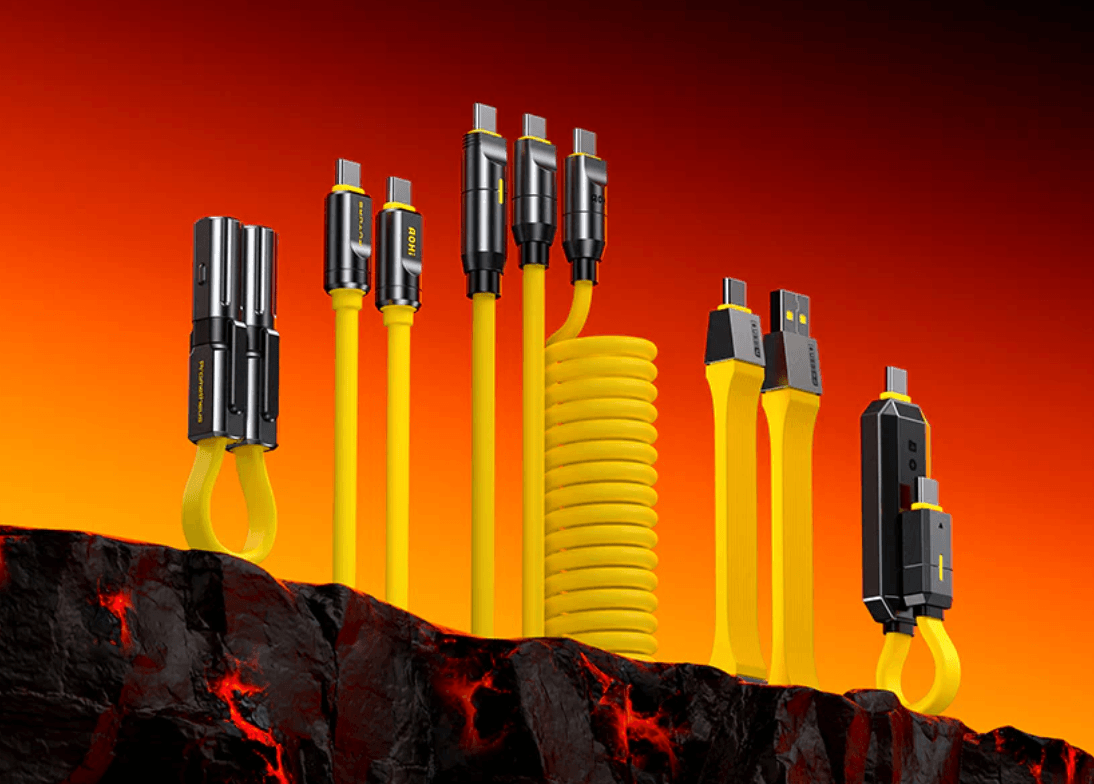
Both flagship AOHI power banks are engineered to sit under the common 100Wh airline threshold while still fast-charging a laptop — a combination that’s harder to find at this price than the specs sheet makes it look.
Getting Started: Step by Step
- Pick the right anchor product. Choose the 280W desktop station if your main need is a stationary multi-device hub; choose the Starship 240W or Black Warrior 170W if you need something portable and airline-legal; choose the 40,000mAh 2-in-1 Starship if you want both in one device.
- Check your cable and airline requirements. Confirm your existing USB-C cable is rated for the wattage you actually need (140W or 240W cables are not interchangeable with basic 60W cables), and check your airline’s specific power bank Wh policy before a flight, since rules vary by carrier.
- Set up the smart app if you bought the 280W station. Connect it to Wi-Fi and choose Smart AI mode for everyday use, or switch to Turbo or App Manual mode when you need guaranteed full-speed charging on a specific port.
- Charge devices by priority. Plug your highest-power device (a laptop) into the top-rated port first, then fill in phones, tablets and accessories on the remaining ports so the built-in power distribution allocates wattage sensibly.
- Use pass-through charging on travel days. On the 2-in-1 Starship, leave it plugged into the wall while it’s also charging your other devices, so it recharges itself with the power it isn’t actively using elsewhere.
- Build your kit over time. Add a matching high-wattage cable, a protective case for travel, or a second lower-wattage charger for a bag you don’t want to unpack — most bundles cost less than buying each piece separately later.
Tips for Getting Maximum Value
Always copy the coupon code shown directly on the product page before checkout — it stacks on top of the already-discounted sale price and is easy to miss if you go straight to the cart. If you’re weighing the Starship 240W against the Black Warrior 170W, remember the extra cost buys you real headroom (140W vs. 100W per port) that matters most if you’re fast-charging a laptop rather than a phone, so don’t overspend on wattage you won’t use. Keep your original 240W or 140W cable paired with its matching charger, since mixing a lower-rated cable back in will quietly cap your charging speed with no warning. If you plan to fly with any AOHI power bank, screenshot the Wh rating listed on the product page before you travel — it’s the number airline staff will ask for, not the mAh figure. And because AOHI ships from its own warehouse network with duties and taxes included over $40, it’s usually cheaper to buy a bundle (charger plus cable, or power bank plus case) directly than to source the pieces separately from different sellers.
Future Outlook and Final Assessment
The charging accessory market in 2026 is consolidating around a handful of manufacturer-backed direct-to-consumer brands that can move fast on new protocols like PD3.2 and GaN+, and AOHI is positioning itself squarely in that group rather than competing on price alone. Its factory-level manufacturing base, growing patent portfolio and willingness to ship genuinely novel form factors — like the 2-in-1 power bank and charging station — suggest a brand investing in real engineering differentiation rather than just rebadging commodity hardware.
The honest caveat is that AOHI’s own direct-to-consumer storefront is still building the kind of independent review depth that Anker and Ugreen have accumulated over the better part of a decade, and at least one detailed public complaint about a third-party reseller’s support process is worth keeping in mind. Buy through the official iaohi.com checkout, keep your order confirmation, and match the product’s real wattage to what your devices can actually use, and AOHI’s hardware genuinely competes with — and in a few specs, beats — the established names at a lower price.
Conclusion
AOHI isn’t trying to win on brand recognition alone — it’s trying to win on the strength of two decades of actual charger manufacturing, and on that front it largely delivers: genuinely high per-port wattage, a smart desktop station with real app control, and power banks that hit the rare combination of high output and airline-legal capacity. It asks you to trust a newer direct-to-consumer storefront over a decade-old one, and to buy through the right channel to get the support that backs it up, but for buyers chasing the newest charging specs at an aggressively discounted price, AOHI’s current lineup is one of the stronger options in the category. Confirm the live price, match the wattage to your devices, and it can genuinely replace a drawer full of mismatched chargers with one connected system.
Ready to power your whole setup from one smart ecosystem?
Explore more honest reviews, tutorials and tech comparisons to find the right gear for the way you work, travel and live — at World Of Tech, where we make everything easy.
👉 Shop AOHI: https://worldoftech.space/aohi
👉 Our YouTube Channel: youtube.com/@world_tech79
👉 Our Facebook Fanpage: Facebook
👉 Our X (Twitter): @worldoftech79
Pricing, specifications and policy details in this review were verified against iaohi.com and independent sources (including Amazon listings and manufacturer datasheets) as of September 2026. Charging hardware pricing, discounts and coupon codes change frequently, so confirm current details on the official site before purchasing. Competitor prices are approximate and subject to change.