
The pitch behind Emergent is a bold one: describe your app idea in plain English, and a team of AI agents — architect, designer, developer, integration specialist, project manager — plans, codes, tests and deploys a full-stack web or mobile application for you. Backed by Y Combinator’s Summer 2024 batch and roughly $100 million from investors including Lightspeed, Khosla Ventures and SoftBank, and founded by ex-Google, Amazon and Dropbox engineers, Emergent has real credibility as a company. The product genuinely delivers on speed when it works: real, ownable React/Next.js and Expo/React Native code, with authentication, databases and payment integrations built in from the start.
But this review has to be direct about something that isn’t a minor footnote: Emergent’s independent Trustpilot record is genuinely rough — sitting around 2.7 to 2.8 out of 5 across hundreds of reviews, sharply polarized between delighted five-star users and a large, vocal cluster of one-star complaints centered specifically on credit burn, refund refusals, and support that many reviewers describe as unresponsive on disputes. That’s not a minor gripe pattern; it’s a recurring, well-documented theme across a meaningful review volume. This 2026 review covers what Emergent actually builds, its real current pricing, how it compares to Bolt and Lovable, and — because the trust signals here genuinely warrant it — a clear-eyed look at the buyer risks before you put a credit card down.
Emergent Review 2026: A Fast, YC-Backed AI App Builder With a Trust Problem Worth Knowing About
Overview and Background
Emergent launched in 2025 out of Y Combinator’s S24 batch, founded by twin brothers Mukund and Madhav Jha, with the company headquartered in San Francisco and a significant engineering team in Bengaluru. It positions itself as an “AI engineer in a box” — rather than a single chatbot generating code snippets, Emergent runs a multi-agent pipeline where distinct AI agents handle architecture, design, development, integrations and project management collaboratively, aiming to take a plain-language idea all the way to a deployed, working application.
Output is real, ownable code — React and Next.js with Tailwind on the frontend, Node.js or FastAPI on the backend, and Expo/React Native for mobile — rather than a locked-in proprietary format. The platform bundles authentication, databases, hosting and payment integrations directly into the build process, and supports saving projects to GitHub and forking for collaboration. Emergent reports over 3–6 million users, though as with most self-reported platform metrics, that figure comes from the company itself and hasn’t been independently verified.
Like most AI app builders in 2026, Emergent runs on a credit-based subscription model, where every AI action (generating a component, running a test, fixing a bug) consumes credits from a monthly allowance. That model is common across the category — Bolt, Lovable and others use variations of it too — but it’s also where a large share of Emergent’s negative reviews originate, discussed in detail below.
Why Emergent Stands Out in 2026
A genuine multi-agent build pipeline, not a single chatbot: Separate architect, designer, developer and integration agents collaborating on one project is a meaningfully different approach than a single AI model generating code turn by turn, and reviewers who’ve had smooth builds specifically credit this structure for handling multi-file, full-stack complexity better than simpler tools.
Real, exportable code with no lock-in: Output is standard React/Next.js and Expo/React Native — not a proprietary format — with GitHub save and fork support, so a project built on Emergent isn’t stranded on the platform if you decide to move development elsewhere later.
Full-stack from the first prompt: Authentication, databases, hosting and payment integrations are built into the generation process rather than bolted on afterward, which genuinely differentiates Emergent from simpler front-end-only AI builders for anyone who needs a working backend, not just a UI mockup.
Serious, credible backing: Y Combinator S24, roughly $100 million raised from Lightspeed, Khosla Ventures, SoftBank and Google’s AI Futures Fund, and a founding team with ex-Google, Amazon and Dropbox experience — this is not a fly-by-night operation, whatever the Trustpilot pattern suggests about execution on billing.
Genuinely fast first drafts, per positive reviewers: When a build goes cleanly, five-star Trustpilot reviews specifically praise the speed of going from an idea to a working mobile app or dashboard, describing it as one of the smoother “vibe coding” experiences available.
Broad application range: Web apps, mobile apps, dashboards, e-commerce sites, internal business tools and SaaS MVPs are all within scope, giving it wider applicability than tools narrowly focused on a single output type like landing pages or dashboards alone.

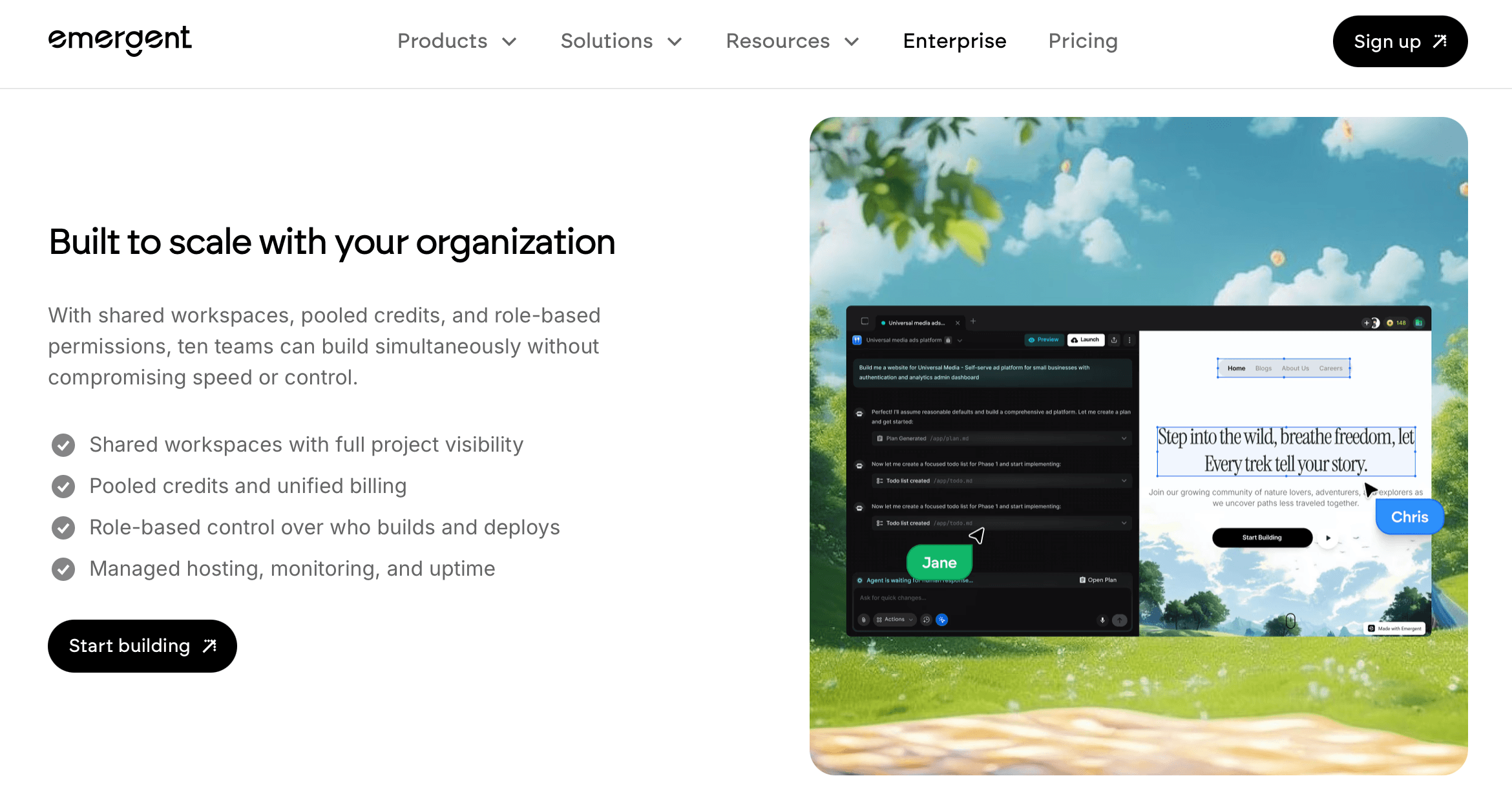
Emergent’s multi-agent pipeline plans, codes, tests and deploys full-stack web and mobile apps from a single natural-language description.
Key Features and Technology
Emergent’s platform organizes around a conversational build process backed by a specialized agent team. Here’s how it actually works.
Multi-Agent Architecture
Rather than a single model handling everything, Emergent splits the build process across an architect agent (planning structure), a designer agent (UI/UX), a developer agent (writing code), an integration agent (connecting third-party services like Stripe or Google Sheets) and a project-manager agent (coordinating the whole pipeline). This is the core of what differentiates Emergent’s approach from simpler single-model code generators.
Full-Stack Generation
Web output uses React and Next.js with Tailwind CSS, backed by Node.js or FastAPI. Mobile output is generated as Expo and React Native code. Authentication, database setup, and payment integrations (Stripe and others) are built into the generation flow rather than requiring separate manual setup, and popular integrations like Google Sheets and Airtable are supported on paid tiers.
The Mobile App Store Gap
One limitation worth understanding clearly before you plan a mobile launch around Emergent: it generates real, working Expo/React Native code, but it does not handle the native build, code signing, or App Store/Google Play submission and review process. That work is yours to complete afterward, typically via Expo’s own build and submission tooling — a meaningful gap if your goal is a published mobile app rather than just the underlying codebase.
GitHub Integration and Custom Agents
Save to GitHub and project forking are available on paid tiers, letting a project move beyond Emergent’s own environment for further development. Higher tiers also unlock custom AI agents and editable system prompts for teams that want to tailor the build pipeline to a specific internal workflow or coding standard.
Billing, Credits and Refund Policy
This deserves its own section rather than a passing mention. Emergent’s stated policy treats spent credits as non-refundable once consumed, regardless of whether the underlying build succeeded — a standard clause across most credit-based SaaS tools, but one that becomes contentious specifically because of how often reviewers report credits being consumed on builds that failed, looped, or were later found to be broken despite being marked “complete” by the AI. Company responses visible on Trustpilot generally direct dissatisfied users to a support email (trust@emergent.sh) or a Google Form for case review, and some reviewers report a resolution after escalating this way, while others describe the same generic response repeated without a concrete outcome. If you’re spending real money on Emergent, understanding this policy — and building in checkpoints so a single failed session doesn’t burn a large share of your monthly allowance — matters more here than on most tools in this category.
Pricing, Plans, and Package Structure
Emergent runs on a credit-based subscription model. Official pricing (confirmed on emergent.sh) starts at $17/month for individual builders on annual billing ($20/month billed monthly), scaling to $167/month for power users (annual; $200/month billed monthly), and $250/month for teams (annual; $300/month billed monthly). Each plan includes a monthly credit allowance, and additional credits can be purchased on top. Credits do not roll over between billing periods, so unused allowance is lost at the end of each cycle.
| Plan | Price (USD) | Monthly Credits | Best For |
|---|---|---|---|
| Free | $0 | ~10 credits/mo (sources vary slightly) | Testing a single simple prompt, not a real build |
| Standard | $17/mo annual ($20/mo monthly) | 100 credits/mo | Solo builders, roughly 1 simple MVP per month |
| Pro | $167/mo annual ($200/mo monthly) | 750 credits/mo, 1M context window, custom agents | Power users, agencies, complex multi-project work |
| Team | $250/mo annual ($300/mo monthly) | 1,250 shared credits/mo | Teams sharing a credit pool across projects |
How Emergent Compares to Alternatives
| Factor | Emergent | Bolt.new | Lovable |
|---|---|---|---|
| Core strength | Multi-agent full-stack build, mobile + web | Fast, developer-oriented browser IDE | Guided full-stack build with Supabase backend |
| Free tier | ~10 credits/mo, limited to basic testing | 1M tokens/mo, genuinely usable (approx.) | Small daily credit allowance (approx.) |
| Entry paid price | $17/mo annual (verified official) | ~$18–20/mo annual (approx.) | ~$16/mo annual (approx.) |
| Trustpilot signal (approx.) | ~2.7–2.8 / 5, polarized, refund complaints common | Not independently verified here | Not independently verified here |
| Mobile app support | Generates code; App Store submission is manual | Web-focused, limited native mobile path | Web-focused, limited native mobile path |
| Best for | Full-stack MVPs with backend + mobile code | Developers wanting IDE-level control | Non-technical founders wanting a polished UI fast |
vs. Bolt.new: Bolt’s browser-based WebContainer approach renders previews without a round trip to the cloud, making it noticeably faster per iteration, and its free tier (roughly 1M tokens/month) is more genuinely usable for exploration than Emergent’s 10-credit free tier. Emergent’s edge is its multi-agent full-stack approach and native mobile code generation, which Bolt doesn’t match as directly.
vs. Lovable: Lovable is widely regarded as producing more polished, design-forward UIs out of the box and pairs tightly with Supabase for backend setup, making it a strong choice for non-technical founders focused on a clean first impression. Emergent’s multi-agent architecture is generally considered better suited to more complex, multi-file projects, though at a real cost premium on its higher tiers.
vs. hiring a developer: For anyone building something genuinely complex, business-critical, or requiring guaranteed reliability, a human developer or agency still carries far lower financial risk than any current AI app builder, Emergent included. Emergent’s real competition is the simple, well-scoped MVP or internal tool that would otherwise cost significantly more in freelance development time.
Emergent’s credit-based plans scale from a 100-credit Standard tier to a 1,250-credit shared Team pool, with unused credits expiring each billing cycle.
Pros and Cons
What Users Love
Genuine speed when a build goes smoothly: Multiple five-star reviews specifically describe Emergent as one of the smoothest mobile app building experiences among vibe-coding platforms they’ve tried, with fast update cycles once an app is established.
Real full-stack output, not just a UI mockup: Users consistently note that Emergent handles genuine backend complexity — auth, databases, integrations — rather than stopping at a front-end prototype, which is a real differentiator from simpler builders.
Support can be excellent — for some users: A number of reviews single out specific support staff by name for quickly resolving technical issues, suggesting the support team is capable when a case gets proper attention.
A credible, well-funded company behind it: Y Combinator backing, a nine-figure funding round, and an experienced founding team give real confidence in the platform’s longevity compared to smaller, less capitalized competitors.
Limitations Worth Knowing
A genuinely concerning independent trust record: Emergent’s public Trustpilot score sits around 2.7–2.8 out of 5 across hundreds of reviews — a meaningfully weaker signal than most established competitors in this category. This isn’t a fringe complaint pattern; it’s documented across dozens of separate reviews spanning many months, centered specifically on billing and refund handling.
Credits consumed on failed or looping builds, with reported refund refusals: A recurring and specific theme across negative reviews: agents getting stuck in error loops, repeating failed attempts, or producing broken output, with credits charged regardless — and refund requests frequently declined by citing a strict non-refundable credit policy, even when reviewers argue the failure was the platform’s own fault.
Inconsistent support outcomes on disputes: While some reviewers praise specific support staff, a substantial number describe being bounced between an AI agent and a chatbot, receiving generic template responses, or having promised refunds never actually processed. Treat any refund promise as unconfirmed until it appears on your statement.
Credits expire and do not roll over: Unused monthly credits are lost at the end of each billing cycle, which can be a real disadvantage for anyone with uneven, bursty usage patterns compared to competitors offering rollover.
No handling of native mobile app store submission: Emergent generates working Expo/React Native code but leaves the actual App Store and Google Play build, signing and submission process entirely to you — a real gap if a published mobile app, not just source code, is your end goal.
Who Should Use Emergent
Non-technical founders with a clearly-scoped MVP: If you can describe a well-defined, reasonably simple application and are prepared to iterate carefully within a credit budget, Emergent’s full-stack generation can genuinely compress weeks of freelance development into days.
Product managers prototyping internal tools: For internal dashboards, admin panels or lightweight business tools where a failed attempt is low-stakes and easily rescoped, the platform’s speed is a real asset.
Developers wanting a fast, ownable starting point: Because output is standard React/Next.js and Expo code with GitHub export, a technical user can treat Emergent as an accelerated first draft, then take the codebase elsewhere to finish and harden it.
Who should look elsewhere: anyone with a low tolerance for billing disputes or who can’t absorb the financial risk of a build going wrong should weigh the Trustpilot pattern seriously before committing meaningful budget. Anyone whose end goal is a published, App Store-live mobile app rather than source code should plan separately for the native build and submission process. And for complex, business-critical, or high-stakes projects, the more predictable path of a human developer or a more established platform with a stronger independent trust record may be worth the extra cost.

Emergent bundles authentication, database setup and payment integrations directly into the generation process for a full-stack MVP.
Getting Started: Step by Step
- Start on the Free tier with one specific prompt. Write a single, tightly-scoped test project rather than exploring broadly — 10 credits won’t cover a real build, but it will show you output quality and credit consumption on a small task.
- Break large projects into small, checkpointed prompts. Rather than describing an entire complex application at once, build in stages and confirm each stage actually works before letting the agents proceed to the next.
- Monitor credit consumption closely. Check your credit balance after each significant step, and stop an agent that appears to be looping or repeatedly failing rather than letting it burn credits unsupervised.
- Save to GitHub early and often. Once you’re on a paid tier, export your project to GitHub regularly so you always have a recoverable copy independent of the platform.
- Test deployment before declaring a project “done.” Reviewers have reported the AI claiming a build is “production-ready” when a deployment subsequently fails — verify the actual live deployment yourself before relying on the platform’s own status claims.
- Plan mobile app store submission separately. If your goal is a published app, budget time and, if needed, developer help for the native build, signing and App Store/Google Play review process that Emergent doesn’t handle.
Tips for Getting Maximum Value
Write prompts with real specificity — the exact features, data model, and user flows you need — since vague, exploratory prompts are consistently what leads to costly back-and-forth iteration. Screenshot your checkout page before completing any purchase, so you have proof of exactly what credit amount and plan you were promised if a discrepancy comes up later. Use your credits on Standard before committing to Pro or Team, since 100 credits is usually enough to genuinely test whether Emergent fits your specific project type. If an agent gets stuck fixing the same bug repeatedly, stop the session and start a fresh, more specific prompt rather than letting it keep consuming credits on the same failed approach. And given the documented refund pattern, keep any support correspondence in writing (email rather than in-app chat where possible) and don’t rely on a verbal or chat promise of a credit refund until it actually appears in your account.
Future Outlook and Final Assessment
The AI app-builder category is one of the most competitive and best-funded corners of software right now, and Emergent’s multi-agent, full-stack approach — plus serious YC and venture backing — gives it a genuine technical case for staying relevant as the category matures. The underlying product capability isn’t really in dispute; positive reviewers consistently praise output speed and quality when a build goes as intended.
What genuinely needs to improve, based on the volume and consistency of independent complaints, is billing transparency and refund handling around failed or looping builds. A 2.7–2.8 Trustpilot score with hundreds of reviews isn’t noise — it’s a real signal that a meaningful share of users have had costly, frustrating experiences specifically around money, not just product quality. Until that pattern shifts, the smartest way to use Emergent in 2026 is with a tight budget, small scoped prompts, and realistic expectations about financial risk if something goes wrong.
Conclusion
Emergent’s technology is real and its backing is serious — a multi-agent pipeline producing genuine full-stack code, from a company with Y Combinator credibility and nine-figure funding behind it. But this is a review that has to be honest about the other half of the picture: a polarized, meaningfully below-average independent trust record, with billing and refund complaints too consistent and too numerous to wave away as a vocal minority. Use it for well-scoped projects, budget carefully, checkpoint your progress, and keep a paper trail on anything support promises you — and Emergent can genuinely deliver on its speed. Skip the careful approach, and the same reviews that praise its output are matched by just as many warning you about the cost of a build that goes wrong.
Ready to turn your idea into a working app?
Explore more honest reviews, tutorials and tech comparisons to find the right gear for the way you work, travel and live — at World Of Tech, where we make everything easy.
👉 Try Emergent: https://worldoftech.space/emergent
👉 Our YouTube Channel: youtube.com/@world_tech79
👉 Our Facebook Fanpage: Facebook
👉 Our X (Twitter): @worldoftech79
Pricing, specifications and policy details in this review were verified against emergent.sh and independent review sources (including Trustpilot) as of August 2026. AI app-builder pricing, credit costs and platform policies change frequently, so confirm current details on the official site before purchasing. This review reflects a notably cautious trust assessment based on documented independent complaint patterns; competitor prices referenced for comparison are approximate and subject to change.