
Crypto whitepapers are written for engineers, not for the person deciding whether to buy in. A 20-page technical paper full of consensus mechanisms, tokenomics tables and cryptographic proofs is exactly the kind of document most people skim, half-understand, and then trust anyway — or ignore completely. ChainClarity was built to close that gap: an AI-powered research platform that turns dense crypto whitepapers into plain-English explanations, organized into quick summaries, full breakdowns and paid “deep dive” analysis, plus a built-in AI assistant you can ask follow-up questions to.
Founded in 2023 and running a free tier alongside a $9/month Pro subscription, ChainClarity has quietly built a library of 560+ whitepaper explanations covering Layer 1s, Layer 2s, DeFi protocols, stablecoins, DAOs and more — and positions itself as a cheaper, noise-free alternative to research services like Messari and Bankless. But it’s also a small, young platform with essentially no independent review footprint yet, which changes how much weight you should put on its own claims versus what you can verify yourself. This 2026 review walks through what ChainClarity actually is, how its free and Pro tiers differ, how it stacks up against established crypto-research subscriptions, and exactly who should (and shouldn’t) rely on it.
ChainClarity Review 2026: Can AI Really Make Crypto Whitepapers Make Sense?
Overview and Background
ChainClarity is a content and research platform, not an exchange, a trading tool or a portfolio tracker. Its entire job is translation: take a project’s original whitepaper, run it through AI-assisted analysis, and present the result as a structured explainer a non-technical reader can actually get through. According to the company’s own About page, the project launched in 2023 with the stated mission of “translating the jargon-laden whitepapers” of thousands of cryptocurrencies into accessible content, and it publicly credits a small, engineer-led team rather than a large research staff.
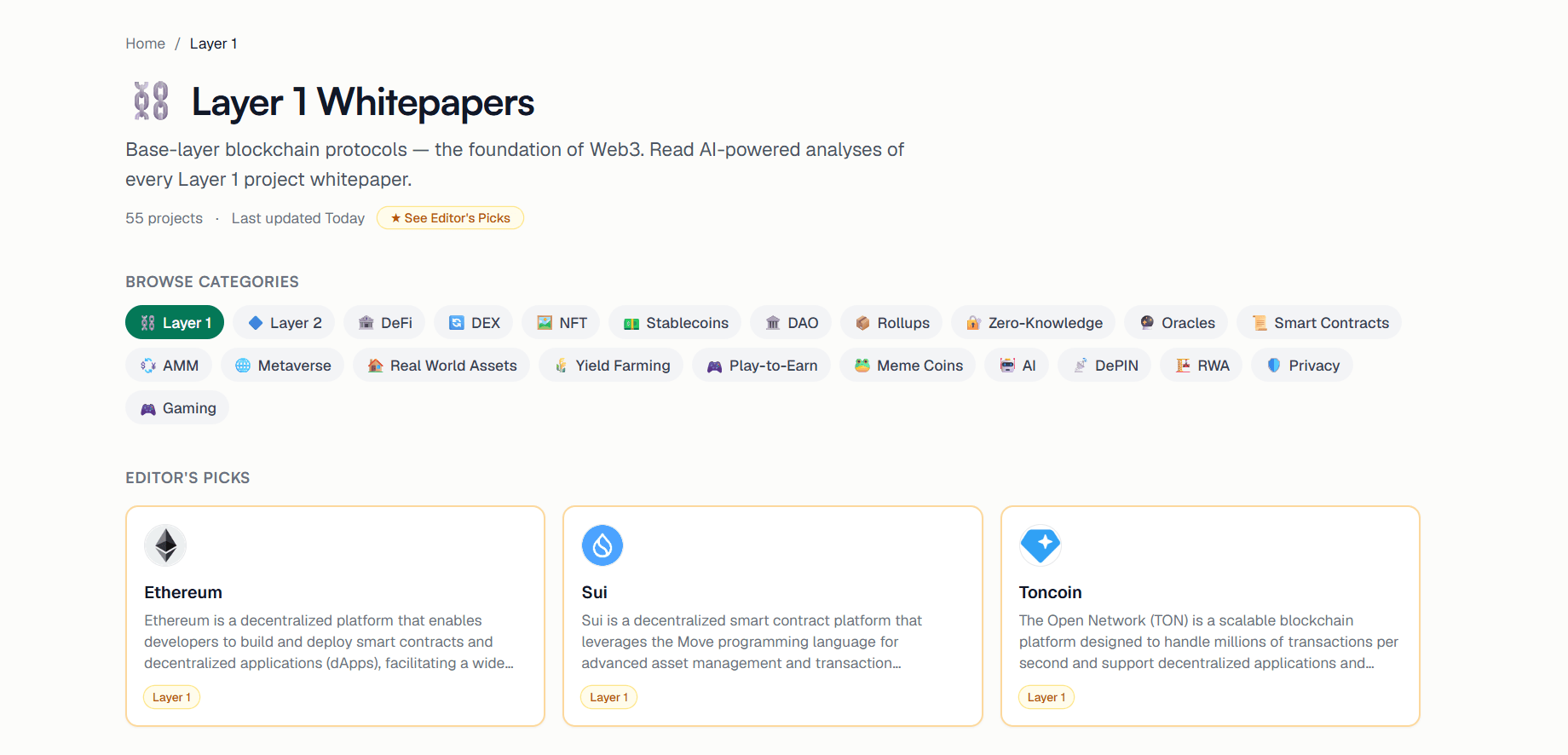
The site organizes its library by category — Layer 1, Layer 2, DeFi, DEX, NFT, Stablecoins, DAO, Rollups and Zero-Knowledge — and each project page follows the same format: a short “Quick Take,” a longer “Full Explanation” broken into sections like What Is It, The Problem It Solves, How It Works and Why It Matters, and a gated “Deep Dive” that adds tokenomics, team background, on-chain signals and risk factors for paying subscribers. As of this review the platform listed 562 projects and 560+ whitepaper explanations in its own site navigation, though its About page separately claims a much larger ambition of covering “over 8000 cryptocurrencies” — a gap worth noting, since the live, verifiable library is the 560+ figure, not 8,000.
ChainClarity also builds in a conversational AI assistant called Qai, a side-by-side project comparison tool, a personal watchlist with update alerts, and affiliate “where to buy” links to exchanges like Binance, OKX and DigiFinex on individual project pages. It picked up early visibility through a Product Hunt launch in May 2024 and has since been listed in a handful of AI-tool directories, but it has not yet built the kind of large-scale, independently verifiable review base that older research subscriptions like Messari or Bankless have accumulated over years.
On the awareness side, ChainClarity picked up an early boost from a Product Hunt launch in May 2024 — a modest but real showing, with dozens of upvotes and a few hundred followers on the platform — and has since shown up in a handful of AI-tool directories (The Rundown AI, Dynamic Business, and similar aggregator sites) that catalog crypto and AI tools rather than independently rate them. Its social presence is split across an underused primary X account and a more active Threads account that regularly publishes short educational threads on topics like Layer 2 bridge risk and rollup mechanics — content that mirrors the same plain-English approach as the main site.
Why ChainClarity Stands Out in 2026
A genuinely tiered reading experience: Most crypto-education content is one-size-fits-all. ChainClarity splits every project into a Quick Take (roughly a minute), a Full Explanation (several minutes, broken into digestible sections) and a paid Deep Dive with tokenomics and risk analysis — so a beginner and a researcher can use the same page without either being underserved.
Meaningfully cheaper than the established players: ChainClarity’s own pricing page puts its $9/month Pro plan next to Messari Pro ($24.99/mo), Bankless Premium ($22/mo) and The Defiant Pro ($15/mo) — and even at face value, it undercuts all three on sticker price while covering similar ground on project explanations and market context.
A real free tier, not a bait-and-switch trial: Unlike services that gate almost everything behind a paywall, ChainClarity’s Free plan gives unlimited access to every short-form explanation in the library, plus 3 Qai questions and 2 comparisons a day. You can genuinely learn from the product before ever entering a card number.
Qai, a built-in AI research assistant: Rather than sending you off to a general chatbot, ChainClarity keeps the conversation inside the platform. Qai can answer follow-up questions about a specific project, and the company states those conversations aren’t shared with third parties or used to train external models.
No price predictions, by design: The platform is explicit that it delivers “clear analysis you can actually use,” not hype or price calls. For readers tired of influencer-style crypto content, that stated stance — even if you should still verify it in practice — is a differentiator worth noting.
Freshness signals on every page: Whitepaper pages carry small trust markers — “Reviewed against the source,” “Verified whitepaper,” and an “Updated” date — which at least give you a way to judge how current a given explanation is, something static crypto blogs rarely offer.
Low-friction trial: The 7-day Pro trial requires no credit card up front, so you can test the Deep Dive content, unlimited Qai and the full watchlist before deciding whether $9/month is worth it to you.
Key Features and Technology
ChainClarity’s feature set is narrower than a full portfolio or trading platform, but everything it offers points back at the same core job: helping you understand a project faster than reading the raw whitepaper yourself. Here’s how it breaks down.
Three-Tier Explanations: Quick Take, Full Explanation, Deep Dive
Every project page opens with a Quick Take summary, then expands into a Full Explanation split into consistent sections — what the project is, the problem it solves, how it works, and why it matters — usually reading in the 5–15 minute range depending on complexity. Free users get the Quick Take and Full Explanation in full; the Deep Dive, which adds tokenomics, team background, on-chain signals, competitive positioning and an investment-thesis style writeup, is capped at a roughly 300-character preview unless you’re on Pro.
Qai, the Built-In AI Research Assistant
Qai lets you ask follow-up questions about a project directly on its page — useful when the structured explanation doesn’t answer the exact thing you’re wondering about. Free accounts get 3 questions per day and a 7-day rolling chat history; Pro removes both limits, giving unlimited questions and permanent conversation history. As with any AI assistant summarizing technical source material, treat answers as a starting point for further reading rather than a final source, especially for anything involving money.
Watchlist, Alerts, and Side-by-Side Comparisons
You can save projects to a personal watchlist (5 on Free, unlimited with update alerts on Pro) and run head-to-head comparisons between two projects — 2 per day on Free, unlimited on Pro. The comparison tool is also exposed publicly through URL patterns like “1inch vs Bitcoin,” which doubles as an SEO strategy and a genuinely useful quick-reference format for readers deciding between two similar tokens.
Coverage: 560+ Whitepapers and Growing
The library spans major Layer 1s (Bitcoin, Ethereum, Solana, Avalanche), Layer 2s (Arbitrum, Optimism, Base), DeFi protocols, stablecoins, DAOs and NFT/gaming tokens, organized into nine browsable categories. New projects are added on an ongoing basis, and Pro subscribers get early access — the site states 48 hours ahead of general release — plus a weekly personalized digest and PDF export of any explanation.
Individual project pages also surface a light layer of market context — a risk-level tag, price, market cap, circulating supply and all-time high — alongside links to compare that project against others in the library. It’s a nice-to-have rather than a replacement for a dedicated market-data tool, since the depth doesn’t approach what a service like CoinMarketCap or Messari’s own data terminal offers, but it saves a tab-switch when you just want a quick snapshot alongside the explanation you’re reading.
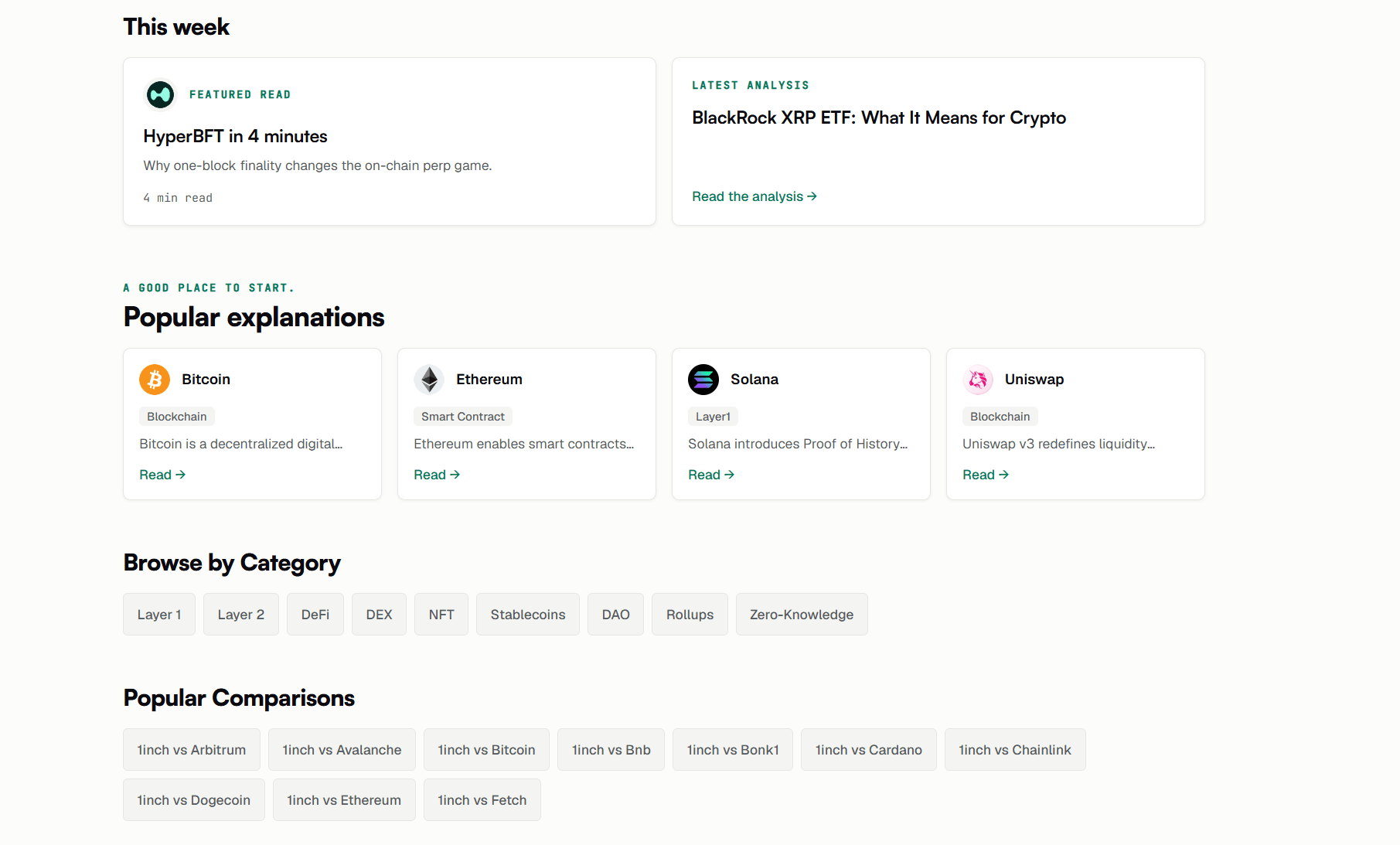
A sample project page: structured sections, a “Reviewed against the source” trust marker, and a gated Deep Dive upsell.
Pricing, Plans, and Package Structure
ChainClarity runs a simple two-tier structure: a permanently free, ad-supported plan and a single Pro subscription. According to the platform’s FAQ, Pro is billed at $9/month or $79/year (the annual option working out to roughly $6.58/month, a stated savings of $29 versus paying monthly). Worth flagging for transparency: the pricing page itself displays several different promotional monthly-equivalent figures in different widgets on the same page (at various points showing $4.99/mo and $6.58/mo alongside the $9/mo baseline), which looks like inconsistent or A/B-tested promotional copy rather than a single clear number — so treat any headline price as approximate and confirm the exact figure at checkout before subscribing.
| Plan | Price | What It Is | Best For |
|---|---|---|---|
| Free | $0 forever | Unlimited short-form explanations, 3 Qai questions/day, 2 comparisons/day, 5-project watchlist, Deep Dive preview only, 7-day chat history, ads shown | Casual readers who just want plain-English project summaries |
| Pro (Monthly) | $9/month | Full Deep Dive analysis, unlimited Qai, unlimited watchlist + alerts, unlimited history, weekly digest, 48h early access, PDF export, ad-free | Active researchers who want flexibility to cancel anytime |
| Pro (Annual) | $79/year (≈$6.58/mo) | Same full Pro feature set as monthly, billed annually; stated savings of $29/year vs. monthly billing | Committed users confident they’ll use Pro long-term |
How ChainClarity Compares to Alternatives
ChainClarity’s own pricing page positions it against Messari Pro, Bankless Premium and The Defiant Pro — three established names in crypto research and media. It’s a fair set of comparisons since all four sell some version of “understand crypto projects without the noise,” even though their depth and audience differ.
| Factor | ChainClarity | Messari Pro | Bankless Premium |
|---|---|---|---|
| Monthly price (approx.) | $9/mo | $24.99/mo | $22/mo |
| Core format | AI-generated whitepaper explainers + AI Q&A | Analyst-written research reports and on-chain data | Newsletter, podcast and market commentary |
| Free tier depth | Unlimited short-form explanations, no paywall on basics | Limited; most in-depth research is paywalled | Free newsletter tier; premium content gated |
| Track record / reviews | Launched 2023; no established Trustpilot/G2 rating base yet | Long-established, widely cited by institutions and media | Long-established media brand with a large audience |
| Best for | Beginners and casual researchers wanting fast, cheap explainers | Institutional-grade research and on-chain data | Narrative, culture and market commentary |
ChainClarity vs. Messari: Messari is built by professional analysts and is widely cited in institutional crypto research; ChainClarity’s explanations are AI-generated and reviewed against the source, which is faster to scale but carries a different kind of trust profile. If you need institution-grade data and citations, Messari’s higher price reflects that depth. If you want a quick, affordable way to understand what a project actually does, ChainClarity is the cheaper on-ramp.
ChainClarity vs. Bankless: Bankless leans into personality-driven media — newsletters, podcasts, opinionated takes — while ChainClarity is deliberately format-neutral and reference-style. They serve different moods: Bankless for following crypto culture and narratives, ChainClarity for looking something up and getting a straight answer.
ChainClarity vs. The Defiant: The Defiant sits closer to ChainClarity on price ($15/mo vs. $9/mo) and both mix news with education, but The Defiant is a media outlet with reporters and editors, while ChainClarity’s content pipeline is AI-first with human review layered on top — a trade-off between original journalism and speed/breadth of coverage.
Pros and Cons
What Users Love
Genuinely useful for beginners: A visible testimonial on the pricing page (“White papers are a dread to read. ChainClarity makes that knowledge accessible to people who aren’t deep in the technical weeds”) captures the core value proposition well, and the Free tier is generous enough to actually deliver on it without a card on file.
Fast, consistent format: Every project follows the same predictable structure, which makes it easy to compare projects quickly instead of hunting through inconsistent blog posts or Medium articles for basic facts.
Meaningfully cheaper than the alternative subscriptions: At $9/month (or less annually), Pro undercuts Messari, Bankless and The Defiant by a wide margin, which matters for casual learners who don’t need institutional-grade research.
No-risk trial and refund window: A 7-day trial with no card required, plus a no-questions-asked refund if you’re unhappy within 7 days of a paid subscription, keeps the downside low if Pro doesn’t turn out to be for you.
Clear cancellation terms: The FAQ spells out exactly what happens if you cancel — you keep Pro access until the end of the billing period, then revert to Free automatically, with watchlist and Qai history preserved for 90 days in case you resubscribe. That kind of upfront clarity is easy to overlook but genuinely reduces subscription anxiety.
Limitations Worth Knowing
No independent rating base yet: As of this review, ChainClarity has no active Trustpilot page and its G2 seller listing shows zero reviews. That’s normal for a platform this young, but it means you’re currently relying on the company’s own claims and third-party directory blurbs rather than a broad base of independently verified user feedback.
Inconsistent pricing display: The pricing page itself shows more than one monthly-equivalent figure for the annual plan in different promotional widgets ($4.99/mo, $6.58/mo, and $9/mo baseline all appear), which is confusing and worth double-checking at checkout before you commit.
AI-generated content has inherent limits: Even with source-review markers on each page, AI-assisted summarization of technical documents can compress or misstate nuance. For anything with real financial stakes, use ChainClarity as a starting point and verify claims against the original whitepaper or a second source before acting.
Small team, no enterprise tier yet: The company’s own About page credits a compact, engineer-led team rather than a large research staff, and its FAQ states team/enterprise plans are still “on the roadmap” — fine for individual learners, less proven for organizations needing dedicated support or SLAs.
Affiliate exchange links sit alongside “no hype” branding: Project pages include affiliate “Where to Buy” links to exchanges. That’s a common and reasonable way to fund free content, but it’s a mild tension worth knowing about given the site’s positioning as free of hype or sales pressure.
Who Should Use ChainClarity
Crypto beginners and curious newcomers: If whitepapers intimidate you and you just want to know what a project actually does in plain language, ChainClarity’s Free tier alone will get you most of the way there.
Casual researchers comparing tokens: The built-in comparison tool and consistent explanation format make it fast to size up two or three similar projects before digging deeper elsewhere.
Budget-conscious learners who don’t need institutional research: At $9/month, Pro is an easy way to get deeper tokenomics context without paying Messari- or Bankless-level prices — as long as you’re comfortable that the depth comes from AI analysis rather than a named analyst.
Content creators and educators: The structured, jargon-free explanations are a genuinely useful starting reference when preparing your own content about a project you’re not deeply familiar with yet.
Who should look elsewhere: professional traders and analysts who need institutional-grade, analyst-authored research with a long verification track record are better served by Messari or similar established providers; anyone making large financial decisions should not treat ChainClarity’s Deep Dive as a substitute for independent due diligence, given the platform’s AI-first pipeline and thin third-party review history so far.
Getting Started: Step by Step
- Create a free account. Sign up with no card required and browse the library — search or filter by category (Layer 1, DeFi, Stablecoins, and so on) to find a project you want to understand.
- Read the Quick Take, then the Full Explanation. Start with the one-minute summary, then read the full breakdown if you need more context on how the project actually works and why it matters.
- Ask Qai a follow-up question. If something in the explanation isn’t fully clear, use one of your daily Qai questions to dig into the specific point you’re unsure about.
- Build a watchlist. Save the projects you’re actively tracking (up to 5 on Free) so you can revisit them quickly instead of re-searching each time.
- Start the 7-day Pro trial if you want the Deep Dive. If Quick Take and Full Explanation aren’t enough for a project you care about, trial Pro to unlock the tokenomics, risk-factor and competitive-landscape sections before deciding whether to subscribe.
- Cross-check anything financially significant. For any project you’re actually considering buying into, use ChainClarity as your starting explanation, then verify key claims against the original whitepaper or a second independent source before acting.
Tips for Getting Maximum Value
Treat the Free tier as more capable than it first appears — with unlimited short-form explanations, you can genuinely learn about dozens of projects without ever paying, so don’t rush into Pro before you know how often you’ll actually use the Deep Dive content. When you do trial Pro, spend the week on projects you already have money or interest in rather than browsing at random, since that’s where the tokenomics and risk-factor sections earn their keep. Use the comparison tool whenever you’re torn between two similar projects — it’s faster than reading two full explanations side by side. If you subscribe annually, lock in your rate early since the FAQ states existing subscribers keep their price even if rates rise for new sign-ups later, and double-check the exact annual figure at checkout given the inconsistent pricing shown on the marketing page. Finally, remember the “Where to Buy” links on project pages are affiliate links to exchanges — feel free to use them, but shop around if you want to confirm you’re getting competitive fees.
Future Outlook and Final Assessment
AI-assisted research is becoming a crowded corner of the crypto content space, and ChainClarity’s bet — plain-English explanations, a real free tier, and a much lower price than legacy research subscriptions — is a reasonable one if it can keep its content accurate as it scales to more projects. The addition of Qai, watchlists and a comparison tool shows the platform is trying to become a daily-use reference rather than a one-time blog, and its trust markers (source-review flags, update dates) are a sensible step toward accountability that AI content sites often skip.
The honest caveats are real, though: this is a young, small-team platform with no established Trustpilot or G2 review base yet, inconsistent pricing display on its own site, and a content pipeline that leans on AI summarization of technical material. None of that makes ChainClarity untrustworthy, but it does mean you should treat it as a fast, affordable starting point for understanding a project — not as a final, independently audited source.
Conclusion
ChainClarity isn’t trying to replace institutional crypto research — it’s trying to make the first step of understanding a project take minutes instead of an evening spent decoding a whitepaper, and at that specific job it does a solid, well-organized job for a fraction of the price of established alternatives. Its Free tier is generous enough to be useful on its own, its Pro plan adds real depth for $9 a month, and features like Qai and the comparison tool make it a practical daily reference rather than a one-off read. The caveats — a young platform with no independent review track record yet, some inconsistent pricing copy, and the inherent limits of AI-summarized technical content — are worth keeping in mind, especially before making any real financial decision based on what you read there. Confirm the current price, start with the free trial, and ChainClarity can genuinely take the dread out of reading crypto whitepapers.
Ready to actually understand crypto whitepapers instead of skimming them?
Explore more honest reviews, tutorials and tech comparisons to find the right gear for the way you work, travel and live — at World Of Tech, where we make everything easy.
👉 Try ChainClarity: https://worldoftech.space/chainclarity
👉 Our YouTube Channel: youtube.com/@world_tech79
👉 Our Facebook Fanpage: Facebook
👉 Our X (Twitter): @worldoftech79
Pricing, plan details and platform features in this review were verified against chainclarity.io (homepage, pricing, about and sample whitepaper pages) as of July 2026. ChainClarity had no active Trustpilot listing and a zero-review G2 seller profile at the time of writing. SaaS pricing, feature limits and promotional offers change frequently, so confirm current details on the official site before subscribing. Competitor prices (Messari, Bankless, The Defiant) are approximate and subject to change.