
If you’ve ever wished you could turn a single prompt into a finished slide deck, a cited research report, and a spreadsheet all at once, Skywork AI is built to sell you on exactly that dream. It’s an AI “workspace agent” platform out of Singapore that positions itself as the antidote to tab fatigue: describe what you need, and its specialized Super Agents research the web, cross-check sources, and hand back a polished document, presentation, spreadsheet, webpage, or podcast script — complete with clickable citations. Backed by Kunlun Tech, the Chinese internet company behind nearly 400 million monthly active users across its other products, Skywork launched globally in May 2025 with a bold tagline: “The Originator of AI Workspace Agents.”
On paper, the pitch is compelling: a DeepResearch engine that reportedly scans hundreds of webpages per task, a top-tier GAIA benchmark score, and a monthly plan priced well under $20. But an honest look at Skywork also has to reckon with something the marketing pages don’t mention — a Trustpilot record dominated by billing and cancellation complaints. This 2026 review walks through what Skywork actually does, its Super Agents and DeepResearch technology, current pricing and plan structure, how it stacks up against Gamma and Jasper, the genuine pros and the real red flags, and exactly who should — and shouldn’t — hand over a credit card.
Skywork AI Review 2026: Powerful DeepResearch Agents, Real Billing Complaints Worth Knowing
Overview and Background
Skywork AI (legally SKYWORK AI PTE. LTD.) is a Singapore-registered AI workspace platform that generates multimodal content — documents, slide decks, spreadsheets, webpages, and podcasts — from a single natural-language prompt. It isn’t a general chatbot competing with ChatGPT on conversation; it’s positioned as a “research-to-deliverable” tool aimed at analysts, consultants, marketers, educators, and students who need a finished, citable artifact rather than a wall of text to reformat themselves.
The company’s history is worth knowing before you dig in. Before it was Skywork, the same corporate entity operated as Star Shine Entertainment PTE. LTD., building Android entertainment apps that racked up several million installs. Between 2021 and 2024 it pivoted entirely away from entertainment into AI, re-emerging as Skywork with backing from Kunlun Tech, a large Chinese internet company that also acquired Singularity AI in a 2023 deal reported at roughly $160 million. Skywork officially launched globally in May 2025, initially supporting English and Japanese.
The core product is a set of five specialized “Super Agents” — Documents, Slides, Sheets, Webpage, and Podcast — plus a General Agent for broader multimedia requests like images, music, and short video. All of them sit on top of Skywork’s proprietary DeepResearch engine, which the company says scans over 600 webpages per task and cross-validates sources before writing, aiming to reduce the generic, unsourced output that plagues most single-shot AI chat tools.
Skywork also isn’t limited to office documents. Beyond the five Super Agents, a General Agent handles broader multimedia requests — images, short videos, music, and picture-book-style content — and the company has released related sibling tools like Mureka (music generation) and SkyReels (short-form AI video), suggesting a wider content ecosystem forming around the same DeepResearch core. The platform publicizes parts of its underlying models on GitHub and Hugging Face, which is a meaningful transparency signal in a category where most vendors keep their model details entirely closed.
Why Skywork AI Stands Out in 2026
DeepResearch goes deeper than a typical chatbot: Rather than answering from a handful of top search results, Skywork’s DeepResearch engine reportedly analyzes hundreds of webpages per task and cross-references them before drafting, which several independent reviewers noted produces noticeably more grounded, source-backed output than asking a general chatbot for the same document.
One prompt, multiple deliverables: A single request can be routed to several Super Agents at once — reviewers testing the platform generated a pitch deck, a spreadsheet, and a landing page from one prompt in a single chat, with the system automatically dispatching each sub-task to the right agent.
Traceable citations, not just prose: Every generated fact is meant to link back to its source, which matters for anyone producing client-facing research, investment notes, or academic work where an unverifiable claim is a liability, not a convenience.
A strong benchmark result, with a caveat: Skywork’s DeepResearch framework reports an 82.42% score on the GAIA benchmark, a widely referenced test of an AI agent’s ability to reason and complete multi-step tasks. It’s a genuinely competitive number — though it’s self-reported by the company rather than independently audited, so it’s worth treating as directional rather than gospel.
Clarification Cards reduce wasted generations: Before committing credits to a long research task, Skywork asks upfront clarifying questions to narrow scope and format, which is a small but meaningful design choice that cuts down on regenerating an entire report because the first pass missed the brief.
Genuinely competitive pricing versus category peers: At $19.99 a month for the Pro tier, Skywork undercuts comparable research-and-document tools like Jasper, whose Pro plan runs $59–$69 per seat per month, while offering a broader multimodal output range.
Cross-device availability: Skywork ships as a web app plus native iOS and Android apps and a browser extension, so a research thread started on desktop can reasonably be picked up or reviewed from a phone.
Open-ish underpinnings build a degree of technical credibility: Skywork publishes parts of its models and research on GitHub and Hugging Face, which is unusual for a consumer-facing AI product and gives technically minded buyers a way to sanity-check some of the platform’s claims rather than taking marketing copy at face value.
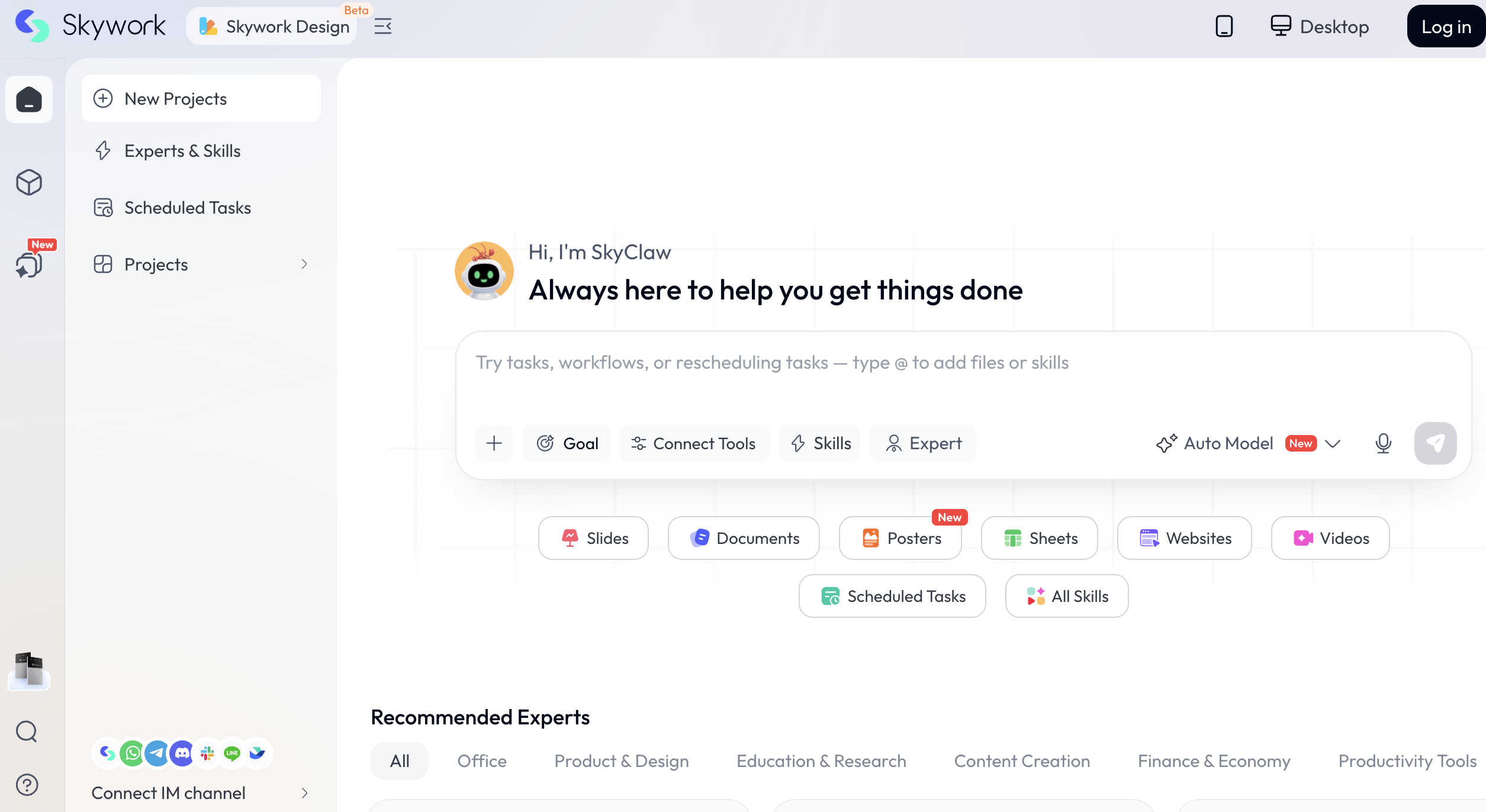
Skywork’s Super Agents route a single prompt to specialized document, slide, sheet, webpage, and podcast generators — all grounded in the same DeepResearch pass.
Key Features and Technology
Skywork’s platform organizes around its Super Agents, each tuned for a different output type, all sharing the same underlying research and citation layer. Here’s how the pieces actually work.
The DeepResearch Engine
This is the layer every Super Agent draws from. Skywork says it scans over 600 webpages per task, drawing on academic papers, industry reports, news, and specialized databases, and cross-validates facts across sources before an agent starts writing. In practice, this is what separates Skywork’s output from a plain chatbot answer: claims arrive with inline citations you can click through to verify, rather than confident-sounding prose with no paper trail. The company also reports a 94.5 score on SimpleQA, a benchmark focused on short-answer factual accuracy — again a vendor-reported figure, but directionally consistent with the emphasis on sourcing over speed.
Documents, Slides, and Sheets Agents
The Documents Agent produces reports, papers, resumes, and marketing copy with automatic charts and citations, exportable to DOCX or PDF. The Slides Agent builds full presentations with auto-layout and on-brand design suggestions, exportable to PPTX, PDF, HTML, or directly into Google Slides, and supports regenerating a single slide instead of the whole deck when one section misses the mark. The Sheets Agent analyzes raw data into tables, charts, and basic financial models, exporting to XLS. Across all three agents, output is meant to be editable rather than a locked final export — you can go back into the generated document, presentation, or sheet and adjust individual sections, regenerate a single slide, or refine a chart without starting the whole task over, which matters for anyone iterating on a client-facing deliverable rather than accepting the first draft as-is.
Webpage and Podcast Agents
The Webpage Agent (also marketed as an AI Developer/AI Skypage builder) turns a prompt into a structured, styled landing page or content page without manual coding — useful for a quick campaign page or portfolio site, though reviewers note it leans toward generic templates on complex, multi-page requests rather than fully following detailed structural briefs. The Podcast Agent converts written source material or a topic prompt into an audio script and narration, aimed at content teams repurposing research into audio.
Persistent Knowledge Base
Users can upload their own documents, links, and media to build a private knowledge base that later generations draw from — useful for teams that want outputs grounded in internal material (brand guidelines, prior reports) rather than the open web alone, and for reusing past research instead of starting each project from zero.
Pricing, Plans, and Package Structure
Skywork runs a freemium model. The free tier is genuinely usable for testing the interface and light tasks, while the Pro plan is the entry point for regular, credit-hungry work like full slide decks or long research reports. Third-party listings show some variation in the exact figures (a handful cite $16.99–$17/month or $14.99 first-month promos), which is common for platforms that run frequent regional or coupon-driven discounts — treat the numbers below as the standard listed rate and confirm the live price at checkout.
| Plan | Price | What It Is | Best For |
|---|---|---|---|
| Free | $0 | 500 daily credits in month one, then 500 credits weekly; standard processing speed | Testing the interface before committing |
| Pro (Monthly) | $19.99/mo | 7,000 monthly credits, all five Super Agents, faster processing, full commercial license | Regular individual use, testing commitment month to month |
| Pro (Annual) | $149.99/yr (~$12.50/mo) | Same Pro features at a lower effective monthly rate, billed annually | Confirmed heavy users only, given refund complaints on annual charges |
| Ultra Membership | Varies (confirm at checkout) | Higher-tier plan above Pro, introduced in a recent update; expanded limits | Power users generating high volumes of decks/reports weekly |
Payment is handled through credit or debit card or PayPal, and subscriptions can be canceled anytime through account settings, at least in theory — in practice, this is the exact step a large share of negative reviews say failed. Refund availability appears to depend heavily on timing and support responsiveness rather than a clearly published policy, so if a refund matters to your decision, don’t assume it will be automatic just because you’re inside a trial window.
How Skywork AI Compares to Alternatives
| Factor | Skywork AI | Gamma | Jasper |
|---|---|---|---|
| Core Focus | Research-to-deliverable, multi-format, citation-driven | Fast, visually polished slides and web content | Brand-consistent marketing copy and campaigns |
| Starting Price | $19.99/mo (Pro) | ~$8/mo (Plus), approximate | ~$59/seat/mo (Pro, annual), approximate |
| Citations | Core feature, clickable source links | Limited; design-first, not research-first | Not a primary feature |
| Output Range | Docs, slides, sheets, webpages, podcasts | Slides, docs, websites, social content | Marketing copy, campaign assets, brand voices |
| Independent Rating Signal | Trustpilot ~1.5/5 (billing complaints); App Store notably more positive | Generally strong, design-focused praise | Generally strong among marketing teams |
| Best for | Research-heavy reports, decks, and cross-format projects | Fast, visually engaging decks and web-native content | Marketing and agency teams needing brand-consistent copy |
Skywork AI vs. Gamma comes down to depth versus speed: Gamma is built for fast, visually striking decks and web content with a lighter research layer, while Skywork leans into citation-backed depth at the cost of being noticeably slower to generate a first draft. If you’re pitching investors on visual polish alone, Gamma is the faster path; if the deck needs to survive a fact-check, Skywork’s sourcing is the stronger foundation.
Skywork AI vs. Jasper is more of an apples-to-oranges comparison: Jasper is purpose-built for on-brand marketing copy and campaign workflows with per-seat team pricing, while Skywork is a broader multi-format research tool at a fraction of Jasper’s per-seat cost. Teams standardizing brand voice across a marketing org will likely still prefer Jasper’s dedicated tooling; solo analysts and consultants producing varied research deliverables get more range for the money from Skywork.

Skywork undercuts Jasper on price and out-ranges Gamma on citation depth — but neither rival carries Skywork’s volume of Trustpilot billing complaints.
Pros and Cons
What Users Love
Genuine time savings on research-heavy work: Reviewers consistently report that tasks estimated at 8–40 hours of manual research and drafting come back as usable first drafts in 8–20 minutes, with citations already attached.
Source traceability that survives scrutiny: Analysts and consultants specifically praise being able to click through every stated fact to its origin, which matters far more in professional deliverables than raw writing speed.
One workspace instead of five tools: App Store reviewers, including at least one independent researcher, describe a noticeable quality jump compared to routing the same work through a general chatbot, crediting the platform’s structured, multi-agent pipeline.
Strong slide and website polish for the price: Multiple reviewers single out the Slides and Webpage agents for producing client-ready, professional-looking output well below what comparable design-forward tools charge.
Limitations Worth Knowing
A rough Trustpilot record centered on billing: Skywork’s Trustpilot page has trended toward roughly 1.5 out of 5 stars across dozens of reviews, with a recurring, specific complaint pattern: no visible cancel button, being charged automatically after a free trial with no advance notice, and difficulty getting refunds — including one reviewer describing a $509 annual charge for a plan used for ten minutes. This is the single biggest thing to verify for yourself before committing a card.
Rating divergence is itself a signal: App Store reviews and several YouTube walkthroughs are considerably more positive than Trustpilot, often 4.5+ stars. That gap usually means the core product experience is genuinely liked by people who complete a project successfully, while the subscription and billing layer is where trust breaks down — treat both signals as real rather than picking whichever is more convenient.
Credits burn faster than expected: Several reviewers report that a single complex task, or one that requires regenerating a slide or section, can consume a disproportionate share of the monthly allotment, and one reviewer specifically noted a presentation task that used all their points without producing a usable slide.
Slower than design-first competitors: Because DeepResearch genuinely does more work per request, Skywork is noticeably slower to produce a first draft than speed-focused tools like Gamma — a fair trade for depth, but a real friction point if you’re on a tight deadline.
Website generation can ignore detailed briefs: On multi-page or highly specific structural requests, the Webpage Agent has been reported to default to a generic single-page template rather than following the requested structure closely.
Chinese-backed ownership is a factor for some buyers: Skywork is developed by a Singapore entity but backed by Kunlun Tech, a Chinese internet company. The company states user data isn’t used for model training, but organizations with strict data-sovereignty or vendor-origin policies should review the privacy terms directly rather than assume they meet internal compliance requirements.
Who Should Use Skywork AI
Analysts and consultants producing cited reports: If your deliverable needs to survive a client or manager fact-checking every number, Skywork’s source-traceable output is a real time-saver over manually compiling citations.
Solo founders and freelancers juggling formats: Anyone who regularly needs a deck, a one-pager, and a landing page from the same research gets real value from one tool covering all three instead of stitching together separate subscriptions.
Students and educators building structured material: Research papers, lesson decks, and study guides benefit from the citation-first workflow, and the price point is friendlier than most premium research tools.
Comfortable managing their own subscription hygiene: Given the billing complaint pattern, Skywork suits people who reliably track their trial end dates, set calendar reminders before renewal, and are willing to verify a cancellation actually went through — not those who prefer to “set and forget” a subscription.
Who should look elsewhere: if you need same-day, deadline-critical visual polish over research depth, a design-first tool like Gamma will get you there faster. If you’re not confident you’ll remember to cancel a trial on time, or you’ve had past frustration with subscription cancellations generally, start with the free tier only and avoid entering payment details until you’ve used the product enough to be certain you want it — or skip Skywork’s annual plan specifically and stick to monthly if you do proceed. Teams with strict vendor-origin or data-residency requirements should also route this decision through their own compliance review rather than relying on this article, given the Kunlun Tech backing noted above.
Getting Started: Step by Step
- Create a free account. Sign up with email or a social login to claim your first-month daily credits without entering payment information.
- Pick the right Super Agent. Choose Documents, Slides, Sheets, Webpage, or Podcast based on the deliverable you actually need — this routes your prompt correctly from the start.
- Write a context-rich prompt. Specify the audience, format, length, and any structural requirements up front; vague prompts are the most common cause of generic, off-target output.
- Answer the Clarification Cards. Respond to the platform’s upfront questions before it commits credits to a full generation — this step exists specifically to avoid wasted runs.
- Review the DeepResearch outline. Approve or adjust the structured outline the agent proposes before it pulls the full draft together, catching direction issues early.
- Verify citations before you export. Click through the sourced facts, confirm your cancellation settings if you’re on a trial, then export to DOCX, PPTX, XLS, or PDF as needed.
A detailed prompt plus the Clarification Cards step is the difference between a usable first draft and a wasted credit run.
Tips for Getting Maximum Value
Front-load detail into your first prompt rather than iterating your way there — specify format, tone, length, and any must-include sections, since regenerating a full document or slide deck costs meaningfully more credits than getting the brief right the first time. Use the free tier’s weekly credits to test the exact type of task you plan to do regularly before upgrading, since a research report and a slide deck can consume very different amounts of your allowance. If you do upgrade, start with the monthly Pro plan rather than annual until you’ve confirmed cancellation works cleanly in your account, and mark your renewal date somewhere you’ll actually see it — the billing complaints on Trustpilot almost universally trace back to missed trial-end dates rather than dissatisfaction with the core output. Finally, always verify at least the two or three most important citations manually before sending Skywork’s output to a client or publishing it; DeepResearch reduces hallucination risk but doesn’t eliminate the need for a final human check. If you’re building a knowledge base from your own documents, upload your highest-value reference material first — brand guidelines, prior reports, pricing sheets — since early uploads shape how well later generations stay on-brief, and a thin knowledge base gives the DeepResearch engine less to anchor to than the open web alone would provide.
Future Outlook and Final Assessment
Skywork is iterating quickly — the recent removal of the credit system on some plans in favor of the new Ultra Membership tier suggests the company is actively responding to the “credits burn too fast” complaint, and its backing by Kunlun Tech gives it more runway than a typical bootstrapped AI startup to keep building out the Super Agent lineup. The underlying DeepResearch technology and GAIA benchmark performance are genuinely competitive against much larger, better-funded rivals, and the multi-format output range remains a real differentiator in a market full of single-purpose tools. Expect continued iteration on the pricing and credit model specifically, since that’s clearly the area drawing the most user pushback, and expect the sibling tools like Mureka and SkyReels to keep expanding the ecosystem around the core DeepResearch engine rather than staying siloed.
Whether Skywork earns broader trust in 2026 and beyond will depend far more on fixing its subscription and cancellation experience than on adding new features — the product’s biggest reputational risk right now isn’t the AI, it’s the billing flow. Until that Trustpilot pattern shifts, the smart approach is to treat Skywork as a capable tool worth testing on its free tier and monthly plan, not a subscription to commit to blind.
Conclusion
Skywork AI delivers on its core promise more often than not: a single prompt genuinely can turn into a cited report, a polished deck, or a working spreadsheet in minutes instead of hours, at a price that undercuts most research-focused competitors. That’s real value for analysts, consultants, students, and solo operators who need range across formats. But this is a review that has to hold two things true at once — a capable product and a subscription experience that a meaningful number of paying customers describe as difficult to escape. Start free, keep a close eye on your trial date, and let the tool prove itself on the monthly plan before you consider anything longer.
Ready to see if Skywork AI fits your workflow?
Explore more honest reviews, tutorials and tech comparisons to find the right gear for the way you work, travel and live — at World Of Tech, where we make everything easy.
👉 Try Skywork AI: https://worldoftech.space/skyworkai
👉 Our YouTube Channel: youtube.com/@world_tech79
👉 Our Facebook Fanpage: Facebook
👉 Our X (Twitter): @worldoftech79
Pricing, specifications and policy details in this review were verified against skywork.ai and independent review sources, including Trustpilot, the Apple App Store, and third-party comparison sites, as of July 2026. AI software pricing, credit systems and features change frequently, so confirm current details on the official site before purchasing. Competitor prices are approximate and subject to change.