
WaveSpeed AI 2026 has emerged as one of the most powerful multimodal AI acceleration platforms on the market, consolidating image generation, video creation, audio synthesis, 3D asset building, and language model inference workflows that used to require separate accounts, APIs, and contracts with dozens of providers into a single unified platform. Before diving into the detailed feature breakdown and pricing analysis ahead, it’s worth highlighting that WaveSpeed AI’s leap forward in 2026 — 1,000+ pre-optimized AI models behind one REST API, up to 4x faster inference than competing platforms, sub-second image rendering, WaveSpeed Studio desktop app with 1M+ installs, ComfyUI and N8N integration, exclusive early access to cutting-edge models from ByteDance, Alibaba, Google, and OpenAI, and transparent pay-as-you-go pricing starting from just $0.005 per image — has redefined what developers, creative studios, and AI-powered product teams can build with generative media. Whether you’re a solo developer prototyping an AI-powered application, a creative agency producing visual content at scale, a startup building a generative media product, or an enterprise deploying production-grade AI pipelines, this comprehensive resource walks you through every major capability, plan, and update of WaveSpeed AI in 2026.
WaveSpeed AI 2026 Review: The Ultimate Multimodal AI Acceleration Platform for Developers and Creative Teams
Overview and Major Updates of WaveSpeed AI in 2026
WaveSpeed AI has evolved from a fast inference API into a full multimodal AI generation ecosystem trusted by developers, creative agencies, and enterprise teams worldwide. Headquartered in Singapore and serving a global developer base, WaveSpeed AI operates as an acceleration layer on top of the world’s leading generative AI models — aggregating outputs from Google, ByteDance, Alibaba, OpenAI, Black Forest Labs, Runway, Kuaishou, MiniMax, and more into a single unified API, web dashboard, and desktop studio. Rather than competing with individual model providers, WaveSpeed AI’s value proposition is eliminating the infrastructure fragmentation, cold-start latency, and multi-vendor contract complexity that plagues teams building serious AI media pipelines. With WaveSpeed Studio now exceeding 1 million desktop installs and a model catalog crossing 1,000 entries, WaveSpeed AI has established itself as the most comprehensive multi-model AI inference platform available in 2026.
Major 2026 Updates
- 1,000+ Model Catalog: The WaveSpeed AI model library has crossed 1,000 pre-optimized models — covering image generation, video creation, audio synthesis, 3D asset generation, avatar lip-sync, image upscaling, background removal, and language model inference — all accessible via a single API key.
- Latest Model Integrations (2026): WaveSpeed AI now provides API access to the newest releases including GPT Image 2, Seedance 2.0, Nano Banana 2, WAN 2.7, Seedream 5.0 Lite, Veo 3.1, FLUX 2, Sora 2, Kling 3.0, and Happy Horse 1.0 — often available on WaveSpeed before competing aggregator platforms.
- WaveSpeed Studio 2.0 (Desktop App): The cross-platform desktop application (Windows, macOS, Linux) now supports both cloud model execution and local model running — with offline capabilities that allow generation without an active internet connection for supported local models.
- ComfyUI Integration (Official Custom Nodes): Official WaveSpeed ComfyUI custom nodes now expose 70+ models directly in ComfyUI workflows — including FLUX, Hunyuan, Kling, WAN, and more — without requiring REST API coding, with support for 6+ simultaneous LoRA models per generation.
- N8N Workflow Integration: WaveSpeed AI nodes are now natively available in N8N automation workflows — enabling no-code AI media generation pipelines triggered by external events, scheduled jobs, or multi-step automation sequences.
- Serverless GPU Deployment (Expanded): Custom model deployment now supports B200, H200, H100 Pro, A100, A6000, and RTX 5090 GPU options — with per-second billing and auto-scaling for bursty production workloads.
- Ultra-Fast Image Generation (Sub-2 Seconds): Proprietary CUDA kernel acceleration and optimized GPU clusters deliver image generation in approximately 2 seconds and video generation under 2 minutes — benchmarked at up to 4x faster than comparable inference platforms on equivalent models.
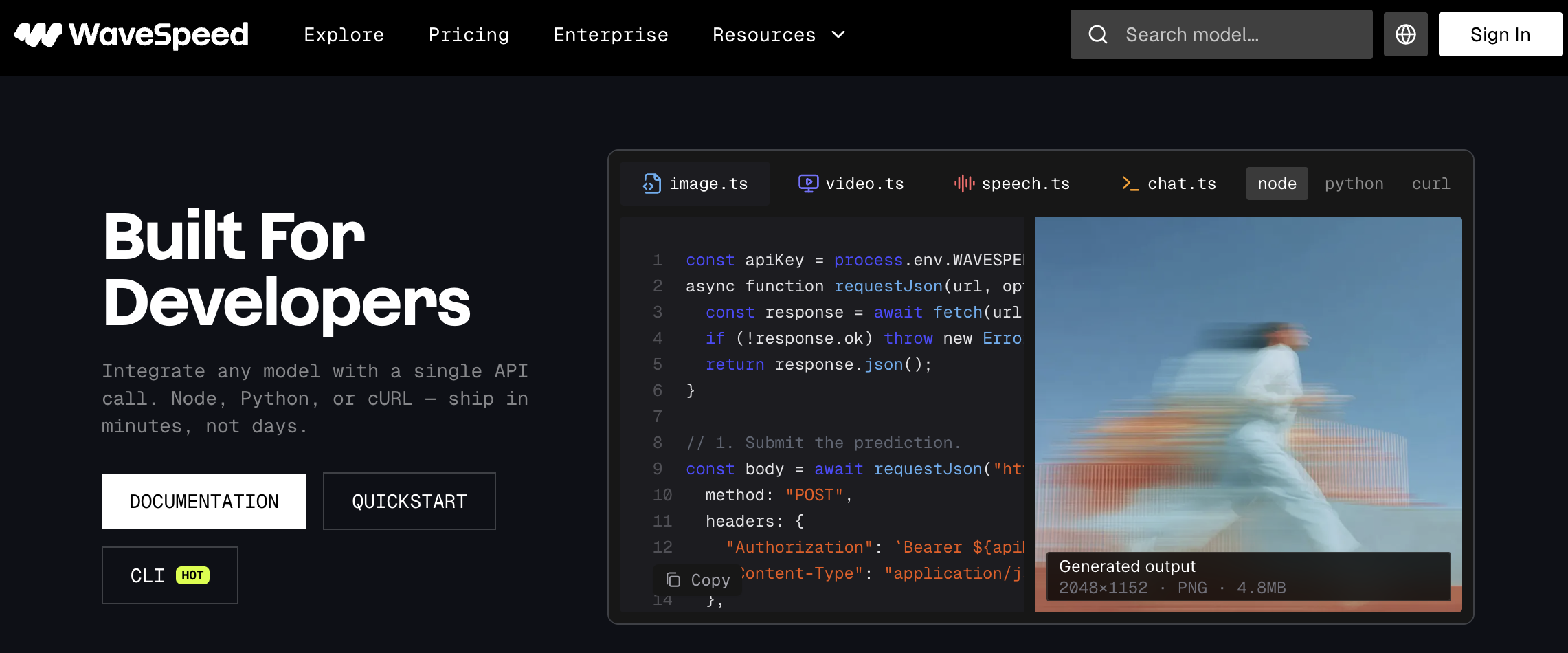
WaveSpeed AI 2026 gives developers and creative teams access to 1,000+ AI generation models — image, video, audio, 3D, and language — through a single API key, with up to 4x faster inference than competing platforms.
Key Features and AI Capabilities
WaveSpeed AI’s strongest competitive advantage in 2026 isn’t any individual AI model — it’s the unified acceleration infrastructure that eliminates the complexity of managing multiple model providers while delivering faster inference, broader model access, and more predictable costs than maintaining separate vendor relationships.
Model Catalog: 1,000+ Models Across Every Generation Category
- Image Generation: Access to FLUX 2, GPT Image 2, Nano Banana 2, Seedream 4.5/5.0 Lite, Imagen 4.5, Ideogram 3.0, Recraft V4, Grok Imagine, and 100+ additional image generation models — covering photorealism, illustration, anime, vector, and specialty styles across all aspect ratios.
- Video Generation: Text-to-video and image-to-video models including WAN 2.7, Seedance 2.0, Kling 3.0, Veo 3.1, Sora 2, Runway Gen-4, Hailuo 2.3, Vidu Q3, and MiniMax — the most comprehensive multi-provider video generation catalog available through a single API endpoint.
- Audio and Speech: Text-to-speech synthesis, voice cloning, music generation, and audio enhancement models — accessible via the same unified API as image and video generation.
- 3D Asset Generation: Hunyuan3D and additional 3D model generators for creating game assets, product visualizations, and architectural models from text or image inputs.
- Utility Models: Image Upscaler (4K/8K), Video Upscaler Pro, Video Watermark Remover, Avatar Lip-Sync (InfiniteTalk), background removal, image editing, segmentation, and LoRA model application — covering the full post-generation production pipeline.
- Language Models: LLM inference with token-based pricing across major language models — consolidating text and media generation under the same account and billing system.
Speed and Infrastructure: The 4x Acceleration Advantage
WaveSpeed AI’s defining technical differentiator is raw inference speed — achieved through proprietary infrastructure optimizations rather than model-level changes:
- Sub-2-Second Image Generation: Proprietary CUDA kernel acceleration delivers image generation in approximately 2 seconds for optimized models — enabling real-time creative iteration and high-throughput production pipelines.
- Up to 4x Faster Inference: Benchmarked against comparable inference platforms on equivalent models, WaveSpeed AI delivers up to 4x faster token generation for LLMs and significantly reduced latency for image and video jobs.
- No Cold Starts: Unlike self-hosted solutions and some competing cloud platforms, WaveSpeed AI guarantees no cold-start delays — models are always warm and ready for immediate inference, critical for production applications with real user-facing latency requirements.
- Optimized GPU Clusters: WaveSpeed’s infrastructure runs on dedicated GPU clusters optimized for generative AI workloads — providing more consistent throughput than general-purpose cloud compute platforms.
- Auto-Scaling Serverless Deployment: Custom model deployments auto-scale with demand — handling traffic spikes without manual capacity management or pre-provisioning overhead.
Developer Tools and Integration Ecosystem
- Unified REST API: A single API key and consistent endpoint structure provides access to all 1,000+ models — eliminating the need for separate authentication, rate limit management, and billing relationships with individual model providers.
- Python, Node.js, and cURL Support: Official SDKs and documented examples for Python and Node.js, plus standard cURL compatibility — covering the widest range of development stacks and deployment environments.
- ComfyUI Custom Nodes: Official WaveSpeed ComfyUI integration exposes 70+ models directly in the ComfyUI node editor — allowing visual workflow builders to access WaveSpeed’s catalog without writing API code, with dynamic model selection and support for 6+ simultaneous LoRAs.
- N8N Integration: Native WaveSpeed AI nodes in N8N enable no-code AI generation workflows triggered by webhooks, schedules, form submissions, or any N8N-supported trigger — making AI media generation accessible to automation teams without backend development.
- Webhooks and Async Job Handling: Production-ready webhook callbacks and asynchronous job submission patterns enable reliable integration into backend systems handling high-volume generation tasks.
- Bearer Authentication: Standard Bearer token authentication fits existing backend security patterns — straightforward to integrate into any API-secured application architecture.
WaveSpeed Studio: The Desktop App for No-Code Generation
- Cross-Platform (Windows, macOS, Linux): WaveSpeed Studio provides a full no-code interface to the WaveSpeed model catalog — available across all major desktop operating systems with 1M+ installs as of 2026.
- Cloud + Local Execution: Switch between cloud-based model execution (using WaveSpeed’s GPU clusters) and local model execution (using your own hardware) — with offline generation capability for supported local models.
- Free Local AI Tools: The desktop app includes free access to a range of local AI tools that run on-device — providing privacy-preserving generation options for sensitive content without sending data to cloud servers.
- Full Privacy Mode: Local execution mode ensures no generation data is transmitted to external servers — important for enterprise teams with data governance requirements around creative content.
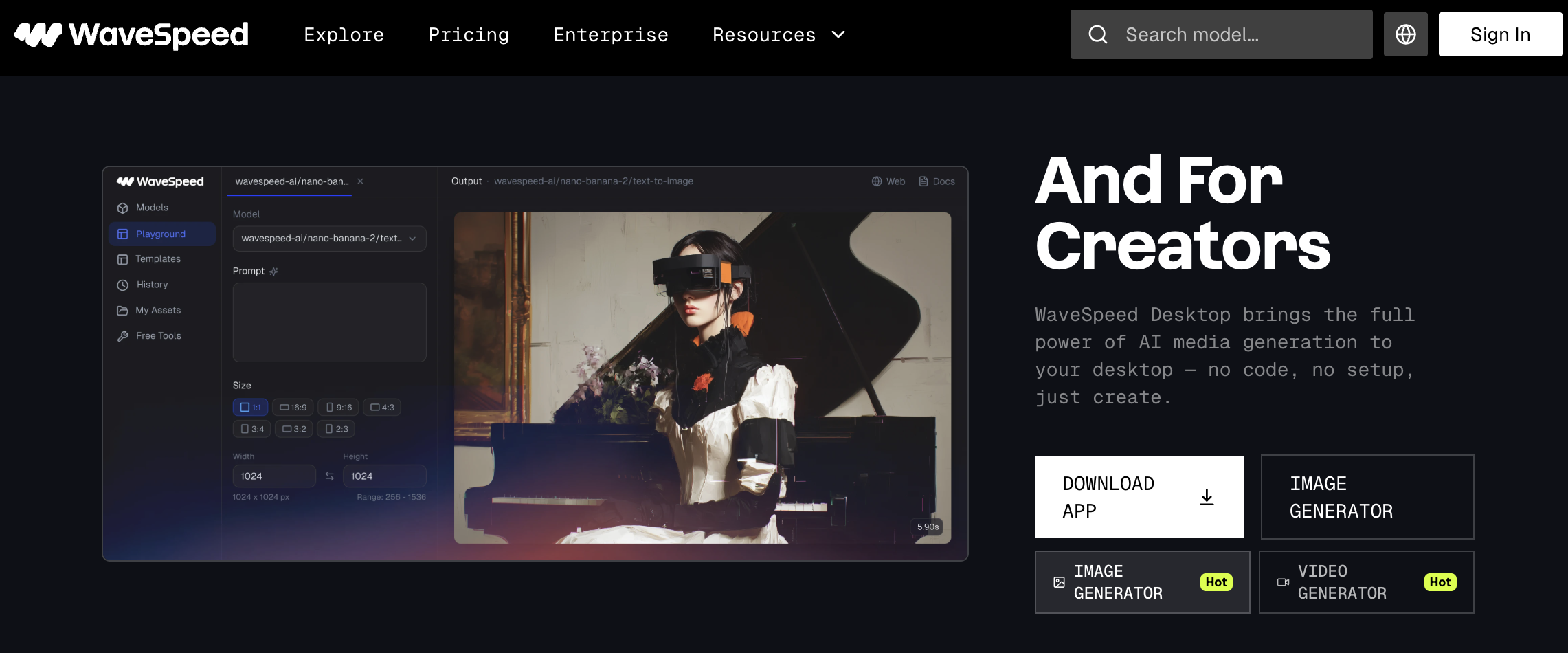
WaveSpeed AI’s unified REST API, ComfyUI custom nodes, and N8N integration give developers multiple pathways to access 1,000+ generation models — from production API pipelines to no-code visual workflows.
Pricing, Accessibility, and User Experience
WaveSpeed AI uses a transparent, usage-based pricing model — pay for what you generate, with no fixed monthly seat fees, no idle charges, and credits that never expire. Volume tiers unlock higher concurrency and throughput for teams scaling production workloads.
WaveSpeed AI Pricing Breakdown for 2026
| Plan / Tier | Credit Top-Up / Cost | Best For | Key Details |
|---|---|---|---|
| Free Trial | $1 free credits (no card required) | Developers evaluating the platform | $1 starter credits upon signup — enough to generate dozens of images or several short video clips across any models in the catalog |
| Pay-As-You-Go | From $0.005/image, $0.01/video second | Solo developers, low-volume users | No minimum commitment; credits purchased as needed; image pricing from $0.005 (Flux Dev Ultra Fast); video from $0.01/second; LLM token-based billing |
| Bronze Tier | ~$100 top-up | Growing teams, regular users | Volume discount on credit purchases; higher rate limits; increased concurrent task capacity |
| Gold Tier | ~$1,000 top-up | Agencies, production pipelines | Significantly higher concurrency; priority queue access; volume pricing advantages; access to dedicated support channel |
| Ultra Tier | ~$10,000 top-up | Enterprise, high-volume platforms | Maximum concurrency and throughput; lowest per-unit pricing; dedicated account management |
| Enterprise / Custom | Custom pricing | Large organizations, regulated industries | Custom SLAs, dedicated GPU infrastructure, custom model deployment, performance guarantees, dedicated support, data residency options |
Pricing model explained: WaveSpeed AI’s open-source models are priced to match original provider rates with full transparency. Closed-source models are priced at or below market average with no hidden fees. Credits never expire — there is no “use it or lose it” monthly reset that wastes budget during slow periods. API keys require a credit top-up before use, so the trial $1 credit is the only path to true free evaluation.
Pro tip: WaveSpeed AI’s pricing is most advantageous for high-iteration workflows — teams generating large volumes of images or video clips benefit from the per-unit economics compared to fixed-seat subscription tools. The reported 67% video generation cost reduction achieved by Novita AI as a WaveSpeed partner gives a meaningful real-world benchmark for what scale users can achieve. Always confirm current per-model pricing at wavespeed.ai/pricing before budgeting production workloads — rates can adjust as new model versions release.
Free Trial vs. Paid: When to Scale Up
The $1 free trial is a genuine evaluation tool — not a teaser. Commit to paid credits when you need:
- Higher rate limits — the free trial credit tier has lower concurrent task capacity than paid tiers; production pipelines need Bronze tier or above for reliable throughput.
- Large-volume generation jobs — batch image or video generation at scale requires credit volume that exceeds the trial allocation within minutes of production-scale operation.
- Access to premium models — some newer or higher-quality model variants require paid account status to access at full throughput.
- Serverless GPU deployment for custom models — custom infrastructure deployment requires a paid account with sufficient credit balance.
- SLA guarantees and dedicated support — available only on Gold, Ultra, and Enterprise tiers; critical for customer-facing applications with uptime requirements.
Cost-saving math: Maintaining separate API subscriptions to Runway ($12–$76/month), Midjourney ($10–$60/month), Kling, and FLUX individually can easily exceed $150–$200/month for a full model stack — with different authentication systems, billing dashboards, rate limits, and integration overhead for each. WaveSpeed AI consolidates all of these behind one $0.005-per-image billing system, with credits that never expire and no fixed monthly minimums — delivering dramatically better economics for teams that use multiple model families across different project types.
Interface and Usability: Developers vs. No-Code Users
- Developers: The REST API with Bearer auth, Python/Node.js SDKs, webhook support, and comprehensive documentation covers production-grade integration into any application stack — the primary audience WaveSpeed AI is designed to serve.
- ComfyUI Users: The official ComfyUI custom node integration provides a visual, no-code workflow interface to WaveSpeed’s full model catalog — accessible to ComfyUI power users without requiring REST API knowledge.
- No-Code / Desktop Users: WaveSpeed Studio delivers a click-to-generate interface for non-technical users — installed locally on Windows, macOS, or Linux with both cloud and local execution options.
- Automation Teams: N8N integration makes WaveSpeed AI generation a building block in any automated workflow — triggered by virtually any system event without custom backend development.
Comparisons: WaveSpeed AI vs. Competitors in 2026
The AI inference and model aggregation space is active in 2026 — but WaveSpeed AI’s combination of raw inference speed, model catalog breadth, transparent pricing, and developer tooling creates clear differentiation from every major alternative.
WaveSpeed AI Strengths vs. Replicate, fal.ai, RunPod, and Together AI
| WaveSpeed AI 2026 | Replicate | fal.ai | RunPod | Together AI | |
|---|---|---|---|---|---|
| Model Catalog Size | 1,000+ models | Thousands (community) | 200+ models | Custom deployments | 100+ LLMs |
| Inference Speed | Up to 4x faster; sub-2s images | Standard | Fast (optimized) | Depends on GPU selection | Fast (LLMs) |
| No Cold Starts | Yes (guaranteed) | Variable | Yes (warm pools) | Variable | Yes |
| Video Generation Models | Yes (WAN, Kling, Veo, Sora, Runway…) | Limited selection | Yes (growing) | Custom only | No |
| ComfyUI Integration | Yes (official custom nodes) | No official nodes | Yes | Limited | No |
| Desktop App | Yes (1M+ installs) | No | No | No | No |
| Credits Expiry | Never expire | No expiry | No expiry | No expiry | No expiry |
| Target User | Devs, studios, AI product teams | Developers, experimenters | Developers, fast prototyping | Self-managed GPU workloads | LLM-focused developers |
WaveSpeed AI’s edge: No competing platform at WaveSpeed AI’s price point matches the combination of 1,000+ pre-optimized models covering image, video, audio, 3D, and language — with no-cold-start guaranteed inference, up to 4x faster throughput, official ComfyUI integration, a 1M+ install desktop app, and never-expiring pay-as-you-go credits. Replicate offers a broader community model library but with more variable cold-start latency and less optimization for video generation workflows. fal.ai is a strong alternative for fast image generation but has a narrower video model catalog. RunPod provides more flexibility for self-managed custom deployments but requires significantly more infrastructure expertise. Together AI excels at LLM inference but lacks WaveSpeed’s media generation breadth. For teams building or running multimodal AI media pipelines in 2026, WaveSpeed AI is the most comprehensive single-platform solution available.
Getting Started: Tutorials and Common Use Cases
WaveSpeed AI is API-first — but the $1 free trial, web playground, ComfyUI integration, and desktop app provide accessible entry points for users at every technical level. Here’s how to go from signup to first generation.
Step-by-Step Guide for New Users
- Sign Up and Get Your Free $1 Trial Credits:
- Create a free account at wavespeed.ai — no credit card required for the $1 starter credit allocation.
- Navigate to the Models page to browse the 1,000+ available models filtered by category: image generation, video generation, audio, 3D, or utility tools.
- Use the web playground to test your first generation without any API setup — select a model, enter a prompt, and receive your generated output directly in the browser.
- Make Your First API Call (Developers):
- Generate an API key from your account dashboard after topping up with credits.
- Use the documented REST endpoint with Bearer authentication: POST your generation parameters (model ID, prompt, image size, steps) to the WaveSpeed API endpoint.
- Handle async job responses via webhook callback or polling — WaveSpeed’s documentation provides code examples in Python, Node.js, and cURL for every major model family.
- Test latency benchmarks on your target models using the web playground before building production integration — confirm speed expectations for your specific use case.
- Set Up ComfyUI Integration (Visual Workflow Users):
- Clone the WaveSpeed ComfyUI custom node repository into your ComfyUI/custom_nodes directory and install requirements.
- Add your WaveSpeed API key in ComfyUI settings — the first load fetches all 600+ available models (takes 2–4 minutes; subsequent loads are instant from cache).
- Drop WaveSpeedAI Task Create and Task Submit nodes into your workflow — select any model at runtime and configure parameters that adapt automatically to the chosen model.
- Add LoRA nodes to load up to 6 simultaneous LoRA models from public URLs for fine-grained style and character control over generation outputs.
- Install WaveSpeed Studio (No-Code Desktop Users):
- Download WaveSpeed Studio for Windows, macOS, or Linux from the WaveSpeed AI website.
- Connect your API key to enable cloud model access — or use the local AI tools for privacy-preserving offline generation without sending data to external servers.
- Browse available models in the Studio interface, enter your prompt or upload a reference image, and generate content with a single click — no terminal or code required.
Tips for Better Results and Cost Efficiency
- Use “Ultra Fast” model variants (e.g., Flux Dev Ultra Fast) for rapid iteration and prompt testing — reserve higher-quality, higher-cost model variants for final production outputs where quality justifies the additional spend.
- Batch image generation jobs into single API calls where the model supports it — reducing per-request overhead and improving throughput efficiency at scale.
- For video generation, use image-to-video workflows rather than text-to-video when you need precise compositional control — generate a reference image first (cheaply), then animate it, rather than iterating expensive text-to-video generations.
- Monitor per-model pricing changes at wavespeed.ai/pricing before scaling large production budgets — rates update as new model versions release and optimize.
- Enterprise teams: engage with WaveSpeed’s enterprise team before committing Ultra-tier or above spend — dedicated support and custom SLA negotiation is available and can significantly reduce effective cost at scale.
Advanced Use Cases and Expert Analysis
For AI product developers, creative studios, enterprise automation teams, and high-volume content operations, WaveSpeed AI 2026 enables production workflows at speed and scale that would require significant infrastructure investment to replicate independently.
Expert Reviews on Performance and Production Value
- AI-Powered SaaS Products: Developers building AI image or video generation features into SaaS products use WaveSpeed AI’s unified API as their generation backend — eliminating the need to negotiate separately with FLUX, Kling, Runway, and other providers while benefiting from WaveSpeed’s optimized infrastructure for user-facing latency.
- Creative Agencies at Scale: Digital agencies producing high volumes of AI-generated marketing assets use WaveSpeed’s multi-model access to match the right generation model to each creative brief — photorealism for product photography, anime style for entertainment campaigns, vector illustration for UI assets — all from one billing account.
- Video Production Pipelines: Studios and individual creators use WaveSpeed’s video generation API (WAN 2.7, Kling 3.0, Veo 3.1, Sora 2) to produce short-form video content at volumes that would be cost-prohibitive through individual provider subscriptions — with the 67% cost reduction reported by partner Novita AI as a real-world efficiency benchmark.
- AI Avatar and Lip-Sync Applications: Products requiring talking avatar generation use WaveSpeed’s InfiniteTalk API for lip-sync video from reference image and audio inputs — integrating directly into virtual assistant, educational, and communication platform workflows.
- Automation Platforms and N8N Workflows: Operations teams building automated content generation pipelines connect WaveSpeed AI generation to triggering systems (form submissions, CRM events, scheduled jobs) via N8N — producing visual assets automatically as part of broader business process automation without custom backend development.
Industry validation: WaveSpeed AI has secured partnerships with notable platforms including Freepik (whose Cloud Architect noted WaveSpeed “helped us stay competitive in AI media generation”) and Novita AI (whose COO reported WaveSpeed “significantly improved our inference efficiency and helped us cut video generation costs by up to 67%”). The platform earns a 4.5 out of 5 rating from independent reviewers with consistent praise for inference speed, model breadth, pricing transparency, and no-cold-start reliability.
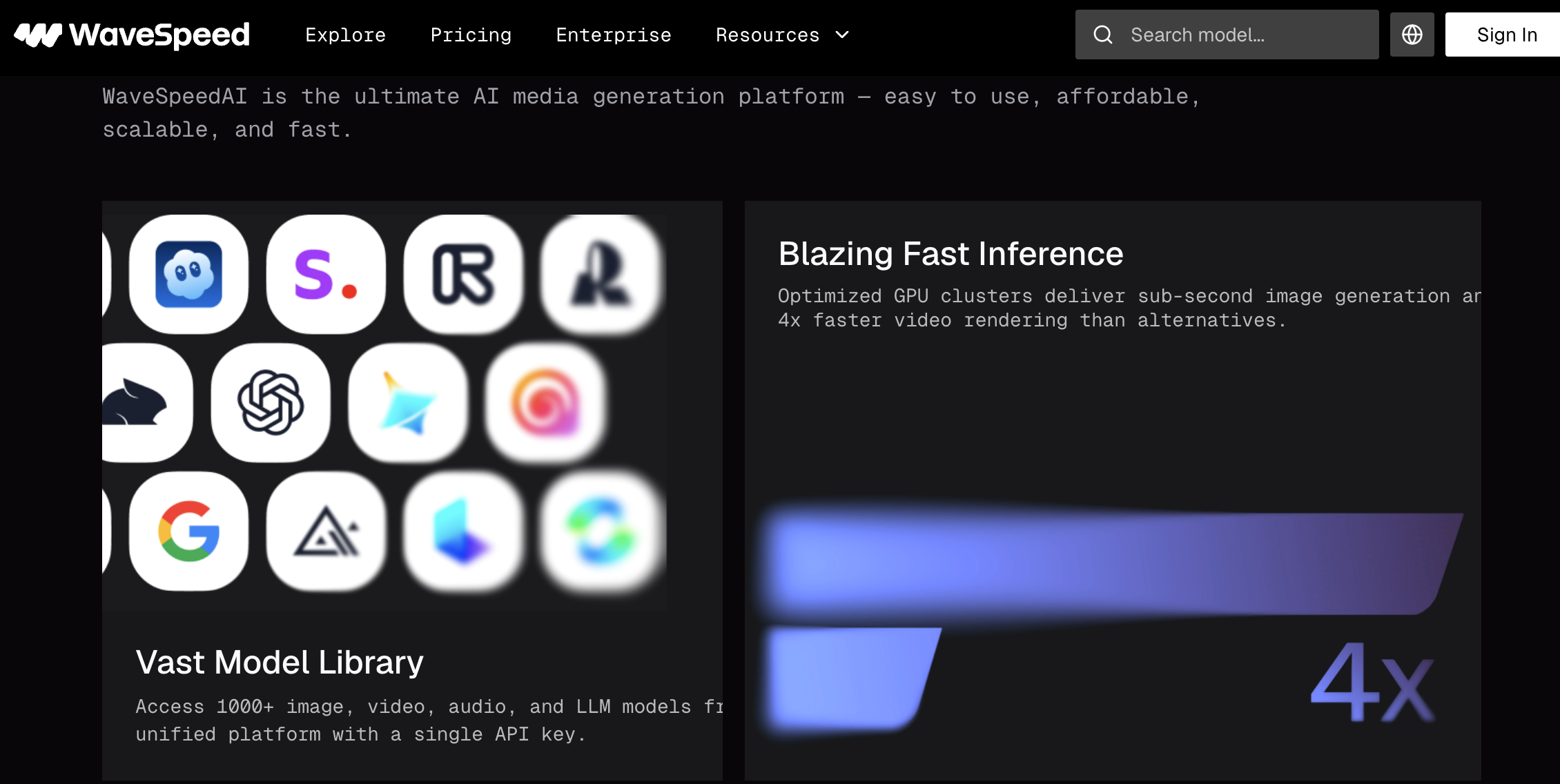
Developers, creative studios, and AI-powered SaaS teams use WaveSpeed AI to run high-volume generation pipelines — accessing the newest models from Google, ByteDance, OpenAI, and Alibaba through a single API at up to 4x faster inference than self-managed alternatives.
Potential Limitations and Community Feedback
Despite its strengths, WaveSpeed AI 2026 has clear limitations worth understanding before committing:
- No Fixed Monthly Plans: WaveSpeed AI’s credit top-up model means there is no predictable flat monthly subscription — finance teams and individuals who prefer fixed monthly costs may find the usage-based billing model less budgetable than fixed-seat subscriptions.
- API-First Architecture Requires Technical Setup: Non-technical users without coding experience will find the API-first interface overwhelming without the assistance of WaveSpeed Studio or ComfyUI — the platform is primarily designed for developers and technical creative professionals.
- Output Quality Varies Across Model Backends: With 1,000+ models from dozens of providers, output quality and consistency varies significantly between models — finding the optimal model for each specific use case requires testing and tuning that adds onboarding friction for new users.
- Third-Party Model Policy Risk: WaveSpeed’s catalog breadth depends on access to models from Google, ByteDance, OpenAI, Alibaba, and others — policy or licensing changes from these providers could affect model availability without WaveSpeed’s direct control.
- Data Residency Limitations: Advanced data residency and privacy controls outside Singapore are limited at standard tiers — regulated industries with strict data localization requirements should verify compliance options with the enterprise team before deploying in production.
- Support Tiers: Standard support operates via Discord and email — mission-critical production applications requiring guaranteed response times and dedicated support channels need Gold, Ultra, or Enterprise tier commitments.
The WaveSpeed AI team ships new model integrations at an aggressive pace — the catalog growth from hundreds to 1,000+ models in 2026 demonstrates active expansion — but pricing predictability, simplified non-developer onboarding, and enhanced data governance documentation remain areas where the platform has room to mature.
Future Outlook and Real-World Applications
WaveSpeed AI isn’t just a model aggregator anymore — it’s becoming a critical infrastructure layer for the AI-powered media economy, enabling a new generation of AI-native products and workflows that would be economically or technically impossible to build on fragmented multi-vendor infrastructure.
Use Cases Across Development, Creative Production, and Enterprise Automation
- AI-Powered Product Developers: Build generation features into consumer and enterprise applications without managing multi-vendor API relationships — one integration, one billing account, and automatic access to new model releases as they are added to the WaveSpeed catalog.
- Digital Creative Agencies: Serve clients across multiple verticals with the right generation model for each creative brief — without maintaining separate subscriptions, teams, or technical expertise for each AI image and video provider.
- E-Commerce Visual Content Pipelines: Automate product image generation, background replacement, upscaling, and video creation at catalog scale — connecting WaveSpeed AI generation to product management systems via API or N8N workflow automation.
- Media and Entertainment Production: Generate concept art, storyboard visuals, animated clips, and marketing materials during production using the latest video generation models (Kling 3.0, Veo 3.1, Sora 2) as production tools rather than experimental curiosities.
- ComfyUI Power Users and Artists: Access WaveSpeed’s enterprise-grade model catalog directly within custom ComfyUI workflows — benefiting from WaveSpeed’s infrastructure speed and model breadth without leaving familiar creative tooling.
- Research and AI Experimentation Teams: Rapidly experiment with the newest model releases from every major AI lab — WAN 2.7, Seedance 2.0, GPT Image 2, FLUX 2 — without waiting for individual provider access approvals or managing separate API credentials for each.
Expert prediction: As AI model proliferation accelerates — with new image, video, and audio models releasing every few weeks from competing labs — the operational complexity of maintaining direct integrations with each provider will become increasingly untenable for all but the largest engineering teams. Unified inference platforms like WaveSpeed AI that handle model aggregation, infrastructure optimization, billing consolidation, and new model integration on behalf of their customers are positioned to become essential infrastructure for every organization building AI media capabilities. With 1,000+ models, 1M+ desktop installs, validated enterprise partnerships, and a pricing model aligned with usage rather than seat count, WaveSpeed AI is well-placed to become the default AI generation infrastructure layer for the next wave of AI-native creative products.
Conclusion
WaveSpeed AI 2026 delivers one of the most technically impressive, comprehensive, and cost-efficient AI generation infrastructure platforms available at any price point. With 1,000+ pre-optimized models across image, video, audio, 3D, and language generation — all accessible through a single REST API key, web playground, ComfyUI custom nodes, N8N integration, and the WaveSpeed Studio desktop app — plus up to 4x faster inference than competing platforms, guaranteed no cold starts, sub-$0.01-per-image pricing, never-expiring credits, and real-world validated cost reductions of up to 67% on video generation workloads, it has established itself as the go-to infrastructure platform for developers and technical creative teams building AI-powered media applications in 2026. Non-technical users preferring point-and-click interfaces may find Picsart or Canva more immediately accessible — but for any developer, studio, or enterprise team that needs serious generative AI infrastructure with production-grade speed, breadth, and economics, WaveSpeed AI belongs at the foundation of your AI media stack.
Ready to build, create, and scale with the world’s fastest AI generation infrastructure? Get started with WaveSpeed AI today:
👉 Open WaveSpeed AI Account: https://worldoftech.space/wavespeedai
👉 Our YouTube Channel: https://www.youtube.com/@world_tech79
👉 Our Facebook Fanpage: https://www.facebook.com/profile.php?id=61576258059614
👉 Our X (Twitter): https://x.com/worldoftech79