
If you’ve ever run Facebook or Instagram ads for a small business, you know the routine: write copy, design a creative, launch, wait, watch the cost-per-acquisition creep up, kill it, repeat. Crush AI (trycrush.ai) was built to take that entire loop off your plate. It’s an AI media-buying platform that connects to your Meta ad account, studies your product and your competitors, generates the ad creatives and copy, launches campaigns, and then optimizes them around the clock — pausing what’s losing money and scaling what’s working, without you touching Ads Manager. It’s positioned as a software alternative to hiring a paid media agency, built by a founder who spent close to a decade running client ad accounts before automating his own job.
For dropshippers, small e-commerce brands, coaches and local service businesses who can’t justify a $3,000–$8,000 monthly agency retainer but are tired of guessing their way through Ads Manager, the pitch is straightforward: an always-on media buyer for a flat software fee. But autonomous ad management is a big promise, and a fair review has to look past the testimonials at the real trade-offs — inconsistent early-stage support, mixed third-party trust signals, and a tool that’s built almost entirely around Meta rather than the whole advertising stack. This 2026 review walks through what Crush AI actually does, its pricing and setup process, how it stacks up against Madgicx and AdCreative.ai, its genuine strengths and limitations, and exactly who should (and shouldn’t) hand it their ad account.
Crush AI (TryCrush.ai) Review 2026: Can an AI Really Replace Your Media Buyer?
Overview and Background
Crush AI is a paid-advertising automation platform, not a general marketing suite. Its entire job is to run the day-to-day work of a Meta (Facebook and Instagram) media buyer: generating ad creative, structuring campaigns, running split tests, and reallocating budget based on performance — all with minimal manual input after setup. The company frames itself as an “AI media buyer trained on over $100 million in ad spend and tens of thousands of creatives,” a self-reported figure that, like most training-data claims from AI ad tools, can’t be independently verified and should be treated as marketing rather than fact.
The platform is run by a small, visibly hands-on team. Co-founder Albert (referred to in some coverage by his fuller name, Albertas) describes spending roughly eight years managing Facebook ad accounts for agency clients before building internal automation tools to handle the repetitive parts of the job — and eventually turning those tools into the product. A second name, Rokas, appears in press coverage as CEO/founder, and both names show up directly in Crush’s own Trustpilot replies, which suggests a genuinely small founding team rather than a faceless SaaS operation. That founder-led responsiveness is visible throughout the platform’s public reviews, for better and worse.
Crush AI is a relatively young product — third-party site-trust scanners note the domain is only a matter of months old — and its review base is still small compared to established players. On Trustpilot it currently sits at a 4.4 out of 5 “Excellent” rating across a growing base of reviews (the count has climbed from roughly 23 to over 80 across recent snapshots), with the company replying to the large majority of negative reviews, often within a week. That’s a genuinely strong signal for a company this new, though it’s worth weighing against automated trust-scanning tools, which have flagged the young domain age and given the site a low algorithmic score unrelated to actual user experience — a divergence worth knowing about before you sign up.
Why Crush AI Stands Out in 2026
It runs the full loop, not just one piece: Most AI ad tools do one job well — AdCreative.ai generates creatives, Madgicx optimizes budgets and audiences. Crush AI is built to handle creative generation, campaign structuring, launch, testing, and daily optimization end-to-end, closer to what an agency actually does than what a single-purpose tool does.
Genuinely fast setup: The onboarding is a five-minute quiz about your product and goals plus a two-click sync to your Facebook Ads account and Pixel data, with campaigns able to go live inside an hour. That’s a meaningfully lower barrier than most media-buying platforms, which often require manual campaign-structure setup before automation kicks in.
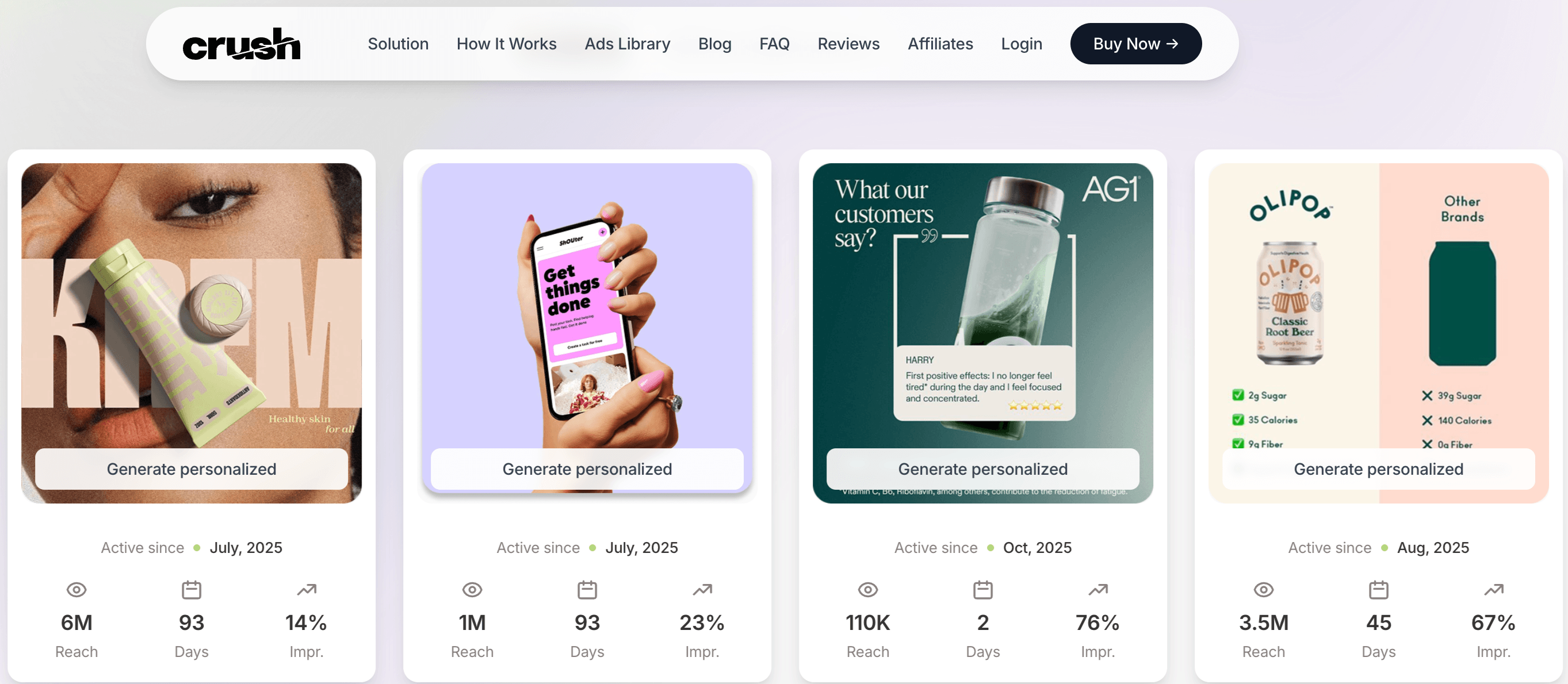
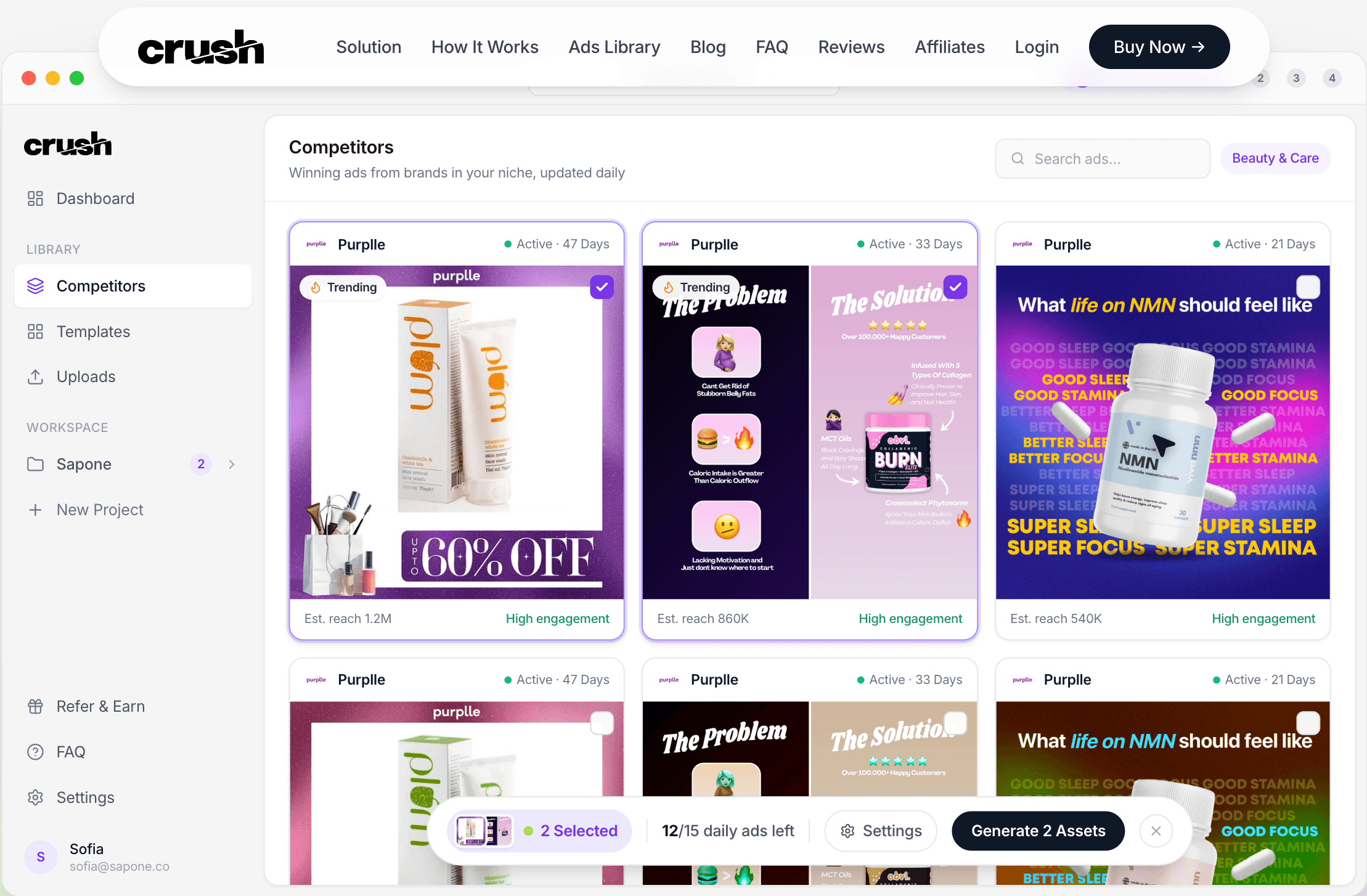
Competitor-aware creative generation: Rather than generating creatives in a vacuum, Crush AI analyzes what’s currently working for competitors in your category and generates images, headlines, and ad angles informed by that data — a research step most solo advertisers skip because it’s time-consuming to do manually.
Broad, automated audience testing: The platform tests dozens of audience combinations automatically rather than relying on manually built interest stacks, and user feedback suggests it leans toward simple broad targeting that Meta’s own algorithm tends to reward — a modern approach that outperforms the granular interest-stacking strategies many advertisers still default to.
24/7 budget protection with kill switches: Campaigns are monitored continuously, with underperforming ads automatically paused against a target ROAS or CPA and budget reallocated to winners — the kind of constant babysitting that’s the most time-consuming part of manual media buying.
Founder-level support in the current beta stage: Multiple reviews describe direct, personal account audits from the founders themselves, including hands-on help fixing a stalled setup — a level of access that’s rare at this price point and unlikely to persist once the company scales past its current beta-style stage.
Real testimonials with real numbers: Reviews aren’t just praise-in-general; several cite specific before-and-after figures — moving from a fixed monthly ad spend to measurably better lead flow, or replacing a multi-thousand-dollar agency retainer at a fraction of the cost — which is more verifiable than vague satisfaction claims.
Key Features and Technology
Crush AI’s feature set is narrower and deeper than a general-purpose marketing suite — everything is built around one workflow: Meta ad creation, launch, and optimization.
AI Creative and Copy Generation
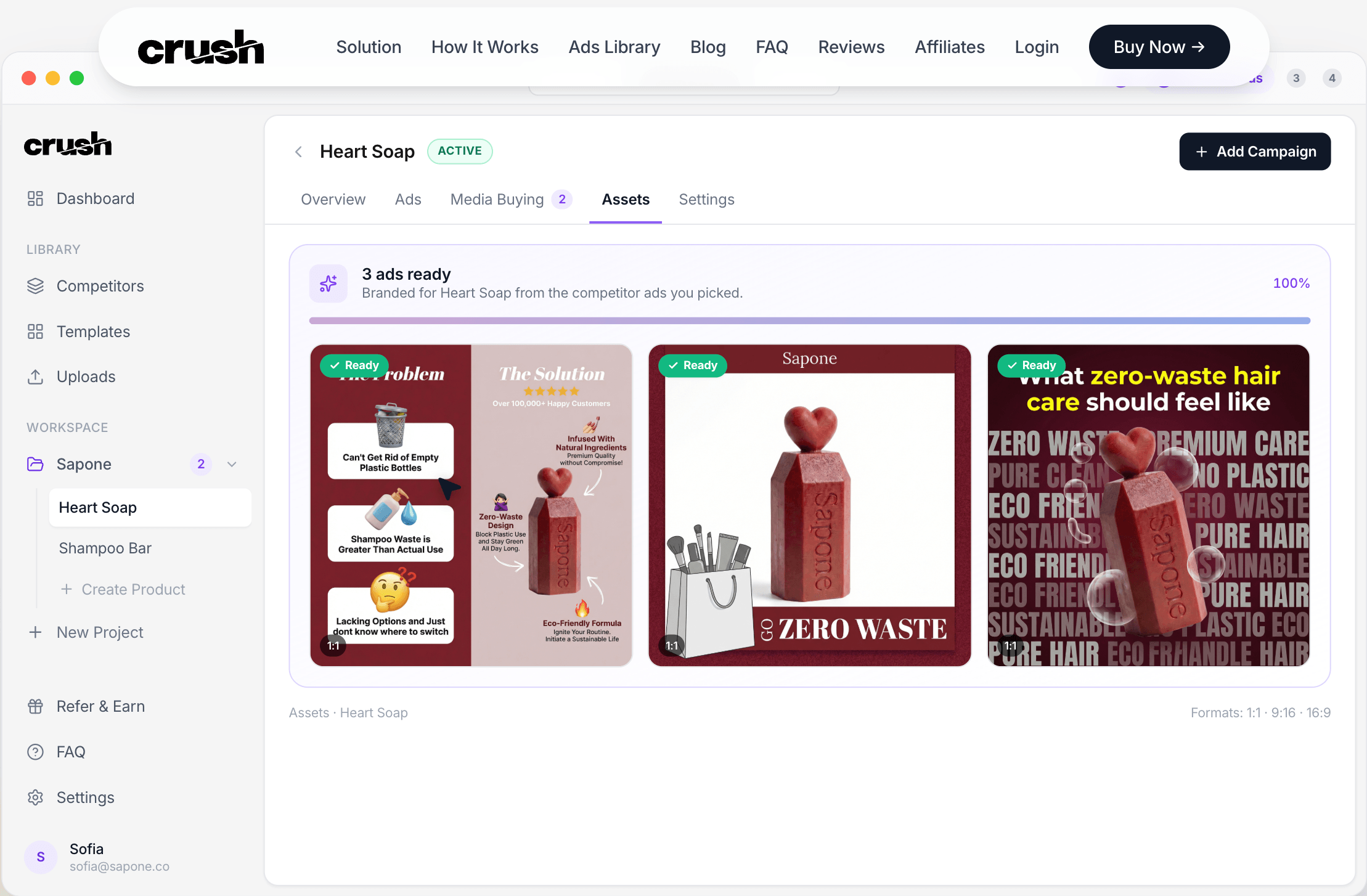
The platform generates ad images, headlines, and copy based on your product data and on patterns it identifies from proven emotional triggers, visual hooks, and copy lengths associated with lower CPA. It launches 50 or more ad variations for testing rather than the two or three most advertisers manually produce. One recurring caveat from users: AI-generated product images can drift from how the actual product looks, which matters more for physical products than for services or digital offers — worth checking closely on your first batch of creatives.
Automated Audience and Creative Testing
Crush AI structures and runs multivariate A/B tests directly inside your Meta ad account rather than requiring you to build test structures by hand. It’s reported to test over 50 audience combinations to find profitable segments, generally favoring broad targeting over the narrow interest-stacking many advertisers still rely on, and typically identifies clear creative winners within about 24 hours of a test launching.
24/7 Budget Optimization and Kill Switches
Once campaigns are live, the platform continuously monitors spend and performance across any currency, automatically scaling ad sets that hit target ROAS or CPA and pausing ones that don’t — a rules-based kill switch that’s meant to stop budget waste faster than a human checking the dashboard once a day could.
Competitor Tracking and Funnel Diagnostics
Beyond the ad account itself, Crush AI analyzes what’s working for competitors in your niche and surfaces recommendations that go beyond ad metrics — flagging pricing, offer structure, or website issues that may be capping conversion rates. Several reviewers single this competitor-insight layer out as worth the subscription on its own, separate from the ad automation itself.
Pricing, Plans, and Package Structure
Crush AI is currently priced as a single flat-rate plan rather than the spend-tiered or credit-based models common among its competitors, which makes budgeting simpler but also means the software cost doesn’t scale down for very small accounts. The listed subscription is $99 per month, with a recommended minimum ad budget of $200 per month for the automation to have enough data to optimize against. As with any young platform, confirm the live price on trycrush.ai before subscribing, since beta-stage software pricing can change as the product matures.
| Product | Price (USD) | What It Is | Best For |
|---|---|---|---|
| Crush AI Plan | $99/month | Full AI media-buying automation for one Meta ad account | Single-product stores, coaches, small service businesses |
| Recommended Ad Budget | $200+/month minimum | Separate spend paid directly to Meta, not to Crush AI | Giving the algorithm enough signal to optimize |
| Setup Time | Under 1 hour | 5-minute quiz + 2-click Facebook Ads/Pixel sync | Getting campaigns live quickly |
| Founder Support (Beta) | Included | Direct account audits from the founding team | New users wanting hands-on onboarding help |
How Crush AI Compares to Alternatives
| Factor | Crush AI | Madgicx | AdCreative.ai |
|---|---|---|---|
| Core job | Full-cycle: creative, launch, and daily optimization | Optimization and analytics layer on top of your own ads | Ad creative and copy generation only |
| Launches campaigns for you | Yes, autonomously | No — you launch; it optimizes what’s already running | No — you download creatives and launch manually |
| Pricing model | $99/month flat rate | $99–$329+/month, tiered by ad spend (approximate) | $29–$399+/month, credit-based (approximate) |
| Ad platforms covered | Meta (Facebook/Instagram), some TikTok mentions | Meta only for management; other channels for reporting | Platform-agnostic creative export |
| Third-party rating | 4.4/5 “Excellent” on Trustpilot (growing review base) | Mixed — around 3.1/5 on Trustpilot; 4.3/5 on G2/Capterra | 4.3/5 on G2, generally positive |
| Company maturity | Young, small founder-led team, beta-stage support | Established, larger customer base | Established, millions of registered users claimed |
| Best for | Hands-off, single-product accounts wanting full automation | Teams who want to keep control but automate optimization | Agencies and teams that just need creative volume |
vs. Madgicx: Madgicx is the more established name and offers deeper analytics and audience tooling, but it’s explicitly an optimization layer — you still build and launch the campaigns yourself, and its pricing is gated behind an ad-spend tier you only see after signing in. Crush AI’s flat $99 rate and full launch-to-optimization automation make it the simpler, more hands-off option, at the cost of Madgicx’s longer track record and larger review base.
vs. AdCreative.ai: AdCreative.ai is purely a creative-generation tool — strong at producing high volumes of ad images, video, and copy, but it doesn’t launch, manage, or optimize campaigns at all, and its most useful features (like video generation) are locked behind pricier tiers. If all you need is creative assets to plug into your own campaigns, AdCreative.ai’s larger feature set and established user base may fit better. If you want the whole loop handled, Crush AI covers more ground for a comparable entry price.
vs. a traditional media buying agency: A skilled human media buyer can read nuance and strategy that software still can’t — but that expertise typically costs $2,500–$8,000+ per month in retainer fees. Crush AI’s pitch is replicating a meaningful share of that value at roughly one-tenth the cost, with the honest trade-off that it’s still a young platform without an agency’s accumulated judgment or account history.
Pros and Cons
What Users Love
Genuinely hands-off automation: The most consistent praise in reviews is that Crush AI actually runs campaigns rather than just suggesting changes — users describe going from actively guessing at ad strategy to letting the system test, scale, and cut on its own.
Real results at modest ad budgets: Several reviewers running $200–$400/month in ad spend report clear improvements in cost per lead or ROAS compared to managing campaigns manually — a meaningful signal since the platform doesn’t require a large budget to start showing value.
Direct founder involvement: Multiple reviews describe the founders personally checking in on account performance every two weeks and offering strategic input beyond just running the software — a level of service that’s unusual at this price point.
Creative quality that’s usable beyond ads: Some users report reusing the AI-generated visuals for organic social content, not just paid campaigns — a nice side benefit of the creative-generation engine.
Competitor and offer-level insight: Beyond ad performance, the recommendations around pricing and website friction points are called out by reviewers as adding value the core “just run my ads” pitch doesn’t fully capture.
Accountability when issues arise: When something goes wrong, public replies from the founders show a pattern of acknowledging the problem directly and fixing it — including one case of a delayed refund being resolved in full once escalated.
Limitations Worth Knowing
Young company, unverified training claims: The “$100M+ in ad spend” and “50,000+ creatives” figures are self-reported and can’t be independently confirmed. The platform’s domain and Trustpilot history are both recent, so the long-term track record simply doesn’t exist yet the way it does for Madgicx or AdCreative.ai.
Support has been inconsistent: At least one detailed public review describes slow support and a delayed refund that required a chargeback dispute before it was resolved — the founders have acknowledged this and say they’ve since fixed the support-routing issue, but it’s a real complaint pattern worth knowing before you commit a monthly subscription plus ad spend.
AI creative can distort product images: At least one reviewer noted the AI-generated visuals altered how the actual product looked closely enough that it no longer matched reality — a real risk for physical products where accuracy matters for customer trust and platform compliance.
Built for single-product, not multi-SKU, campaigns: The platform is reportedly best suited to single-offer or hero-product businesses rather than large catalogs with many products running simultaneously, which narrows its fit for bigger multi-category stores.
Trust signals diverge across sources: While Trustpilot reflects a strong 4.4/5 from real customer reviews, at least one automated site-trust scanner has flagged the site with a low algorithmic score tied to its young domain age — not evidence of fraud, but a reminder to do your own due diligence on any new platform before connecting a live ad account and payment method.
Meta-centric by design: If your growth strategy leans on Google Ads, TikTok, or a multi-channel mix, Crush AI’s core automation is built around Facebook and Instagram — you’ll need separate tools or manual work for other ad platforms.
Who Should Use Crush AI
Single-product e-commerce and dropshipping stores: If you’re selling one hero product or a tight product line through Meta ads and want a system that tests and scales without daily babysitting, this is squarely the use case Crush AI is designed around.
Coaches, consultants and service businesses: Lead-generation campaigns for coaching, local services, or B2B offers are a strong fit, particularly for founders who don’t have the time or expertise to manage Ads Manager themselves.
Businesses replacing an agency retainer: If you’re currently paying an agency several thousand dollars a month for what amounts to standard creative testing and budget optimization, Crush AI is worth trialing as a much cheaper alternative — with the caveat that you’re trading agency judgment for software automation.
Early-stage founders comfortable with a young platform: Because the founders are directly involved in onboarding and troubleshooting right now, early adopters willing to be hands-on during setup tend to report the best experiences.
Who should look elsewhere: Large multi-SKU retailers, brands needing precise product-image accuracy in every ad, businesses running significant budgets across Google, TikTok, and Meta simultaneously, and anyone uncomfortable handing campaign control to a young, small-team platform should either wait for Crush AI’s track record to mature or consider a more established option like Madgicx for optimization or AdCreative.ai for creative generation alone.
Getting Started: Step by Step
- Confirm the fit. Crush AI works best for a single core product or offer running on Meta. If you manage a large multi-product catalog, verify with support that your account structure will work before subscribing.
- Sign up and complete the quiz. The five-minute onboarding quiz captures your product, goals, and target CPA/ROAS, which the AI uses to set initial testing parameters.
- Connect your Meta Ads account and Pixel. The two-click sync links your ad account and conversion tracking, which the platform needs to measure and optimize campaigns accurately.
- Review the first batch of AI-generated creatives. Before letting campaigns launch, check that generated product images accurately represent your actual product — this is the single most-cited quality issue to catch early.
- Set your budget and let the automation run. Fund at least the recommended $200/month minimum so the system has enough spend and data to test meaningfully, and resist the urge to manually override decisions in the first week or two.
- Check in weekly and use the founder support. Review performance weekly rather than daily, and take advantage of the direct founder access during this beta stage if you hit setup issues or want a strategy review.
Tips for Getting Maximum Value
Give the algorithm real budget and real time before judging results — a $200/month test with only a few days of data won’t show what the system can actually do, while a $400+/month budget run for two to three full weeks gives it enough signal to find and scale genuine winners. Always review AI-generated product creatives against your actual product before they go live, especially for physical goods, since even small visual inaccuracies can create customer trust issues or platform policy problems. Keep a written record of any support requests, especially anything involving billing or refunds, since the fastest resolutions in public reviews came from users who documented the issue clearly and followed up. If you’re comparing this against an existing agency relationship, run Crush AI in parallel for a full billing cycle before canceling anything, so you have a clean, apples-to-apples performance comparison. And because this is a young, fast-moving platform, check trycrush.ai directly for the current price and feature set before signing up, since beta-stage products often adjust their offering as they grow.
Future Outlook and Final Assessment
Autonomous ad management is one of the more genuinely useful applications of AI in marketing right now, and the direction of the category is clear: fewer dashboards for humans to stare at, more of the repetitive testing and budget work handled automatically. Crush AI is a credible early entrant in that shift for Meta advertising specifically, with a founder team that has real hands-on media-buying experience rather than a purely engineering-first background, and a review pattern that shows genuine responsiveness to customer problems as they come up.
The honest caveats are real, too: the platform is young enough that its long-term reliability and support quality at scale are still unproven, self-reported training claims can’t be verified, and it’s a Meta-only tool in a marketing world that’s increasingly multi-channel. Established competitors like Madgicx and AdCreative.ai bring longer track records and larger review bases, even if neither replicates Crush AI’s full launch-to-optimization automation at a comparable flat price. For businesses running a single strong offer through Meta ads who want to trade a chunk of manual media-buying work for software, Crush AI is worth a real trial — approached with the same due diligence you’d apply to any young platform handling your ad spend and payment details.
Conclusion
Crush AI sets out to do something ambitious for a $99-a-month tool: replace the day-to-day work of a Facebook media buyer, from creative generation through campaign launch to ongoing optimization. For the right business — a single, strong offer running on Meta with a real testing budget behind it — the reviews suggest it genuinely delivers on a good chunk of that promise, backed by a founding team that shows up personally when things go wrong. It isn’t a finished, fully proven platform yet, and it isn’t the right tool for large multi-product catalogs or multi-channel advertisers. But for small, focused Meta advertisers looking to trade manual campaign management for automation at a fraction of agency cost, it’s a legitimate option worth testing with eyes open.
Ready to see if AI can run your Facebook ads better than you can?
Explore more honest reviews, tutorials and tech comparisons to find the right gear for the way you work, travel and live — at World Of Tech, where we make everything easy.
👉 Shop Crush AI: https://worldoftech.space/trycrushai
👉 Our YouTube Channel: youtube.com/@world_tech79
👉 Our Facebook Fanpage: Facebook
👉 Our X (Twitter): @worldoftech79
Pricing, specifications and policy details in this review were verified against trycrush.ai and independent review sources (including Trustpilot and third-party pricing coverage) as of July 2026. AI advertising software pricing, features and terms change frequently, so confirm current details on the official site before purchasing. Competitor prices are approximate and subject to change.