
Buying resale tickets almost always comes with a gut-punch moment at checkout: the price you searched for isn’t the price you pay, because “service fees,” “delivery fees” and “transfer fees” get quietly stacked on at the last screen. MegaSeats was built to remove that moment entirely. It’s a secondary ticketing marketplace for sports, concerts and theater that shows one all-in price up front, backs every order with a 100% money-back guarantee, and — unlike almost every major resale platform — adds no buyer fees at checkout. Operated by TicketNetwork, Inc., a Connecticut-based ticketing company that has run exchanges and box-office software since 2002, MegaSeats sits on top of a large, established secondary-market inventory pool rather than trying to build one from scratch.
For anyone who has ever added a ticket to their cart at $80 and watched it become $110 by the time they entered their card details, the pitch is immediately appealing: the number on the listing page is the number you pay. But no-fee pricing, a wide reseller network and a busy affiliate/discount-code program don’t automatically mean a flawless buying experience, and an honest look at MegaSeats turns up a real mix of praise and pointed complaints worth knowing before you buy. This 2026 review walks through how MegaSeats actually works, its pricing model and no-fees claim, how it stacks up against StubHub and Vivid Seats, the genuine pros and cons pulled from thousands of verified reviews, and exactly who should — and shouldn’t — buy tickets through it.
MegaSeats Review 2026: Is This No-Fees Ticket Marketplace Actually Worth It?
Overview and Background
MegaSeats.com is a secondary ticketing marketplace — meaning it doesn’t sell tickets on behalf of venues or artists directly, it connects buyers with a network of ticket sellers: brokers, box-office partners, licensed resellers and individuals reselling tickets they can’t use. When you place an order, MegaSeats forwards the request to the seller who listed it, and that seller fulfills delivery, usually through Ticketmaster transfer, mobile transfer or a comparable e-ticket method. This is standard practice across the resale industry (StubHub and Vivid Seats work the same way), but it does mean MegaSeats itself never physically holds the tickets it lists.
The company behind the brand is TicketNetwork, Inc., headquartered in South Windsor/Vernon, Connecticut, founded and led by CEO Don Vaccaro. TicketNetwork operates several consumer-facing and B2B ticketing brands from the same underlying exchange, including MyTicketTracker, TicketLiquidator, Tickets.Expert and TicketNetwork Direct — MegaSeats is one storefront drawing from that shared inventory pool, which is why its selection is unusually deep for a relatively newer-facing brand name. On Trustpilot, MegaSeats currently holds a “Great” rating around 4.2–4.3 out of 5 across more than 3,000 reviews, with roughly three-quarters of reviewers leaving 5 stars and a meaningful 13–14% leaving 1 star — a split worth sitting with before you buy.
Why MegaSeats Stands Out in 2026
Genuinely no buyer fees: This is the headline differentiator. MegaSeats’ own price comparisons show StubHub adding more than 24% and Vivid Seats adding upward of 35% at checkout through “drip pricing” — service fees and transfer fees layered on after you’ve already committed to a price. MegaSeats displays the total up front, so what you see on the event page is what hits your card.
100% money-back guarantee: Every order is covered by a refund guarantee if tickets don’t arrive on time or turn out to be invalid at the gate. It’s the same basic promise every major resale platform makes, but it matters more here because MegaSeats is less of a household name than StubHub or Ticketmaster.
Deep, shared inventory: Because MegaSeats draws on TicketNetwork’s broader exchange (the same pool feeding MyTicketTracker and TicketLiquidator), its catalog of sports, concert and theater listings is considerably larger than a typical standalone reseller, including long-tail local venues, minor-league sports and touring theater productions.
Aggressive first-time and app discounts: Stackable promo codes (commonly in the 15–16% range) and an additional discount for booking through the mobile app mean the effective savings versus fee-laden competitors can be larger than the sticker price alone suggests.
Responsive customer support, by the numbers: MegaSeats replies to the large majority of negative Trustpilot reviews (99–100% response rate reported), and most complaint threads show a company reply within a day — a meaningfully more engaged pattern than many resale marketplaces show publicly.
Simple, familiar shopping flow: Reviewers repeatedly describe the browsing and checkout experience as fast and intuitive — pick an event, filter seats, pay, and in most cases receive transfer instructions within minutes to a few hours.
An affiliate and partner program: MegaSeats runs its own affiliate program alongside its consumer storefront, which is part of why you’ll see it referenced across ticket-comparison and coupon sites — a sign the brand is actively investing in growth rather than sitting still.
Key Features and Technology
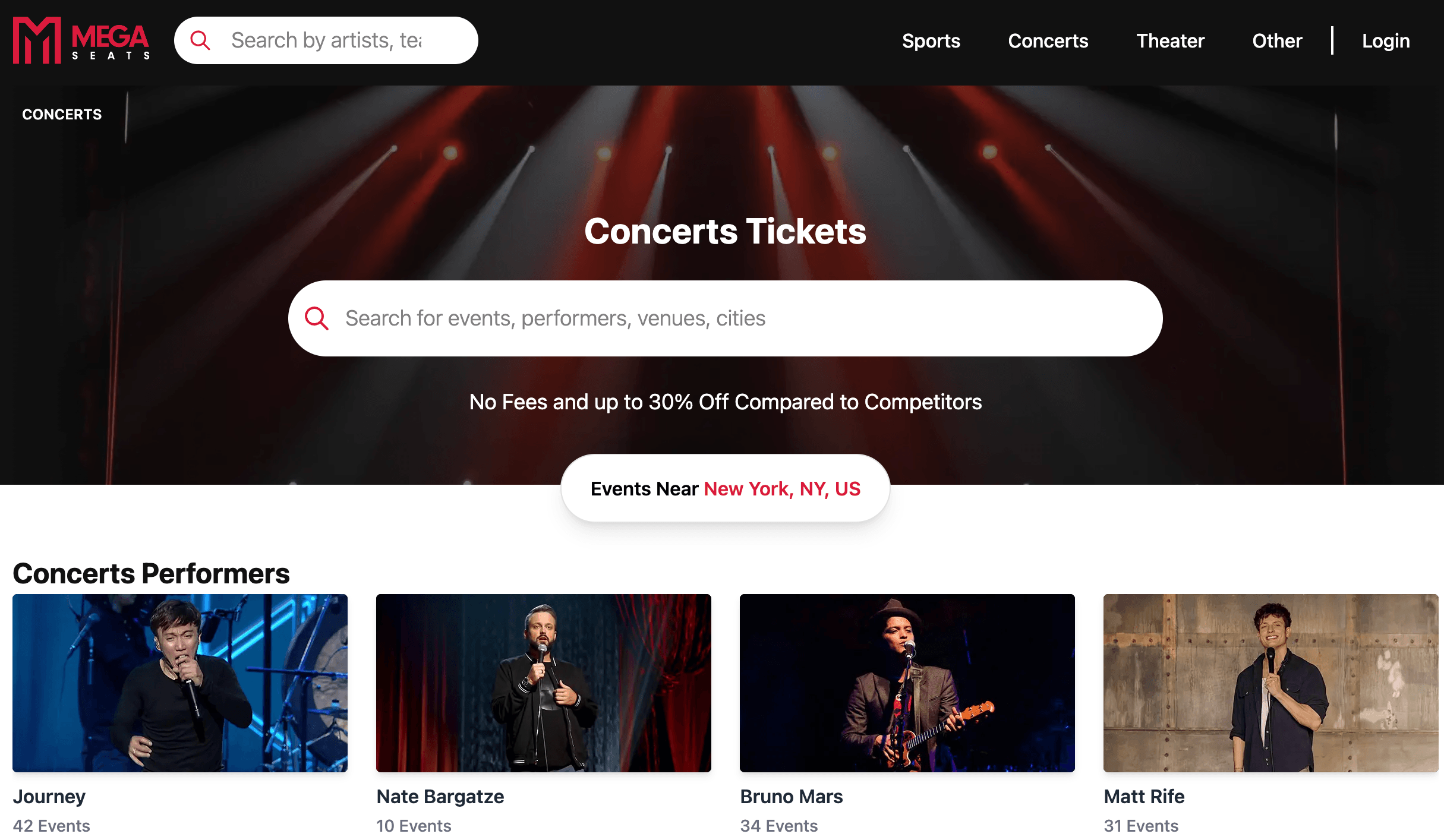
MegaSeats keeps its feature set intentionally simple — this isn’t a bloated app, it’s a focused marketplace built around three categories (Sports, Concerts, Theater) plus a catch-all “Other” section for comedy, festivals and family shows.
All-In Price Display
Every listing shows the final, all-fees-included price directly on the seat map, not just at the final checkout page. MegaSeats’ own side-by-side comparisons put this in concrete terms: a roughly $300 ticket that costs $353 all-in on StubHub runs about $305 on MegaSeats, and a $500 Vivid Seats order that becomes $681 after fees comes to roughly $563 on MegaSeats — savings of 14–17% purely from not layering fees on top of the sticker price.
iOS and Android App
MegaSeats’ app (available on the App Store and Google Play) mirrors the website’s browsing experience and layers on push-notification deals plus app-exclusive discount codes, with the site advertising savings of up to 18% when you book through the app instead of the browser.
Digital Delivery and Ticket Transfer
Most tickets are delivered as mobile transfers (commonly via Ticketmaster’s transfer system) or PDF/e-tickets, sent directly to the email on your order. Delivery timing varies by seller — many reviewers report tickets within minutes to a few hours, though for high-demand events sellers can legitimately hold delivery until closer to the event date, which is a recurring source of buyer anxiety worth planning around.
Buyer Guarantee and Support Channels
The 100% money-back guarantee covers late, invalid or significantly different tickets from what was advertised. Support is available via live chat and phone, and the company’s public reply rate to negative reviews (near 100%) suggests a genuine escalation path exists, even if outcomes aren’t always what the buyer hoped for.
Pricing, Plans, and Package Structure
MegaSeats doesn’t use a subscription or tiered-plan model — it’s a per-ticket marketplace, so “pricing” comes down to the listing price itself, any active promo code, and whether you book via web or app. Based on MegaSeats’ own published comparisons against StubHub and Vivid Seats, here’s roughly how the numbers break down at different price points:
| Ticket Range | All-In Price | What It Is | Best For |
|---|---|---|---|
| ~$20 tickets | ~$27.20 (vs. $29.01 on StubHub) | Entry-level local shows, minor-league games | Casual fans, budget outings |
| ~$50 tickets | ~$50.60–$60.80 (vs. $59.69–$67.55 elsewhere) | Mid-tier concerts, regular-season sports | Most everyday buyers |
| ~$100 tickets | ~$99.50–$100 (vs. $107.65–$136.75 elsewhere) | Popular touring artists, playoff-adjacent games | Fee-sensitive buyers upgrading seats |
| $300–$500+ tickets | ~$304.80–$562.70 (vs. $353.45–$681.35 elsewhere) | Premium seats, sold-out marquee events | Buyers who’d otherwise absorb the biggest fee hikes |
How MegaSeats Compares to Alternatives
| Factor | MegaSeats | StubHub | Vivid Seats |
|---|---|---|---|
| Buyer fees | None — all-in pricing shown up front | ~24%+ added at checkout (approx.) | ~35%+ added at checkout (approx.) |
| Brand recognition | Smaller, less widely known | Major household name (eBay-founded) | Major household name, publicly traded |
| Trustpilot rating | ~4.2–4.3/5 “Great” (~3,000+ reviews) | Mixed — fee complaints are common | Mixed — fee complaints are common |
| Guarantee | 100% money-back guarantee | FanProtect guarantee | 100% Buyer Guarantee |
| Inventory depth | Large — draws on TicketNetwork’s shared exchange | Very large, independently sourced | Very large, independently sourced |
| Best for | Fee-sensitive buyers comfortable with a less mainstream brand | Buyers who prioritize brand familiarity over price | Buyers who want rewards/loyalty perks over lowest price |
MegaSeats vs. StubHub: StubHub has far greater brand recognition and a long track record, but its checkout typically adds a substantial service-and-transfer fee on top of the listed price. MegaSeats’ comparison data (and independent reporting on “drip pricing” in ticket resale generally) suggests the effective savings on MegaSeats can run into double digits once StubHub’s fees are factored in — the trade-off is buying from a less familiar name.
MegaSeats vs. Vivid Seats: Vivid Seats offers a loyalty-rewards program and is publicly traded with strong brand trust, but its fee structure tends to run even higher than StubHub’s on MegaSeats’ own comparisons. If loyalty points matter more to you than the lowest all-in price, Vivid Seats may still make sense; if the final number is what matters, MegaSeats’ no-fee model is built specifically to undercut it.
Pros and Cons
What Users Love
No surprise fees: This is by far the most repeated praise in reviews — buyers consistently note that the price at checkout matched the price they saw on the seat map, with several specifically comparing it against a higher StubHub or Ticketmaster total for the identical seats.
Fast, easy checkout: Multiple reviewers describe the site as intuitive for first-time users, with instant email confirmation and, in many cases, tickets delivered within 20 minutes to a few hours of purchase.
Real savings versus fee-heavy competitors: Several reviewers specifically call out saving $25–$40 or more compared to identical seats priced with fees on other resale sites, echoing MegaSeats’ own published comparison data.
Attentive customer service, for most: Positive reviews frequently mention support staff following up personally to confirm an order went smoothly, and the company’s high public reply rate to negative reviews backs this up structurally, not just anecdotally.
Wide event coverage: From major touring concerts down to minor-league baseball and local theater, the shared TicketNetwork inventory gives MegaSeats meaningfully more long-tail selection than a typical newer resale brand.
Limitations Worth Knowing
Orders are requests, not guarantees: Because listings can be requested by multiple buyers simultaneously, sellers are contractually obligated to honor whichever order arrived first — occasionally leading to a confirmed-then-cancelled experience for the second buyer, which understandably reads as a bait-and-switch even when it’s a structural feature of live marketplaces.
Delivery timing can be inconsistent: While many buyers get tickets within minutes, a recurring complaint involves tickets not being released until the day of the event, which creates real anxiety for buyers who want confirmation well in advance — MegaSeats attributes some delays to sellers holding inventory for demand or logistics reasons.
Fraud-dispute friction: A subset of negative reviews describe difficulty getting refunds after disputing an order as unauthorized; MegaSeats’ public replies indicate its fraud team checks billing-detail matches against the buyer’s card issuer, which can leave a genuinely unauthorized-purchase victim feeling unheard even when the company’s process is procedurally sound.
Seat information is limited pre-purchase: Exact seat numbers aren’t disclosed before checkout (only section/row), which a handful of reviewers found frustrating when trying to judge sightlines in advance — obstructed-view complaints do appear in the review history.
Parent-company history is worth a mention: MegaSeats operates under TicketNetwork, Inc., which the New York Attorney General sued in 2018 over “speculative” ticket listings — advertising tickets the seller network didn’t yet actually hold — settling for $1.5 million. That case predates MegaSeats’ current no-fees positioning by several years, but it’s a legitimate piece of due-diligence context for a buyer weighing which resale brand to trust with a high-value purchase.
Who Should Use MegaSeats
Fee-sensitive ticket buyers: If the final checkout number is what matters most to you and you’re willing to buy from a brand that’s less of a household name than StubHub or Ticketmaster, MegaSeats’ all-in pricing is the whole reason to choose it.
Fans chasing sold-out or hard-to-find seats: Because MegaSeats draws on TicketNetwork’s shared exchange, it’s a reasonable place to check for sold-out shows and high-demand games where primary box-office tickets are gone.
Deal-hunters comfortable stacking promo codes: Buyers willing to look for an active discount code and book through the app to capture the extra app-exclusive percentage will get the most value out of MegaSeats specifically.
Buyers who plan reasonably far ahead: Because delivery timing can slip toward the event date for some listings, MegaSeats works best for people who aren’t relying on same-day-of-purchase confirmation for peace of mind.
Who should look elsewhere: Buyers who want a guaranteed brand-new on-sale at face value should go straight to the venue or Ticketmaster’s primary listing, not a resale marketplace. Anyone who wants to see the exact seat before paying, needs same-hour ticket delivery for peace of mind, or would rather pay a known premium to a very large, publicly traded brand for maximum name recognition may be better served by StubHub or Vivid Seats despite the higher fees.
Getting Started: Step by Step
- Search your event. Use the Sports, Concerts, Theater or Other categories, or search directly by performer, team or venue, and filter by location and date.
- Compare listings by all-in price. Sort by price and check section/row rather than exact seat number (which isn’t disclosed until after purchase), and cross-check the same event on a competitor site’s final checkout total, not their teaser price.
- Apply a promo code. Look for a current discount (first-time-buyer and seasonal codes commonly run 15–16%) before you finalize — MegaSeats frequently surfaces one automatically at checkout, but it’s worth double-checking.
- Consider booking via the app. The iOS/Android app advertises up to an additional discount on top of web pricing, plus push alerts for deals on events you follow.
- Complete checkout and watch your email. Your order is a request that the seller must confirm; once confirmed, delivery instructions (usually a mobile transfer or e-ticket link) arrive by email — for high-demand shows, allow for delivery as late as the day before the event.
- Keep your confirmation and use support if needed. If tickets don’t arrive on time or don’t match the listing, contact MegaSeats support and reference the 100% money-back guarantee; keep all order confirmation emails as your paper trail.
Tips for Getting Maximum Value
Always price-check the exact same section and row on at least one competitor before buying, but compare their true checkout total, not the number that shows on their event page — that’s where MegaSeats’ no-fee structure actually earns its keep. Stack an active promo code with app-exclusive pricing whenever both are available, since the combined discount can meaningfully beat either one alone. If a listing’s delivery timing worries you, use live chat before purchasing to ask when tickets for that specific event typically ship, since it varies by seller rather than by MegaSeats itself. For high-stakes purchases — pricey premium seats, once-in-a-lifetime shows, or events you’re traveling for — consider paying with a credit card rather than a debit card, since credit-card chargeback protections add a second safety net on top of MegaSeats’ own money-back guarantee. And if you do end up in a dispute, respond quickly and factually to MegaSeats’ support team; the company’s own review replies suggest orders get resolved faster when the buyer engages directly rather than only through a card-issuer chargeback.
Future Outlook and Final Assessment
Ticket-fee transparency is becoming a bigger regulatory story every year — congressional hearings and FTC scrutiny of “drip pricing” have put pressure on the entire resale industry to show all-in prices earlier in the checkout flow, and several U.S. states have already passed or proposed all-in pricing laws. MegaSeats’ entire positioning is built around being ahead of that curve rather than reacting to it, which gives the brand a reasonable tailwind heading into 2026 and beyond as consumer (and legislative) patience for hidden fees keeps shrinking.
The honest caveats remain real, though: MegaSeats is a smaller, less universally recognized name than StubHub or Vivid Seats, its parent company TicketNetwork carries a settled 2018 speculative-ticketing case in its history, and a meaningful slice of buyers report friction around delivery timing, fraud disputes, or the “first request wins” mechanics of live marketplace ordering. None of that is unique to MegaSeats — every resale platform has some version of these issues — but they’re worth going in aware of rather than discovering after you’ve paid.
Conclusion
MegaSeats isn’t trying to out-brand StubHub or Vivid Seats — it’s trying to out-price them by removing the single most-hated part of buying resale tickets: the fee that shows up after you’ve already decided to buy. By displaying all-in pricing, backing orders with a money-back guarantee, and drawing on TicketNetwork’s large shared inventory, it delivers real, measurable savings for buyers willing to trade a bit of brand familiarity for a lower final total. It rewards buyers who plan ahead, stack an available promo code, and read the fine print on how live marketplace orders work — and it’s not the right call for anyone who needs guaranteed same-hour delivery or wants to see an exact seat number before paying. Confirm the current listing price and any active discount code before you check out, and MegaSeats can make finding a fair-priced ticket meaningfully less stressful.
Ready to find your next ticket without the fee surprise?
Explore more honest reviews, tutorials and tech comparisons to find the right gear for the way you work, travel and live — at World Of Tech, where we make everything easy.
👉 Shop MegaSeats: https://worldoftech.space/megaseats
👉 Our YouTube Channel: youtube.com/@world_tech79
👉 Our Facebook Fanpage: Facebook
👉 Our X (Twitter): @worldoftech79
Pricing, specifications and policy details in this review were verified against megaseats.com and independent review sources (including Trustpilot and BBB) as of August 2026. Resale ticket pricing, availability and promotions change frequently and vary by event and seller, so confirm current details on the official site before purchasing. Competitor prices and fee percentages are approximate, drawn in part from MegaSeats’ own published comparisons, and are subject to change.