
If you have watched the rise of open-source AI agents in 2026, you already know the frustrating gap at the center of it. Frameworks like OpenClaw and Hermes Agent promise a tireless digital assistant that can read your email, write code, browse the web and run tasks around the clock — but actually getting one online means cloning a repo, wrestling with Docker, configuring a VPS, and then babysitting updates, crashes and security patches forever. MyClaw is built to erase that headache. It is a managed cloud hosting platform that spins up a private, always-on instance of your chosen agent in about 30 seconds, then quietly handles the updates, backups, scaling and security you would otherwise own yourself. Think of it as the “Heroku for open-source AI agents” — you bring the goal, MyClaw keeps the machine running.
For non-technical founders, busy operators, small teams and even developers who would rather ship than manage servers, the pitch is genuinely appealing: the power of a self-hosted agent, without the DevOps. But MyClaw is a young platform — the domain is only months old — and an honest look turns up real trade-offs around stability, support, billing clarity and the fact that AI model tokens are not included in the subscription. This 2026 review walks through exactly what MyClaw is, how it works, its full pricing structure, how it stacks up against self-hosting and rival hosts, its verified reputation so far, the genuine pros and cons, and precisely who should (and shouldn’t) sign up.
MyClaw Review 2026: The Managed Way to Run OpenClaw & Hermes AI Agents 24/7
Overview and Background
MyClaw (operated by Cubo World Inc.) is a managed cloud hosting service purpose-built for open-source AI agents. It is not an AI model of its own, and it is not a chatbot — it is the infrastructure layer that runs someone else’s agent framework for you. The core idea is simple but powerful: instead of installing and maintaining a complex agent stack on your own hardware, you log in, pick a plan, choose an agent, and within seconds you have a dedicated, private instance already online and ready to work. MyClaw handles provisioning, updates, security, scaling and daily backups in the background so you never have to touch a terminal.
The platform’s flagship product is managed hosting for OpenClaw — an open-source personal AI agent that launched in late 2025 (originally known as Clawdbot, and before that Moltbot) and quickly became one of the fastest-growing open-source AI projects in recent memory, amassing well over 100,000 GitHub stars and a large, active community. OpenClaw runs a central “gateway” that connects an autonomous agent to the messaging apps people already use — WhatsApp, Telegram, Slack, Discord and email — and lets it browse, write and run code, manage files and automate multi-step workflows. It is now stewarded by a non-profit foundation. MyClaw also offers managed hosting for Hermes Agent, the self-improving, function-calling agent runtime from Nous Research, and advertises support for other agent tools such as Claude Code and Codex.
What separates MyClaw from simply running these tools yourself is the fully-managed, dedicated-instance model. Each subscription provisions an isolated container or virtual machine that is private to you, encrypted, always-on, and automatically kept up to date. You get one-click multi-channel integrations, a community-driven skills library, and a hosted environment that survives your laptop closing, your Wi-Fi dropping or a bad Docker update. Crucially, MyClaw is an independent commercial service — it is not the official OpenClaw or Hermes project, and it is not operated by their creators. It is a third party that packages those open-source frameworks into a paid, hands-off product.
Why MyClaw Stands Out in 2026
It removes the hardest part of open-source agents: This is MyClaw’s whole reason to exist. Self-hosting OpenClaw or Hermes is genuinely difficult — cloning the repo, sorting out Docker, configuring environment variables, dealing with port conflicts, setting up a process manager and SSL, then maintaining all of it indefinitely. MyClaw compresses that into a one-click deploy that is ready in roughly 30 seconds. For most people, that operational friction is the exact wall they hit, and removing it is the entire value.
Always-on, dedicated and private by design: Every plan runs your agent 24/7 in an isolated, encrypted instance that is yours alone — not a shared multi-tenant bot. That means your assistant keeps working after you close your laptop, and your data, conversations and API keys stay inside your own container rather than on a communal server. Daily backups and automatic updates are handled for you, so the instance stays current without any maintenance on your part.
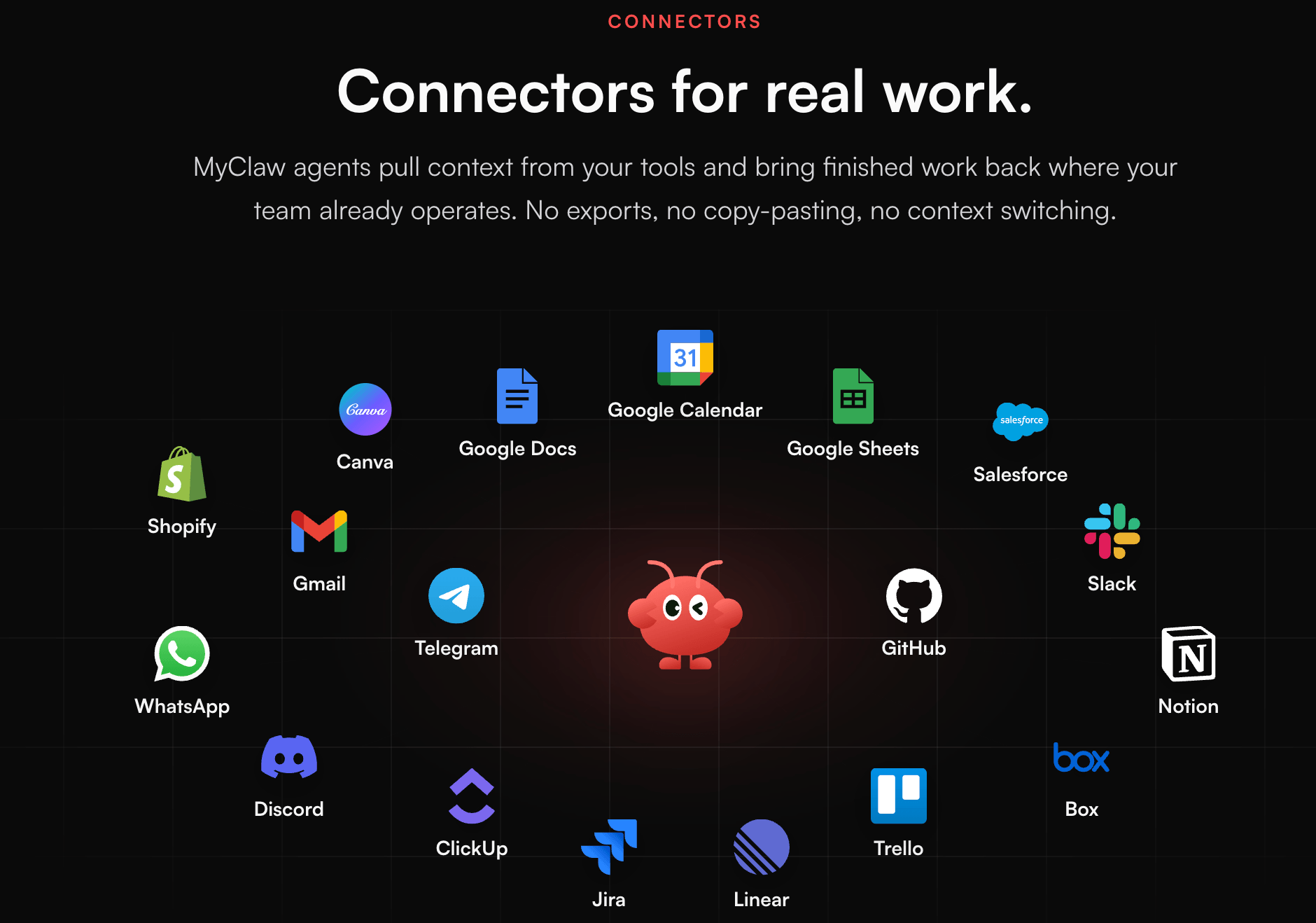
Real work, not just chat, across your own channels: Because it hosts genuine agent frameworks, MyClaw goes far beyond a question-and-answer chatbot. A hosted OpenClaw or Hermes agent can browse the web, write and run code, generate files, draft pages and return finished results — and you can reach it from email, Telegram, WhatsApp or a browser, connected to the repos, apps and data your workflow already uses. Set a goal once, and it keeps moving the work forward on a schedule.
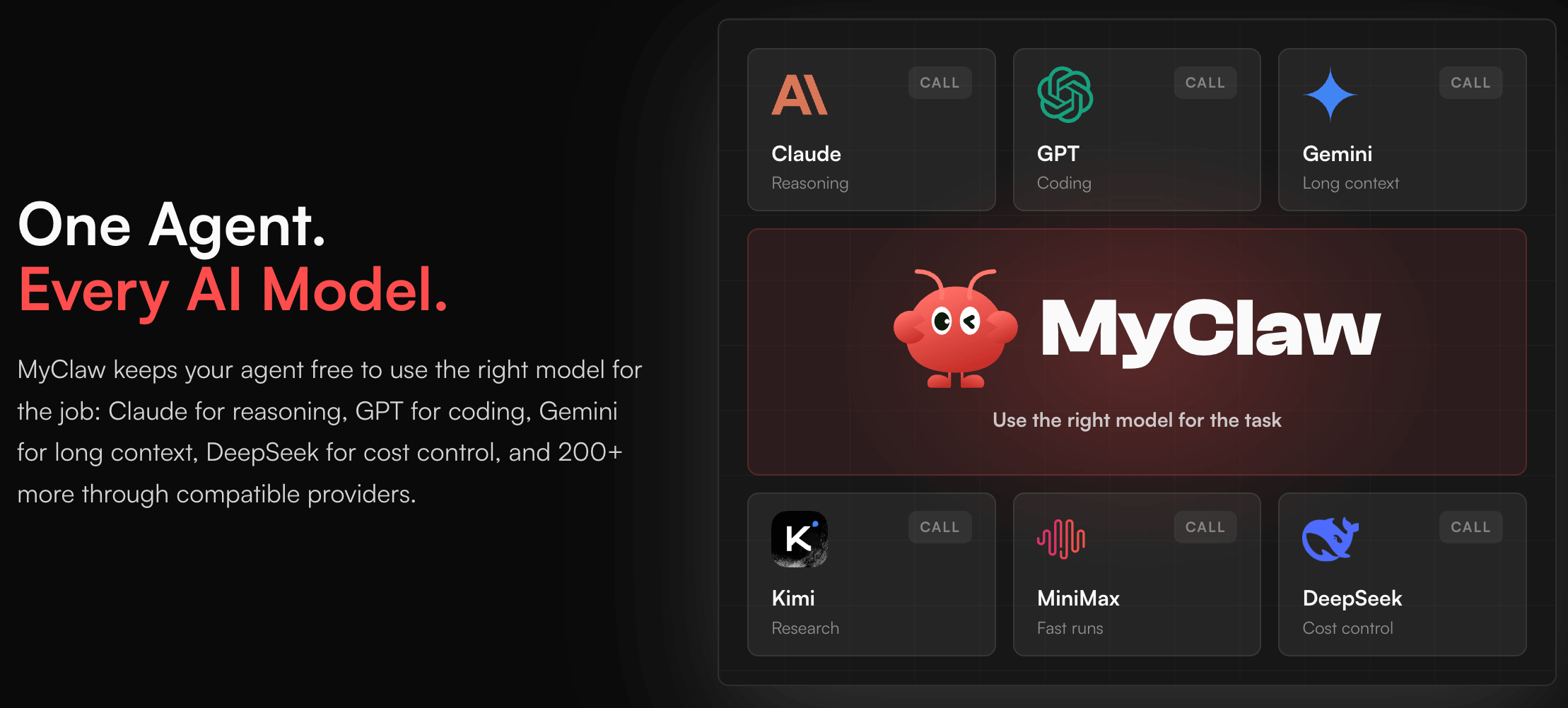
Multiple agents and a huge model catalog: Rather than locking you to one runtime, MyClaw hosts OpenClaw and Hermes Agent, and advertises support for Claude Code, Codex and more — with 100+ integrations and 200+ model options. Because both leading frameworks use a bring-your-own-model approach, you can point your agent at whichever provider fits your budget and task, from frontier models for hard reasoning to cheaper models for routine automation.
Scheduled autonomy for recurring work: The most useful thing an always-on agent can do is run without being asked. MyClaw leans into this: daily reports, price monitoring, inbox triage and page-watching can all be set once and left to run, with the agent only pinging you when a decision or review is actually needed. That “runs while you sleep” pattern is what separates a hosted agent from a tool you have to keep re-opening.
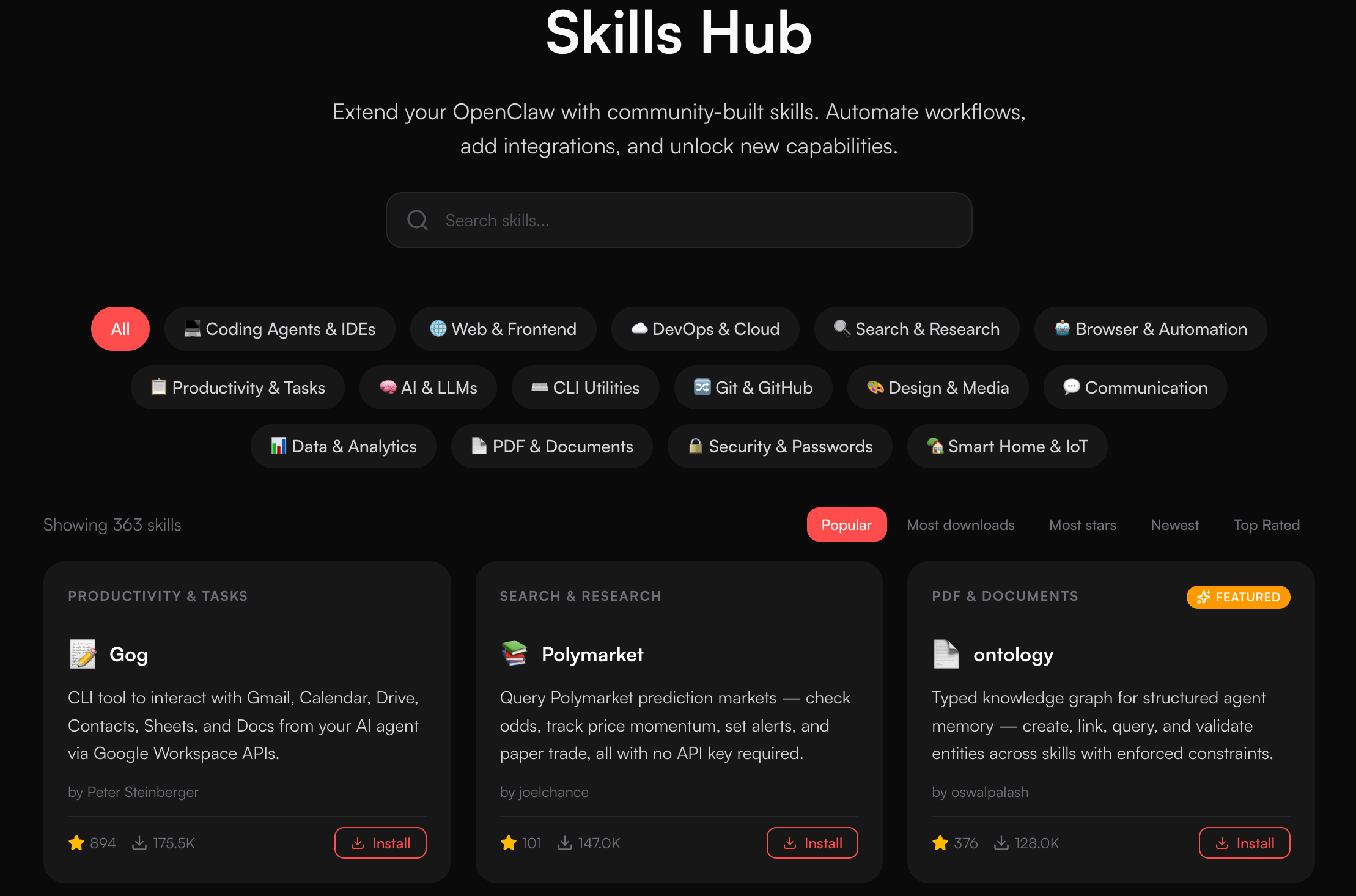
A community skills hub and integrations: Beyond the base runtime, MyClaw exposes custom skills and integrations across all tiers, drawing on the broad open-source skill ecosystems around OpenClaw and Hermes. Skills can add capabilities like email management, document and URL summarizing, Notion editing, durable cross-session memory and proactive suggestions, letting you shape the agent around your actual routine rather than a fixed feature set.
A clear on-ramp for the AI-curious: For the large group of people who watched OpenClaw go viral but never got it running, MyClaw is the shortest path from “I want an autonomous agent” to “I have one online.” Independent reviewers repeatedly land on the same verdict — it delivers the capability of a self-hosted agent without the operational overhead — and that accessibility, more than any single feature, is why the platform is being talked about.
MyClaw spins up a private, always-on instance of OpenClaw or Hermes Agent in about 30 seconds and handles updates, backups and scaling for you — the open-source agent experience without the DevOps.
Key Features and Technology
MyClaw’s offering is broad, but it organizes cleanly into a handful of pillars. Here is how the platform actually breaks down.
One-Click Deploy and Managed Infrastructure
The heart of the product. You create an account, choose a plan and an agent, and MyClaw provisions a prepared, optimized instance for you — typically ready in around 30 seconds with no setup required. From there, the platform manages the parts people hate: automatic updates so your agent stays on the latest release, security hardening, resource scaling, and daily backups. There is no terminal, no Docker file, no VPS console. The trade-off, which we return to below, is that this convenience comes with an abstraction layer that deliberately hides the low-level controls a hardcore self-hoster might want.
Supported Agents: OpenClaw, Hermes, and More
MyClaw’s two headline products are managed OpenClaw hosting and managed Hermes Agent hosting. OpenClaw is the more assistant-oriented of the two: a Node.js gateway that fans out to consumer messaging apps and ships a large skills and tool ecosystem, ideal for a personal, channel-connected assistant. Hermes Agent, from Nous Research, is a Python-first, function-calling runtime with a self-improving learning loop and persistent memory, aimed at developers who want a scriptable, model-agnostic agent. MyClaw also markets support for Claude Code, Codex and other tools, positioning itself as a general home for “best-in-class” agents rather than a single-framework host.
Multi-Channel Access and Integrations
A hosted agent is only useful if you can reach it where you already work. MyClaw supports access from email, Telegram, WhatsApp and the browser, and advertises 100+ integrations connecting the agent to files, repositories, apps and data sources. Individual skills extend this further — reading and sending email, summarizing URLs, PDFs, images, audio and video, organizing Notion pages, and giving the agent durable memory across sessions so it keeps context instead of starting from scratch each time.
Bring-Your-Own-Model and AI Credits
This is the feature buyers most often misunderstand. MyClaw hosts the agent, but the intelligence comes from an external large language model that you connect via API key — from Anthropic, OpenAI, Google, OpenRouter and others, with 200+ model options advertised. AI token usage is explicitly not included in the base subscription. To soften this, the Pro, Max and Ultra plans bundle extra AI credits ($100, $150 and $200 respectively), but heavy agent use — which browses, reads files, calls tools and retries steps — can consume far more tokens than a normal chat, so model spend is a real and variable line item to plan for.
Privacy, Isolation and Backups
Every instance is described as fully private and encrypted, running in its own isolated environment rather than a shared pool, with daily backups included on every tier. For an autonomous agent that may touch your inbox, calendars, credentials and documents, that isolation matters. It is also a partial mitigation for one real risk in this space: the community skill marketplaces around open-source agents have had security scares, so a private, sandboxed instance is safer than a shared one — though, as always with any hosted AI workflow that handles sensitive data, you should read the provider’s privacy, retention and access terms before trusting it with anything critical.
Because it hosts real agent frameworks, a MyClaw instance can browse, write code, handle files and run scheduled jobs — reachable from email, Telegram, WhatsApp or the browser, and connected to the tools you already use.
Pricing, Plans, and Package Structure
MyClaw uses a straightforward subscription model with four main tiers — Lite, Pro, Max and Ultra — each available on a Personal or Team basis, and each billable monthly or yearly (yearly saves roughly 43–58%). The plans scale on compute: more vCPU, RAM, SSD storage and monthly traffic as you move up, with the higher tiers adding priority support, guaranteed performance and larger bundled AI credits. Pricing on this kind of platform shifts frequently and is promotion-driven, so treat the figures below as approximate and confirm the live price and any active discount before you subscribe. Remember, too, that these are hosting prices — model tokens are billed separately.
| Plan | Price (USD) | What You Get | Best For |
|---|---|---|---|
| Lite | ~$29/mo, or ~$199/yr (~$16.60/mo) | 2 vCPU, 4 GB RAM, 40 GB SSD, 3 TB traffic; always-on, auto-updates, daily backups | Personal projects & getting started |
| Pro (Most Popular) | ~$59/mo, or ~$399/yr (~$33.30/mo) | 4 vCPU, 8 GB RAM, 80 GB SSD, 5 TB traffic; priority support; +$100 AI credits | Power users relying on AI daily |
| Max | ~$119/mo, or ~$799/yr (~$66.60/mo) | 8 vCPU, 16 GB RAM, 160 GB SSD, 10 TB traffic; priority support; +$150 AI credits | Heavy workloads & higher performance |
| Ultra | ~$239/mo, or ~$1,599/yr (~$133/mo) | 16–64 vCPU, 32–128 GB RAM, up to 1,280 GB SSD, 20 TB traffic; guaranteed resources; +$200 AI credits | Demanding, high-volume or team workloads |
| AI Model Tokens | Not included (separate) | Bring-your-own API key (Anthropic, OpenAI, Google, OpenRouter, etc.); usage billed by the model provider | Budget this on top of any plan |
How MyClaw Compares to Alternatives
| Factor | MyClaw | VPS + 1-Click Agent (e.g. Hostinger) | Self-Hosting (DIY) |
|---|---|---|---|
| Setup effort | One-click, ready in ~30s | 1-click template, then some config | Manual: repo, Docker, env, SSL |
| Ongoing management | Fully managed (updates, backups, scaling) | You manage the VPS; some AI-assisted tooling | All manual, ongoing forever |
| Control & customization | Limited by design (abstraction layer) | High (root access to the VPS) | Full, source-level control |
| AI model tokens | Not included (BYO key; some credits on higher tiers) | Not included (BYO key) | Not included (BYO key) |
| Entry price (approx.) | ~$29/mo (~$16.60/mo yearly) | ~$8–15/mo VPS (promo pricing) | Bare VPS cost + your time |
| Track record | New (2026); thin, mixed reviews | Established host; strong reputation | Depends entirely on you |
| Best for | Hands-off users & small teams | Tinkerers wanting cheap control | Developers wanting maximum control |
vs. self-hosting: Running OpenClaw or Hermes yourself is free at the framework level — both are MIT-licensed — and gives you total control, but you pay in time and maintenance forever. MyClaw’s entire proposition is buying that time back. If your goal is to use the assistant rather than to keep it alive, the managed path wins; if you enjoy the tinkering, want to run experimental forks, or need granular infrastructure control, self-hosting stays the better fit. Note that DIY still costs you a VPS and your own model tokens, so “free” is never truly free.
vs. a VPS with a 1-click agent template: Large hosts like Hostinger now offer one-click OpenClaw and Hermes deployment on affordable VPS plans, often with AI-assisted management and weekly backups. This middle path is cheaper than MyClaw and comes from established providers with long track records, but you still shoulder more responsibility for the box — and you get root-level control in exchange. MyClaw goes further toward fully hands-off, at a higher price and with less control, on a newer platform.
vs. other dedicated agent hosts: A small cluster of niche services (with names like PrivateClawd, LobsterTank and PaioClaw) target the exact same “managed OpenClaw” space. They compete mainly on price, resource efficiency and channel support, and most are just as new as MyClaw. MyClaw’s pitch within this group is breadth — multiple agents, many integrations and a large model catalog — but because the whole category is young, none has a deep, proven reputation yet, and you should compare current pricing and reliability directly before committing.
The core trade-off is convenience versus control and cost: MyClaw’s fully managed, always-on model saves real time, while self-hosting or a raw VPS stays cheaper and more flexible for those willing to do the work.
Pros and Cons
What Users Love
The “it just works” setup: The most consistent praise, across hands-on reviews and community threads, is how much friction MyClaw removes. People who bounced off self-hosting — tired of Docker errors, port conflicts and a laptop that had to stay on — describe finally getting a working, always-on agent in minutes. For the right user, that convenience alone justifies the subscription.
Genuinely always-on autonomy: Reviewers highlight the value of an agent that keeps running on a schedule — triaging an inbox, watching prices, generating daily reports — without a machine of theirs staying awake. The shift from “a tool I open” to “a teammate that runs in the background” is the capability people get most excited about.
Reliable performance when it is up: Several testers report that, during their evaluation windows, the hosted environment ran consistently — no noticeable slowdowns and solid uptime for agent tasks — which is a real, practical upgrade over a resource-starved self-hosted box that falls over at the worst moment.
Flexibility of agents and models: Being able to host OpenClaw or Hermes (and connect Claude Code, Codex and 200+ models) is a recurring favorite. It lets users match the runtime and model to the job — a capable assistant on their channels, or a scriptable developer agent — without being locked into one stack.
Privacy and isolation: The dedicated, encrypted, single-tenant instance is a genuine selling point for anyone nervous about an autonomous agent touching their data. Owners like that their conversations and API keys live in their own container rather than a shared service, and that daily backups are handled automatically.
A real on-ramp to a viral technology: For the many people who wanted to try OpenClaw after seeing it everywhere, MyClaw is often described as the easiest way in. That accessibility — turning a hard, developer-only project into something a non-technical user can actually run — is the platform’s most-praised quality.
Limitations Worth Knowing
AI tokens are not included — and that surprises people: This is the single most common complaint. The subscription buys hosting, but you must supply your own model API key, and usage is billed separately by the provider. At least one detailed public review described feeling misled that a paid plan still required buying more to actually use the AI. It is stated on the site, but it is easy to miss — budget for model spend on top of the plan, or expect an unwelcome surprise.
Stability and reliability are still maturing: A meaningful minority of early users report real problems — sessions crashing or freezing, messages disappearing without being processed, generated outputs that are hard to access via broken links, and unreliable media or file handling. Some report multi-day outages. MyClaw’s own support has, at times, attributed these to the platform going through “growing pains,” which is honest but little comfort if it happens on your workload.
Support can be inconsistent: While priority support is a selling point on paid tiers, some reviewers describe support as slow or unresponsive during outages. For a service you are trusting to keep an agent alive, responsiveness matters, and current experiences are mixed.
A thin and mixed public reputation: MyClaw is new, and its independent review profile is small. Its Trustpilot score sat low (around 2.3/5 on a handful of reviews at the time of writing), and automated domain-safety scanners have flagged the very new, privacy-registered domain as low-trust — something those tools routinely do to young sites, and not proof of wrongdoing, but a signal that long-term reputation data simply does not exist yet. Much of the glowing coverage online reads as affiliate or sponsored content, so weigh it accordingly.
Limited control by design: The abstraction that makes MyClaw easy also caps what advanced users can do. If you want to modify the underlying runtime, run experimental forks or tune infrastructure at a granular level, the managed model will feel restrictive — and the community skills library is uneven in quality, so skills need vetting before production use.
Not officially affiliated, on an evolving framework: MyClaw is an independent third party, not the official OpenClaw or Hermes project, and it is hosting fast-moving open-source software that has itself had security incidents in the wider ecosystem. That is not a reason to avoid it, but it does mean you are placing trust in a young company running young software — so review its data-handling terms and keep genuinely sensitive work out of experimental setups.
Who Should Use MyClaw
Non-technical founders and operators: This is MyClaw’s sweet spot. If you want the capability of an autonomous AI agent — automating email, research, content and workflows — but have no desire to run servers, MyClaw is the shortest route from idea to a working, always-on assistant.
Small teams testing agent workflows: For a team that wants to trial OpenClaw- or Hermes-style automation without spinning up a new infrastructure project, MyClaw’s Team plans and managed uptime lower the barrier to a proof of concept — just weigh reliability carefully before making it business-critical.
Developers who would rather ship than babysit: Plenty of capable engineers simply do not want to spend time on DevOps. If you value the agent’s output over owning the stack, MyClaw hands you full OpenClaw or Hermes capability without the maintenance — a fair trade for many.
Anyone who tried self-hosting and gave up: If you cloned the repo, fought the Docker setup and eventually walked away, you are precisely who MyClaw is built for. It resolves the exact friction that stops most people from actually using these agents day to day.
Who should look elsewhere: Developers who want source-level control, experimental forks or granular infrastructure tuning will find MyClaw’s abstraction limiting — self-hosting or a raw VPS is the better call. Extreme budget-watchers should note that a 1-click agent on a cheap VPS can cost less. And anyone running mission-critical or highly sensitive workloads right now should be cautious given the platform’s youth, mixed reliability reports and thin track record — pilot it on low-stakes tasks first, keep backups of anything important, and confirm it holds up before you depend on it.
Getting Started: Step by Step
- Pick your agent and plan. Decide between OpenClaw (a channel-connected personal assistant) and Hermes Agent (a scriptable, developer-oriented runtime), then choose a tier — start with Lite or Pro to validate stability before scaling. Opt for yearly billing only once you’re confident, since it locks in a bigger discount but a longer commitment.
- Create your account and deploy. Sign up, choose your plan, and let MyClaw provision your dedicated, private instance — it’s typically ready in around 30 seconds with no setup required. Your agent is online before you’ve finished your coffee.
- Connect a model (bring your own key). This is the step newcomers miss: add an API key from a model provider (Anthropic, OpenAI, Google, OpenRouter or similar) so your agent has intelligence to run on. Use any bundled AI credits first, then monitor usage — this is where your variable cost lives.
- Link your channels and tools. Connect the agent to email, Telegram, WhatsApp or the browser, and wire up the integrations your workflow needs — files, repos and apps. Add skills carefully, vetting each one before you rely on it for anything important.
- Give it a goal and a schedule. Instead of chatting turn-by-turn, hand the agent a real objective — a daily report, an inbox triage routine, a price watch — and set it to run on schedule, asking you only when review is needed. Start with a low-stakes task to learn how it behaves.
- Review, harden, then scale. Check outputs, confirm the instance stays stable for your use case, and read MyClaw’s privacy and data-handling terms before trusting it with anything sensitive. Once it proves reliable, expand to more workflows or a higher tier — but keep backups of anything critical.
Tips for Getting Maximum Value
Treat your model spend as the real budget line and manage it deliberately: route heavy, routine automation to a cheaper model and save frontier models for genuinely hard reasoning, since agent loops that browse, read files and retry steps can consume far more tokens than a normal chat. Lean into the always-on advantage by setting up recurring, scheduled jobs — daily digests, monitoring, triage — rather than treating the agent like a chatbot you re-open, because unattended work is where a hosted agent earns its keep. Start small on Lite or Pro, prove the platform is stable for your specific workflows, and only then move up a tier or commit to yearly billing to capture the larger discount. Vet every community skill before it touches a production task, keep sensitive data out of experimental setups, and always confirm the live plan price and any active promotion at checkout, since pricing on these platforms shifts often and a coupon or the periodic “buy one, get one” agent offer can meaningfully change what you pay.
Future Outlook and Final Assessment
The managed-agent-hosting category barely existed a year ago, and in 2026 it is filling fast. As open-source frameworks like OpenClaw and Hermes keep maturing — and as more people want an always-on agent without becoming a systems administrator — the “Heroku for AI agents” idea only grows more compelling. MyClaw is an early, ambitious entrant with genuine breadth: multiple agents, deep integrations, a large model catalog, and a real focus on making a hard technology genuinely accessible. If it can convert that ambition into rock-solid reliability and clearer, more transparent pricing, it is well placed to be a leader in a category that is clearly going to matter.
The honest caveats are equally real, and they are the caveats of youth. Stability and support are inconsistent for a minority of users, the token-billing model has left some buyers feeling blindsided, the public reputation is thin and mixed, and cheaper VPS-based routes exist for those willing to do a little more work. This is a young company running young software, and it should be treated as promising rather than proven. Within those boundaries, though, MyClaw does the core job it sets out to do — it turns the painful process of running an open-source AI agent into something you can start in seconds — and for the right user, that is worth a lot.
Conclusion
MyClaw isn’t trying to build a smarter AI — it’s trying to make the powerful open-source agents that already exist genuinely usable, and at that specific job it is often effective. By provisioning a private, always-on instance in seconds and handling the updates, backups and scaling that make self-hosting such a chore, it removes the biggest obstacle standing between most people and a working autonomous agent. It rewards realistic expectations: budget for your own model tokens, start small to confirm stability, vet your skills, and keep sensitive work out of an experimental setup. It is not the right call for control-hungry developers, extreme budget shoppers, or anyone who needs a proven, mission-critical service today — but for the large group who watched OpenClaw go viral and never got it running, MyClaw can turn “I wish I could run one of these” into “mine’s already online.” Confirm the current pricing, check for an active promotion, pilot it carefully, and MyClaw can take the hardest part of running an AI agent off your plate.
Ready to run your own always-on AI agent without the DevOps?
Explore more honest reviews, tutorials and tech comparisons to find the right tools for the way you work, build and automate — at World Of Tech, where we make everything easy.
👉 Try MyClaw: https://worldoftech.space/myclaw
👉 Our YouTube Channel: youtube.com/@world_tech79
👉 Our Facebook Fanpage: Facebook
👉 Our X (Twitter): @worldoftech79
Pricing, specifications and policy details in this review were verified against myclaw.ai and independent sources (including Trustpilot and hands-on reviewer testing) as of July 2026. Managed AI hosting is a fast-moving, promotion-heavy category and this is a new platform, so pricing, features and reliability can change quickly — confirm current details on the official site before purchasing. Remember that AI model tokens are billed separately from the hosting subscription. Competitor prices are approximate and subject to change.