
Most people lose the best parts of their day to note-taking. A client says something important on a phone call and you’re driving. A doctor says something critical and you’re too busy listening to write it down. A meeting ends and you spend the next twenty minutes typing up what just happened instead of moving to the next task. Plaud was built to close that gap. It’s an AI note-taking ecosystem built around a family of ultra-thin hardware recorders — the Plaud Note Pro, Plaud Note, Plaud NotePin S, and Plaud NotePin — paired with Plaud Intelligence, a cloud AI engine that turns raw audio from in-person conversations, phone calls, and online meetings into transcripts, structured summaries, and action items within minutes. Plaud says it’s trusted by more than 2 million professionals globally, carries a 4.9/5 App Store rating from roughly 16,000 reviews and a 4.6/5 G2 score, and has picked up a Forbes Vetted 2026 Best AI Wearable nod alongside an iF Design Award.
For salespeople, clinicians, lawyers, executives, and students, the pitch is straightforward: stop dividing your attention between the person in front of you and the notes you’re supposed to be taking, and let a small piece of hardware plus an AI layer do that job instead. But Plaud isn’t a flawless product, and a fair look reveals real trade-offs around subscription costs, charging hardware, and a minority of genuinely rough customer-service experiences worth knowing before you buy. This 2026 review walks through Plaud’s full device lineup and AI plans, the technology behind Plaud Intelligence, complete pricing, a head-to-head comparison against Otter.ai and Bee, the honest pros and cons, and exactly who should — and shouldn’t — buy in.
Plaud Review 2026: The AI Note-Taking Ecosystem That Turns Conversations Into Action
Overview and Background
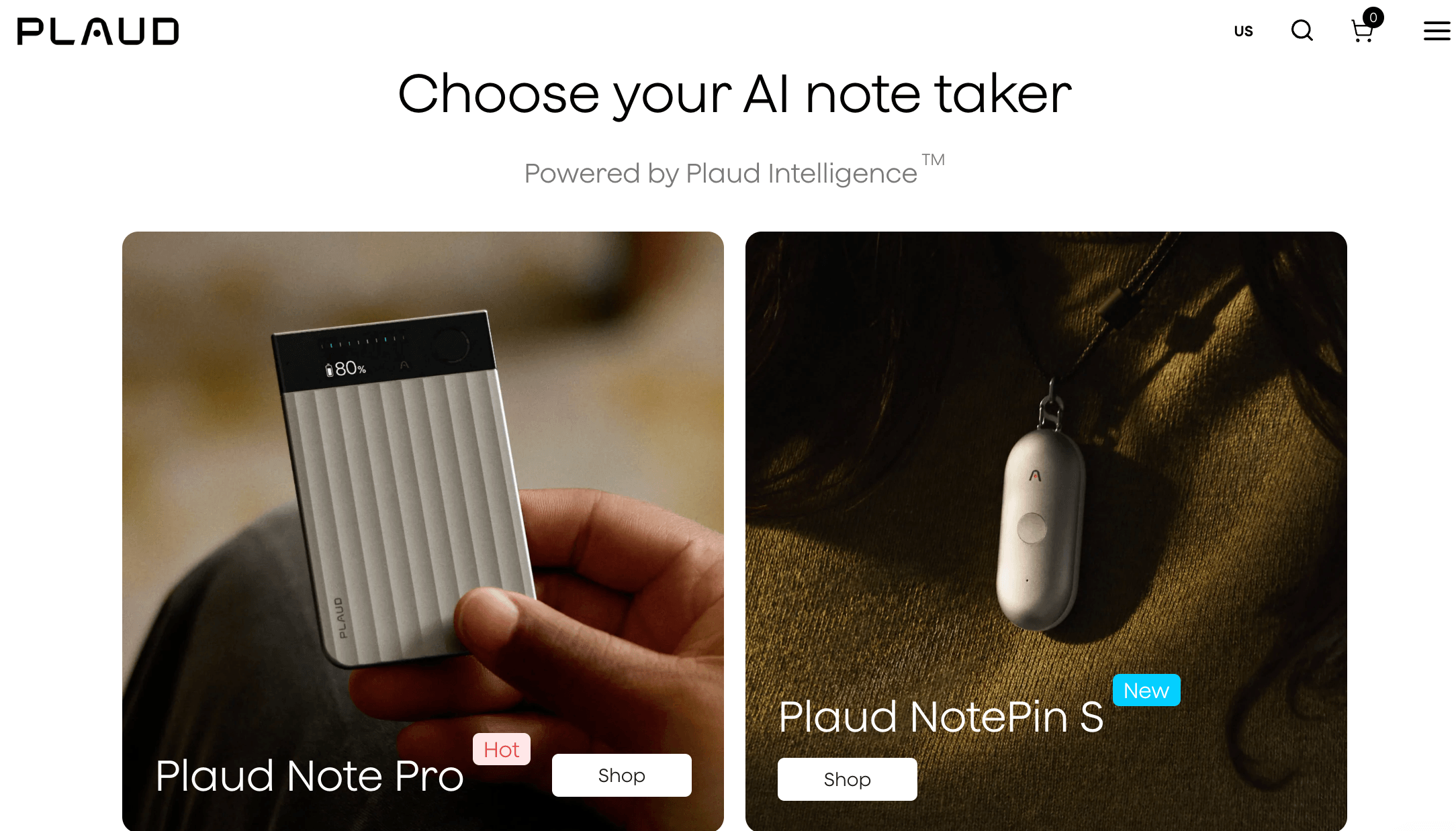
Plaud Inc. positions itself as the world’s No.1 AI note-taking brand, and it’s built around one idea: the only AI note-taking platform that bridges in-person conversations, phone calls, and online meetings into a single workflow, rather than forcing you to use a separate tool for each. Instead of a single gadget, Plaud sells a small hardware family — a credit-card-thin magnetic recorder (Note Pro and Note) and a wearable pendant (NotePin S and NotePin) — that all feed into the same Plaud app and the same Plaud Intelligence AI engine on the back end.
The core workflow is simple. You press one button to start recording — in a meeting room, on a phone call, or during a solo brainstorm — and Plaud’s AI transcribes the audio, identifies speakers, and generates a structured summary with key points and action items, typically within minutes of the recording ending. From there you can ask Plaud follow-up questions about what was discussed, export the summary to your notes app or CRM, or share a clean write-up with colleagues who weren’t in the room.
Plaud has built real credibility beyond its own marketing. The flagship Plaud Note Pro has been recognized as a Forbes Vetted 2026 Best AI Wearable and an iF Design Award 2026 winner, and the brand shows up consistently in outlets like The Verge, Forbes, TechCrunch, Wired, and ZDNET. On review platforms, the picture is strong but not spotless: the Plaud app carries a 4.9/5 rating on the App Store across roughly 16,000 ratings and a 4.6/5 score on G2, while Trustpilot — where thousands of verified buyers have weighed in — sits in solidly positive but noticeably more mixed territory, which is worth digging into before you commit to a device plus a subscription.
What separates Plaud from a basic voice recorder or a single-purpose meeting bot is the breadth of the ecosystem: four distinct hardware devices at different price points and form factors, a tiered AI subscription structure with add-on minute packs, business-focused offerings including a device SDK, API, and MCP/CLI integration for developers, and dedicated solutions built out for sales, healthcare, and education. It’s a platform play, not just a gadget.
Why Plaud Stands Out in 2026
One workflow across every kind of conversation: Most competitors are built for one context — a meeting bot that only joins Zoom calls, or a pendant that only captures in-person chatter. Plaud’s whole pitch is bridging in-person conversations, phone calls, and online meetings into a single app and a single searchable record, so you’re not juggling three tools to cover your actual day.
Genuinely impressive hardware in the Note Pro: At 2.99mm thin and 30 grams, the Note Pro packs four MEMS microphones plus a dedicated voice-pickup unit, delivering an effective pickup range independent reviewers put at roughly 16.4 feet (about 5 meters) across a conference table. It also adds a small AMOLED status display and smart dual-mode recording that automatically switches between phone-call mode and in-person meeting mode, so you’re not fumbling with settings mid-conversation.
Battery life that survives a real work week: The Note Pro is rated for up to 30 hours of continuous recording in its higher-quality Enhance mode, or up to 50 hours in Endurance mode, backed by a 500mAh battery — a meaningful jump from the original Note’s 400mAh cell and roughly 30-hour ceiling. For most professionals, that means charging on your schedule, not the device’s.
Multimodal capture and 112-language transcription: Plaud Intelligence doesn’t just process audio — it accepts multimodal input and transcribes in 112 languages, which matters for global teams, multilingual clinics, or anyone working across borders where a single-language tool falls short.
Ask Plaud turns your history into a searchable memory: Beyond a one-time summary, you can query Plaud about past conversations — pulling a commitment made three meetings ago or a detail buried in a call from last month — using natural language rather than scrolling through old transcripts.
Security posture built for regulated industries: Plaud publishes ISO 27001, ISO 27701, SOC 2, GDPR, HIPAA, and EN18031-1 compliance, and states plainly that recordings and transcriptions are never used to train AI models or shared with third parties. For healthcare and legal use cases specifically, that’s a genuine differentiator over consumer-grade recording apps.
A device for every use case, not one compromise: The lineup spans a discreet magnetic card recorder (Note / Note Pro) and a hands-free wearable pendant (NotePin / NotePin S), so you can pick the form factor that matches how you actually work — clipped to your phone for back-to-back meetings, or worn all day for in-person, hands-free capture — rather than forcing one shape to fit every scenario.
Key Features and Technology
Plaud’s platform breaks down into hardware, the AI engine that processes what the hardware captures, and the business/developer layer sitting on top. Here’s how each piece actually works.
The Device Lineup: Note Pro, Note, NotePin S, and NotePin
The Plaud Note Pro is the flagship: a 2.99mm-thin, 30-gram card that magnetically attaches to the back of a MagSafe iPhone or a compatible Android case, effectively disappearing from view while it records. It runs four MEMS beamforming microphones plus a voice-processing unit for noise suppression and echo cancellation, a small AMOLED display for at-a-glance recording status and battery life, BLE 5.4 connectivity, and smart dual-mode recording that auto-detects whether you’re on a call or in a room full of people. The original Plaud Note keeps the same magnetic card form factor at a lower price, but with two MEMS microphones instead of four, roughly half the pickup range (about 9.84 feet versus 16.4 feet), no display, manual mode switching instead of automatic, and BLE 5.2. The Plaud NotePin S and Plaud NotePin shift to a wearable pendant format for hands-free, always-on capture — well suited to in-person conversations, lectures, and situations where clipping a device to your phone isn’t practical, with the NotePin S adding several bundled accessories over the standard NotePin.
Plaud Intelligence: Transcription, Summaries, and Ask Plaud
Once audio is captured, Plaud Intelligence takes over: multimodal input processing, transcription across 112 languages, and AI-generated summaries built from more than 10,000 official templates (meeting minutes, sales call recaps, lecture notes, medical consultation summaries, and more), plus support for fully custom templates and a template community for sharing formats other users have built. The Ask Plaud feature lets you query your own recording history conversationally, and an industry glossary helps the AI correctly interpret specialized terminology in fields like law, medicine, and finance. Finished notes can be exported, shared, or integrated into other tools rather than trapped inside the app.
Cross-Platform Access: Web, Desktop, and Mobile
Recordings and notes sync across the Plaud mobile app (iOS and Android), Plaud Web, and a native Plaud Desktop client for Windows and macOS (both Intel and Apple Silicon), so a conversation captured on the hardware in the morning is searchable and editable from a laptop later in the day without manually transferring files.
Business, Developer, and Security Tools
Beyond individual use, Plaud offers a Team Plan and dedicated business solutions with expert-guided recommendations for organizations, plus a Device SDK and API and an MCP (Model Context Protocol) and CLI integration for developers who want to build Plaud’s capture and transcription layer into their own tools. On security, Plaud publishes ISO 27001, ISO 27701, GDPR, SOC 2, HIPAA, and EN18031-1 compliance, encrypts data in transit and at rest with additional layers for sensitive personal information, and gives users control over whether recordings stay on-device or sync to Plaud’s encrypted private cloud.
Pricing, Plans, and Package Structure
Plaud follows a hardware-plus-subscription model: you buy a device once, and every device includes a free Starter plan with 600 minutes of AI transcription per month. Heavier users can upgrade to a paid Pro or Unlimited AI plan, either as a monthly subscription or a discounted annual plan bundled at checkout with the device. The prices below reflect Plaud’s standard published rates as of mid-2026; the brand runs frequent promotions, so always confirm the live price before purchasing.
| Product | Price (USD) | What It Is | Best For |
|---|---|---|---|
| Plaud Note Pro | $189.00 | Flagship 2.99mm magnetic recorder, 4 mics, AMOLED display, 50hr battery | Professionals in back-to-back calls and meetings |
| Plaud Note | $159.00 | Original magnetic card recorder, 2 mics, manual mode switching | Hybrid workers wanting core features at a lower cost |
| Plaud NotePin S | $179.00 | Wearable pendant recorder with 4 bundled accessories | Hands-free capture of in-person conversations |
| Plaud NotePin | $159.00 | Lightweight wearable pendant, 3 color options | Everyday, lightweight wearable capturing |
| AI Pro Plan | $99.99/yr ($17.99/mo) | 1,200 minutes/month AI transcription, full template library | Regular meeting and call volume |
| AI Unlimited Plan | $239.99/yr ($29.99/mo) | Unlimited minutes AI transcription, full template library | Heavy daily users, back-to-back schedules |
| Minute Add-Ons | 600 / 3,000 / 6,000 min packs | One-time transcription quota top-ups | Occasional overflow without upgrading plans |
How Plaud Compares to Alternatives
| Factor | Plaud (Note Pro) | Otter.ai | Bee Pioneer |
|---|---|---|---|
| Hardware required | Yes — dedicated recorder | No — software/app only | Yes — wearable pendant |
| Captures in-person conversations | Yes — core use case | Limited (phone mic only) | Yes — core use case |
| Joins Zoom/Teams/Meet directly | Via desktop/mic capture | Yes — bot joins meetings | No — needs phone nearby |
| Free tier minutes/month | 600 (Starter, with device) | 300 (30-min cap per call) | 300 (approx., paid plans available) |
| Entry hardware price | $159–$189 | None (software-only) | ~$49.99 |
| Top paid AI plan (annual) | $239.99/yr unlimited | ~$240/yr per seat (Business) | ~$8–$20/mo (approx.) |
| Compliance certifications | ISO 27001/27701, SOC 2, HIPAA, GDPR | SOC 2 (Enterprise tier) | Limited / varies |
| Best for | Mixed in-person, call & meeting workflows | Teams living inside online video calls | Budget-conscious all-day capture |
vs. Otter.ai: Otter is a pure-software meeting assistant that joins Zoom, Teams, and Google Meet as a bot and transcribes what happens on-screen — it has no dedicated hardware and a weaker story for capturing in-person conversations, since it relies on your phone or laptop microphone. Plaud’s advantage is the dedicated recorder purpose-built for rooms and calls away from a screen. If your work is almost entirely video calls, Otter’s meeting-bot integration is more turnkey; if your day mixes in-person meetings, phone calls, and video calls, Plaud’s hardware-first approach covers more ground.
vs. Bee Pioneer: Bee is the budget wearable pendant in this category, priced around $49.99 with no mandatory subscription for basic use. It’s a reasonable low-cost entry point into AI wearables, but it lacks Plaud’s specialized call-recording hardware, its dual-mode auto-switching, and its compliance certifications for regulated fields. If price is the only factor, Bee undercuts Plaud significantly; if build quality, microphone performance, and enterprise-grade security matter, Plaud’s Note Pro pulls well ahead.
vs. a plain voice recorder plus ChatGPT: A basic digital recorder is cheaper up front and produces raw audio you can feed into any AI tool manually. But that workflow means exporting files, uploading them somewhere, and prompting an AI yourself every single time — Plaud automates that entire chain, adds speaker identification, purpose-built templates, and a searchable history, and does it inside one connected app rather than three disconnected steps.
Pros and Cons
What Users Love
Transcription and summary accuracy: The most consistent praise across App Store, G2, and Trustpilot reviews is straightforward — users repeatedly describe the transcripts and AI-generated summaries as surprisingly accurate and well-structured, even in multi-speaker settings like boardrooms with people joining by phone.
It genuinely lets you stay present: Reviewers across professions — sales, healthcare, law, education — describe the same benefit in different words: no longer splitting attention between listening and writing, because Plaud is quietly capturing everything in the background.
Premium hardware feel on the Note Pro: Independent hands-on reviewers consistently call out the Note Pro’s thinness, the bright, legible AMOLED display, and the accuracy of the four-microphone beamforming array, comparing the transcription quality favorably against manual phone-recording-plus-separate-AI workflows.
Customer support that comes through for most: A meaningful share of Trustpilot reviews describe fast, effective resolutions to hardware problems — replacement units shipped quickly and support staff described as courteous and thorough, with some reviewers explicitly calling out staff by name.
Depth of templates and use-case fit: With over 10,000 official templates plus a template community, users across very different fields — from medical consultations to sales calls to lecture notes — report the AI output matching the actual format they need rather than a generic one-size-fits-all summary.
Privacy stance resonates with buyers: Reviewers in regulated fields specifically cite the “never sold or trained on” data policy and HIPAA/SOC 2/GDPR certifications as a reason they chose Plaud over a generic recording app.
Limitations Worth Knowing
Real support complaints exist alongside the praise: Trustpilot also carries a meaningful minority of serious negative experiences — reports of packages lost in transit, one buyer describing their purchase flagged as a “fraudulent transaction” by support, and units arriving defective. Balance the many positive service stories against the fact that a real subset of buyers have had a genuinely bad experience.
Hardware plus subscription adds up: The $189 Note Pro plus a $239.99/year Unlimited plan runs close to $430 in year one — more than double the price of Otter.ai’s Business plan, though Otter has no hardware and weaker in-person capture. Budget for both pieces before comparing sticker prices.
Proprietary charging cable on the Note Pro: To preserve its 2.99mm profile, the Note Pro uses a proprietary cable rather than USB-C. Losing it means waiting on a replacement before the device can charge — a real inconvenience even if the design trade-off is understandable.
Battery mode is a real trade-off: The advertised 50-hour battery figure applies only to Endurance mode, which drops beamforming and shortens pickup range to under 10 feet. Most users running the higher-quality Enhance mode should plan around roughly 30 hours, not 50.
Minute caps sting on lower tiers: The free Starter plan’s 600 monthly minutes and even the Pro plan’s 1,200 minutes can be consumed quickly by anyone in back-to-back meetings, pushing heavy users toward the $239.99/year Unlimited plan or one-time minute add-on packs.
Cloud dependence and consent obligations: Full AI processing generally requires syncing to Plaud’s cloud, so users with strict no-cloud requirements should review the on-device options carefully. And because Plaud records other people, users bear the responsibility of getting consent and following the recording laws in their own jurisdiction — this isn’t a “record anyone, anytime” device without legal considerations attached.
Who Should Use Plaud
Sales professionals: Capturing client calls automatically and generating structured follow-ups means less time updating the CRM after the fact and more time actually selling — a use case Plaud builds dedicated sales solutions around.
Clinicians and healthcare professionals: With HIPAA compliance and templates built for medical consultations, Plaud lets clinicians stay focused on patients instead of typing notes during the visit, then generates a complete chart afterward.
Lawyers and consultants: Accurate, searchable records of client consultations matter when precision counts — Plaud turns spoken conversations into records that can be searched and referenced later rather than relying on memory or handwritten notes.
Executives, students, and educators: Anyone in a high volume of meetings, lectures, or briefings who wants to stay mentally present instead of transcribing in real time will find genuine value here, whether that’s an executive tracking key decisions or a student capturing a full lecture.
Who should look elsewhere: Anyone whose work happens almost entirely inside Zoom or Teams may get more turnkey value from a pure meeting bot like Otter.ai without buying hardware. Extremely budget-conscious buyers who just want occasional voice memos are better served by a free phone recorder or a low-cost pendant like Bee. And anyone with a strict no-cloud-processing requirement should scrutinize Plaud’s data-sync policies carefully before buying, since full AI features generally rely on cloud processing.
Getting Started: Step by Step
- Pick your device. Choose the Note Pro for the best microphones, longest battery, and display; the standard Note for the same magnetic form factor at a lower price; or a NotePin/NotePin S if you want a hands-free wearable rather than a phone-attached card.
- Take stock of your monthly minutes. Before subscribing to anything paid, use the free Starter plan’s 600 monthly minutes for a few weeks and track how much transcription time you actually use — it’s the best way to decide between the Pro plan (1,200 min/mo) and the Unlimited plan.
- Set up the app and connect your device. Download the Plaud app (iOS, Android, Web, or Desktop), pair it with your device over Bluetooth, and take a minute to review the recording modes so you understand call mode versus meeting mode.
- Record with consent. Before recording others, let them know and confirm you’re following your local consent laws — some jurisdictions require everyone’s agreement, not just your own.
- Choose the right template. Match the AI summary format to the conversation — a sales-call template for client calls, a medical-consultation template for patient visits, a lecture template for classes — rather than defaulting to a generic summary every time.
- Build your workflow around Ask Plaud. Once you’ve built up a history of recordings, use Ask Plaud to pull details from past conversations instead of manually searching old transcripts, and set up exports to your notes app or CRM so summaries land where you actually work.
Tips for Getting Maximum Value
Use Enhance mode for anything where transcription accuracy matters most — client calls, patient consultations, legal conversations — and reserve Endurance mode for long, lower-stakes days where battery life outweighs the extra pickup range. Build a small library of custom templates for your most common conversation types instead of relying on generic summaries every time; the time invested up front pays off on every future recording. If you’re weighing the Note Pro against the standard Note, remember the real difference isn’t just battery — it’s microphone count and pickup range, which matters most in larger rooms or noisier environments. Keep the proprietary charging cable somewhere you won’t lose it, since it isn’t a standard USB-C cable you can easily replace on short notice. And before recording any external party, take the extra ten seconds to mention it and get a nod — it protects you legally and keeps the relationship on solid footing.
Future Outlook and Final Assessment
The AI note-taking category is consolidating fast in 2026. Meta’s acquisition of Limitless removed one of Plaud’s higher-profile wearable rivals from the market, and the field is increasingly splitting between software-only meeting bots (Otter.ai and similar) and dedicated hardware players (Plaud, Bee, and a handful of newer entrants). Plaud’s bet — that people need one workflow spanning in-person conversations, phone calls, and online meetings, backed by dedicated hardware rather than relying on a phone’s built-in microphone — looks well positioned given how the category is evolving, and the brand’s growing press recognition and near-2-million user base suggest real market traction rather than just marketing spend.
The honest caveats remain real: the combined cost of hardware plus an annual AI plan is a genuine commitment, a real minority of Trustpilot reviews describe serious shipping and support problems, and the proprietary charging cable on the flagship Note Pro is a small but recurring frustration. Within those limits, Plaud delivers one of the more complete AI note-taking systems available in 2026 — strong hardware, a capable AI layer, and enterprise-grade security credentials that matter for regulated professions.

Conclusion
Plaud isn’t trying to be the cheapest AI recorder or the simplest meeting bot — it’s trying to be the one tool that follows you across every kind of conversation your job actually involves, from a hallway chat to a client call to a scheduled video meeting. By pairing genuinely strong hardware with a capable, security-conscious AI layer and a broad template library, it removes a real amount of the administrative overhead that comes with modern work. It rewards buyers who track their actual usage before committing to an annual plan, and it isn’t the right call for people whose work lives entirely inside Zoom or who want to spend as little as possible on the category — but for the high-conversation reality of sales, healthcare, law, and executive work, few AI note-taking systems in 2026 cover as much ground. Confirm the current price and plan bundle, and Plaud can take one of the most tedious parts of a working day off your plate.
Ready to stop taking notes and start staying present?
Explore more honest reviews, tutorials and tech comparisons to find the right gear for the way you work, travel and live — at World Of Tech, where we make everything easy.
👉 Shop Plaud: https://worldoftech.space/plaud
👉 Our YouTube Channel: youtube.com/@world_tech79
👉 Our Facebook Fanpage: Facebook
👉 Our X (Twitter): @worldoftech79
Pricing, specifications and policy details in this review were verified against plaud.ai and independent review sources (including Trustpilot, App Store, and G2) as of August 2026. AI hardware pricing, subscription plans, and promotions change frequently, so confirm current details on the official site before purchasing. Competitor prices are approximate and subject to change.