
Chatbase (chatbase.co) has emerged as one of the most powerful and accessible AI chatbot builders in the world, serving over 10,000 businesses across dozens of countries since its viral launch in February 2023 — building a global reputation for fast deployment, no-code simplicity, and unmatched AI model flexibility that makes intelligent customer support automation genuinely accessible for businesses of every size. Before diving into the full feature breakdown and buying guide ahead, it’s worth highlighting what makes Chatbase the standout choice for AI chatbot builders in 2026: a complete platform offering 15+ AI models from 6 providers including GPT-5.2 and Claude Opus 4.6, a genuinely no-code setup that gets a live chatbot deployed in under 10 minutes, multi-channel deployment across website, WhatsApp, Messenger, Instagram, Slack, and Email, powerful AI Actions for real task automation beyond simple Q&A, enterprise-grade SOC 2 Type II + GDPR security, a free plan with no credit card required, and paid plans starting at just $40/month. Whether you’re a small business owner who needs a 24/7 FAQ bot that never takes a sick day, a SaaS company looking to automate first-line customer support at scale, a marketing team wanting to capture leads while visitors are most engaged, an e-commerce brand that needs to handle order questions without growing the support headcount, or simply a business ready to deploy AI and stop letting support tickets pile up — this comprehensive review walks you through every major feature, pricing tier, limitation, and buying consideration for Chatbase in 2026.
Chatbase Review 2026: The Best No-Code AI Chatbot Builder for Customer Support, Lead Capture, and Business Automation
Overview: What Is Chatbase and Who Is It For?
Chatbase is an AI-powered platform that lets businesses build custom AI agents — intelligent chatbots trained on their own business data — and deploy them across websites and popular messaging channels without writing a single line of code. Founded on February 4, 2023 by Yasser Elsaid, a York University computer science graduate who previously interned at Meta, Tesla, and BlackBerry, Chatbase was one of the very first “chat with your data” SaaS products ever built. Launched to just 16 Twitter followers, it went viral almost immediately and has since grown into a platform serving over 10,000 businesses, generating an estimated $5–6M in annual recurring revenue — entirely bootstrapped with zero external funding.
The platform’s core promise is disarmingly simple: feed Chatbase your business knowledge — website URLs, PDFs, documents, FAQs, or Q&A pairs — and it creates a conversational AI agent that answers customer questions, captures leads, books meetings, and performs automated tasks based specifically on your content. Unlike general-purpose AI assistants like ChatGPT, a Chatbase agent responds only from your indexed business data, significantly reducing hallucinations and off-topic responses that erode customer trust.
What truly differentiates Chatbase from every competitor in 2026 is its AI model flexibility. While most chatbot builders lock users into a single AI provider’s model, Chatbase offers 15+ models from 6 different providers — including OpenAI’s GPT-5.2, Anthropic’s Claude Opus 4.6, Google’s Gemini 3 Pro, xAI’s Grok 4, Moonshot AI’s Kimi K2, and DeepSeek models. This lets businesses choose the right model per agent and switch at any time, optimizing for cost, speed, or intelligence depending on the specific use case.
Chatbase in 2026 — Key Platform Facts
- 10,000+ Businesses Served Globally: Chatbase has grown to serve over 10,000 businesses since its 2023 launch — a remarkable adoption rate for a bootstrapped product that validates the market demand for accessible, no-code AI chatbot deployment at a broad scale.
- Founded February 2023, Entirely Bootstrapped: Unlike most AI SaaS companies that have raised millions in venture capital, Chatbase has grown to an estimated $5–6M ARR without any external funding — a testament to genuine product-market fit and sustainable growth driven by real user value rather than marketing spend.
- 15+ AI Models from 6 Providers: No other chatbot builder in 2026 offers this level of AI model flexibility — providers include OpenAI, Anthropic, Google, xAI, Moonshot AI, and DeepSeek, with each model optimized for different use cases, cost levels, and quality requirements.
- Under 10 Minutes to Deploy: Chatbase’s no-code setup genuinely delivers on its speed promise — paste a URL, customize the widget, copy the embed code, and a live AI chatbot is answering customer questions on your website in minutes without any developer involvement.
- SOC 2 Type II + GDPR + SSO Security: Enterprise-grade security at mid-tier pricing — Chatbase’s SOC 2 Type II certification with independently audited security controls, GDPR compliance, AES-256 encryption, and SSO (added January 2026) is a rare combination that most competitors reserve for plans costing $495+ per month.
- 6+ Native Deployment Channels: One trained AI agent deploys across website chat widget, WhatsApp Business, Facebook Messenger, Instagram DMs, Slack, and Email — plus API, Zapier, and Make integrations for additional channels and custom workflows.
- RAG Technology Architecture: Chatbase uses Retrieval-Augmented Generation — when a visitor asks a question, the platform retrieves the most relevant information from indexed business data and feeds it to the selected AI model, ensuring responses are grounded in your content rather than general AI knowledge.
- Free Plan Available: Chatbase offers a genuine Free Forever plan (50 message credits/month, 1 AI agent) that allows businesses to evaluate the platform with zero financial commitment before deciding whether to upgrade to a paid tier.
Chatbase enables businesses to build custom AI agents trained on their own data and deploy them across 6+ channels — transforming customer support, lead capture, and business automation without writing a single line of code.
Key Features and Platform Capabilities
Chatbase’s 2026 platform covers five core capability areas — AI training and knowledge management, AI model selection, task automation via AI Actions, multi-channel deployment, and analytics and improvement tools — plus enterprise security and voice AI as emerging capabilities. Here is a comprehensive breakdown of each major feature area.
AI Training and Knowledge Base: What You Can Feed Your Agent
The foundation of any Chatbase agent is the knowledge base — the business data the AI draws from when answering questions. Chatbase supports the most comprehensive range of training data sources of any no-code chatbot builder in its class.
- Website URL Crawling (1-Click): Paste any website URL and Chatbase automatically crawls all linked pages — product pages, blog posts, FAQs, help documentation, pricing pages — and indexes everything as AI training data. The system handles site structure automatically, so you don’t need to list individual pages. This is Chatbase’s most-used onboarding method and the fastest way to train a support agent on an existing website.
- Document Upload (PDF, DOCX, TXT, CSV): Upload internal documents — user manuals, SOPs, product specs, training guides, pricing sheets — directly to the knowledge base. The AI learns from document content and can cite specific sections when answering questions. CSV uploads are particularly useful for product catalogs and FAQ lists with structured question-answer formats.
- Notion Workspace Integration: Connect your Notion workspace directly to sync knowledge base pages, wikis, and documentation as live training data — particularly valuable for teams that maintain their internal knowledge in Notion and want the AI agent to reflect the most current information.
- Q&A Pairs (Manual Override): Define specific question-answer pairs for critical queries that need exact, controlled responses — pricing questions, legal disclaimers, escalation triggers — where you need deterministic outputs rather than AI-generated responses. Q&A pairs always take priority over general knowledge base content.
- Zendesk and Salesforce Ticket Import (New in 2026): As of January 2026, Chatbase can ingest historical support tickets from Zendesk and Salesforce as training data — giving the AI agent the benefit of thousands of real customer interactions and resolution patterns that never existed in static documentation.
- Automatic Daily Retraining: Set your agent to automatically retrain every 24 hours so it stays current when your website content, pricing, or product information changes — eliminating the manual effort of keeping the AI knowledge base synchronized with evolving business content.
AI Model Selection: 15+ Models, 6 Providers
- OpenAI Models: GPT-5.2 (highest tool-calling accuracy at 98.7%, best for AI Actions), GPT-5 Mini, GPT-4o, GPT-4o Mini (1 credit, most cost-efficient), GPT-4.5, O3 Mini. GPT-5.2 is the recommended default for businesses deploying AI Actions due to its superior task completion reliability.
- Anthropic Claude Models: Claude Opus 4.6 (5 credits, best for nuanced reasoning and financial analysis), Claude Opus 4.5 (5 credits), Claude Sonnet 4.5 (3 credits), Claude 3.7 Sonnet, Claude 3.5 Sonnet (1 credit). Claude models are recommended for use cases requiring careful, nuanced language and complex reasoning beyond simple FAQ retrieval.
- Google Models: Gemini 3 Pro (2 credits), Gemini 2.5 Pro, Gemini 2.0 Flash. Gemini models excel at multilingual tasks and long-context document analysis — useful for businesses with diverse international customer bases or lengthy technical documentation.
- xAI, Moonshot AI, and DeepSeek Models: Grok 4 (4 credits), Grok 3 (3 credits), Kimi K2 (excellent for research and analysis tasks), DeepSeek-V3 and DeepSeek-R1 (1 credit each, strong quality-to-cost ratio). DeepSeek models provide near-GPT-4o quality at 1-credit consumption — the best value option for high-volume deployments where cost management is a priority.
Chatbase’s selection of 15+ AI models from 6 providers — including GPT-5.2, Claude Opus 4.6, Gemini 3 Pro, Grok 4, and DeepSeek — gives businesses the flexibility to optimize for cost, speed, or quality that no single-provider chatbot builder can match.
AI Actions: Automation Beyond Q&A
AI Actions are what elevate Chatbase from a smart FAQ bot to a genuine AI agent capable of autonomous task completion. Rather than simply retrieving information, AI Actions allow the agent to take real-world actions during a conversation — connecting to external systems and executing tasks without human intervention.
- Meeting Booking (Calendly / Cal.com): The agent can check availability and book meetings directly in the conversation flow — presenting available slots, collecting attendee information, and creating confirmed bookings without routing the visitor to a separate scheduling page.
- Order Lookup and Status Checks: Connect the agent to your order management system via API and it can retrieve and present live order status, tracking information, and delivery estimates in response to customer questions — eliminating the most common inbound support query for e-commerce businesses.
- Billing and Subscription Queries (Stripe): The agent can access billing information, subscription status, and invoice history via Stripe integration — handling payment-related questions that previously required human agent involvement.
- Support Ticket Creation (Zendesk): When the AI cannot resolve a query from the knowledge base, it can create a structured support ticket in Zendesk with conversation context — ensuring human agents receive all necessary background without the customer needing to repeat their issue.
- Custom Webhooks and API Calls: Define custom API Actions to connect the agent to any internal or external system — inventory management, CRM updates, custom databases, proprietary business logic — enabling use cases specific to each business’s unique workflows.
- 5,000+ App Integrations via Zapier and Make: For businesses using Zapier or Make, AI Actions can trigger automated workflows across the entire app ecosystem — creating CRM contacts, sending Slack notifications, updating spreadsheets, and hundreds of other automated tasks as a direct result of chatbot conversations.
Multi-Channel Deployment: One Agent, Six Channels
- Website Chat Widget: A floating chat bubble that appears on any webpage where the embed code is installed — customizable with your brand colors, logo, welcome message, and suggested opening questions. For WordPress, the free WP Code plugin handles installation without theme editing.
- Help Page (Standalone Interface): A full-page ChatGPT-style interface at a custom path on your domain — giving customers a dedicated support portal experience rather than a floating widget. Ideal for help centers and documentation sites where users expect a full-screen support experience.
- WhatsApp Business: Native WhatsApp deployment reaches customers in their preferred messaging environment — particularly valuable for businesses serving international markets where WhatsApp is the dominant communication platform across Latin America, Europe, and Southeast Asia.
- Facebook Messenger and Instagram DMs: Deploy the same trained agent to handle conversations arriving through Facebook and Instagram social channels — unifying support across social media without maintaining separate bot configurations for each platform.
- Slack Workspace Integration: Internal knowledge bot for team use — employees can ask the AI agent questions about company policies, product specs, or internal processes directly in Slack without leaving their work environment.
- Email Channel (Beta): Email-based support automation is available in beta — the agent can read incoming support emails, generate draft responses, and handle routine email queries at scale.
Lead Capture, Analytics, and Continuous Improvement
- Intelligent Lead Capture: Configure the agent to request visitor information — name, email, phone number — before or during conversations. Captured leads are stored in the Leads dashboard, filterable by date range, and exportable as CSV for CRM import or Zapier-triggered follow-up workflows.
- Conversation Analytics: Review full conversation histories to identify patterns — what questions the AI answered well, where it struggled, which topics generated the most conversations, and where visitors disengaged. This qualitative insight is invaluable for both improving the AI agent and understanding customer needs.
- Source Transparency (“Show Sources”): Every AI response includes a “Show Sources” option revealing which specific pieces of training data were used to generate the answer — enabling quality monitoring and identification of knowledge gaps that need additional documentation.
- Improve Answer Feature: When reviewing chat logs and identifying an incorrect or incomplete response, the Improve Answer feature lets you submit a corrected version that the agent learns from — creating a continuous improvement loop that makes the agent progressively more accurate over time.
- 95+ Languages with Auto-Detection: The agent automatically detects and responds in the visitor’s language — even if all training data is in English. As of January 2026, the chat widget UI is also localized in 40+ languages including Arabic and Hebrew RTL support.
Pricing, Plans, and Value Proposition
Chatbase’s pricing structure covers a genuine range from a free entry point through professional and enterprise tiers — with the critical variable being message credits, which are consumed at different rates depending on which AI model the agent uses. Understanding credit consumption is essential for accurately projecting monthly costs before committing to a plan.
Chatbase Pricing Plans for 2026
| Plan | Monthly Price | Message Credits | AI Agents | AI Actions | Best For |
|---|---|---|---|---|---|
| Free | $0/month | 50 credits | 1 | — | Platform testing, proof of concept |
| Hobby | $40/month | 1,500 credits | 1 | 5 per agent | Small businesses, single-bot deployment |
| Standard | $150/month | 10,000 credits | 2 | 10 per agent | Growing teams, multi-bot deployments |
| Pro | $500/month | 40,000 credits | 3 | 15 per agent | High-volume support, advanced analytics |
| Enterprise | Custom pricing | Custom | Custom | Custom | Large organizations, dedicated support |
| Annual Billing Discount | –20% off all paid plans | — | — | — | Committed users seeking best value |
Credit consumption by AI model: This is the most important pricing variable to understand before selecting a plan. A 1-credit response from GPT-4o Mini or DeepSeek costs the same as a 5-credit response from Claude Opus 4.6. The Hobby plan’s 1,500 credits can yield 1,500 responses with efficient models or just 300 responses with premium models. Mapping model choice to monthly conversation volume before committing to a plan avoids mid-month credit depletion. Notable credit rates: GPT-4o Mini / DeepSeek (1 credit), GPT-5.2 / Gemini 3 Pro (2 credits), Claude Sonnet / Grok 3 (3 credits), Grok 4 (4 credits), Claude Opus 4.6 (5 credits).
Add-on costs to factor into total budget: Extra message credits ($15–20 per 1,000 credits), extra AI agents ($25/month each), custom domain ($199/month), and Chatbase branding removal ($199/month). White-labeling the chatbot completely — removing all Chatbase branding and using a custom domain — adds up to $398/month on top of the base plan, which is a significant consideration for agencies building chatbots for multiple clients.
Pro tip: New users should start with the Free plan to validate that the AI handles their specific business questions accurately before paying anything. If the free plan’s 50 credits are quickly exhausted and responses are high quality, that’s a strong signal to upgrade to Hobby at $40/month and start with 1-credit models like GPT-4o Mini or Claude 3.5 Sonnet. Reserve premium 5-credit models like Claude Opus 4.6 for specific high-stakes conversations rather than as the default model for all interactions — this dramatically extends monthly credit budgets without sacrificing quality where it matters most.
Comparisons: Chatbase vs. Competitors in 2026
The AI chatbot builder market in 2026 is crowded — with dozens of platforms competing across the no-code, mid-market, and enterprise segments. Chatbase’s differentiation lies in its AI model flexibility, its rapid no-code deployment, and its mid-tier pricing for enterprise-grade security that competitors typically reserve for significantly more expensive plans.
Chatbase vs. Tidio, CustomGPT, Botpress, and LiveChat
| Chatbase 2026 | Tidio | CustomGPT AI | Botpress | Intercom Fin AI | |
|---|---|---|---|---|---|
| Starting Price | $0 (Free plan) | Free (50 chats) | $89/month | Free (limited) | $29/seat/month |
| AI Models Available | 15+ from 6 providers | Lyro (Claude-based) | GPT-4o, GPT-4o Mini | GPT-4o, Claude | Fin AI (proprietary) |
| Setup Time | <10 minutes | <15 minutes | <10 minutes | Hours (visual builder) | Hours |
| Built-in Live Chat | ✗ No | ✓ All plans | ✗ No | ✗ No | ✓ Yes |
| Visual Flow Builder | ✗ No | ✓ Add-on | ✗ No | ✓ Core feature | ✓ Yes |
| SOC 2 + GDPR | ✓ Both | GDPR only | ✓ Both | GDPR only | ✓ Both |
| WhatsApp Deployment | ✓ Native | ✓ Native | ✗ No | ✓ Via integration | ✓ Yes |
| Data Never Used for Training | ✓ Confirmed | ✓ Confirmed | ✓ Confirmed | Varies by model | ✓ Confirmed |
| Languages Supported | 95+ (auto-detect) | 45+ | 40+ | 50+ | 40+ |
| Best For | AI flexibility, fast deploy, lead capture, global businesses | E-commerce + live chat | High-accuracy custom agents | Complex conversation flows | Enterprise support at scale |
Chatbase’s edge: Chatbase’s competitive position is strongest at the intersection of AI model flexibility and deployment speed. No other platform in the $0–$500/month tier offers 15+ AI models from 6 providers — and the ability to switch models per agent or compare them side-by-side in the Playground is a genuine differentiator for businesses that want to optimize for cost or quality without being locked into one provider’s ecosystem. For businesses choosing between Chatbase and Tidio, the key decision point is live chat: Tidio includes a built-in live chat inbox on every plan (even free), making it the better choice when human handoff is non-negotiable. For businesses comparing Chatbase to Botpress, Chatbase wins on speed (under 10 minutes vs. hours with a visual flow builder) but Botpress wins when conditional logic and deterministic conversation paths are required. For businesses evaluating Intercom Fin AI, Chatbase offers significantly lower cost at the expense of Intercom’s more mature support ticketing and human handoff ecosystem.
Getting Started: How to Choose the Right Chatbase Plan and Set Up Your First Agent
Chatbase’s broad platform capabilities mean that choosing the right approach requires a clear assessment of your use case, conversation volume, required AI quality, and whether built-in live chat is a must-have or a nice-to-have. Here is a practical buying and setup framework for new Chatbase customers.
Step-by-Step Setup Guide for New Chatbase Users
- Define Your Primary Use Case Before Choosing a Plan:
- FAQ automation and customer support (low-to-moderate volume, under 1,000 conversations/month): Free plan to test, then Hobby ($40/month) with efficient 1-credit models — the most cost-effective entry point for small businesses validating AI support automation for the first time.
- Lead capture and sales qualification (marketing-driven, conversion-focused): Hobby or Standard plan with GPT-5.2 for AI Actions accuracy — the agent needs reliable task execution to book meetings and qualify leads without human review of every interaction.
- Multi-bot deployment (separate agents for support, sales, and internal use): Standard ($150/month, 2 agents) or Pro ($500/month, 3 agents) — each agent maintains its own knowledge base and model configuration for specialized performance in its dedicated role.
- High-volume support automation (thousands of conversations/month): Pro or Enterprise — the 40,000 credits at Pro level supports substantial monthly conversation volumes with mid-tier models, while Enterprise pricing provides custom credit packages for genuinely high-scale deployments.
- Train Your First Agent in Under 10 Minutes:
- Create your free Chatbase account and navigate to the “Add New Agent” dashboard — no credit card required at the free tier.
- Select “Website” as your data source and paste your primary business URL — Chatbase automatically crawls all linked pages and indexes content. For immediate quality testing, also upload your most frequently referenced PDF (product guide, FAQ document, or pricing sheet) to supplement the crawled content.
- Choose your AI model — start with GPT-4o Mini (1 credit) or Claude 3.5 Sonnet (1 credit) for testing to preserve free plan credits, then switch to a higher-capability model once you’re satisfied with the knowledge base quality.
- Customize the chat widget — brand colors, logo, welcome message (“Hi! I’m [Business Name]’s AI assistant — how can I help?”), and 3–4 suggested opening questions that reflect your most common customer queries.
- Test thoroughly in the Playground before going live — ask the agent your 20 most common support questions and review both the accuracy of responses and the sources cited. Identify gaps and add Q&A pairs or additional documentation for any questions the agent handles poorly.
- Deploy to Your Website:
- Copy the single-line embed code from the Deploy tab and paste it into your website’s footer or before the closing </body> tag — the chat widget appears immediately on all pages where the code is installed.
- For WordPress users specifically: install the free “WP Code” plugin from the WordPress plugin directory, create a new snippet with your Chatbase embed code, and set it to run in the site footer — this adds the chatbot to every page without editing theme files or risking theme update conflicts.
- Enable auto-retraining in the Settings tab — set the agent to automatically retrain every 24 hours so it stays current when your website content changes without requiring manual knowledge base updates.
- Set Up Lead Capture for Maximum Business Value:
- Configure the lead capture form in Agent Settings — decide whether to request visitor information before the conversation starts (proactive, higher capture rate but may deter casual browsers) or mid-conversation after the visitor has engaged (less friction, more qualified leads who’ve already invested in the interaction).
- Connect the Leads dashboard to your CRM via Zapier — set up a Zap that automatically creates a new CRM contact whenever Chatbase captures a lead, enabling immediate sales follow-up without manual CSV export and import cycles.
- Review lead quality weekly in the first month — if the agent is capturing low-quality leads (wrong contact fields, irrelevant visitor segments), refine the capture prompt wording and the point in the conversation where information is requested.
- Establish a Monthly Review Process for Continuous Improvement:
- Review the Chat Logs every two weeks — look for conversations where the agent gave incorrect responses, failed to answer questions, or where visitors disengaged after an unsatisfying exchange. These are your highest-priority improvement opportunities.
- Use the “Improve Answer” feature for every incorrect response you identify — submitting corrected answers trains the agent to handle similar questions better in future conversations.
- Monitor credit consumption monthly — if usage is consistently approaching plan limits, either upgrade to the next tier or evaluate whether switching to a more efficient AI model can reduce credit consumption without meaningfully degrading response quality for your specific use case.
Tips for Getting the Most from Your Chatbase Agent
- Write a strong system prompt (Instructions) before going live — define your agent’s personality, tone of voice, what it should and shouldn’t discuss, and how it should handle questions outside its knowledge base. A well-written system prompt dramatically improves response consistency and reduces off-topic conversations.
- Use Q&A pairs for your top 20 most critical questions — these override the AI’s general knowledge base retrieval with exact controlled answers, ensuring pricing, legal, and policy questions are always answered precisely as you intend regardless of how the question is phrased.
- Start with 1-credit models for testing and scale up only when quality demands it — DeepSeek-V3 and GPT-4o Mini deliver strong performance for straightforward FAQ retrieval at 1 credit per response, preserving plan credits for higher-volume months without degrading the customer experience for most query types.
- Deploy to WhatsApp early if your customer base is international — WhatsApp is the dominant messaging platform across Latin America, Europe, Southeast Asia, and the Middle East, and a Chatbase agent on WhatsApp reaches customers where they’re already most comfortable communicating rather than requiring them to visit your website.
- Set an escalation condition in natural language — configure the agent to trigger a Zendesk ticket or send an email alert when it detects customer frustration, repeated failed queries, or specific escalation phrases, ensuring that genuinely difficult cases reach a human agent before the customer gives up.
Real-World Use Cases and Expert Analysis
For small business owners replacing their first-response support inbox, SaaS companies automating tier-1 support at scale, marketers capturing high-intent leads 24/7, e-commerce brands handling order and product questions without growing headcount, and agencies building white-labeled AI support tools for multiple clients, Chatbase’s 2026 platform delivers measurable business impact at price points that make AI automation financially viable without enterprise-level investment.
Real-World Business Applications
- The Small Business Replacing Email Support: A service business receiving 50–100 repetitive support questions per week trains a Chatbase agent on its FAQ and service documentation. The agent handles the majority of inbound questions 24/7 — reducing the founder’s time spent on email support from hours per week to minutes of weekly chat log review — while capturing contact information from visitors who ask questions, building a qualified lead list as a secondary benefit.
- The SaaS Company Automating Tier-1 Support: A SaaS company trains a Chatbase agent on its help documentation, feature guides, and known issue database. The agent handles first-response for common questions (“How do I reset my password?”, “Where do I find my API key?”, “Does the plan include X feature?”) — allowing the human support team to focus exclusively on complex technical issues and account management rather than answering the same questions hundreds of times per month.
- The E-Commerce Brand Handling Order Inquiries: An online retailer connects Chatbase AI Actions to its order management API and Shopify store. The agent can look up order status, estimated delivery dates, and return policy details in real time during the conversation — handling the two most common support categories (order status and returns) entirely without human intervention, reducing support ticket volume significantly.
- The Marketing Team Capturing High-Intent Leads: A B2B SaaS company deploys a Chatbase agent on its pricing and product comparison pages — the highest-intent pages on the site. The agent answers detailed product questions, qualifies visitors by company size and use case, captures contact information, and books demo calls directly via Calendly AI Action — converting website visitors into sales opportunities around the clock without requiring a human SDR to monitor inbound interest in real time.
- The Agency Building White-Label AI Chatbots: A digital marketing agency deploys Chatbase agents for multiple clients — each trained on the client’s specific documentation, customized with the client’s branding, and deployed to the client’s website. The Standard or Pro plan’s multi-agent capacity allows the agency to manage separate agents for each client under a single Chatbase account, with branding removal ($199/month) providing clean white-label presentation for professional client deliverables.
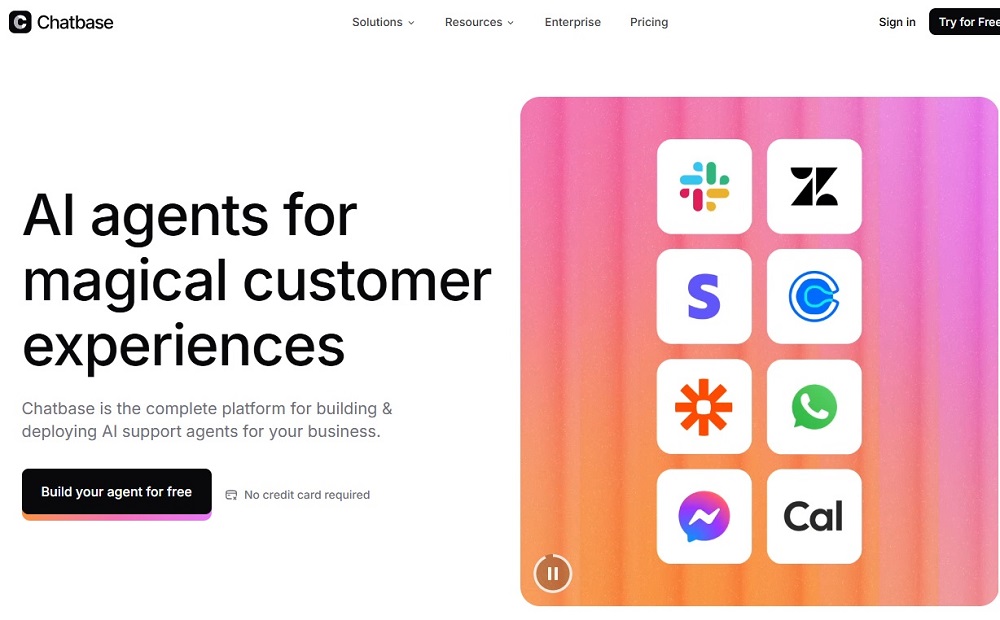 Chatbase’s no-code platform enables businesses of every size — from solo founders to enterprise teams — to deploy AI support automation that handles customer questions, captures leads, and executes real business tasks without developer involvement or ongoing technical maintenance.
Honest Limitations and Important Considerations
Chatbase is a strong AI chatbot platform for its target market, but there are real limitations that new buyers should understand before purchasing.
- No Built-In Live Chat — The Most Notable Gap: Chatbase does not include a live chat inbox where human agents can take over conversations in real time. This is the platform’s most significant missing feature — businesses that need seamless human handoff within the same interface need to route escalations to external tools like Zendesk, Intercom, or Freshdesk, adding complexity and additional monthly costs. If live chat is non-negotiable, Tidio is the most comparable alternative that includes it on every plan.
- Variable Credit Consumption Makes Cost Prediction Difficult: Monthly costs depend heavily on which AI model the agent uses — and this variability makes it genuinely difficult to budget accurately before seeing real usage patterns. The Hobby plan’s 1,500 credits could yield 1,500 responses with GPT-4o Mini or just 300 with Claude Opus 4.6. New users should track actual credit consumption closely in the first two months before committing to an annual plan.
- No Visual Flow Builder for Conditional Logic: Chatbase relies entirely on the AI model to interpret user intent — there are no conditional conversation branches, decision trees, or deterministic flow paths. For businesses that need predictable, structured conversation flows where specific inputs always trigger specific outputs, Botpress or Tidio’s flow builder provide capabilities Chatbase cannot replicate.
- Expensive White-Label Options: Full white-labeling — removing Chatbase branding and using a custom domain — costs $398/month on top of the base plan. For agencies building multiple client chatbots, this cost structure can make Chatbase economically inefficient compared to platforms that offer white-label capabilities at lower price points or as standard plan features.
- Steep Price Jumps Between Tiers: The jump from Hobby ($40/month) to Standard ($150/month) is a 275% increase — and the Standard plan’s key additional features (second agent, more AI Actions) may not justify that cost increase for businesses that only need a single agent. This pricing gap can make growth awkward for businesses that outgrow Hobby but don’t yet need Standard’s full capability set.
- Free Plan Is Testing-Only in Practice: The free plan’s 50 credits/month (enough for roughly 50 conversations with 1-credit models), 10 training link limit, basic models only, and 14-day agent deletion on inactivity makes it genuinely unsuitable for any real business use. It is a proof-of-concept tool, not a viable free tier — factor in at least $40/month for the Hobby plan when evaluating true cost of entry.
Future Outlook: Chatbase’s Trajectory in the AI Chatbot Market
Chatbase’s market position strengthens as AI adoption in small and mid-sized businesses accelerates in 2026 — rising customer expectations for instant 24/7 support, growing discomfort with headcount-driven support scaling, and the increasing reliability of large language models collectively make AI chatbot deployment a mainstream business decision rather than an experimental one. Chatbase’s rapid development cadence — weekly feature releases including SSO, voice dictation, agent duplication, UI localization in 40+ languages, Zendesk/Salesforce ticket ingestion, and Voice AI Agents in just the first few months of 2026 — reflects a team that is actively competing to maintain its position as the fastest-to-deploy, most AI-model-flexible platform in its class.
Use Cases Expanding in 2026 and Beyond
- Voice AI Agents: Chatbase’s newest feature frontier — phone-based AI support that handles basic customer inquiries with natural-sounding speech, available 24/7 without hold times. For businesses receiving significant support volume via phone, Voice AI Agents represent the next major step in automation that text-only chatbots cannot reach.
- International WhatsApp Market Penetration: Chatbase’s native WhatsApp deployment gives it a significant advantage for businesses serving markets where WhatsApp is the primary customer communication channel — Latin America, Southern Europe, Southeast Asia, and the Middle East — where website chat widget adoption rates are lower but WhatsApp response rates are extremely high.
- CRM and Helpdesk AI Front-End: The growing pattern of Chatbase deployed as an AI front-end for existing Zendesk and Salesforce deployments — handling first-response automation and ticket creation while routing complex cases to human agents in the existing helpdesk workflow — positions Chatbase as an AI enhancement layer for the established support tool ecosystem rather than a full replacement requiring migration.
- Agency Market Growth: The multi-agent Standard and Pro plans combined with white-label options are positioning Chatbase increasingly as a platform for agencies to build client-facing AI support products — a market segment that could drive significant account growth as AI implementation services become a standard digital agency offering in 2026 and beyond.
Expert assessment: Chatbase’s bootstrapped growth to $5–6M ARR and 10,000+ businesses served without external funding validates that the product delivers genuine value in a market full of well-funded competitors. The platform’s willingness to maintain a functional free plan (rather than a time-limited trial) and publish honest capability documentation — including the explicit acknowledgment that some features like built-in live chat are not available — reflects a maturity of brand communication that builds the long-term trust required for sustainable growth in a market where AI tool hype frequently outpaces actual capability.
Conclusion
Chatbase in 2026 delivers the most AI-model-flexible, fastest-to-deploy, and security-conscious no-code chatbot building platform available for small and mid-sized businesses, marketing teams, and agencies who need intelligent AI support automation without developer involvement — backed by 10,000+ businesses served, 15+ AI models from 6 providers, enterprise-grade SOC 2 Type II + GDPR security at mid-tier pricing, and a free entry point that lets any business evaluate the platform with zero financial commitment. The AI Actions system — enabling real task automation for meeting booking, order lookups, billing queries, and custom API calls — elevates Chatbase beyond a simple FAQ bot into a genuine AI agent capable of meaningfully reducing human support workload across multiple business functions. The no-live-chat limitation is real and must be factored in by businesses where human handoff is non-negotiable, and the variable credit consumption model requires careful monitoring to avoid bill surprises during high-traffic periods. But for the broad majority of businesses that need a reliable, well-secured, customizable AI chatbot deployed quickly across website and messaging channels — Chatbase is the platform that 10,000+ businesses in 2026 have chosen for exactly that reason, and the platform’s rapid development cadence suggests it will remain the benchmark for no-code AI chatbot deployment well into 2027 and beyond.
Ready to build your own AI support agent and join 10,000+ businesses using Chatbase? Get started free today:
👉 Open Chatbase Account: https://worldoftech.space/chatbase
👉 Our YouTube Channel: https://www.youtube.com/@world_tech79
👉 Our Facebook Fanpage: https://www.facebook.com/profile.php?id=61576258059614
👉 Our X (Twitter): https://x.com/worldoftech79