
If you have ever tried to buy a US stock from Singapore and watched a chunky brokerage commission swallow your first few profits, you already understand why moomoo caused such a stir. moomoo Singapore is an all-in-one trading app that bundles US$0 lifetime commission on US stocks, free institutional-grade Level 2 market data, an AI research assistant, paper trading and a social investing community into a single, slick mobile-and-desktop platform. Backed by Nasdaq-listed Futu Holdings, regulated by the Monetary Authority of Singapore (MAS), and the first digital broker to win full membership of the Singapore Exchange, it has grown from a 2021 newcomer into what it now calls the No.1 trading app by downloads in Singapore, with more than one million local users — roughly one in every two adult residents.
But low headline fees and a feature-stuffed app are only half the story, and an honest look reveals real trade-offs around hidden line-item costs, a custodian-by-default model, an overwhelming amount of notifications for beginners, and a surprisingly weak Trustpilot score that sits oddly next to glowing app-store ratings. This is an independent product review, not financial advice — investing carries risk and you can lose money — so we weigh the good against the genuinely annoying. This 2026 review walks through moomoo Singapore’s full offering: how it is regulated, what you can actually trade, exactly how the fees and promotions work, the AI and data tools that set it apart, head-to-head comparisons against Tiger Brokers and Webull, the real pros and cons, and precisely who should (and shouldn’t) open an account.
moomoo Singapore Review 2026: The Low-Cost Trading Super App That Brought Pro-Grade Tools to Everyone
Overview and Background
moomoo is a digital brokerage and investing platform operated in Singapore by Moomoo Financial Singapore Pte. Ltd., a subsidiary of Futu Holdings Limited (NASDAQ: FUTU) — a fintech group founded in 2012 and listed on the Nasdaq since 2019, today serving more than 23 million users worldwide. It is not a traditional bank brokerage or a stripped-back beginner app. Instead, it positions itself as a technology company that happens to do broking: the idea is to put the kind of real-time data, charting and analytics once reserved for professional terminals into a free app that a first-time investor can actually navigate. You fund an account, and from one platform you can trade across the US, Singapore, Hong Kong, China A-shares and Japanese markets, plus options, ETFs, REITs, bonds and crypto.
moomoo launched in Singapore in March 2021 and grew with unusual speed. On 30 June 2022 it became the first digital brokerage granted full membership of the Singapore Exchange, and by April 2024 it had passed one million Singapore users. It has since won the Securities Investors Association (Singapore) “Best Retail Broker” award three years running, picked up the “Best Stock Trading App” title at the 2024 FinTech Breakthrough Awards, expanded into physical experience stores, and built up reportedly over S$5 billion in assets under wealth management. This is not an anonymous marketplace app — it is a heavily marketed, locally regulated platform competing on tools, data and price rather than the heritage of an established bank.
What separates moomoo from the wider field of low-cost brokers is the depth packed into one interface. It is regulated by MAS under a Capital Markets Services Licence (CMS101000) and also holds a Major Payment Institution licence; client onboarding runs through Singpass MyInfo and can be approved in as little as fifteen minutes; and the platform spans mobile, desktop and a TradingView-integrated web experience. Layered on top are free Level 2 market data, a built-in AI research assistant, advanced charting, heat maps, institutional trackers, a $1,000,000 paper-trading account and a Facebook-style investor community — features most rivals either charge for or simply don’t have.
Why moomoo Stands Out in 2026
Lifetime US$0 commission on US stocks — with a flat, predictable fee: This is moomoo’s headline draw and the main reason Singapore investors flock to it. Eligible local residents pay no commission on US shares and ETFs, just a flat US$0.99 platform fee per order regardless of trade size. Because the fee is fixed rather than a percentage, it becomes proportionally cheaper the larger your trade — a meaningful edge over percentage-based rivals once you move beyond small orders.
Free Level 2 market data that usually costs money: moomoo gives users free real-time Level 2 depth — up to 60 levels of order-book visibility — on US stocks for life (a perk it values at US$6.99 a month) and on SGX stocks through to 31 December 2026. On most platforms this institutional-style data sits behind a paid subscription or a professional terminal, so getting it bundled in for free is a genuine, tangible differentiator for active traders.
An AI research assistant built into the workflow: moomoo AI summarises analyst views, distils earnings reports, flags risks to watch and chews through large volumes of market data to surface real-time insights — directly inside the app and desktop terminal. Reviewers consistently describe it as practical rather than gimmicky: it speeds up the first pass of research and helps you reach clarity faster without reading every filing line by line. It informs decisions; it doesn’t make them for you.
Genuinely multi-market from one account: From a single login you can trade US, Singapore, Hong Kong, China A-share and Japanese equities, plus US options, futures, ETFs, REITs, bonds, money-market funds and crypto. Few Singapore-regulated apps match that breadth, and the in-app currency exchange lets you hold and convert SGD, USD and HKD without juggling separate brokerage accounts for each market.
CDP linkage for investors who want true ownership: By default SGX shares are held in moomoo’s custodian (nominee) structure, but the platform now also supports linking your personal Central Depository (CDP) account — making moomoo one of the few low-cost brokers that lets you buy and sell SGX stocks directly into your own CDP while keeping the modern app and data tools. CDP-linked trades cost more, but the option to own shares in your own name is rare at this price point.
Professional charting and capital-flow analytics: Through its TradingView integration and proprietary suite, moomoo offers 80-plus technical indicators, multi-chart layouts, drawing tools, screeners, heat maps, an earnings calendar, an institutional tracker and unusual “capital flow” indicators that visualise where larger money appears to be moving. That density of analytics sits well above most free brokers, while still being approachable for newcomers.
Regulation, scale and a risk-free practice mode: moomoo is MAS-regulated, a full SGX member, and backed by a Nasdaq-listed parent — and it pairs that credibility with a $1,000,000 virtual paper-trading account and an in-app community where investors share ideas. New users can learn and rehearse strategies with zero financial risk before committing real capital, which lowers the barrier to entry considerably.
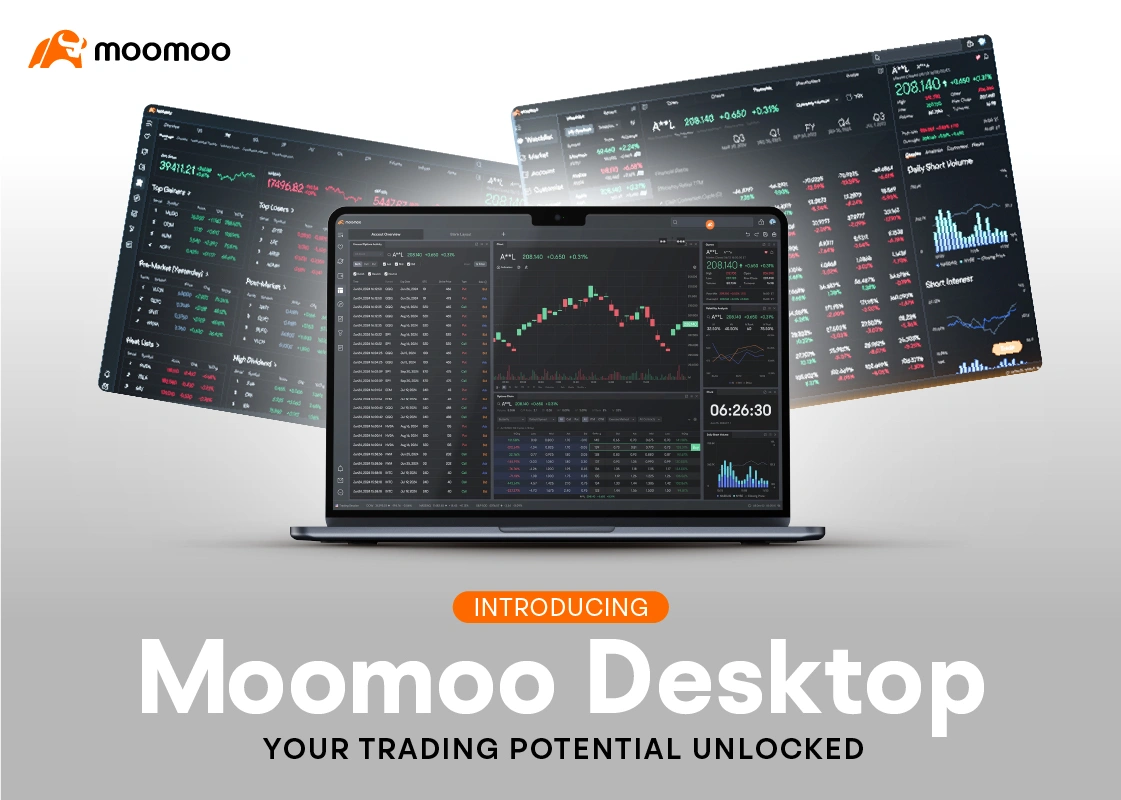
moomoo Singapore packs free Level 2 data, an AI research assistant, advanced charting and multi-market access into one MAS-regulated app — pro-grade tooling that most low-cost brokers either charge for or simply don’t offer.
Key Features and Technology
moomoo’s feature list is long, but it organises cleanly into a handful of pillars. Here’s how the platform actually breaks down for a Singapore user.
Multi-Market Trading and Product Range
The core of the app is broad market access. You can trade US, Singapore, Hong Kong, China A-share and Japanese equities, alongside ETFs, REITs, daily leverage certificates (DLCs) and structured warrants, US stock and index options, selected futures, bonds, money-market funds and crypto such as Bitcoin, Ethereum and Ripple (XRP). moomoo also supports fractional shares on US stocks, so you can start building a position in a high-priced company without waiting until you can afford a full share. The notable gaps are a lack of London Stock Exchange access and no support for investing via CPF or SRS funds — both worth knowing if those matter to your strategy.
Free Level 2 Data, Charting and AI Tools
This is where moomoo earns its “pro tools for everyone” reputation. Free real-time Level 2 quotes (up to 60 levels of order-book depth) are included for US stocks for life and for SGX stocks until end-2026. The charting suite, boosted by a TradingView partnership, offers 80-plus indicators, multi-screen layouts and capital-flow visualisations, while screeners, heat maps, an institutional tracker and a 24/7 news feed round out the research toolkit. moomoo AI sits across all of it as a research assistant that summarises earnings and analyst sentiment and surfaces key things to watch — useful for cutting research time, provided you treat its output as a starting point and still make your own calls.
Cash Management and Margin
moomoo Cash Plus lets you park idle cash in selected money-market and bond funds with no subscription or redemption fees and the flexibility to redeem anytime — a way to earn a yield on uninvested cash rather than letting it sit idle (promotional rates such as a time-limited 6.8% p.a. for 30 days have appeared, but standard yields are lower and fluctuate with the market). For leveraged trading, moomoo publishes competitive margin financing, with annual rates advertised as low as around 4.8% on its Singapore financing and roughly 6.8% in broader contexts; rates change and are charged on negative cash balances, so check the live schedule before trading on margin.
Onboarding, Funding and Security
Opening an account is fast: a Singpass MyInfo flow pre-fills your details and applications can be approved within fifteen minutes, with no minimum funding requirement and no deposit fee. Funding runs through instant local rails — FAST, PayNow and MEPS — and withdrawals return to your Singapore bank account, with no withdrawal fee on fast transfers below S$200,000. Security covers biometric login and two-factor authentication, and the interface supports English, Mandarin, Malay and Tamil, adjustable font sizes and a dark mode. moomoo also offers a CDP-linkage option for investors who want to hold SGX shares in their own name rather than under the broker’s custodian.
Pricing, Plans, and Package Structure
There is no account subscription with moomoo — you pay per trade, plus standard market and regulatory costs. The structure is genuinely competitive, but it is layered, so the table below summarises the headline costs for Singapore users. All figures are moomoo SG’s standard rates and exclude the 9% GST applied to Singapore tax residents; the broker runs frequent promotions (commission waivers, welcome rewards, referral bonuses), so always confirm the live fee schedule and any active offer before you trade.
| Market / Service | Cost (moomoo SG) | What It Is | Notes |
|---|---|---|---|
| US stocks & ETFs | US$0 commission + US$0.99 platform fee / order | Lifetime $0 commission for eligible SG residents | Flat fee; cheaper proportionally on larger trades |
| Singapore stocks (custodian) | 0.03% commission + 0.03% platform fee, min S$0.99 each | SGX shares held in moomoo’s nominee structure | ~S$1.98 min/trade; commission waived first year for new users |
| Singapore stocks (CDP-linked) | ~0.10% commission + ~0.12% platform fee, min S$4.99 each | Shares held directly in your own CDP account | Pricier, but true ownership; low for a CDP-linked broker |
| Hong Kong stocks | 0.03% commission + platform fee | Access to HKEX-listed shares | 30-day $0-commission promo often available for new users |
| US options (fixed plan) | US$0.65/contract + US$0.30/contract platform fee | Single- and multi-leg options, index options, rolling | Min US$1.99 commission + US$0.99 platform/order; tiered plan also offered |
| Margin financing | From ~4.8%–6.8% p.a. | Interest on borrowed funds / negative cash balances | Rates change; leverage amplifies losses as well as gains |
| Account, deposits & withdrawals | S$0 | Opening, holding, deposits, fast withdrawals | No min funding or inactivity fee; $0 withdrawal under S$200K |
How moomoo Compares to Alternatives
| Factor | moomoo SG | Tiger Brokers SG | Webull SG |
|---|---|---|---|
| US stock fee model | $0 commission + flat US$0.99 platform fee | ~US$0.99/order min (commission + platform) | $0 platform fee, ~0.025–0.05% commission (min ~US$0.50) |
| SG stock fee (approx.) | 0.06% total, min ~S$1.98 (yr 1 from S$0.99) | ~0.03%, min ~S$1.99 | ~0.06% |
| Markets | US, SG, HK, China A, Japan + crypto | US, SG, HK, China A, Australia + more | US, SG, HK, China A, Australia |
| Free Level 2 data | Yes — US lifetime, SGX to end-2026 | Promo-based / tiered | Intro period, then conditions apply |
| AI & research tools | moomoo AI, capital flow, institutional tracker | Solid tools, growing AI features | Data-rich; real-time monitoring AI |
| CDP linkage / robo | CDP linkage available; no robo-advisor | Custodian model; some auto-invest tools | Built-in robo-advisory; custodian model |
| Regulation | MAS (CMS101000), full SGX member | MAS-regulated | MAS-regulated |
| Best for | Tool-rich, flat-fee US trading + local features | Broad markets & competitive all-round fees | Small, frequent trades & passive robo investing |
vs. Tiger Brokers: Tiger is moomoo’s closest local rival — also MAS-regulated, also feature-rich, and broadly comparable on cost. For US stocks, moomoo’s flat US$0.99 platform fee (with $0 commission) tends to edge ahead once trade sizes grow, while Tiger remains highly competitive across markets and has its own strong analytics. For SGX stocks the two are nearly identical, with moomoo’s minimum a few cents lower. If you want the deepest free data and the slickest charting-plus-AI package, moomoo has a slight lead; if you value Tiger’s particular market mix and interface, the gap is small enough that promotions may decide it.
vs. Webull: Webull SG advertises a $0 platform fee but charges a small percentage commission on US stocks, which makes it cheaper on tiny orders and pricier than moomoo’s flat fee on larger ones. Webull leans into built-in robo-advisory and a fully app-based, percentage-fee model, suiting hands-off investors making small, frequent trades. moomoo counters with flat US-stock fees that scale better, broader market access (including Japan and crypto), stronger localised features and physical experience stores. In short: Webull for small-and-passive, moomoo for larger trades and heavier tooling.
vs. Interactive Brokers (IBKR): IBKR is the global heavyweight, with access to 170-plus markets, deep instrument coverage and rock-bottom per-share US pricing (from around US$0.35/order), but its interface is famously complex and its SGX minimum (around S$2.50/order) is higher than moomoo’s. For an advanced, multi-market professional who values reach and tiered pricing, IBKR can win on raw cost and breadth; for most Singapore retail investors who want low fees and an approachable, data-rich app, moomoo is far easier to live with day to day.

moomoo’s flat US$0.99 platform fee scales better than percentage-based rivals on larger US trades, while free Level 2 data and AI tools give it an edge on research depth — but check the line-item costs behind every “0 commission” headline.
Pros and Cons
What Users Love
Low, transparent, flat-fee trading: The most consistent praise is simply how cheap moomoo is for US stocks — $0 commission and a predictable flat platform fee, with no minimum funding and no inactivity charge. For investors moving from traditional bank brokerages where commissions ran into the tens of dollars, the savings feel transformative, especially on larger orders.
Pro-grade tools without the pro price: Free Level 2 data, advanced charting, screeners, heat maps and the moomoo AI assistant draw repeated praise from active traders, who note that comparable depth elsewhere often costs a monthly subscription. Reviewers describe the AI as a genuine time-saver for summarising earnings and analyst views rather than a marketing gimmick.
An intuitive app that scales with you: Owners frequently call moomoo beginner-friendly yet deep — easy to place a first trade, with guided tutorials and a $1,000,000 paper-trading mode, but powerful enough that experienced traders don’t outgrow it. App-store ratings sit around 4.5–4.7 with roughly three-quarters of reviewers giving five stars, which speaks to a well-received core experience.
Real local credibility and CDP options: Being MAS-regulated, a full SGX member and a three-time SIAS “Best Retail Broker” winner reassures cautious investors, and the CDP-linkage option — rare among low-cost brokers — lets Singapore users hold SGX shares in their own name. Physical experience stores add a human touch most app-only rivals lack.
Genuine breadth in one account: Trading US, Singapore, Hong Kong, China A-shares, Japan, options, futures and crypto from a single login — with in-app currency exchange and fractional US shares — is a recurring favourite. Many users consolidate several brokerages into moomoo for the convenience.
Rewarding, community-driven experience: The Facebook-style investor community, frequent welcome rewards, referral perks and learning quests keep users engaged, and the educational resources help newcomers build confidence. It’s an ecosystem designed to make investing feel approachable rather than intimidating.
Limitations Worth Knowing
“Zero commission” hides other costs: The headline waiver applies to commission only — platform fees, exchange and regulatory pass-throughs, a 9% GST for Singapore tax residents, FX spreads and a 30% US dividend withholding tax (reducible to 15% with a W-8BEN) all still apply. Beginners who fixate on “free” and ignore the line items are the most common source of disappointed reviews.
A weak Trustpilot score sits beside strong app ratings: This is the most striking caveat. While app stores rate moomoo around 4.5–4.7, its global Trustpilot score is a “Poor” 2.4 or so across roughly 400 reviews, with complaints clustering around withdrawals, account restrictions, promotional confusion and support. The gap suggests the platform delights active traders but frustrates people who hit admin, funding or expectation-mismatch issues — worth going in clear-eyed about.
Custodian by default, and notification overload: Unless you actively link CDP, your SGX shares sit in moomoo’s nominee structure rather than your own name — fine for many, a dealbreaker for CDP purists. The app also pushes frequent promotional notifications, which beginners often find noisy, and the sheer density of tools can overwhelm anyone who just wants to buy and hold.
Coverage and account-type gaps: There’s no London Stock Exchange access, no support for CPF or SRS investing, no robo-advisory, and crypto selection is narrower than a dedicated exchange. Compared with a bank-run broker, moomoo also offers less in-person support and is, by nature, a younger and leaner operation.
Parent-company and impersonation risks: In May 2026, Chinese authorities proposed a large fine (reported at roughly 1.85 billion yuan, about US$271–330 million) against parent Futu Holdings over cross-border services to mainland clients, and Futu stopped opening accounts for mainland China traders. This concerns the China business rather than the MAS-regulated Singapore entity, but it’s relevant context. Separately, scammers have impersonated moomoo via clone entities and fake messaging accounts promising “guaranteed returns” — always verify you’re using the official moomoo.com/sg site and the correct licensed entity.
Investing risk is the platform’s, not removed by it: No app, however polished, changes the fundamental reality that markets fall as well as rise, leverage magnifies losses, and you can lose money. moomoo’s tools and AI can speed up research, but they are not advice and not a guarantee of returns — the decisions, and the risk, remain yours.
Who Should Use moomoo
Cost-conscious US-market investors: This is moomoo’s sweet spot. If you regularly buy US stocks and ETFs in reasonable sizes, the $0 commission plus flat US$0.99 platform fee is hard to beat, and free lifetime Level 2 US data is a real bonus. The larger your typical order, the more the flat fee works in your favour.
Active, data-driven traders: Anyone who lives in charts, screeners, options chains and order-book depth will appreciate the tool density — 80-plus indicators, capital-flow analytics, an institutional tracker and the moomoo AI assistant. It’s a platform built to be grown into, not outgrown.
Beginners who want room to learn: A fifteen-minute Singpass sign-up, no minimum funding, a $1,000,000 paper-trading account, in-app courses and a supportive community make moomoo an unusually gentle on-ramp — provided you take the time to understand the fee schedule and ignore the promotional noise.
Multi-market and CDP-minded Singaporeans: If you want one app for US, SG, HK, China A-share and Japanese markets plus crypto, moomoo delivers — and the optional CDP linkage means SGX investors who care about owning shares in their own name don’t have to give that up for low fees.
Who should look elsewhere: Investors who want to use CPF or SRS funds, trade on the London Stock Exchange, lean on a built-in robo-advisor, or rely heavily on branch-based human support may find moomoo’s gaps frustrating — Webull suits passive robo investors and tiny frequent trades, IBKR fits advanced multi-market professionals, and a bank-run broker may reassure those who prize in-person service. And anyone who simply wants to buy one index fund and never look again may find the app’s depth and notifications more than they need.

From a single MAS-regulated account you can trade US, Singapore, Hong Kong, China A-share and Japanese markets plus crypto — with fractional US shares and a $1,000,000 paper-trading mode to practise risk-free.
Getting Started: Step by Step
- Open your account. Download the moomoo app or use the desktop platform, then register with your email or phone. Use Singpass MyInfo to pre-fill your details — applications are often approved within fifteen minutes, with no minimum funding required to get started.
- Decide custodian vs CDP. For SGX stocks, choose whether to hold shares in moomoo’s custodian (nominee) structure for the lowest fees, or link your CDP account to own shares in your own name at a higher cost. You can also keep a separate moomoo account for US, HK and other markets.
- Practise with paper trading first. Before committing real money, use the $1,000,000 virtual paper-trading account to place trades, test the charting and options tools, and get comfortable with the interface — a genuinely valuable, risk-free way to learn.
- Read the fee schedule for your markets. Check the exact commission, platform fee, GST and FX costs for the specific products you’ll trade (US stocks, SG stocks, options, etc.). Knowing your real per-trade cost upfront is the single best way to avoid the “I thought it was free” surprise.
- Fund and claim any promotion. Top up via FAST, PayNow or MEPS, and check for an active welcome reward or commission waiver before your first deposit — many offers require entering a promo code at the funding stage. Submit a W-8BEN to cut US dividend withholding tax from 30% to 15%.
- Trade, then build your routine. Place your first order, lean on moomoo AI and Level 2 data for research, and use Cash Plus to earn a yield on idle cash. Add tools to your workflow over time — but always size positions sensibly and invest only what you can afford to put at risk.
Tips for Getting Maximum Value
Lean into moomoo’s flat-fee structure by consolidating smaller US trades into fewer, larger orders where it suits your strategy, since the US$0.99 platform fee shrinks as a percentage the bigger the trade. Hold and convert currencies thoughtfully using the in-app exchange to avoid repeated FX spreads, and submit your W-8BEN early so US dividends are taxed at 15% rather than 30%. Put idle cash to work in moomoo Cash Plus instead of leaving it flat, but read the terms and treat any promotional yield as temporary. Use the free Level 2 data and moomoo AI to speed up research — then make your own decision, because the AI summarises, it doesn’t advise. Time your sign-up around one of moomoo’s frequent welcome rewards or commission waivers and enter any promo code at the funding step, since the platform rarely lacks an active offer. Turn off non-essential push notifications if the marketing noise bothers you, choose the CDP-linkage path if owning shares in your own name matters to you, and above all, only invest money you can afford to lose — the cheapest fees in the world don’t remove market risk.
Future Outlook and Final Assessment
The Singapore brokerage market in 2026 has decisively shifted toward low-cost, tool-rich digital platforms, and moomoo helped drive that change. With more than a million local users, three consecutive SIAS “Best Retail Broker” wins, full SGX membership and a Nasdaq-listed parent, it has gone from challenger to one of the default choices for a generation of self-directed investors. Its trajectory — deeper AI tooling, expanding crypto and wealth-management products, CDP linkage, physical stores and a TradingView-powered web experience — suggests it intends to be a long-term fixture rather than a passing app, and as data and AI features keep improving, its core pitch of pro-grade tools at consumer prices only gets stronger.
The honest caveats remain: the “free” headline masks real line-item costs, the Trustpilot picture is genuinely mixed, the custodian-by-default model and notification overload won’t suit everyone, and there are coverage gaps (no LSE, no CPF/SRS, no robo-advisor). Rivals like Tiger and Webull are competitive and closing in, and parent-company headlines are worth monitoring. But within those boundaries, moomoo Singapore delivers one of the most complete, genuinely useful low-cost investing platforms available locally in 2026 — and for cost-conscious, tool-loving investors, it’s still the benchmark to beat.
Conclusion
moomoo Singapore set out to make low-cost, global, tool-rich investing accessible to ordinary people, and at that job it largely succeeds. By waiving commission on US stocks, bundling in free Level 2 data and an AI research assistant, opening up US, Singapore, Hong Kong, China A-share and Japanese markets from one MAS-regulated app, and offering both custodian and CDP options, it removes most of the old friction around getting started. It rewards investors who read the fee schedule, ignore the marketing noise and use its depth wisely — and it’s not the right fit for CPF/SRS users, LSE traders, robo-advisor fans or anyone wanting heavy in-person support. But for the cost-conscious, data-driven reality of modern retail investing in Singapore, few platforms deliver more value. Verify the current fees and any live promotion on the official site, remember that all investing carries risk, and moomoo can take much of the cost and complexity out of building a global portfolio.
Ready to start investing with one of Singapore’s most powerful low-cost trading apps?
Explore more honest reviews, tutorials and tech comparisons to find the right gear for the way you work, travel and live — at World Of Tech, where we make everything easy.
👉 Open your moomoo account: https://www.moomoo.com/sg
👉 Our YouTube Channel: youtube.com/@world_tech79
👉 Our Facebook Fanpage: Facebook
👉 Our X (Twitter): @worldoftech79
Pricing, fees, features and regulatory details in this review were verified against moomoo.com/sg and independent review sources (including Trustpilot, app-store ratings and hands-on reviewer testing) as of June 2026. This article is an independent product review for informational purposes only and is not financial advice or a recommendation to invest; investing involves risk, including loss of capital. Brokerage fees, promotions and product features change frequently, so confirm current details on the official site before opening an account. Competitor fees are approximate and subject to change.