
If you’ve ever stared at Facebook Ads Manager at 2 a.m., burning cash on a campaign that refuses to convert, you already know why “AI media buyer” tools have exploded. Crush AI (trycrush.ai) is one of the newest and most aggressive entrants in that category: instead of just generating a few ad images, it claims to run your entire Meta advertising operation on autopilot — scanning your store, writing and designing creatives, launching campaigns, testing dozens of variations, and cutting or scaling based on real performance data. It’s built and led by Albert, Albertas and Rokas, a small founding team with roughly a decade of combined hands-on Facebook and TikTok media-buying experience, and it’s priced as a flat $99-a-month subscription rather than the opaque, spend-tiered pricing most competitors use.
The pitch is bold: replace a $3,000–$5,000-a-month agency retainer with a $99 piece of software trained on more than $100 million in historical ad spend and over 1.6 million ads. That’s an attractive trade on paper, but Crush AI is also a genuinely young company — the domain is under a year old, the platform is still in a founder-led beta, and early users have flagged real friction alongside the wins. This 2026 review walks through what Crush AI actually does, its pricing and package structure, how it stacks up against Madgicx and AdCreative.ai, the honest pros and cons pulled from verified Trustpilot reviews, and exactly who should — and shouldn’t — hand their ad account over to it.
Crush AI Review 2026: Is TryCrush.ai’s Autonomous Meta Ad Manager Worth $99 a Month?
Overview and Background
Crush AI, marketed at trycrush.ai, is a digital advertising platform built to automate and manage Meta ad campaigns — Facebook and Instagram — for store owners, dropshippers and small marketing teams. It isn’t a creative generator that stops once it hands you a few image files, and it isn’t a bidding-and-budget layer you bolt onto campaigns you built yourself. Crush AI positions itself as an end-to-end “AI media buyer”: it researches your product and competitors, writes ad copy, generates visual creatives, launches the campaign directly into your Meta Ads account, runs multivariate testing across dozens of variations, and then continuously scales winners while cutting losers — all without a human babysitting the dashboard.
The company is fronted by co-founders Albert and Albertas, alongside co-founder Rokas, who according to the platform’s own materials and third-party coverage have collectively managed more than $50 million in combined Facebook and TikTok ad spend and roughly eight years of hands-on media-buying work for clients before building the software. That experience is baked into the product positioning: Crush AI describes itself as encoding the playbooks of a “brand ambassador” who has personally spent over $50 million on ads, trained on a dataset the company says spans more than $100 million in historical spend and 1.6 million-plus analyzed ads.
Crush AI is a young company. Public domain records show trycrush.ai was registered roughly eight months ago through GoDaddy, and the platform describes itself as being in a “founder-led beta” stage, with Albert and Albertas personally replying to and auditing customer accounts. On Trustpilot, Crush carries a strong early reputation — a TrustScore in the 4.4–4.5 out of 5 “Excellent” range across a few dozen reviews, with the company responding to 100% of negative reviews it has received. Independent site-safety scanners are split: GridInsoft’s automated scan puts trycrush.ai’s trust score around 75/100 with no malware or phishing detected, while Scam Detector’s automated validator — a tool that tends to score any young, low-traffic domain harshly — flagged it as “untrustworthy” based largely on the site’s age and limited public ownership information. Neither result is a verdict on whether the product itself works; both are worth knowing before you commit a card number.
Why Crush AI Stands Out in 2026
It actually launches and runs your ads, not just designs them: Most “AI ad tools” stop at generating a creative and leave you to build the campaign yourself. Crush AI goes further — after the onboarding quiz and a two-click Meta account sync, it builds the campaign structure, writes the copy, generates the creatives, and pushes the campaign live, typically in under an hour from a cold start.
Simple, transparent flat pricing: Where Madgicx gates its main plan price behind a login and ties it to your ad-spend tier, and enterprise players like Smartly.io require sales calls and annual contracts, Crush AI publishes one number: $99 a month for the software, full stop. Your ad budget is separate and goes directly to Meta, but there’s no hidden spend-based multiplier to calculate.
A dataset built on real spend, not just stock templates: The company says its creative and targeting decisions are informed by more than $100 million in tracked ad spend and 1.6 million-plus ads, including 50,000-plus flagged as top performers. Treat the exact figures as self-reported marketing claims rather than audited numbers, but the underlying idea — pattern-matching against a large library of what has actually worked — is a genuine differentiator from tools that only generate creative from a generic prompt.
Continuous multivariate testing at a scale most owners can’t do manually: Reviewers and third-party write-ups consistently mention Crush launching dozens of creative and angle variations a week, then automatically scaling what performs and killing what doesn’t — the kind of testing cadence that’s realistic for an agency team but exhausting for a solo store owner to run by hand.
It will pause spend on a broken funnel instead of burning it: According to the company and echoed in independent coverage, Crush monitors account health and, if your funnel or landing page is the actual bottleneck, it pauses ads and flags the issue rather than continuing to spend on a leak it can’t fix with better creative.
A genuine no-risk trial structure: New accounts get 14 days to evaluate the platform, and the company’s stated refund policy is unusually generous on paper — if Crush doesn’t beat your manual results, you can ask for a refund and keep every asset it generated for you.
Founder-led support, for better and worse: Because Crush AI is small and still in beta, support often comes directly from Albert or Albertas rather than a tiered ticketing system. Trustpilot shows the founders personally replying to praise and complaints alike, including publicly owning a support-routing failure and fixing it. That’s a level of accountability larger, more established competitors rarely offer — though it also means support capacity is inherently limited as the company scales.
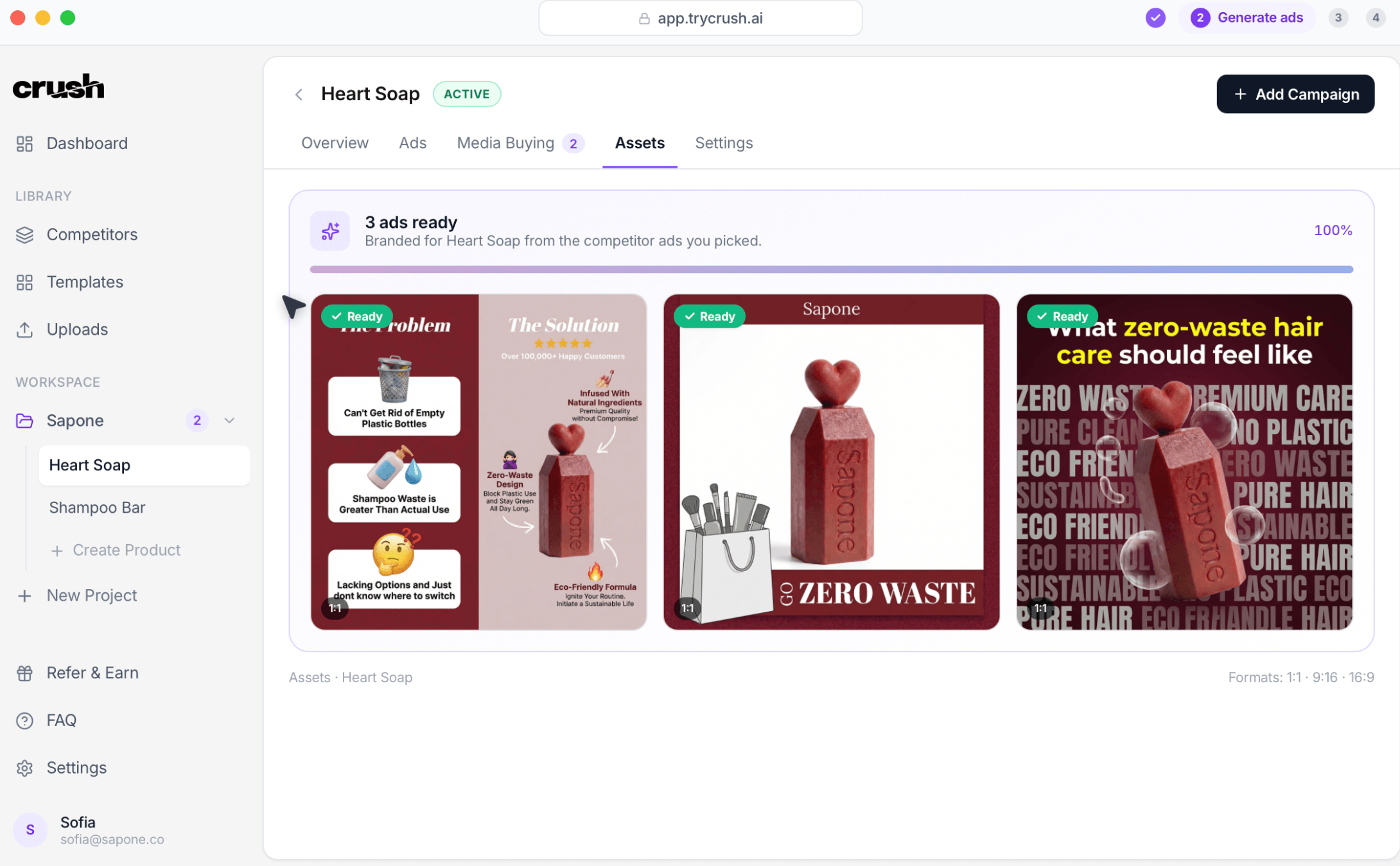
Crush AI positions itself as a full AI media buyer — generating creatives, launching campaigns and optimizing spend on Meta without daily human management.
Key Features and Technology
Crush AI’s feature set is narrower than a general marketing suite by design — it’s built to do one job, running Meta ads, extremely well rather than spreading across every channel. Here’s how the platform breaks down in practice.
AI Creative Generation and Copywriting
Crush scans your product page and, using patterns from its ad database, generates image and video creative variations along with persuasive ad copy pulling on angles like social proof, urgency and problem-agitation. Setup starts with a five-minute quiz covering your unit economics, offer and goals, which feeds directly into what the AI produces. One documented limitation worth knowing up front: at least one verified reviewer reported the AI-edited creative altered product photos enough that they no longer accurately reflected the real product — a real risk with any AI image generation layered on top of e-commerce photography.
Autonomous Campaign Launch and Testing
After a two-click Meta account sync, Crush builds the campaign structure and pushes it live without further manual setup — the company advertises a sub-one-hour path from signup to a running campaign. From there it runs ongoing multivariate testing, launching new creative and audience combinations on a weekly cadence and identifying statistically meaningful winners typically within about 24 hours of real ad delivery.
Budget Scaling and Loss-Cutting
Once winners emerge, Crush reallocates budget toward them automatically and pauses underperforming creatives and audiences — the core “media buyer” behavior of scaling what works and cutting what doesn’t, done continuously rather than during a weekly manual check-in. The platform also looks across countries and audience segments to surface new pockets of demand rather than exhausting a single targeting approach.
Account and Funnel Health Monitoring
Crush tracks post-click behavior, not just ad-level metrics, and is designed to pause spend and alert you if the bottleneck is on your side of the funnel — a slow page, a confusing checkout, a mismatched offer — rather than continuing to spend against a problem creative can’t solve.
Founder Audits and Onboarding
During this founder-led beta stage, new accounts reportedly get direct audits from Albert or Albertas rather than a generic onboarding email — a level of hands-on attention documented repeatedly in Trustpilot reviews, including cases where a founder personally helped diagnose a struggling account.
Pricing, Plans, and Package Structure
Crush AI keeps its pricing deliberately simple: one core plan at a published flat rate, rather than the spend-tiered, gated-behind-login pricing common among Meta ad automation competitors. Your actual monthly cost has two parts — the software subscription and your separate Meta ad spend — and the company is explicit that both are needed for the AI to have enough data to work with. The figures below reflect Crush AI’s current published rate; always confirm the live price on trycrush.ai before subscribing, since promotional discounts have been advertised on the sales page.
| Item | Price (USD) | What It Is | Best For |
|---|---|---|---|
| Crush AI Core Plan | $99 / month | Full AI media-buying subscription: creative generation, autonomous launch, testing and optimization | Store owners who want hands-off Meta ad management |
| Recommended Ad Spend | $200+ / month (separate, paid directly to Meta) | Minimum budget Crush suggests so its AI has enough live data to learn from | Anyone budgeting the true monthly cost, not just the software fee |
| 14-Day Trial Window | Included with the core plan | Full-access evaluation period before you commit long-term | Testing fit before scaling ad spend further |
| “No-Risk” Refund Policy | Included, no extra cost | Company states it will refund the subscription if results don’t beat manual management, and you keep the assets it created | Risk-averse buyers wanting a real trial period |
How Crush AI Compares to Alternatives
| Factor | Crush AI (trycrush.ai) | Madgicx | AdCreative.ai |
|---|---|---|---|
| Core job | Full AI media buyer — creates, launches and optimizes campaigns | Optimization/bidding layer on top of campaigns you set up | Ad creative and copy generation only |
| Launches ads for you | Yes, autonomously after account sync | No — you (or your team) build and launch campaigns | No — exports creative for you to launch elsewhere |
| Pricing model | Flat $99/month, published openly | ~$44–$149+/month, spend-tiered and gated behind login (approximate) | ~$39–$599+/month by seats/credits (approximate) |
| Free trial | 14 days, full access | 7 days, full access | Free trial available (limited credits) |
| Channels covered | Meta (Facebook and Instagram) only | Meta only for management; other channels for reporting | Multi-channel creative export (Meta, Google, TikTok, etc.) |
| Company maturity | New (~8 months old), small founder-led team, beta stage | Established, several years in market | Established, several years in market |
| Best for | Solo store owners wanting full, hands-off campaign automation on a flat budget | Teams with $5K–$100K+/month spend wanting an optimization layer, not full automation | Teams needing bulk, on-brand creative production across channels |
Crush AI vs. Madgicx: The two solve different problems. Madgicx is an optimization and analytics layer that sits on top of campaigns you (or your team) already built — strong AI bidding and creative-fatigue detection, but you’re still doing the strategic setup. Crush AI removes that setup step entirely and launches the campaign for you, which is a bigger leap of trust but a much smaller time commitment. Madgicx also doesn’t publish a clear price until you connect an account and it reads your spend tier; Crush AI’s $99 flat rate is public and predictable from the start.
Crush AI vs. AdCreative.ai: AdCreative.ai is primarily a creative and copy generator — it’s excellent for producing large volumes of on-brand ad assets across multiple channels, but you still have to build, launch and manage the campaigns yourself in Ads Manager. Crush AI does far less creative variety across channels (Meta only) but closes the loop all the way to a live, optimized campaign. If you already have a media buyer or agency and just need faster creative output, AdCreative.ai is the better fit; if you have no one running ads at all, Crush AI’s autonomy is the bigger differentiator.
Pros and Cons
What Users Love
Genuinely hands-off management: Multiple verified Trustpilot reviewers describe moving campaigns from an agency or manual management to Crush AI and seeing performance hold up or improve — one reviewer running Meta ads for a coaching business said the platform started testing new creative automatically and scaled what worked without ongoing input.
Real CPA improvements reported by reviewers: Several Trustpilot reviews cite specific before-and-after numbers — one supplement brand reported cost-per-acquisition dropping from around $42 to $27 within three weeks. These are individual, self-reported testimonials rather than audited case studies, so treat them as directional, not guaranteed.
Founder accountability: Albert and Albertas personally reply to Trustpilot reviews, including publicly acknowledging and fixing a support-routing failure that left a customer’s messages unanswered. That level of direct ownership is rare at any company size.
Predictable, transparent pricing: A single published $99/month rate is easier to budget against than the spend-tiered, quote-based pricing used by most Meta ad automation competitors.
A refund policy that’s actually honored: One Trustpilot reviewer who had to cancel for budget reasons — no fault of the product — confirmed the company processed their refund without pushback, which is a meaningful trust signal for a young company.
Limitations Worth Knowing
Young, unproven company: The trycrush.ai domain is under a year old, and the platform is still explicitly in a founder-led beta. Independent site-safety scanners disagree sharply — GridInsoft found no malware or phishing risk, while Scam Detector’s automated validator flagged the domain as low-trust largely due to its age and limited public ownership records. That’s normal friction for any brand-new company, but it means you should start with the trial and a modest ad budget rather than committing heavily on day one.
The real monthly cost is higher than $99: The software fee is just one part of the bill — Crush recommends at least $200/month in separate Meta ad spend for the AI to have enough data, pushing the realistic minimum commitment to roughly $300/month before you can fairly judge results.
AI creative edits can distort product photos: A verified two-star Trustpilot review specifically flags that AI-generated creative altered product images enough that they no longer accurately represented the real product — a real risk for brands where photo accuracy matters (apparel, food, physical detail-heavy products).
Built for single-product campaigns, not large catalogs: The same review and independent coverage note that Crush AI is currently best suited to simple, single-product or narrow-catalog stores rather than businesses with large, varied product lines.
Early-stage rough edges: Independent write-ups report early users hitting login hurdles and pixel-integration friction during setup — the kind of bugs that come with any young beta product rather than a mature, battle-tested platform.
Marketing claims aren’t independently audited: Figures like “$100M+ in tracked ad spend,” “1.6M+ ads analyzed” and specific conversion-rate lifts come from the company itself and haven’t been independently verified. They may well be accurate, but treat them as self-reported until third-party audits exist.
Who Should Use Crush AI
Solo e-commerce and dropshipping store owners: If you’re running a single hero product or a tight, focused catalog and can’t justify a $3,000+/month agency retainer, Crush AI’s flat-fee, fully hands-off approach is built exactly for this situation.
Coaches, consultants and service businesses already running Meta ads manually: Reviewers running coaching and service-based businesses report Crush automating the testing cadence they were previously doing by hand, freeing up time without sacrificing performance.
Founders with a proven offer and working tracking: Crush works best once you already have some conversion data and a functioning Meta pixel/conversions API setup — it’s built to scale a working funnel, not diagnose one from zero.
Budget-conscious advertisers willing to test cautiously: The 14-day trial and stated refund guarantee make it a reasonable candidate to test in parallel with existing efforts before fully committing your ad budget to it.
Who should look elsewhere: Large multi-SKU retailers and catalog-heavy brands, businesses spending $50,000+/month that need enterprise-grade platforms like Smartly.io, advertisers who need TikTok or Google Ads coverage in the same tool, brands where exact product-photo fidelity is critical, and anyone without a working offer or tracking setup yet — Crush AI amplifies a working strategy, it doesn’t build one from scratch.
Crush AI works best for single-product or simple-catalog stores with an already-working offer and a real ad budget behind it.
Getting Started: Step by Step
- Sign up and complete the onboarding quiz. Answer the roughly five-minute quiz honestly — your real unit economics, target CPA/ROAS and offer details — since Crush’s AI decisions are only as good as the inputs it’s given.
- Connect your Meta ad account. Use the two-click sync to link your Facebook/Instagram ad account and pixel or Conversions API setup. Confirm your tracking is actually firing correctly before launch — Crush needs real conversion data to optimize.
- Let Crush analyze your product and competitors. The AI scans your product page and competitor activity to inform the creative and angle strategy it will generate — this is a good moment to double-check your product page itself is conversion-ready.
- Review the AI-generated creatives before going live. Check that any AI-edited product images still accurately represent the real product, especially for apparel, food or detail-sensitive items, given documented cases of over-aggressive image editing.
- Set your ad budget and launch. Fund your Meta ad account with at least the recommended $200/month so the AI has enough delivery data to test and learn from, then let Crush push the campaign live — typically within an hour of setup.
- Monitor the first two weeks closely, then let it run. Watch early performance and creative quality during the trial window, use the founder-led support channel if something looks off, and decide whether to continue past the 14-day trial based on real results, not just the sales pitch.
Tips for Getting Maximum Value
Treat the onboarding quiz as the single highest-leverage step — feed Crush accurate margins, real target CPA and honest goals rather than aspirational numbers, since every downstream decision the AI makes is built on those inputs. Confirm your Meta pixel and Conversions API are firing correctly before you launch, because no AI can optimize against broken or missing conversion data. Budget for the full realistic cost — $99 software plus $200+ ad spend — rather than judging the platform on a starved test budget, since both the company and independent reviewers agree performance improves once there’s enough delivery data to learn from. If you sell products where photo accuracy matters, manually review every AI-generated creative before it goes live rather than trusting the automation blindly. Because the company is still small and in beta, don’t hesitate to use the founder-led support channel directly if something looks wrong — reviews suggest Albert and Albertas are genuinely responsive when contacted. And use the full 14-day trial and the stated refund guarantee as they’re intended: as a real evaluation window, not just a formality, before you commit to months of subscription and ad spend.
Setup takes under an hour: a short onboarding quiz, a two-click Meta sync, and Crush AI is ready to generate and launch your first campaign.
Future Outlook and Final Assessment
The “AI media buyer” category is one of the fastest-moving corners of ad tech in 2026, as generative AI matures from producing static creative assets toward genuinely autonomous campaign execution. Crush AI is a clear example of that shift — rather than another tool that spits out ad images for you to launch yourself, it’s attempting to close the entire loop from creative to live, optimized spend. If the founding team can scale support and reliability at the same pace as its ambition, and can extend the platform beyond single-product campaigns, it’s well positioned in a category that agencies and larger platforms alike are racing to automate.
The honest caveats are real, though: this is an eight-month-old company still in beta, with mixed independent trust signals, documented creative-editing issues, and a narrow focus on single-product Meta campaigns. Established competitors like Madgicx and AdCreative.ai bring years of track record and larger support teams, even if neither offers the same level of full autonomy. For the specific use case Crush AI targets — a solo store owner or small team with a working offer who wants Meta ads run for them at a predictable flat price — it’s a genuinely compelling and rare combination in 2026’s crowded ad-tech landscape.
Conclusion
Crush AI sets out to do something more ambitious than most AI ad tools: not just generate creative, but actually run your Meta advertising the way an experienced media buyer would, at a flat $99 a month instead of a five-figure agency retainer. For the right store — single product, working offer, real tracking, and a genuine ad budget behind it — early reviewers describe real, tangible results and a founding team that shows up when things go wrong. But it’s still a young, beta-stage company with mixed independent trust signals, a documented creative-editing quirk, and a narrow fit outside single-product campaigns, so it earns cautious optimism rather than a blanket recommendation. Test it inside its 14-day trial with a modest budget, watch the first creatives closely, and confirm current pricing and terms directly on trycrush.ai before you commit further.
Ready to let AI handle your Facebook ads?
Explore more honest reviews, tutorials and tech comparisons to find the right tools for the way you work, grow and sell — at World Of Tech, where we make everything easy.
👉 Try Crush AI: https://worldoftech.space/trycrushai
👉 Our YouTube Channel: youtube.com/@world_tech79
👉 Our Facebook Fanpage: Facebook
👉 Our X (Twitter): @worldoftech79
Pricing, specifications and policy details in this review were verified against trycrush.ai and independent review sources (including Trustpilot, GridInsoft, Scam Detector and hands-on reviewer coverage) as of September 2026. AI advertising software pricing, features and terms change frequently, so confirm current details on the official site before purchasing. Competitor prices are approximate and subject to change. If you are experiencing personal financial hardship, please consult a licensed financial advisor before committing ad spend.