
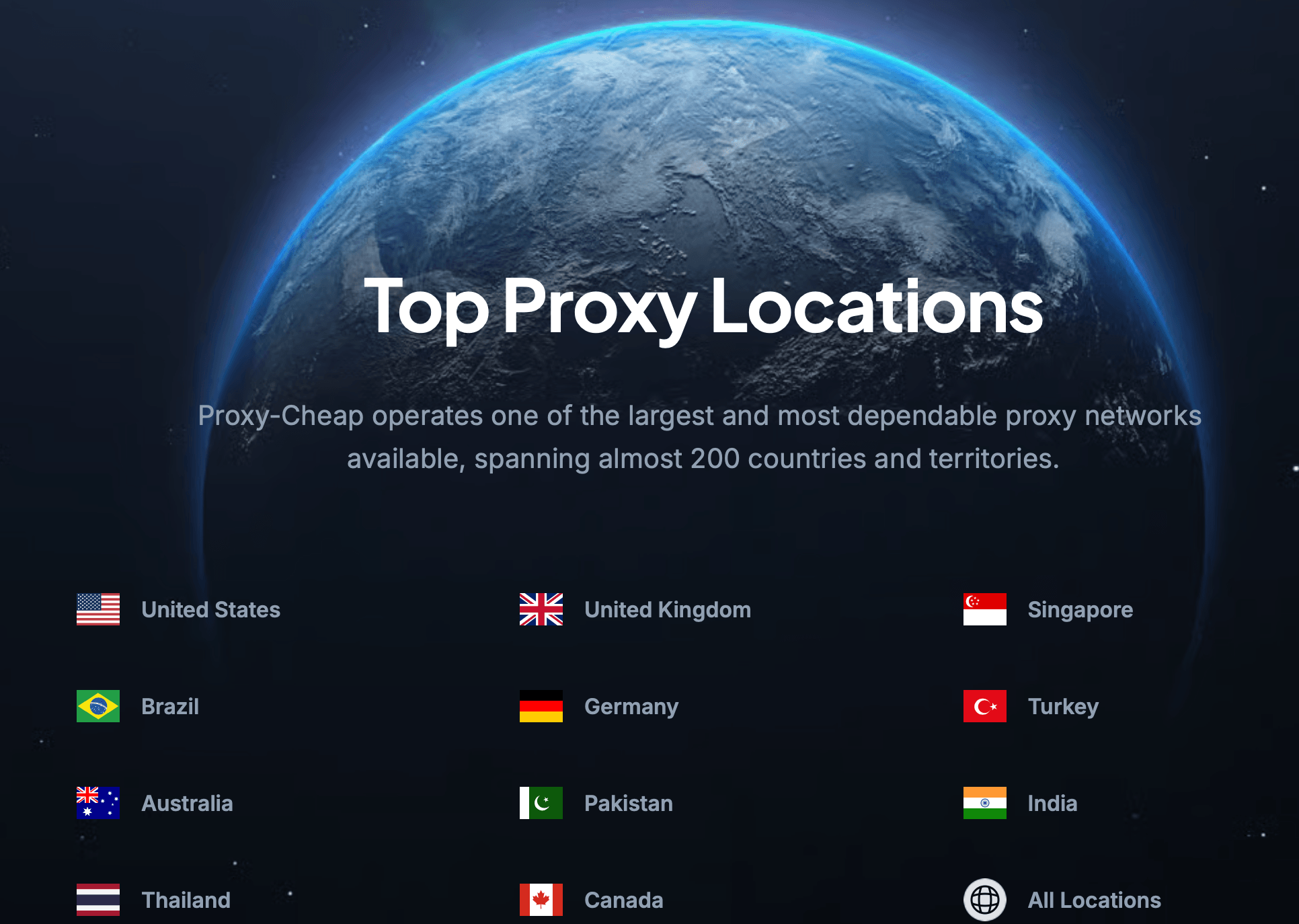
Anyone who’s tried to scrape a product page, manage more than one social account, or check search rankings from another country has hit the same wall: the site notices, and blocks you. Proxy-Cheap has built its entire pitch around removing that wall as affordably as possible — residential, ISP, datacenter, and mobile proxies spanning 180+ countries, pay-as-you-go pricing with no monthly minimum on its rotating plans, and per-IP rates that undercut most of the market. Founded in 2018, the Netherlands-based provider has grown into one of the more recognizable budget names in the proxy space, claiming 45,000+ customers and a network of 155 million+ IPs.
But “cheap” and “reliable” don’t always travel together in this industry, and Proxy-Cheap’s own review footprint tells a genuinely split story: a G2 rating in the mid-4s alongside a Trustpilot score sitting in “Average” territory, with a real cluster of complaints about IPs being mislabeled, fraud-score flags, and refund friction. For a service that lives or dies on whether an IP actually gets past a target site’s defenses, that split is worth understanding before you buy. This 2026 review covers what Proxy-Cheap actually offers, exactly how its per-IP and per-GB pricing works, how it stacks up against Decodo and Webshare, the honest pros and cons pulled from independent review data, and who this service is — and isn’t — a good fit for.
Proxy-Cheap Review 2026: Is the Budget Proxy Provider Actually Reliable?
Overview and Background
Proxy-Cheap operates at proxy-cheap.com, offering four core proxy types — static residential (ISP), rotating residential, datacenter (IPv4 and IPv6), and mobile (static and rotating) — through a self-serve dashboard with no long-term contract required on its metered plans. The company positions itself explicitly around affordability: its homepage leads with “Buy Fast, Affordable Proxies” and a pay-as-you-go pricing model with no set-up costs and cancel-anytime terms on rotating residential traffic.
The network claims are substantial for a budget-tier provider: 155 million-plus IPs spanning 180+ countries and territories, with static ISP coverage concentrated in Eastern Europe, Western Europe, Southeast Asia, Japan, Korea, and the Middle East, and broader residential and datacenter coverage across the Americas, Europe, Asia, the Middle East, and Africa. The company reports over 45,000 customers and displays a 4.5/5 rating sourced from G2 reviews directly on its homepage — a notably higher figure than its Trustpilot presence shows, which is worth keeping in mind as you weigh sources.
Proxy-Cheap supports HTTP, HTTPS, and SOCKS5 protocols, offers a browser extension for Chrome and Firefox to manage proxy switching directly, and provides an API for developers who want to automate proxy provisioning. Payment options include major cards, PayPal, Alipay, and cryptocurrency via CoinGate — a broader payment menu than many competitors, useful for privacy-conscious buyers or those in regions with limited card access.
Why Proxy-Cheap Stands Out in 2026
Genuinely low entry pricing: Static residential (ISP) proxies start around $2.71/month per IP, datacenter IPv4 around $1.49/month, and datacenter IPv6 as low as $0.15/month — figures that sit meaningfully below several established competitors for equivalent proxy types.
No monthly commitment on rotating residential: Rotating residential proxies are billed strictly pay-as-you-go by the gigabyte, with no subscription lock-in — genuinely useful for buyers with unpredictable or seasonal usage who don’t want to commit to a recurring plan.
A real 7-day trial on the most popular plans: Static residential IPv4 and datacenter IPv4 proxies include a 7-day trial at a low fixed price ($1.99/week on static residential), letting buyers validate performance for their specific target sites before committing to a larger purchase.
Broad protocol and payment flexibility: Support for HTTP, HTTPS, and SOCKS5 alongside card, PayPal, Alipay, and crypto payment options covers more use cases and buyer preferences than many competitors offering a narrower payment menu.
Purpose-built use-case guides: Rather than a generic product page, Proxy-Cheap maintains dedicated guidance for specific workflows — social media account management, ad verification, market research, SEO monitoring, travel fare aggregation, and brand protection — which helps less technical buyers pick the right proxy type faster.
A genuinely large, actively growing network: At 155 million-plus IPs across 180+ countries, the scale is competitive with much more expensive providers, and the company continues to add new country and city-level targeting options based on customer requests.

Proxy-Cheap’s self-serve dashboard lets buyers pick a proxy type and country, with pay-as-you-go billing on rotating residential traffic.
Key Features and Proxy Types
Proxy-Cheap’s catalog breaks down into four core categories, each suited to a different workflow.
Static Residential (ISP) and Rotating Residential
Static residential (ISP) proxies give a single, fixed IP tied to a real internet service provider — useful for long-lived sessions like managing a social media or e-commerce account where a consistent identity matters. Rotating residential proxies draw from a large pool and cycle IPs automatically, better suited to high-volume scraping or research tasks where each request should look like it’s coming from a different real user. Both come with unlimited bandwidth on the static plans, 100+ concurrent threads, and 100+ Mbps throughput claims, with HTTP and SOCKS5 support.
Datacenter IPv4 and IPv6
Datacenter proxies are the most affordable and fastest option in the catalog, hosted on server infrastructure rather than tied to a real residential ISP connection. They’re well suited to high-throughput, less detection-sensitive tasks — bulk data collection from sites without aggressive anti-bot measures — but are more likely to get flagged or blocked on platforms that specifically screen for datacenter-origin traffic, such as major social networks or ticketing sites.
Static and Rotating Mobile
Mobile proxies route traffic through real 3G/4G/5G carrier networks across 47+ locations, available as shared or dedicated IPs. These carry the highest trust level with most anti-fraud systems since mobile carrier IPs are shared among thousands of real users by nature, making them well suited to app testing, ad verification, and social media tasks where detection risk is highest — but they’re also the most expensive tier in the catalog.
Dashboard, API, and Browser Tools
Beyond the raw IPs, Proxy-Cheap includes a usage analytics dashboard for tracking data consumption, network testing tools for validating proxy performance and connectivity via cURL directly from the dashboard, a Chrome extension and Firefox add-on for browser-level proxy management, and a referral program paying up to 25% commission for referred signups. An API and white-label reseller program are available for developers and businesses wanting to build proxy provisioning into their own tools.
Matching the right proxy type — residential, datacenter, or mobile — to your target site’s detection sensitivity matters more than raw price per IP.
Pricing, Plans, and Package Structure
Proxy-Cheap’s pricing is genuinely transparent and published directly on the site, without the sales-call-gated pricing common at the premium end of this market. Static residential, datacenter, and mobile proxies are billed per-IP on fixed terms (with discounts for longer commitments), while rotating residential and rotating mobile proxies are billed per-gigabyte with no subscription required. There are no setup fees on any plan, and every proxy type can be added to a single account.
| Proxy Type | Starting Price | Billing Model | Best For |
|---|---|---|---|
| Static Residential (ISP) | $2.71/month per IP | Per IP, fixed term (1 or 12 months) | Long-lived account sessions, e-commerce, social management |
| Static Residential IPv6 | $0.52/month per IP | Per IP, fixed term | High-volume, budget-sensitive IPv6-compatible tasks |
| Rotating Residential | $0.78/GB | Pay-as-you-go, no commitment | Scraping, market research, unpredictable usage |
| Datacenter IPv4 | $1.49/month per IP | Per IP, fixed term | High-throughput, less detection-sensitive tasks |
| Datacenter IPv6 | $0.15/month per IP | Per IP, fixed term | Maximum budget, high-volume automation |
| Static Mobile | From ~$6.00/proxy | Per IP, dedicated plans | App testing, ad verification, high-trust needs |
| Rotating Mobile | $5.99/GB | Pay-as-you-go | Social media management, highest-detection-risk tasks |
| 7-Day Trial (Static Residential/DC) | $1.99/week | One-time, fixed period | Validating quality before a larger purchase |
How Proxy-Cheap Compares to Alternatives
| Factor | Proxy-Cheap | Decodo (Smartproxy) | Webshare |
|---|---|---|---|
| Entry price point | Very low — datacenter from $0.15/mo | Low-to-mid, from $0.026/IP (approximate) | Low, has a limited free tier |
| IP pool size | 155M+ across 180+ countries | 125M+ across 195+ locations | Smaller network, budget-focused |
| Trustpilot rating (approximate) | “Average,” ~3.1/5, 760+ reviews | “Great,” ~4.2/5, ~2,000 reviews | “Great,” ~4.1/5, ~1,000 reviews |
| No-commitment option | Yes — rotating residential is pay-as-you-go | Yes, pay-as-you-go options available | Yes, plus a limited free plan |
| Ethical sourcing certification | Not publicly documented | Co-founder of Ethical Web Data Collection Initiative | Not a primary marketing focus |
| Best for | Absolute lowest cost per IP, casual/budget users | Buyers prioritizing quality assurance and support | Developers wanting to test free before paying |
vs. Decodo (formerly Smartproxy): Decodo carries a notably stronger independent review profile and markets ethical-sourcing credentials directly, positioning itself as a more quality-assured option. Proxy-Cheap generally undercuts it on raw per-IP price, especially for datacenter and IPv6 proxies, making the tradeoff essentially price versus documented reliability and trust signals.
vs. Webshare: Webshare’s limited free tier gives budget-conscious developers a genuine no-cost way to test proxy integration before spending anything, which Proxy-Cheap doesn’t directly match (its $1.99 trial is close but not free). Both target similar budget-conscious buyers; the choice often comes down to which provider’s IPs perform better against your specific target sites, which is difficult to know without testing both directly.
vs. premium providers (Oxylabs, Bright Data): Premium providers charge substantially more but generally carry stronger enterprise support, more consistent IP quality assurances, and dedicated account management — a meaningful advantage for businesses where proxy failures translate directly into lost revenue. For casual users, small-scale scraping, or anyone testing a workflow before scaling, Proxy-Cheap’s lower cost and lack of long-term commitment make it a reasonable starting point, with the option to migrate to a premium provider if volume and reliability needs grow.
Pros and Cons
What Customers Love
Genuinely low prices with no hidden setup fees: The most consistent praise across reviews centers on cost — reviewers frequently note getting a working proxy setup at a fraction of what other providers charge, with no surprise fees at checkout.
Clean, beginner-friendly dashboard: Reviewers consistently highlight the straightforward control panel and fast initial setup process as standout strengths, particularly for users new to proxy services who haven’t used more complex enterprise dashboards before.
Solid performance for standard use cases: For everyday web scraping and automation workloads that aren’t hitting the most aggressively defended targets, reviewers report decent execution speed and proxies that “work seamlessly.”
Long-term customer satisfaction exists: A meaningful share of reviews, including some from multi-year customers, describe reliable service with quick support responses when questions arise — the experience genuinely varies by use case and possibly by which specific IP pool or location is purchased.
Wide device and software compatibility: Reviewers confirm the proxies work across browser extensions, mobile devices, and third-party anti-detect browser software like GoLogin, without requiring complex manual configuration.
Limitations Worth Knowing
A real cluster of IP-quality complaints: Proxy-Cheap’s Trustpilot rating sits in “Average” territory (around 3.1/5 across 760+ reviews), meaningfully lower than several competitors, driven partly by specific complaints of IPs sold as “static residential” testing as datacenter-origin on tools like Scamalytics, and elevated fraud scores that make them unusable for sensitive targets.
Connection stability issues reported by some users: A portion of reviewers describe frequent connection disruptions and unexpected IP blocks on major websites, particularly for higher-security targets — a pattern common across budget proxy tiers generally, but worth factoring into expectations.
Refund and support friction in some cases: Multiple reviews describe difficulty obtaining refunds for non-working proxies, and some describe slow or unhelpful customer support responses when disputing charges — including one case describing an auto-renewal system that renewed for 14 months instead of the intended 1 month with reported difficulty securing a refund.
Low negative-review response rate: Proxy-Cheap’s Trustpilot profile shows the company replies to only around 26% of negative reviews, a notably lower engagement rate than several competitors that respond to 50-100% of negative feedback — a signal worth weighing if post-purchase support responsiveness matters to you.
On-site rating and independent rating diverge meaningfully: The 4.5/5 G2 rating displayed prominently on Proxy-Cheap’s own homepage is notably higher than its Trustpilot standing, which is a common but worth-noting pattern — different review platforms attract different reviewer populations, so cross-checking more than one source before purchasing is a reasonable precaution.
Testing IP quality against your specific target site before a large purchase is the single most effective way to avoid disappointment with any budget proxy provider.
Who Should Use Proxy-Cheap
Budget-conscious individuals and small operations: Solo developers, small e-commerce sellers, or individual researchers who need proxies for standard web scraping or account management without an enterprise budget are the core fit for Proxy-Cheap’s lowest-tier pricing.
Buyers with unpredictable or seasonal usage: The pay-as-you-go rotating residential model, with no monthly minimum, suits anyone whose proxy needs spike occasionally rather than staying consistent month to month.
Teams testing a proxy-dependent workflow before scaling: The low-cost 7-day trial and cancel-anytime terms make Proxy-Cheap a reasonable way to validate a scraping or automation pipeline before committing to a larger, more expensive provider.
Users targeting less aggressively defended sites: For general web scraping, market research, and SEO monitoring against sites without sophisticated anti-bot detection, budget proxies like these typically perform adequately.
Who should look elsewhere: Businesses running mission-critical operations where proxy failures directly cost revenue — large-scale ad verification, high-volume e-commerce automation, or enterprise brand protection — should weigh a premium provider with stronger documented reliability and dedicated support. Anyone targeting the most aggressively defended platforms (major social networks, ticketing sites, banking-adjacent services) should budget for mobile or premium residential proxies and test thoroughly before scaling, given the reported IP-quality complaints. And buyers who place a high priority on responsive customer support during disputes should factor in Proxy-Cheap’s comparatively low negative-review response rate before committing to a large purchase.
Getting Started: Step by Step
- Identify your use case before picking a proxy type. Long-lived account sessions need static residential; high-volume scraping needs rotating residential or datacenter; the most detection-sensitive tasks need mobile proxies.
- Create a free account and start with the 7-day trial. At $1.99 for static residential or datacenter IPv4, this is a low-cost way to validate the specific IPs against your actual target site before a larger commitment.
- Test the IP against a fraud-score checker and your real target. Run the assigned IP through a tool like Scamalytics or IPQualityScore, and — more importantly — actually attempt your intended task against your real target site before scaling up.
- Choose your billing model deliberately. If your usage is unpredictable, start with pay-as-you-go rotating residential rather than committing to a 12-month static plan.
- Set up the browser extension or API integration. For casual browser-based use, the Chrome or Firefox extension is the fastest path; for automated workflows, use the API and dashboard credentials directly.
- Document any IP-quality issues immediately. Given the reported refund friction in some reviews, screenshot or log any non-working IPs or fraud-score flags right away, and reach out to support promptly rather than after extended troubleshooting.
Tips for Getting Maximum Value
Don’t buy a 12-month static plan on your first purchase — start with the 7-day trial or a 1-month term, and only step up to the annual discount once you’ve confirmed the IP quality holds up for your specific target sites over at least a few days of real use. If you’re doing anything sensitive to fraud detection (ad verification, account management on major platforms, anything payment-adjacent), budget for mobile or premium residential proxies rather than the cheapest datacenter tier — the price difference is smaller than the cost of a blocked or banned account. Cross-check Proxy-Cheap’s current Trustpilot and G2 standings yourself before a large purchase, since review sentiment on budget proxy providers shifts over time as network composition changes. And if you hit an IP-quality or billing issue, document it immediately and escalate through multiple channels (live chat, email, and if needed, a Trustpilot or payment-processor dispute) given the reported variability in support responsiveness.
Future Outlook and Final Assessment
Demand for proxy services has grown steadily alongside the expansion of web scraping, ad verification, and multi-account management use cases, and budget providers like Proxy-Cheap fill a genuine gap for buyers who don’t need — or can’t afford — enterprise-tier pricing. The company’s continued investment in self-serve tooling (dashboard analytics, network testing, browser extensions, an API, and a white-label reseller program) suggests an effort to build lasting infrastructure rather than just compete on price alone.
The honest caveat is real, though: Proxy-Cheap’s Trustpilot standing trails several direct competitors, and the specific pattern of complaints — IPs mislabeled by type, fraud-score issues, and refund friction — points to inconsistent quality control somewhere in the sourcing or fulfillment pipeline, even as many other reviewers report years of trouble-free use. Competitors like Decodo carry stronger third-party trust signals at a modest price premium, while Webshare offers a genuinely free tier for initial testing. Within those honest boundaries, Proxy-Cheap remains a reasonable low-cost entry point for budget-conscious buyers and lower-stakes use cases — provided you test before you scale and keep expectations realistic for the price point.
Conclusion
Proxy-Cheap earned its position as one of the more recognizable budget proxy providers by genuinely delivering on low per-IP pricing, a wide protocol and payment menu, and a self-serve dashboard that’s approachable for newcomers to the category. The tradeoff for that affordability shows up in a real, documented cluster of IP-quality and support-responsiveness complaints that separate it from higher-trust, higher-priced competitors. Start with the trial, match your proxy type to your target site’s sensitivity, and keep expectations calibrated to the price point, and Proxy-Cheap is a solid way to get proxy infrastructure running without a large upfront commitment.
Ready to get affordable, self-serve proxy access up and running?
Explore more honest reviews, tutorials and tech comparisons to find the right tools for the way you build, research, and scale — at World Of Tech, where we make everything easy.
👉 Shop Proxy-Cheap: https://worldoftech.space/proxy-cheap
👉 Our YouTube Channel: youtube.com/@world_tech79
👉 Our Facebook Fanpage: Facebook
👉 Our X (Twitter): @worldoftech79
Pricing, specifications and policy details in this review were verified against proxy-cheap.com and independent review sources (including Trustpilot and third-party comparison sites) as of August 2026. Proxy pricing, network composition, and promotions change frequently, so confirm current details on the official site before purchasing. Competitor prices and ratings are approximate and subject to change.