
Electric bikes have gotten a lot more affordable over the past few years, but “affordable” and “actually good” don’t always go together — plenty of budget e-bike brands cut corners on the motor, the battery, or the after-sales support to hit a low price. DYU has built its entire identity around proving that trade-off isn’t necessary. Founded in 2016 and now selling across more than 60 countries, DYU offers one of the widest e-bike lineups in the budget-to-mid-range segment: tiny 14-inch folding commuters for apartment dwellers, 20-inch fat-tire all-terrain machines for weekend trail riders, city step-throughs, and even an electric folding cargo wagon. Its current flagship, the M20 all-terrain e-bike, packs a 750W motor (1500W peak), a removable 48V battery good for up to 160km of pedal-assist range, and Shimano 7-speed gearing into a package that regularly sells for under $1,000.
DYU isn’t a fly-by-night dropshipping outfit — it has a real corporate history, including a Costco retail placement in the US, over a million cumulative riders, and multi-warehouse shipping out of the US, UK, Poland and mainland Europe. But it’s also a budget-tier brand competing on price first, and an honest look turns up a mixed customer-service track record, some inconsistency in the shipping information published across its own site, and a newer dyubikes.com storefront domain with a much thinner independent review history than the parent brand. This 2026 review walks through DYU’s full ebike range and flagship M20 model, its pricing and value proposition, how it stacks up against similarly priced rivals like ENGWE and Himiway, the genuine pros and cons buyers should know, and exactly who DYU is — and isn’t — a good fit for.
DYU Review 2026: Affordable Electric Bikes for City Commuting, Folding Portability, and Off-Road Fun
Overview and Background
DYU (also operating under the DYU Cycle name) is an electric bike brand that launched in 2016 with venture funding behind it, and it built early momentum with a product crowdfunding campaign that raised roughly $1.7 million — a record at the time for the e-bike category. The brand isn’t a newcomer trying to break into a crowded market; by 2018 it had secured retail placement in Costco stores in the United States, and by 2020 it had set up dedicated operations centers in the US, Poland, the Netherlands and the UK to support faster regional fulfillment. Since then DYU says it has expanded into more than 60 countries, crossed one million cumulative users by 2022, was named among the top 50 emerging brands in its category in 2023, and closed a further $14 million financing round in 2024.
The dyubikes.com storefront reviewed here is DYU’s dedicated e-bike shop, distinct from the brand’s original dyucycle.com domain. That distinction matters for shoppers doing due diligence: the parent brand has a longer, more established Trustpilot history (roughly 185 reviews on dyucycle.com, holding a 4-star rating), while the newer dyubikes.com domain currently shows only a handful of independent reviews of its own. The underlying company, products, and warranty are the same — but buyers relying on star ratings specifically for the dyubikes.com storefront are working with a much smaller sample size than the DYU brand’s overall track record suggests.
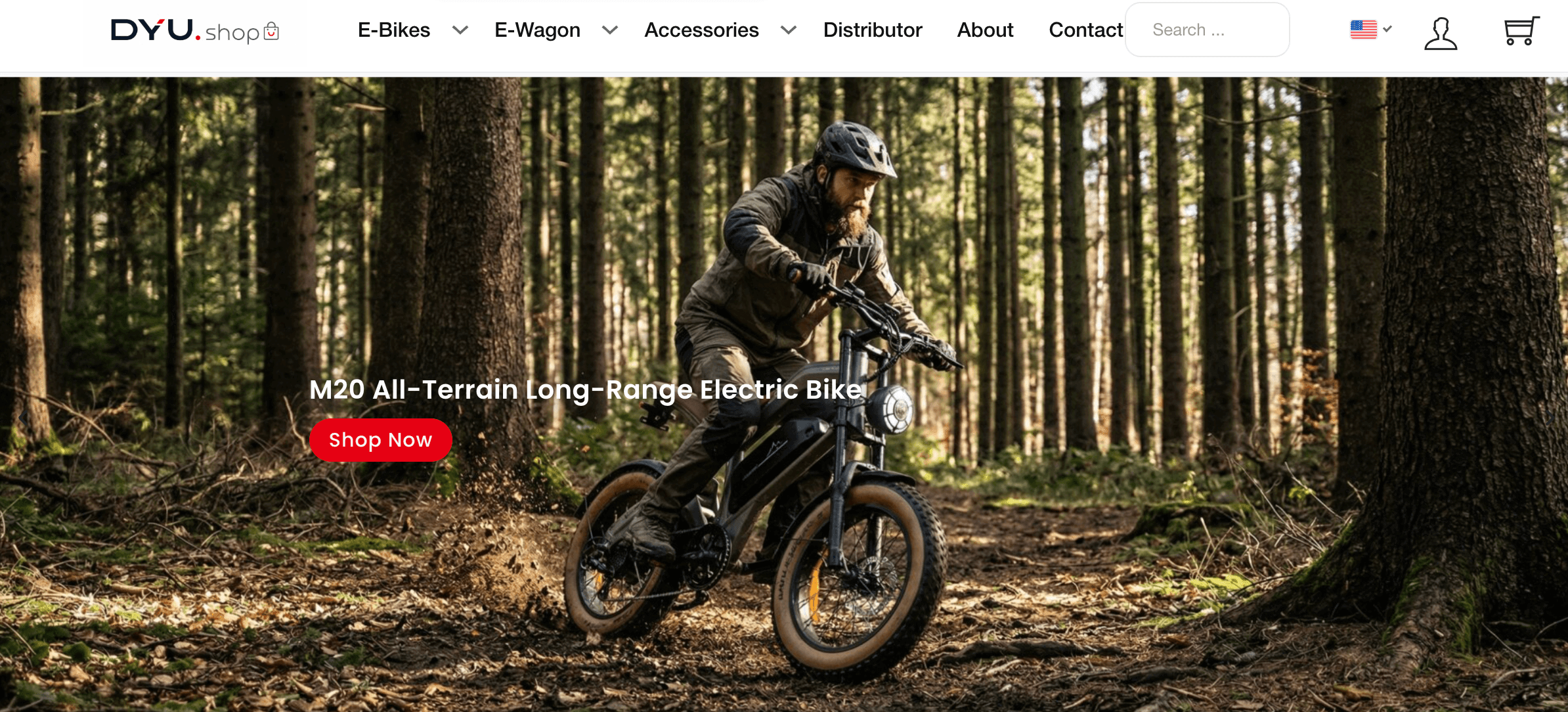
Product-wise, DYU covers nearly every common e-bike category rather than specializing in one niche. The catalog spans ultra-compact 14-inch folding commuters (D3F, D3S, A5), mid-size 16 and 20-inch folders (A1F Pro, C2, C9, T1), traditional 26–27.5-inch city and step-through bikes (C1, C5, C6), long-range models like the 700C Stroll 1, and — at the top of the lineup — the M20, a moped-styled, fat-tire, all-terrain e-bike that’s currently DYU’s best-selling model. There’s also an electric folding cargo wagon (CampX) and a full accessory catalog covering racks, baskets, child seats and displays, which signals a brand trying to build a full ecosystem rather than sell one hero product.
Why DYU Stands Out in 2026
Real power at a genuinely low price: The flagship M20 pairs a 750W motor (1500W peak output) with a 45km/h top speed and up to 160km of pedal-assist range from a removable 48V 18.2Ah battery — specs that in many other brands’ lineups would command a price well north of $1,500. DYU regularly discounts the M20 to around $999 from a $1,399 list price, which is aggressive for the spec sheet on offer.
One of the widest catalogs in the budget e-bike space: Rather than one or two SKUs, DYU sells roughly a dozen distinct e-bike models spanning 14-inch mini-folders under $600 all the way to the fat-tire M20 near $1,000, plus a cargo e-wagon and a full accessories line. Few budget e-bike brands offer this much range to match riders’ exact use case — commuting, folding storage, family hauling, or off-road fun.
A real corporate track record, not a dropshipping storefront: Nearly a decade in business, a Costco retail placement, over a million cumulative riders, and eight-figure funding rounds are the kind of signals that separate an established e-bike company from a white-label import operation. That history gives some added confidence around parts availability and long-term support compared to newer, unproven brands.
Multi-region warehousing for faster delivery: With fulfillment infrastructure across the US, UK, Poland and other parts of Europe, most DYU orders avoid the months-long wait times associated with drop-shipped e-bikes coming directly from overseas factories. Delivery windows advertised across the site range from roughly 3 to 7 business days depending on region and current promotion.
Fast, tool-included assembly: DYU bikes ship mostly pre-assembled, with the brand quoting 10–20 minutes of setup time using the included tools, plus YouTube assembly videos for models that need extra guidance (the M20 has its own dedicated assembly walkthrough). That’s a meaningfully lower barrier to entry than e-bikes requiring a shop visit or a full DIY build.
Removable, fast-charging batteries across the range: Every DYU model in this lineup uses a removable lithium-ion battery, which means charging indoors overnight without hauling the whole bike inside, plus the option to buy a spare battery or charging cable separately for models where that’s offered.
Consistent warranty coverage and a trial window: DYU advertises 12–24 months of warranty coverage on e-bike core components, along with a stated 30-day risk-free trial and (per the FAQ) a 14-day free return/exchange window after delivery — reasonable coverage for the price tier, though buyers should read the specific policy for their model and region before purchasing, since the exact numbers vary slightly by page.
Key Features and Technology
DYU’s catalog is broad, but it’s easiest to understand by looking at the flagship M20 in detail, then at how the rest of the range fans out around it.
The M20: Motor, Battery and Range
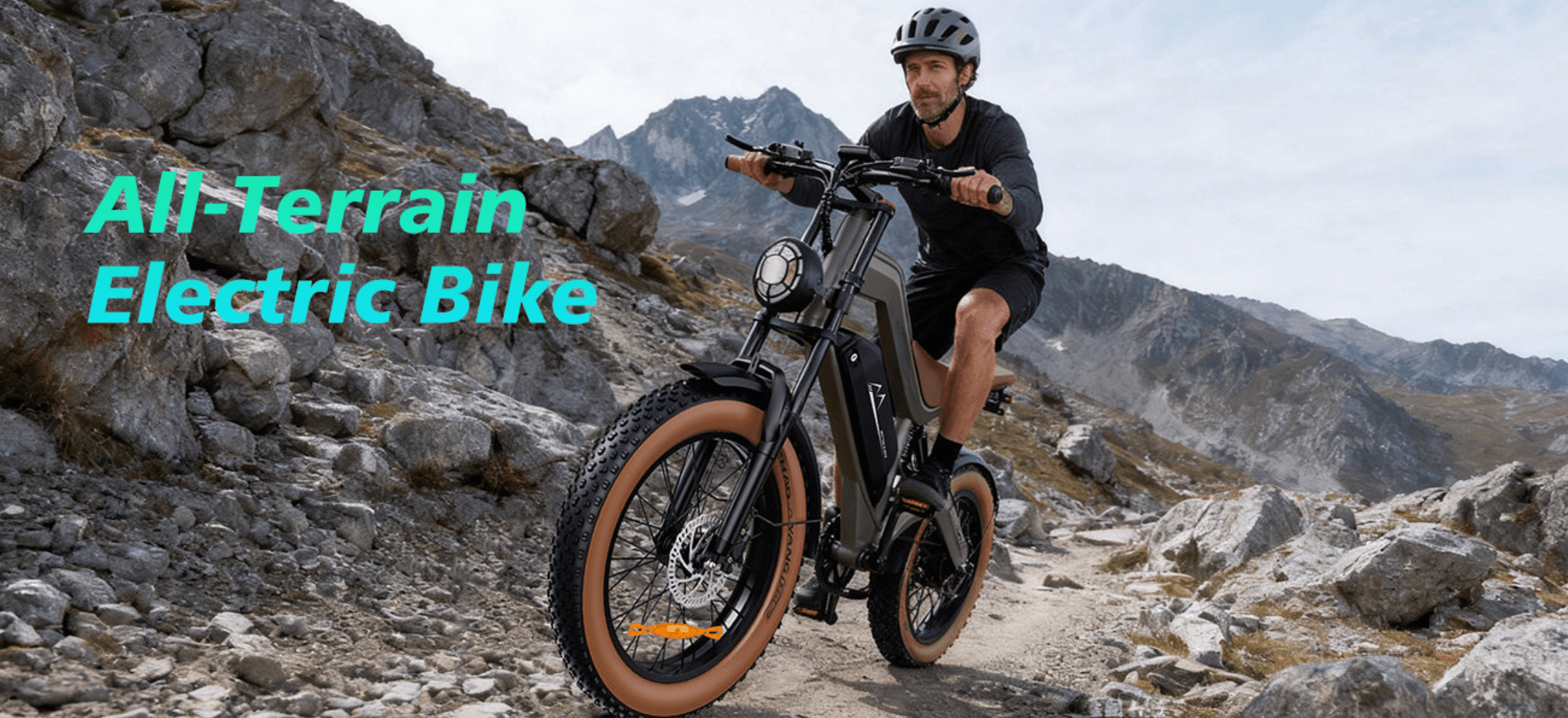
The M20 is built around a 750W rated motor with up to 1500W of peak output, driving a 45km/h top speed and handling inclines up to roughly 15°. Power comes from a removable 48V 18.2Ah lithium-ion battery, rated for up to 160km of range in pedal-assist mode or around 110km on throttle-only riding — DYU quotes a 7–8 hour charge time from an AC100–240V charger. The battery, motor and controller together give the M20 real off-road and long-commute capability rather than the token power output some budget “fat tire” bikes ship with.
Brakes, Suspension and Ride Control
The M20 uses dual-actuated mechanical disc brakes rather than hydraulic ones — mechanical brakes are easier and cheaper to maintain but generally offer less stopping power and modulation than hydraulic setups on pricier bikes. Front fork and seat shock absorption smooth out rough surfaces, and a Shimano 7-speed derailleur lets riders match gearing to hills or flat cruising. The bike rolls on 20 x 4.0-inch fat tires for stability on mixed terrain, rides on an aluminum frame, and carries an IP54 water-resistance rating, meaning it can handle light rain and splashes but isn’t designed for submersion or heavy downpours.
Folding and City Models Beyond the M20
Below the M20, DYU’s lineup shifts toward lighter, more portable, and less expensive commuter-focused bikes. The D3F and D3S are compact 14-inch mini-folders aimed at short urban trips and easy storage; the A1F Pro and C2 are 16-inch folders with similar goals; the C9 and T1 step up to 20-inch wheels with longer range for riders who want more speed and distance without going to the fat-tire M20. Most of these entry and mid-tier models run smaller 250W motors, which keeps them closer to standard e-bike classifications in many regions but also means noticeably less power and shorter range than the M20 — an important distinction for buyers comparing models purely on price.
Accessories and the Wider DYU Ecosystem
DYU sells a reasonably deep accessories catalog alongside its bikes: front and rear baskets, racks, a child seat set, a spare display unit, a removable tail light, a charging cable, and a non-slip kickstand for smaller-wheel models. It’s not as expansive as some dedicated e-bike accessory brands, but it covers the practical basics — hauling groceries, adding a child seat, or replacing a lost charging cable — without forcing owners to hunt for third-party parts.
Pricing, Plans, and Package Structure
DYU sells e-bikes as one-time purchases with no subscription component. Nearly every model on the site is shown with a discount off a listed “original” price, and the site frequently runs coupon codes and seasonal sales on top of those already-discounted prices — so the numbers below should be treated as a snapshot rather than a fixed price list. Always check the live product page and any active promo code before checkout.
| Model | Price (USD, sale) | What It Is | Best For |
|---|---|---|---|
| D3F 14″ Mini Folding | $499 (from $699) | 250W, 50km range mini folder | Tightest budgets, apartment storage |
| A1F Pro 16″ Folding | $581.29 (from $721.07) | 250W lightweight folding commuter | Easy daily storage, short commutes |
| C2 16″ Full Folding | $651.18 (from $1,000.65) | 250W, 40km range compact folder | City riders wanting a deeper discount |
| C9 20″ Foldable Long-Range | $779 (from $1,299) | Larger-wheel folding commuter | Longer commutes needing more range |
| C5 27.5″ City | $930.76 (from $1,047.25) | 65km range city ebike, no folding | Riders who don’t need to fold/store small |
| M20 All-Terrain (flagship) | $999 (from $1,399) | 750W/1500W peak, 160km range, fat tire | Off-road fun, longer rides, most power |
| FF500 20″ Fat Tire | $1,396.72 (from $2,095.66) | 500W, 70km range fat-tire ebike | Riders between the C-series and M20 |
How the DYU M20 Compares to Alternatives
The fairest comparison for DYU’s flagship is against other moped-styled, fat-tire e-bikes in a similar power class, since DYU’s entry-level folding models compete in a different, more crowded sub-$700 segment. The table below compares the M20 against ENGWE’s similarly specced M20 and the notably more premium Himiway Cobra. Competitor prices fluctuate with region and promotions and should be treated as approximate.
| Factor | DYU M20 | ENGWE M20 (approx.) | Himiway Cobra (approx.) |
|---|---|---|---|
| Price | ~$999 sale / $1,399 list | ~$799–1,299 (single battery) | ~$2,399 |
| Motor | 750W rated / 1500W peak | 750W rated / ~1000W peak | 750W hub / ~1000W peak (Pro) |
| Battery / Range | 48V 18.2Ah, up to 160km PAS | 48V 13Ah (26Ah dual optional), up to ~94 mi dual | 48V 20Ah, up to ~60 mi |
| Suspension | Front fork + seat shock | Front fork (full suspension on 2.0 variant) | Full four-bar linkage + coil suspension |
| Tires | 20 x 4.0 in | 20 x 4.0 in | 26 x 4.8 in |
| Warranty | 12–24 months (core components) | 1 year (typical) | 2 years (typical) |
| Best for | Best all-round value on paper | Closest direct rival, similar spec/price | Serious trail riders who’ll pay more for build quality |
DYU M20 vs. ENGWE M20: these two bikes are close enough on paper — same motor class, same tire size, similar suspension — that the decision often comes down to current promotions and which brand’s warranty and support you trust more, rather than a clear spec advantage either way. DYU’s quoted range figure is notably higher, but real-world range on both bikes depends heavily on rider weight, terrain and assist level, so treat the manufacturer numbers as ceilings rather than guarantees.
DYU M20 vs. Himiway Cobra: the Cobra is a genuinely different tier of bike — bigger tires, full four-bar linkage suspension, and a longer warranty — but it costs roughly 2.4x as much. For riders doing serious, sustained off-road trail riding, that jump in suspension and tire volume may be worth the money. For riders who mostly want fat-tire capability with occasional trail use and daily commuting in between, the M20 delivers most of the practical experience at a fraction of the price.
Pros and Cons
What Users Love
Strong power-to-price ratio: Independent reviewers on the M20’s own product page repeatedly single out how much motor power and speed the bike delivers relative to its cost, describing it as outperforming bikes that cost significantly more.
Build quality that feels better than the price suggests: Multiple customer reviews mention a solid, rattle-free feel at speed and compliments from strangers on the bike’s styling — a common theme especially for the retro moped-inspired M20.
Fast, easy delivery and setup: Trustpilot reviewers for the broader DYU brand frequently mention next-day-to-a-few-days delivery and straightforward assembly, which matters a lot for buyers who’ve been burned by slow-shipping e-bike importers before.
Genuine variety across the lineup: Because DYU sells everything from sub-$600 mini-folders to the fat-tire M20, existing customers who like the brand can upgrade or add a second bike for a different use case without switching brands entirely.
Limitations Worth Knowing
Thin independent review history on the dyubikes.com storefront specifically: While the parent DYU brand has a substantial, respectable Trustpilot record on its original domain, the dyubikes.com shop itself currently shows only a handful of independent reviews. Buyers should weigh the brand’s overall history rather than relying solely on this storefront’s own review count.
Mixed customer-service experiences on returns: At least one Trustpilot reviewer for the DYU brand described being asked to pay a return-shipping fee on a faulty bike despite having purchased extended return coverage, and another reported receiving the wrong accessory. These appear to be a minority of cases rather than a pattern, but they’re worth knowing before you buy.
Inconsistent shipping details across the site: Different sections of dyubikes.com quote different delivery windows and warehouse locations — a homepage banner promises 5–7 day shipping, footer badges cite three European warehouses with 3–5 day delivery, and the FAQ separately describes warehouses in Poland, the US and the UK with up to 7 business days. None of this is necessarily wrong, but the inconsistency means buyers should confirm the actual delivery estimate shown at checkout rather than trusting any single page.
Mechanical rather than hydraulic brakes on the M20: At this price, mechanical disc brakes are a reasonable and common trade-off, but they require more frequent adjustment and offer less stopping power than the hydraulic brakes found on pricier rivals like the Himiway Cobra.
Legal classification varies by region: The M20’s 750W/45km/h spec puts it above the power and speed limits that define a standard “e-bike” in many countries, meaning it may only be street-legal in some jurisdictions and require off-road or private-property use elsewhere — a limitation DYU itself flags on the product page.
Who Should Use DYU
Budget-conscious riders who still want real power: If your priority is getting a fat-tire, moped-styled e-bike with genuinely strong specs without spending $1,500+, the M20 is one of the more compelling options at its price point.
City commuters who need to fold and store their bike: The D3F, D3S, A1F Pro and C2 models are built specifically for riders in apartments or small homes who need to carry the bike inside, up stairs, or onto public transit.
Families building out a multi-bike household: With child seat accessories, a wide model range across price points, and a cargo e-wagon, DYU can outfit more than one rider in a household without mixing brands.
Buyers in DYU’s core shipping regions: Riders in the US, UK, and mainland Europe benefit most from DYU’s regional warehousing and faster delivery windows; buyers outside these regions should double-check shipping times and import costs before ordering.
Who should look elsewhere: serious off-road riders who want the biggest possible tires, full coil suspension, and hydraulic brakes should look at premium fat-tire brands like Himiway instead, even at a higher price. Buyers who need airtight certainty about street-legal classification for daily road use in a specific country should verify local e-bike power/speed rules first, since the M20’s 750W/45km/h spec exceeds standard e-bike limits in many places. And anyone who wants to base their purchase decision purely on the dyubikes.com storefront’s own review count should know that count is still small, even though the parent brand’s track record is considerably deeper.
Getting Started: Step by Step
- Pick your model by use case, not just price. Decide whether you need a folding commuter, a standard city bike, or the fat-tire M20 before comparing prices — the right category matters more than shaving another $50 off the wrong bike.
- Check for an active coupon code. DYU frequently runs promo codes on top of already-discounted “sale” prices; look for a current banner code on the homepage or product page before checking out.
- Confirm your shipping estimate at checkout. Delivery windows differ slightly across the site’s own pages, so rely on the estimate shown during checkout for your specific address rather than any single marketing banner.
- Unbox and assemble using the included tools. DYU quotes 10–20 minutes for most models; if you get stuck, DYU publishes model-specific assembly videos on YouTube, including a dedicated walkthrough for the M20.
- Charge fully and do a slow first ride. Before opening up the throttle or top pedal-assist level, take a short, low-speed ride to test both brakes and confirm the gears shift cleanly.
- Register your warranty and note your return window. Keep your order confirmation and warranty card, and mark your calendar for the applicable return/exchange deadline in case anything needs to go back.
Tips for Getting Maximum Value
Get the most out of a DYU e-bike by treating the first few rides as a break-in period rather than a chance to max out speed and range immediately — check tire pressure, re-torque any bolts that may have loosened in shipping, and confirm brake alignment before riding hard or off-road. Use pedal-assist rather than pure throttle when climbing hills to conserve battery and put less strain on the motor, and avoid letting the battery sit fully depleted for long stretches, since that shortens lithium-ion battery lifespan over time. If you’re buying the M20 or another fat-tire model specifically for trail use, budget separately for a helmet and basic lock, since neither is included, and consider a second battery or the charging cable accessory if you plan to ride longer distances regularly. Finally, before your first extended road ride, take five minutes to look up your local e-bike power and speed classification rules — it’s a small step that avoids potential legal headaches with a motor this powerful.
Future Outlook and Final Assessment
DYU’s trajectory over the past decade — from a crowdfunded startup to a Costco-stocked, multi-warehouse brand with over a million riders and continued outside investment as of 2024 — suggests a company that’s still growing rather than coasting. The recent expansion of its dyubikes.com storefront and the M20’s push into the fat-tire, moped-style segment show DYU chasing the same higher-margin, higher-spec trend that’s reshaped the broader budget e-bike market over the last two years, following in the footsteps of brands like ENGWE and Himiway that pioneered that category.
Whether DYU can close the remaining gap with more premium rivals on brake quality, suspension sophistication, and consistent customer support will matter more to its long-term reputation than adding still more SKUs to an already broad catalog. For now, the brand’s core value proposition — real, usable e-bike specs at a genuinely competitive price, backed by a company with real staying power — holds up under scrutiny, provided buyers go in with realistic expectations about component quality at this price tier.
Conclusion
DYU has built a genuinely wide, genuinely affordable e-bike lineup backed by nearly a decade of company history, and the flagship M20 in particular delivers strong power, range, and styling for well under the price of comparable fat-tire rivals. It isn’t a premium brand — the mechanical brakes, occasional customer-service friction, and slightly inconsistent shipping information across the site make that clear — but for riders who want real e-bike capability without a four-figure-plus commitment, DYU is one of the more credible budget options on the market in 2026.
Ready for real e-bike power without the premium price tag?
Explore more honest reviews, tutorials and tech comparisons to find the right gear for the way you work, travel and live — at World Of Tech, where we make everything easy.
👉 Shop DYU: https://worldoftech.space/dyubikes
👉 Our YouTube Channel: youtube.com/@world_tech79
👉 Our Facebook Fanpage: Facebook
👉 Our X (Twitter): @worldoftech79
Pricing, specifications and policy details in this review were verified against dyubikes.com and independent review sources as of July 2026. E-bike pricing, promotions and features change frequently, so confirm current details on the official site before purchasing. Competitor prices are approximate and subject to change.