
Most homes have the same low-grade chaos: a paper calendar nobody updates, sticky notes falling off the fridge, and a TV that’s bolted to one room while everyone else is stuck staring at a phone. Apolosign is a factory-direct electronics brand built around a simple bet — that a single smart screen can replace the whiteboard calendar, the family command center, and the second TV all at once. Its lineup spans three product families: dual-mode Digital Calendars that sync every family member’s schedule without a subscription, battery-powered Portable TVs that roll from the kitchen to the backyard, and Neon-Lit Digital Photo Frames for displaying memories. Apolosign has grown quickly through direct-to-consumer sales, a Kickstarter-funded briefcase TV, and an in-house Android software platform that ties the whole ecosystem together.
For busy families, remote workers, and anyone tired of juggling five different apps to keep a household running, the pitch is straightforward: pay once, get a big touchscreen that handles calendars, chores, meal planning, and entertainment, with no recurring subscription required for the core features. But Apolosign isn’t the only player chasing this idea, and an honest look reveals a few things worth knowing before you buy — from a founding-date claim that doesn’t quite line up with the brand’s own product timeline, to trade-offs in battery life and screen resolution depending on which model you pick. This 2026 review walks through Apolosign’s full lineup — the Digital Calendars, Portable TVs, and Photo Frames, pricing across every size, how it stacks up against category leaders like Skylight Calendar Max, the genuine pros and cons, and exactly who should (and shouldn’t) buy in.
Apolosign Review 2026: Dual-Mode Digital Calendars and Portable Smart TVs for the Whole Family
Overview and Background
Apolosign is a Shopify-based direct-to-consumer electronics brand that designs and manufactures its own hardware rather than reselling white-label devices. According to the company’s own product timeline, its family-screen journey began around 2020 with co-branded digital photo frame partnerships (Frameo and Nixplay), followed by a Neon Light Digital Frame in 2021, the first Smart Portable TV in 24″ and 32″ sizes in 2022, the Kickstarter-funded PackGo briefcase TV in 2023, an upgraded Portable TV Gen 2 in 2024, and the flagship world-first Dual-Mode Digital Calendar in 2025. Today the brand says it serves over one million households and ships roughly two million units a year.
The catalog is organized into three clear pillars. Digital Calendars (15.6″, 21.5″, 27″, and a 27″ 4K model) are wall-mounted or desktop touchscreens that sync with Google, Apple, Outlook, Yahoo, and Cozi calendars, run chore and reward systems, and double as an Android tablet when you want one. Portable TVs (24″ and 32″, plus the briefcase-style PackGo 27″) are battery-powered, wheeled touchscreens running Android with full Google Play Store access, designed to roam between rooms instead of being fixed to a wall. Digital Photo Frames, including the signature Neon-Lit line, round things out as smaller, gift-oriented displays. All three families run on the same underlying Android software stack and are designed to sync with each other through a shared Apolosign mobile app and dashboard.
Apolosign’s own marketing states the company was “founded in 2008,” which sits oddly next to its own published product-launch timeline that starts in 2020. That’s not necessarily disqualifying — companies sometimes count a parent entity’s founding date rather than the consumer brand’s launch — but it’s a discrepancy worth flagging upfront rather than repeating uncritically. On the review side, Apolosign carries a strong Trustpilot rating (close to 5 out of 5 stars across a few hundred reviews as of early 2026) and cites a combined 4.5-star-plus average across Amazon and Trustpilot on its own site. Several of the “featured in” media logos on its homepage — including USA Today, Wired, and Digital Trends — link to sponsored contributor-content or branded-content sections rather than independent staff-written reviews, which is worth knowing when weighing how much editorial weight to put on those placements.
One practical note for shoppers outside the U.S.: Apolosign’s free-shipping promise and most of its promotional pricing are U.S.-focused, and the checkout experience is built primarily around American customers. International buyers can still order, but should budget extra time and cost for shipping and confirm voltage compatibility for their region before purchasing, since the listed pricing and delivery promises assume a domestic U.S. order.
Why Apolosign Stands Out in 2026
No subscription for core calendar features: Unlike several rivals in the smart-calendar space that gate meal planning, chore rewards, or photo screensavers behind a paid tier, Apolosign’s Digital Calendar includes multi-calendar sync, routines and rewards, custom lists, meal planning, and a photo-frame screensaver free for the life of the device. Only optional AI-chat features sit behind a subscription. For a family that just wants a calendar that works, that’s a meaningfully lower total cost of ownership than subscription-based competitors.
A genuine dual-mode calendar, not just a tablet with a calendar app: The 2025 flagship calendar line lets you switch between a dedicated Calendar Mode (built for glanceable family scheduling) and a full Android Mode with a customizable widget dashboard. Most rivals pick one lane — either a locked-down calendar appliance or a general Android tablet. Apolosign lets the same screen do both jobs depending on the day.
Portable TVs solve a real, underserved problem: Most “smart TVs” are permanently mounted. Apolosign’s 24″ and 32″ Portable TVs run on a built-in battery (up to roughly 4 to 6 hours depending on size), sit on a wheeled, height-adjustable stand, and give you a full Android touchscreen with Google Play access wherever you roll it — kitchen, patio, kid’s playroom, or garage workspace.
The PackGo briefcase TV is a genuinely unusual product: A 27″ smart screen that folds into a briefcase-style shell for travel, camping, or car use is not something you’ll find at a typical big-box retailer. It debuted as a successfully crowdfunded Kickstarter project before becoming a standard catalog item, which suggests real early demand rather than a rushed me-too product.
A shared ecosystem across product lines: The Portable TV’s built-in dashboard syncs with the Digital Calendar, and both can display the Neon-Lit Photo Frame’s screensaver mode. Buying more than one Apolosign device compounds the value instead of creating three disconnected gadgets.
Google ecosystem access, not a closed platform: Because the devices run Android with EDLA licensing and full Google Play Store access, you aren’t limited to a manufacturer’s curated app list. Google Assistant and Gemini AI voice control, Google Home integration on the calendars, and mainstream streaming apps all work on the same hardware that runs the family schedule.
Factory-direct pricing and a real warranty: Apolosign designs and manufactures its own hardware, which it says lets it skip middleman markups. Every product ships with a 1-year warranty, a 30-day risk-free trial period, and free U.S. shipping — a fairly low-risk way to try a category of product most shoppers have never used before.
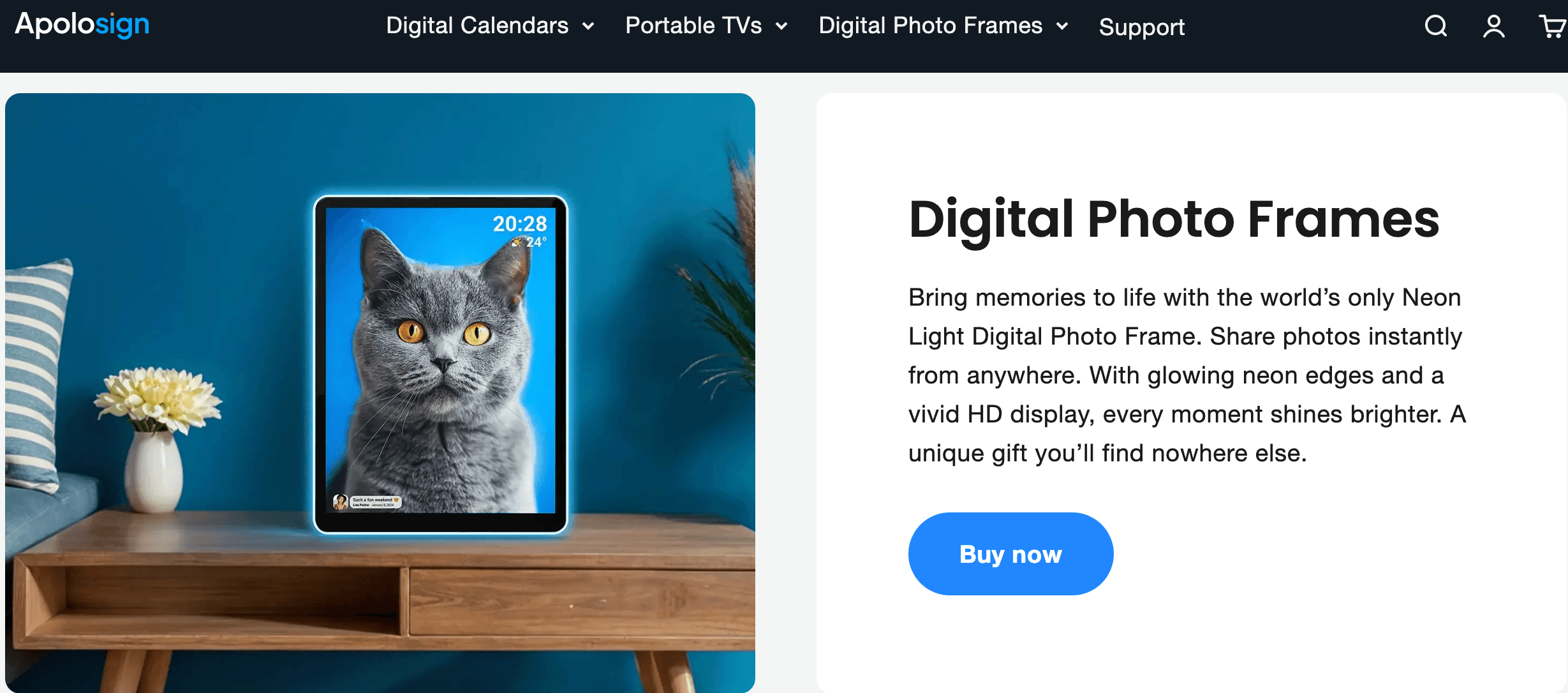
Apolosign’s Dual-Mode Digital Calendar switches between a dedicated family-scheduling view and a fully customizable Android dashboard — no subscription required for the core features.
Key Features and Technology
Apolosign’s catalog is broader than a single hero product. Here’s how the three core product lines actually break down, and what’s under the hood.
A useful way to think about the lineup is by where it lives in the house rather than by product name. The Digital Calendar is the fixed, always-visible hub — mounted in a kitchen or hallway, meant to be glanced at dozens of times a day. The Portable TV is the mobile counterpart — meant to move with you and to be actively watched or used, not just glanced at. The Photo Frame sits somewhere in between: usually stationary once placed, but far more casual and gift-oriented than either of the other two. Understanding which role you actually need filled makes it much easier to pick a starting product instead of trying to evaluate the entire catalog at once.
Digital Calendars: 15.6″, 21.5″, 27″, and 27″ 4K
The Digital Calendar range is Apolosign’s newest and most differentiated product. Every size auto-syncs Google, Apple, Outlook, Yahoo, and Cozi calendars, runs a chore-and-rewards system that turns routines into points for kids, includes a message board for family notes and countdowns, supports meal planning and shopping lists, and doubles as a subscription-free Google Photos screensaver. The 21.5″ model, for example, runs on a Rockchip RK3576 octa-core processor with 4GB RAM and 64GB storage, a 1920×1080 10-point touchscreen, Wi-Fi 6, and an anti-glare matte glass finish. Voice control works through “Hey Google,” including Gemini AI chat, and the calendar can also serve as a Google Home dashboard for doorbells and cameras. The 15.6″ model is the only size that ships with a desktop stand as well as a wall mount; the 21.5″ and larger sizes are wall-mount only.
Portable TVs: 24″ and 32″
The Portable TV line is Apolosign’s original category and its bestseller. Both the 24″ and 32″ models run Android 16 with EDLA certification and full Google Play Store access, an octa-core processor, 16GB of RAM, and either 128GB or 256GB of storage depending on the resolution option. The 32″ model is available in 1080p or 4K resolution and packs a 15,000mAh battery rated for up to 6 hours of streaming; the 24″ model is FHD-only with a smaller 6,800mAh battery rated for up to 4 hours. Both sit on a five-wheel, height-adjustable stand that tilts, swivels, and rotates 90 degrees, include an 8MP camera and dual microphones for video calls, and support HDMI, Wi-Fi, and Bluetooth screen sharing from a laptop or phone.
PackGo: The Briefcase Portable TV
PackGo takes the same Android touchscreen concept and repackages it into a 27″ screen that folds shut into a rugged, briefcase-style shell with a carry handle — built specifically for travel, camping, tailgating, and car-based use where a wheeled stand isn’t practical. It launched on Kickstarter before becoming a standing catalog product, and it’s priced accordingly as the premium item in the lineup.
Neon-Lit and Standard Digital Photo Frames
The Neon-Lit Photo Frame line (9.7″ 2K, 10.1″, and 14.1″) adds a glowing neon-edge design around the display, marketed as a distinctive gift item rather than a purely functional tool. A more conventional Digital Photo Frame line (10.1″ and 15.6″) skips the neon styling for a lower price point. Both frame families support wireless photo sharing so family and friends can push images to the display remotely.
Pricing, Plans, and Package Structure
Apolosign sells direct through its own website with no subscription required for core features on any device. Prices below reflect the brand’s standard sale pricing as listed on apolosign.com; frequent promotional discounts (10-16% off list) are common, so treat the “regular price” as the baseline and the sale price as the typical price most buyers will actually pay.
| Product | Price | What It Is | Best For |
|---|---|---|---|
| 21.5″ Digital Calendar | $379 (list $449) | Wall-mounted dual-mode family calendar | Families wanting a subscription-free scheduling hub |
| 24″ Smart Portable TV | $619 (list $699) | Compact battery-powered Android touchscreen TV | Small spaces, kitchens, kids’ rooms |
| 32″ Smart Portable TV | $719 (list $799) | Larger rolling Android TV, 1080p or 4K | Living rooms, family movie nights, patios |
| PackGo 27″ Briefcase TV | $999 (list $1,099) | Briefcase-style portable smart screen | Travel, camping, tailgating, car use |
| 10.1″ Neon-Lit Photo Frame | $79 (list $89) | Wireless-sync digital photo frame with neon edge | Gifts, entry-level photo display |
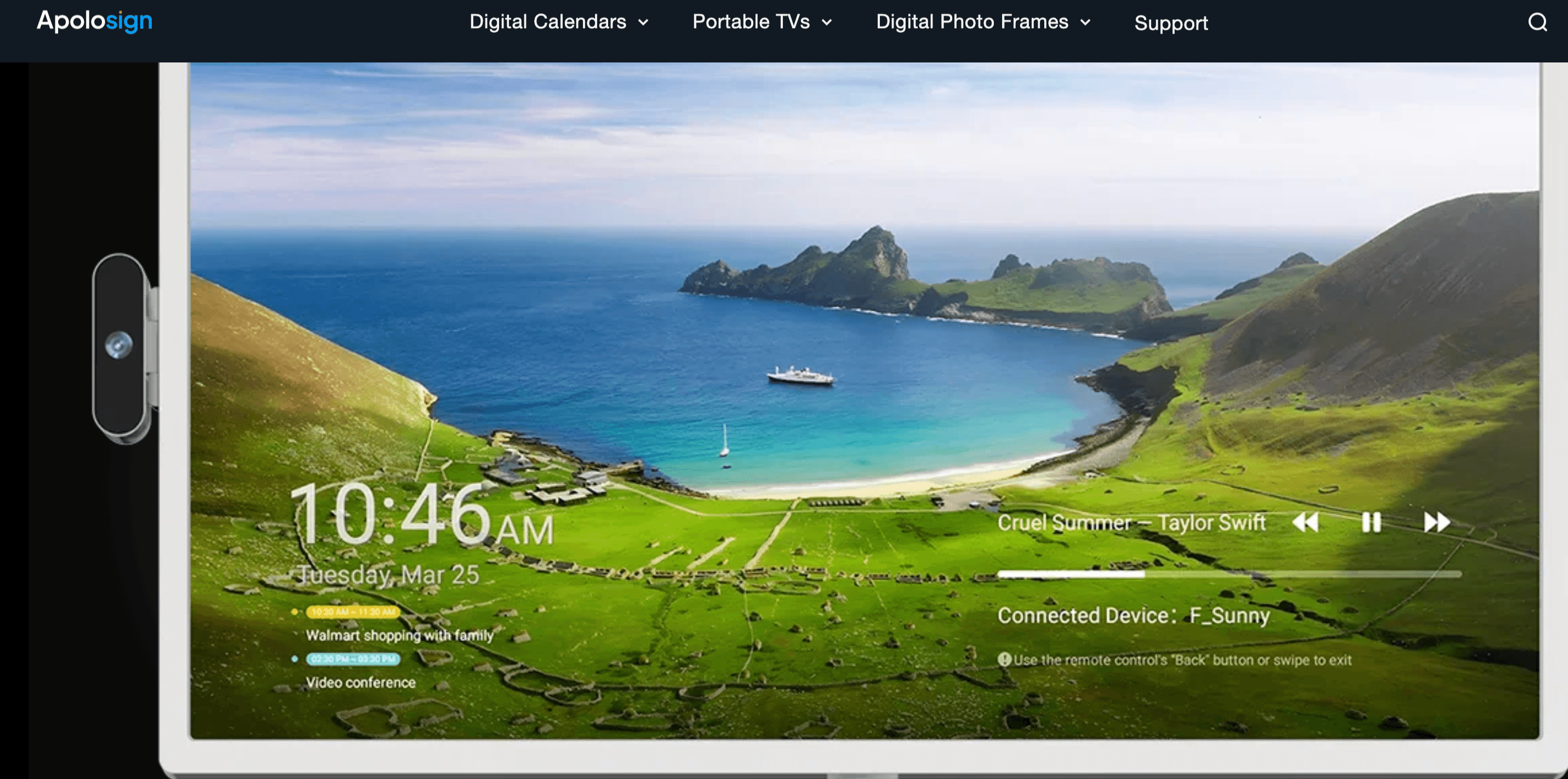
The 32″ Smart Portable TV runs full Android with Google Play access on a battery-powered, wheeled stand that rolls between rooms.
How Apolosign Compares to Alternatives
Apolosign doesn’t have a single direct one-to-one competitor because it straddles two categories. The clearest comparison points are Skylight Calendar Max, the established leader in smart family calendars, and the broader field of generic budget Android portable/rollable TVs on the market.
| Factor | Apolosign | Skylight Calendar Max | Generic Portable Android TVs |
|---|---|---|---|
| Category focus | Calendars + portable TVs + frames | Family calendar only | Portable TV only |
| Subscription required | No (AI chat optional) | Optional Plus plan ~$79/yr for meal planning, rewards, magic import | Varies by brand, usually none |
| Approx. price range | $79 – $999 | ~$349 hardware + optional subscription | $300 – $1,000, wide quality variance |
| App ecosystem | Full Android + Google Play Store | Closed calendar-only interface | Usually open Android, quality varies |
| Power source | Calendars: plugged in. TVs: 4–6 hr battery | Plugged in only, no battery | Usually battery-powered, life varies widely |
| Warranty / trial | 1-year warranty, 30-day trial | 3-year replacement, 4-month returns | Typically 1-year, varies by seller |
| Best for | Households wanting calendar + portable TV in one ecosystem | Families who only want a dedicated calendar and value a longer track record | Buyers who only need a roaming screen and don’t care about brand ecosystem |
Apolosign vs. Skylight Calendar Max: Skylight has been in the smart-calendar category longer and backs its hardware with a 3-year replacement promise and a 4-month return window, which is more generous than Apolosign’s 1-year warranty and 30-day trial. But Skylight gates several genuinely useful features — meal planning, magic import, photo screensaver, and the rewards system — behind an optional $79/year Plus subscription, while Apolosign includes equivalent features free on every calendar. If long-term brand track record and a longer money-back window matter most, Skylight is the safer bet; if a lower total cost of ownership matters more, Apolosign’s calendar line is the better value.
Apolosign vs. generic budget portable Android TVs: The portable-touchscreen-TV category is crowded with similarly specced, similarly priced alternatives from lesser-known brands, many selling in the same $300-$1,000 range with comparable battery life and Android builds. Apolosign’s edge here isn’t unique hardware — it’s the ecosystem tie-in with the Digital Calendar dashboard, a real warranty and support structure behind the product, and a design language (wheeled stand, height/tilt/swivel adjustment) that’s more refined than most no-name competitors. If you’re buying a portable TV in isolation and don’t care about the calendar ecosystem, shop specs and reviews carefully, since this segment has a lot of near-identical hardware wearing different logos.
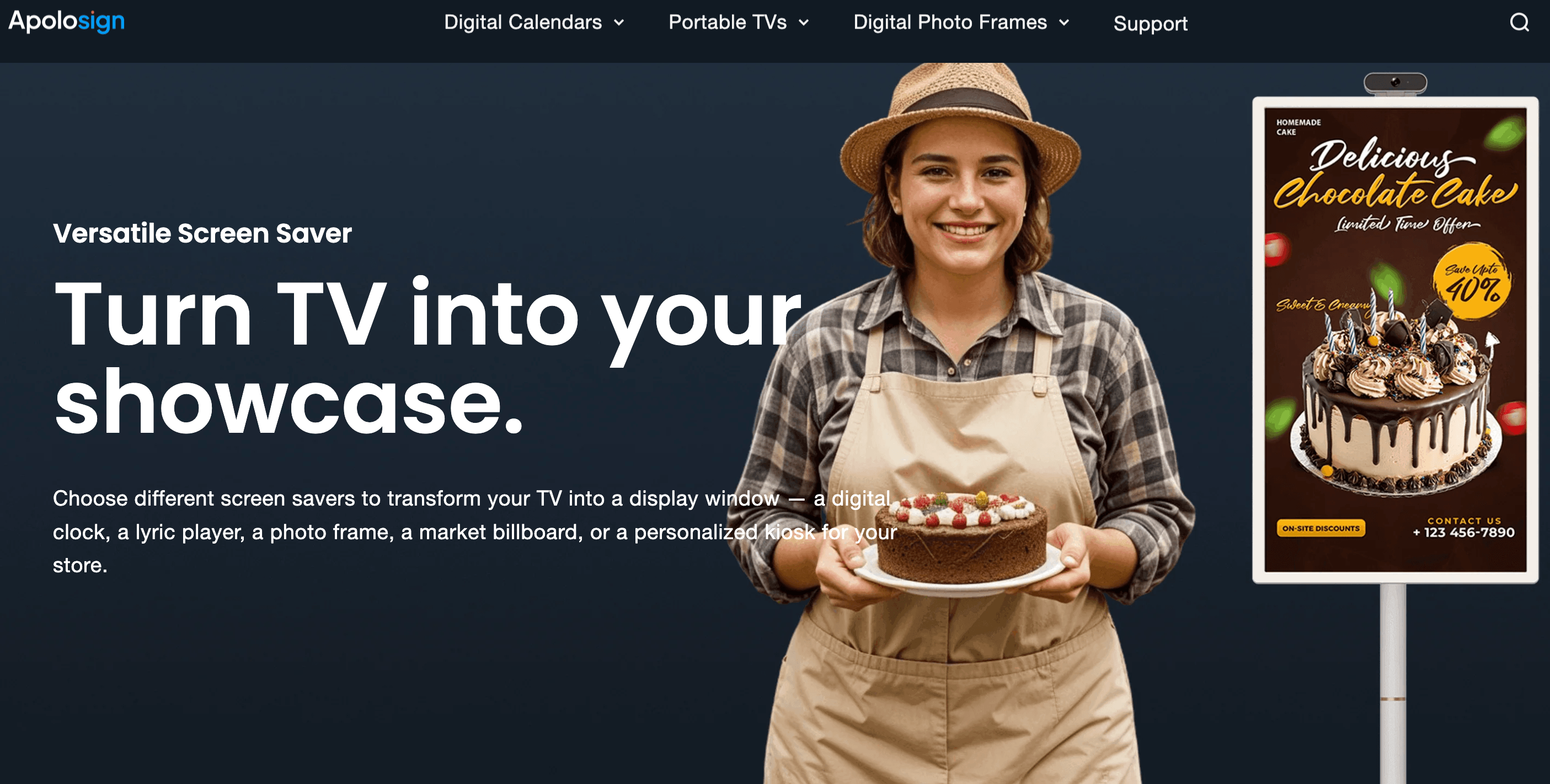
The PackGo 27″ folds into a rugged briefcase shell, making it Apolosign’s most travel-oriented product and its most direct point of differentiation from typical portable TVs.
Pros and Cons
What Users Love
No monthly fees: Reviewers consistently call out that the calendar’s chore, reward, meal-planning, and photo-screensaver features work without a subscription — a direct contrast to some subscription-based competitors in the category.
Easy setup: Multiple Trustpilot reviewers describe setup as fast and beginner-friendly, with clear in-box instructions and video tutorials for people who prefer visual guidance.
Genuine versatility: Owners frequently note that the same device functions as a calendar, chore tracker, photo frame, and casual Android tablet, which reduces the number of separate gadgets a household needs.
Fast, reliable shipping and support: Delivery speed and responsive customer support come up repeatedly and positively across recent Trustpilot reviews, including for holiday-season orders.
Solid build quality for the price: Buyers describe the units as well-packaged and higher quality than they expected for the price point, particularly on the larger calendar and TV models.
Limitations Worth Knowing
A founding-date claim that doesn’t match the brand’s own history: The site states Apolosign was “founded in 2008,” but its own published product timeline only goes back to 2020. Buyers who research the brand closely may find this inconsistency worth questioning, even though it doesn’t affect the hardware itself.
Some early sync issues: A handful of Trustpilot reviews mention initial hiccups syncing Google accounts or keeping the mobile app and on-device widgets in sync, sometimes requiring a factory reset to resolve.
Battery life varies significantly by model: The 24″ Portable TV’s 4-hour rating is modest for a device marketed as roam-anywhere; the 32″ model’s 6-hour rating is more usable but still shorter than dedicated tablets.
Shorter warranty and trial window than the category leader: Apolosign’s 1-year warranty and 30-day trial are standard, but they’re notably shorter than Skylight’s 3-year replacement promise and 4-month return window on comparable calendar hardware.
Media mentions lean heavily on paid placements: Several of the outlets featured on Apolosign’s homepage — including USA Today and Wired — link to sponsored contributor-content sections rather than independent editorial reviews. That’s a common industry practice, but it means those logos carry less independent weight than they might first appear to.
Who Should Use Apolosign
Busy families juggling multiple calendars: If your household runs on a mix of Google, Outlook, and school-shared calendars, the Digital Calendar’s auto-sync and chore/reward system genuinely reduces the daily coordination burden — without a monthly bill attached.
Anyone who wants a TV that isn’t stuck in one room: If you regularly move between kitchen, patio, garage, or bedroom and want a real Android touchscreen (not a phone mirror) to follow you, the 24″ or 32″ Portable TV fills a niche most traditional TVs can’t.
Frequent campers, tailgaters, or road-trippers: The PackGo’s briefcase form factor is a genuinely differentiated option for anyone who wants a big screen that survives being tossed in a trunk.
Gift shoppers on a budget: The Neon-Lit Photo Frames sit at an accessible price point and are designed specifically to be an attractive, ready-to-wrap gift rather than a purely utilitarian device.
Who should look elsewhere: if you want the longest possible warranty and return window on a calendar device and don’t mind paying an annual subscription for premium features, Skylight’s 3-year replacement policy may offer more peace of mind. And if brand history and provenance matter a lot to you, it’s worth doing your own due diligence given the founding-date inconsistency noted above, even though most user reviews of the actual hardware and support experience are positive.
Getting Started: Step by Step
- Pick your primary use case. Decide whether you need a wall-mounted family calendar, a roaming Portable TV, a travel-ready PackGo, or a photo frame first — the sizing and mounting options differ meaningfully between them.
- Choose your size and resolution. For calendars, remember only the 15.6″ ships with a desktop stand. For Portable TVs, the 32″ gives you a 4K option and longer battery life; the 24″ is more compact and budget-friendly.
- Order direct from apolosign.com. Buying direct unlocks the 30-day risk-free trial and 1-year warranty, plus any active promotional discount at checkout.
- Download the Apolosign App. Available on iOS and Google Play, the app is required to link and manage your calendar, chores, lists, and rewards from your phone.
- Sync your existing calendars. Add your Google, Apple, Outlook, or Cozi calendar during setup so events populate automatically instead of manual entry.
- Set up family profiles and routines. Assign color-coded profiles for each family member and build out chore routines before relying on the reward system day to day — a few minutes of setup pays off quickly.
Tips for Getting Maximum Value
Get the most out of an Apolosign device by treating it as a shared household tool rather than a personal gadget: set up individual color-coded profiles right away so everyone can glance at the calendar and immediately see what’s theirs, and use the chore-and-rewards system consistently rather than sporadically, since kids respond better to a routine than an occasional novelty. On the Portable TV side, keep the unit plugged in when it’s parked in one spot for extended use and reserve battery mode for genuinely mobile sessions, since heating and streaming both drain the battery faster than idle display use. If you’re buying more than one device, start with the Digital Calendar as your household’s information hub, then add a Portable TV once everyone’s comfortable navigating the shared dashboard — the ecosystem tie-in is far more useful once the calendar habit is established. Finally, take advantage of the 30-day trial window to genuinely test whether wall placement, viewing angle, and battery life fit your space before that window closes.
Future Outlook and Final Assessment
Apolosign’s product timeline shows a company iterating quickly — a new hero product roughly every year since 2020, culminating in the 2025 Dual-Mode Calendar and a steady cadence of hardware refreshes on the Portable TV line. With Android’s EDLA licensing and Google Play access baked into the hardware, the brand is well positioned to keep pace with software updates rather than getting stuck on an aging, closed platform the way some single-purpose smart displays eventually do. The bigger long-term question is whether Apolosign builds the kind of multi-year track record and warranty confidence that category leaders like Skylight have established, since trust and support infrastructure matter more the longer a household depends on a device.
For 2026, Apolosign is a legitimate, fast-moving option in a still-young product category, with real strengths — no-subscription core features, a broad and genuinely differentiated catalog, and consistently strong recent user reviews — alongside real trade-offs in warranty length and brand-history transparency that are worth weighing rather than glossing over.
Conclusion
Apolosign has built a genuinely useful, subscription-free alternative in the smart family calendar and portable TV space, backed by strong recent user reviews and a catalog that spans budget photo frames to a travel-ready briefcase TV. It’s not the longest-established name in the category, and its warranty terms trail the category leader, but for households that want a big touchscreen that handles scheduling, entertainment, and family organization without a recurring bill, it’s a well-priced, well-reviewed place to start — just confirm current pricing, promotions, and specs on the official site before you buy.
Ready to organize your family and roam your entertainment anywhere?
Explore more honest reviews, tutorials and tech comparisons to find the right gear for the way you work, travel and live — at World Of Tech, where we make everything easy.
👉 Shop Apolosign: https://worldoftech.space/apolosign
👉 Our YouTube Channel: youtube.com/@world_tech79
👉 Our Facebook Fanpage: Facebook
👉 Our X (Twitter): @worldoftech79
Pricing, specifications and policy details in this review were verified against apolosign.com and independent review sources as of July 2026. Consumer electronics pricing and features change frequently, so confirm current details on the official site before purchasing. Competitor prices are approximate and subject to change.