
If you have ever stood in the middle of a gym staring at the equipment with no idea what to do next, you already understand the problem Fitbod was built to solve. Most people don’t quit strength training because they’re lazy — they quit because the planning is exhausting. What exercises today? How many sets? Add weight or not? Which muscles are still sore from Monday? Fitbod takes all of that mental load off your plate. It’s an AI-powered strength-training app that builds a fully personalized workout every time you open it, using your training history, your available equipment, your goals and your muscle-recovery state to decide exactly what you should lift next — then logs it, tracks your progress and adapts the next session automatically. Founded in San Francisco in 2015 and downloaded more than 15 million times, it carries a 4.8/5 App Store rating across roughly 250,000 reviews and an Apple “Editor’s Choice” badge, with features in The New York Times, TIME, Business Insider and Women’s Health.
For solopreneurs, busy professionals, frequent travelers and anyone who wants to get stronger without hiring a personal trainer or studying exercise science, the pitch is immediate: trainer-style programming in your pocket for roughly the price of a single gym session per year. But Fitbod isn’t magic, and an honest look reveals real trade-offs — a subscription with no free tier, an algorithm that needs a couple of weeks to “learn” you before it shines, billing quirks tied to the app stores, and a workout-level AI that plans before you start rather than coaching you mid-set. This 2026 review walks through everything that matters before you commit: how Fitbod actually works, its recovery and progressive-overload engine, current pricing and the recent price hike, head-to-head comparisons against Strong, JEFIT and other rivals, the genuine pros and cons from long-term users, and exactly who should (and shouldn’t) subscribe.
Fitbod Review 2026: The AI Strength-Training App That Plans Every Workout So You Don’t Have To
Overview and Background
Fitbod is a personalized strength-training app built by Fitbod, Inc., a San Francisco company founded in 2015 by Allen Chen (co-founder and CEO) and Jesse Venticinque (co-founder and chief product officer). It is not a follow-along video service, a manual logbook, or a generic fixed-program app — it is purpose-built around one idea: use machine learning to design the right resistance workout for you, on this specific day, given everything the app knows about your body and your circumstances. You tell it your goal, your fitness level and what equipment you have, and Fitbod generates a complete session — exercises, sets, reps and target weights — that you can follow as-is, tweak, or swap exercise by exercise.
The company grew largely through organic word of mouth and a deliberate focus on subscriber retention rather than aggressive paid expansion. After launching on iOS in 2015 and earning an Apple “Editor’s Choice” pick, Fitbod expanded to Android, raised a modest few million in venture funding (backers include Jason Calacanis’s LAUNCH, Pear VC and Techstars), and has since logged more than 120 million workouts for a community of millions of users. Its algorithm reportedly draws on hundreds of millions of data points and a handful of filed patents — engineering depth that’s hard for newer copycats to match.
What separates Fitbod from the wider sea of fitness apps is its combination of three things working together: dynamic personalization (every workout is generated, not pulled from a fixed library), muscle-recovery tracking (it knows which muscle groups you’ve recently trained and steers you toward fresh ones), and progressive overload (it nudges weight, reps or volume upward over time to keep you improving). It’s available on iPhone, Android and Apple Watch, works fully offline once a workout is loaded, and has even become eligible for HSA/FSA reimbursement in the US with a Letter of Medical Necessity — a sign of how mainstream the “app as fitness tool” category has become.
Why Fitbod Stands Out in 2026
It removes the planning entirely: This is Fitbod’s defining benefit and the whole reason to use it over a free logbook. You don’t decide what to train, how heavy to go, or how to balance your week — the algorithm does it for you. Open the app, and a complete, ready-to-lift workout is waiting. For anyone who finds programming intimidating or simply doesn’t have time for it, that single feature is worth the price of entry.
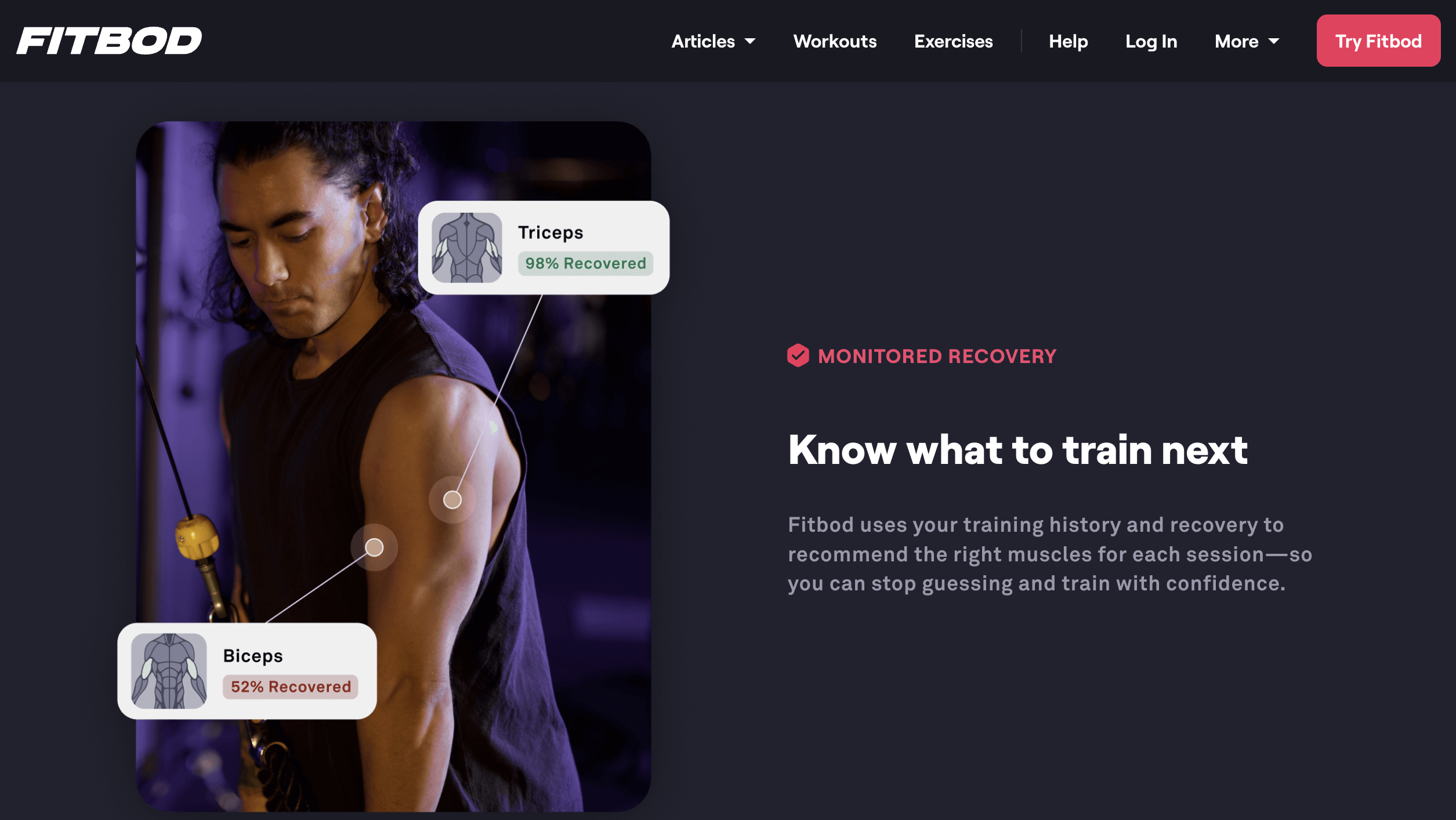
Genuine muscle-recovery intelligence: Fitbod tracks which muscle groups you’ve recently worked and how hard, then recommends sessions that target fresh, recovered muscles while letting fatigued ones rest. This recovery model is designed to reduce the risk of overtraining and injury and to keep your weekly split balanced automatically — a big deal for people who’d otherwise hammer the same favorite lifts and neglect the rest.
Built-in progressive overload: Getting stronger requires systematically increasing the challenge, and Fitbod handles that math for you. Based on your logged performance, it gradually raises target weights, reps or volume so you keep moving forward instead of plateauing. Long-term users repeatedly credit it with breaking through sticking points they couldn’t beat on their own.
Equipment flexibility that fits real life: Fitbod adapts to whatever you actually have — a fully-stocked commercial gym, a few dumbbells at home, resistance bands, or no equipment at all. You set your equipment list, and the app only programs exercises you can perform. That makes it equally usable in a garage gym, a hotel room or a hostel, which is why it’s a favorite among travelers and remote workers.
A large exercise library with real form guidance: Every movement comes with clear HD video demonstrations plus written cues on form and breathing — a genuine help for beginners who don’t want to guess in the gym, and a nice refresher for experienced lifters trying something new. Don’t like an exercise the app picked? Swap it for a similar one in a couple of taps.
Data and progress you can actually see: Fitbod turns your training into clean charts and graphs — volume over time, workout history, calories burned estimates, and a newer Strength Score that converts your estimated strength into a 0–100+ number for each muscle group. That score makes progress tangible and surfaces imbalances, which is a surprisingly strong motivator session to session.
A decade of polish and trust: Fitbod isn’t a here-today-gone-tomorrow app. With 10+ years of development, 15M+ downloads, a 4.8/5 App Store rating, an Apple “Editor’s Choice” badge and press coverage in major outlets, it’s the most established and refined product in the AI-workout category. That maturity shows in the smoothness of the experience.
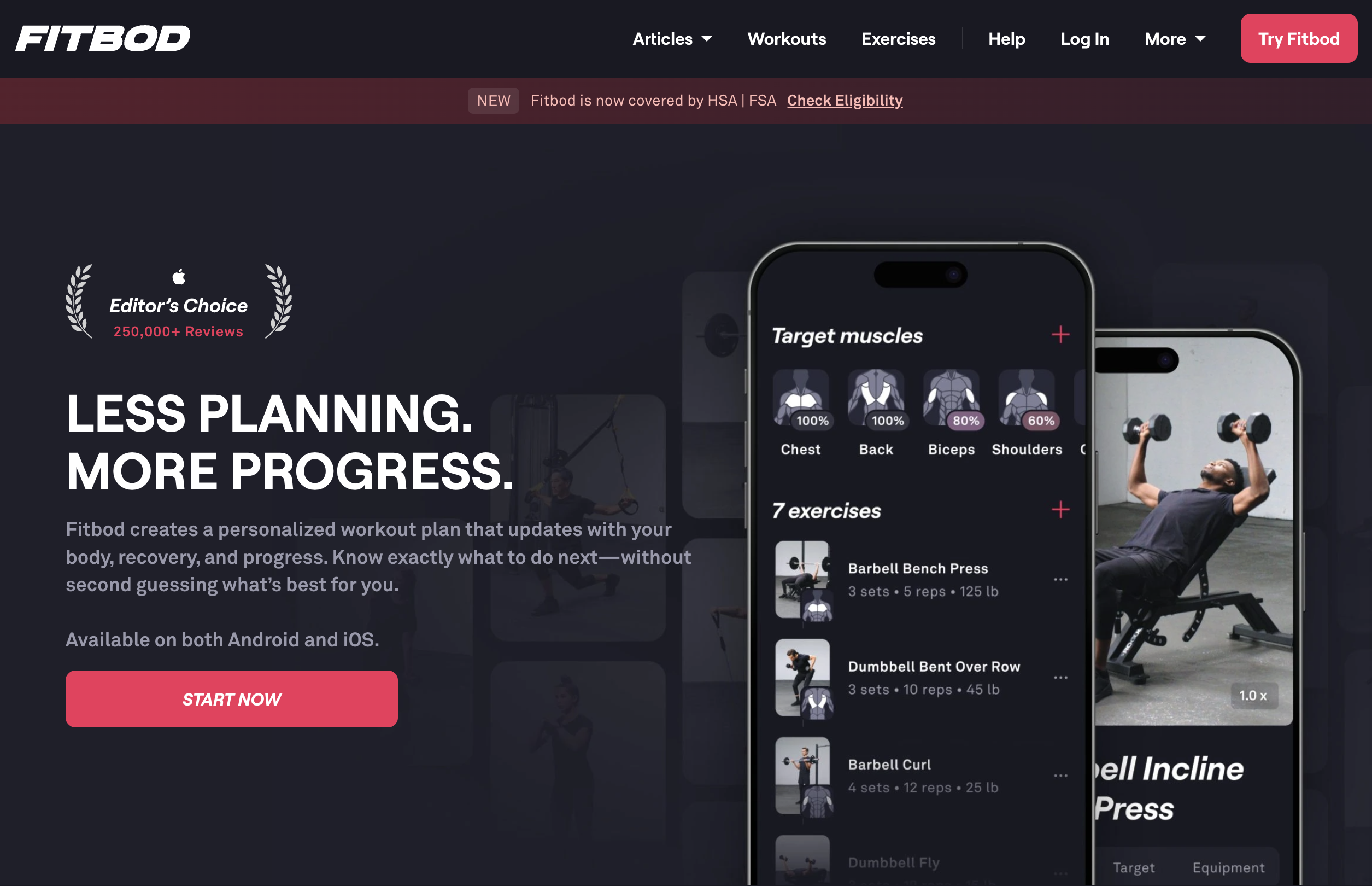
Fitbod builds a complete, personalized strength workout every session — exercises, sets, reps and target weights — using your training history, equipment and muscle-recovery state, so you always know exactly what to do next.
Key Features and Technology
Fitbod packs a lot into a deceptively simple interface, but the platform organizes cleanly into a handful of pillars. Here’s how it actually breaks down.
The Personalization Algorithm
The heart of the product. Fitbod’s machine-learning engine analyzes your logged workout data — what you lifted, how it felt, your recovery state, your available equipment and your chosen goal — to generate each session. Importantly, this is workout-level AI: it builds the plan before you begin rather than adapting set by set in real time during the workout. The model improves with use, and Fitbod itself notes it needs about 10–15 logged sessions before its picture of you is fully dialed in, which is why consistency in those first weeks pays off.
Goals, Splits and Workout Modes
During setup you choose from goals including general fitness, strength training, bodybuilding (hypertrophy), powerlifting, muscle tone and Olympic lifting, and Fitbod tailors the programming accordingly. You can let it fully auto-generate a workout, build your own from scratch using its library, or set up supersets and circuits. Beginners typically do best starting with general, strength training or muscle tone, while advanced lifters and powerlifters get more specialized routines — Fitbod has an especially strong following among intermediate-to-advanced trainees.
Recovery Tracking and Progressive Overload
Two of Fitbod’s smartest systems work quietly in the background. The recovery model maps which muscle groups are fatigued versus fresh and routes your next session toward recovered areas, helping you avoid overtraining a body part. The progressive-overload logic uses your performance history to steadily increase the demand on each lift over time. Together they aim to keep your training both balanced and continuously improving without you having to track any of it manually.
Exercise Library, Demos and Equipment Settings
Fitbod’s library covers hundreds of movements, each with HD video demonstrations and written form and breathing cues. The equipment system is genuinely flexible: tell Fitbod exactly what you have — barbells, dumbbells, machines, kettlebells, bands, or nothing but your bodyweight — and it builds workouts only from those options. You can also exclude specific exercises you can’t or won’t do (handy for working around an injury or a movement you dislike), and the app substitutes appropriately while keeping the training stimulus intact.
Logging, Analytics, Strength Score and Apple Watch
Logging is fast and replaces a paper notebook entirely — tap through sets, weights and reps as you go. Fitbod then visualizes everything with clean charts: training volume, muscle-group balance, estimated calories burned, and the Strength Score (0–100+ per muscle group) that quantifies progress and highlights weak points. It logs on Apple Watch, syncs with Apple Health, and works offline, saving your data locally and uploading it once you’re back online — useful in basement gyms with no signal.
Pricing, Plans, and Package Structure
Fitbod is a subscription service with no permanent free tier — when the trial ends, you subscribe or the app stops generating workouts. In 2026 the company raised its prices from the long-standing $12.99/month and $79.99/year to new standard rates, though subscribers who locked in before the increase keep their legacy pricing. New users get a 7-day free trial (which exposes only a limited number of workouts), and you can subscribe through the App Store, Google Play or Fitbod’s website. The figures below are Fitbod’s standard published rates; because pricing varies by region, platform and promotion, always confirm the live price and any active coupon at checkout on your own device.
| Plan | Price (USD) | What It Is | Best For |
|---|---|---|---|
| 7-Day Free Trial | Free (limited) | Short trial with a limited number of workouts; auto-renews unless canceled | Testing the interface and logging flow |
| Monthly Plan | $15.99 / month | Full access, billed monthly, maximum flexibility | Short-term users & category testers |
| Yearly Plan (most popular) | $95.99 / year (≈ $8/mo) | Full access, billed annually — best value | Committed long-term lifters |
| Legacy Pricing | $12.99/mo or $79.99/yr | Grandfathered rate for pre-2026 subscribers only | Existing members who never lapsed |
| Lifetime Membership | Promo only (≈ $359.99 past) | One-time payment, offered occasionally (e.g. Black Friday) | Superfans who use it for years |
| Gift Subscription | ≈ $95.99 (one year) | A full year of premium access via redeemable code | Gifting a year to a friend or partner |
How Fitbod Compares to Alternatives
Where free loggers like Strong and JEFIT hand you a blank notebook, Fitbod’s edge is that it programs the workout for you — the trade-off is a subscription instead of a free tier.
| Factor | Fitbod | Strong | JEFIT |
|---|---|---|---|
| Core model | AI generates your workouts | Manual logger; you program | Logger + huge library; you program |
| Auto recovery + overload | Yes — the core feature | No (you decide) | No (you decide) |
| Form demos | HD video + cues | Limited | 1,400+ exercises with demos |
| Free tier | No (7-day trial only) | Yes — up to 3 routines free | Yes — free, but ad-heavy |
| Paid price (approx.) | $15.99/mo · $95.99/yr | ~$29.99/yr (Pro) | ~$69.99/yr (Elite) |
| Best for | People who want it planned for them | Self-coached lifters who want a clean logbook | Data lovers who build their own plans |
vs. Strong and Hevy: Strong and Hevy are the beloved free loggers — clean, fast, and free for a few routines (with Pro tiers around $29.99/year and $23.99/year respectively). But they’re digital notebooks: they record what you do, they don’t decide what you should do. If you already know how to program your own training, they’re excellent and far cheaper. Fitbod’s entire reason to cost more is that it does the programming, recovery balancing and progression for you — that’s the line to weigh.
vs. JEFIT: JEFIT is the database heavyweight, with 1,400+ exercises, deep tracking and a large community, and a free (ad-supported) tier plus Elite at roughly $69.99/year. Like Strong, though, you assemble and progress your own routines, and recent versions have drawn complaints about ad clutter and a busier interface. Fitbod trades JEFIT’s encyclopedic, do-it-yourself depth for a cleaner, decisions-made-for-you experience.
vs. Freeletics and AI rivals: Freeletics also uses AI but skews toward bodyweight and HIIT rather than equipment-based strength, and newer apps pitch deeper, real-time, conversational coaching. Against those, Fitbod’s strength is maturity and reliability in the gym-equipment lane — though if you specifically want a coach that adapts mid-session in plain language or reads a wearable’s live recovery data, that’s exactly the gap where some 2026 challengers aim. The honest takeaway: if you want workouts generated and progressed for you with a polished, proven app, Fitbod leads; if you want a free logbook or a chatty real-time coach, look at the rivals above.
Pros and Cons
What Users Love
It eliminates decision fatigue: The most consistent praise is simple — you never have to plan again. Owners describe opening the app, getting a ready workout, and just lifting. For people who used to waste energy deciding what to do (or skipped the gym because of it), that frictionless start is the whole reason they stay subscribed.
Real, trackable progress: Long-term users repeatedly report breaking through plateaus and getting visibly stronger, crediting the automatic progressive overload. The charts, volume tracking and Strength Score make that progress concrete — several reviewers say they can’t imagine training without it after a year or more.
Excellent for home, travel and limited gear: The equipment customization wins constant praise from people training at home, in hotels or around an injury. One reviewer with chronic back pain credited Fitbod’s ability to work around her limitations with rebuilding her core strength; travelers love that it adapts to whatever a hotel gym happens to offer.
Beginner-friendly form guidance: The HD exercise demos and form cues come up again and again as a confidence-builder. New lifters say the videos let them try unfamiliar movements without feeling lost or self-conscious in the gym — a genuine on-ramp into structured strength training.
Fast logging and a polished interface: Owners love how quickly logging replaces a paper notebook, the clean design, and the ability to swap any exercise in seconds. The overall experience feels more refined than most rivals — a benefit of ten years of iteration.
Great value versus a personal trainer: At roughly $8/month on the annual plan, Fitbod costs a fraction of a single in-person training session (typically $50–$100), while delivering personalized programming. For self-motivated lifters who don’t need hands-on form correction, reviewers consistently call that a strong deal.
Limitations Worth Knowing
Subscription and billing frustrations: This is the number-one complaint, and it’s a real one. Many negative reviews center on difficulty canceling and unexpected charges — largely because subscriptions bought through the App Store or Google Play must be canceled through Apple or Google, not Fitbod directly, and Fitbod has limited refund authority over them. Keep your purchase channel in mind and cancel through the right platform.
No free tier and a too-short trial: When the 7-day trial ends, the app stops working — there’s no free version to fall back on, unlike Strong or Hevy. And because the algorithm needs 10–15 workouts to personalize, the trial really only shows you the interface, not the long-term value. You essentially have to pay for at least a month to evaluate it fairly.
It feels generic at first: Short-term users frequently report the early workouts feeling random or templated before the model learns them. The “it gets better over time” pattern is consistent across reviews — but it means the first two weeks of a now-pricier subscription run on a largely generic engine, and impatient users who quit early miss the payoff.
Not a real-time, conversational coach: Fitbod plans before you start; it doesn’t adapt mid-workout, explain why it chose an exercise, or answer “I’m tired, what should I cut?” Advanced lifters also want more variation depth (grip widths, tempo work, partial reps) and occasionally find the highest-level workouts a bit templated. Some independent experts note workout quality can be inconsistent and may need manual tweaks.
Support is slow and ticket-only: Reviewers describe email/ticket-only support with no live chat and slow responses. The community generally rates the product higher than the support experience, so go in expecting self-service rather than fast hand-holding if something goes wrong.
Practical caveats: It’s strength/resistance-focused, so there are no follow-along live classes (look elsewhere if that’s your thing); calorie-burn figures are estimates, not precise measurements; some users report occasional crashes or Apple Watch sync hiccups after updates; and Fitbod is currently available in a limited set of countries and three languages (English, Spanish, Portuguese).
Who Should Use Fitbod
Fitbod’s sweet spot is the self-motivated lifter who wants trainer-style programming without the trainer — at the gym, at home, or on the road.
Busy people who hate planning: This is Fitbod’s sweet spot. If you want to lift consistently but don’t have the time or interest to design your own program, Fitbod removes that barrier completely. Solopreneurs, professionals and parents who value a decision made for them get the most out of it.
Beginners who want guidance and structure: The form videos, sensible default programming and guesswork-free approach make Fitbod a strong on-ramp for newcomers — it recommends appropriate weights, reps and sets while teaching proper technique, so you’re not improvising in an intimidating gym.
Travelers and home gym owners: Because it adapts to any equipment list — including none — Fitbod shines for digital nomads, frequent flyers and anyone training in a garage, spare room or hotel. It substitutes exercises to match whatever you have while keeping your progression on track.
Intermediate-to-advanced lifters who want a smart logbook plus auto-progression: Fitbod has a strong following among experienced trainees and powerlifters who like the automatic overload, recovery balancing and analytics, and who are happy to fine-tune the generated workouts to their preferences.
Who should look elsewhere: If you already program your own training and just want a clean, cheap (or free) logbook, Strong, Hevy or JEFIT make more sense. If you specifically want follow-along video classes, a service like a Peloton-style app fits better. And if you crave a real-time, conversational coach that reasons out loud or reads live wearable recovery — or you’re a light-roast-perfectionist-level hobbyist chasing maximum control — a newer AI coach or a self-built program may suit you more than Fitbod’s plan-it-up-front model.
Getting Started: Step by Step
- Download and start your trial. Get Fitbod from the App Store or Google Play and begin the 7-day free trial. You’ll opt into a monthly or yearly plan to start it, but you won’t be charged until the trial ends — so set a reminder to cancel if it isn’t for you, since it auto-renews.
- Set your goal and profile. Choose your objective (general, strength, hypertrophy, powerlifting, muscle tone or Olympic lifting) and enter your experience level. If you’re unsure, general, strength training or muscle tone are the most beginner-friendly and cover most broad goals including losing fat.
- Configure your equipment. Tell Fitbod exactly what you have access to — full gym, dumbbells only, bands, or bodyweight — and exclude any exercises you can’t or won’t do. This is the single most important setup step for getting usable, realistic workouts from day one.
- Run and log your first workouts. Open the app, get your generated session, and tap through each set logging weight and reps. Use the HD demos for any unfamiliar move, and swap exercises you dislike. Be honest about which sets felt easy or hard — that feedback trains the algorithm.
- Commit to 10–15 sessions before judging it. The personalization sharpens dramatically once Fitbod has real data on you. Push through the first couple of weeks — this is the inflection point where most long-term fans say the app “clicks” and the recommendations start feeling tailored.
- Pick the right plan and track progress. Once you know it fits, switch to the annual plan for the best value (≈ $8/month), watch your Strength Score and volume charts climb, and check whether your subscription qualifies for HSA/FSA reimbursement if you’re in the US.
Tips for Getting Maximum Value
Log everything honestly and consistently, because the algorithm is only as smart as the data you feed it — marking sets that felt too easy or too hard is what turns “generic” workouts into genuinely tailored ones. Don’t quit during the first week; the 10–15-workout learning window is real, so give it a fair month before deciding. Start on the monthly plan to test properly, then move to annual once you’re sure, since $95.99/year is roughly half the cost of paying monthly. Keep your equipment list accurate and update it whenever you travel or change gyms, so every workout stays realistic. Lean on the exercise-swap and exclude features to work around niggles, injuries or movements you dislike rather than forcing them. Watch your Strength Score and volume charts to stay motivated and spot muscle imbalances early. If you use an Apple Watch, log on it and connect Apple Health to refine the calorie estimates. And remember the cancellation rule that trips people up: if you subscribed through the App Store or Google Play, you must cancel through Apple or Google — not inside Fitbod — to actually stop billing.
Future Outlook and Final Assessment
The AI fitness market in 2026 is heating up fast, and the frontier is moving from “generate a good workout” toward coaches that adapt in real time, explain their reasoning, and read live recovery data from wearables. Fitbod helped define the AI-workout category and remains its most polished, established product — a decade of refinement, 15M+ downloads, a 4.8/5 App Store rating and serious engineering depth give it a stability newer apps can’t match. The open question is whether polishing the generator is the right roadmap as conversational, real-time coaches mature. So far, Fitbod’s bet on doing one thing extremely well — programming and progressing strength workouts — continues to pay off for the millions who just want the planning handled.
The honest caveats remain: there’s no free tier, the trial is too short to judge the algorithm, billing through the app stores frustrates a vocal minority, the first two weeks feel generic, and it isn’t a real-time coach. Rivals undercut it on price (Strong, Hevy, JEFIT) or chase deeper live adaptation. But within its lane, Fitbod delivers one of the most complete, genuinely useful strength-training experiences available — and for the core job of taking the planning off your plate while keeping you progressing, it’s still the benchmark.
Conclusion
Fitbod isn’t trying to be everything to everyone — it’s trying to take the single biggest obstacle to consistent strength training, the planning, and make it disappear, and at that job it’s remarkably effective. By generating a personalized workout every session, balancing your recovery, and applying progressive overload automatically, it turns a confusing, willpower-draining process into something you can just open and do. It rewards realistic expectations and a little patience through the learning curve, and it’s not the right call for people who want a free logbook, follow-along classes, or a chatty real-time coach. But for the self-motivated lifter — at the gym, at home, or on the road — few apps remove more friction or deliver more steady progress. Start the trial, give it a fair month, confirm the current price and any active promotion, and Fitbod can take the hardest part of getting stronger off your plate and make it genuinely easy.
Ready to stop planning and start making progress?
Explore more honest reviews, tutorials and tech comparisons to find the right tools for the way you work, train and live — at World Of Tech, where we make everything easy.
👉 Try Fitbod: https://fitbod.me/
👉 Our YouTube Channel: youtube.com/@world_tech79
👉 Our Facebook Fanpage: Facebook
👉 Our X (Twitter): @worldoftech79
Pricing, specifications and policy details in this review were verified against fitbod.me and independent review sources (including the App Store, Google Play and Trustpilot) as of June 2026. Fitness app pricing, features and promotions change frequently, so confirm current details on the official site before subscribing. Competitor prices are approximate and subject to change.