
Chatbase (chatbase.co) has established itself as one of the fastest-growing and most accessible AI chatbot platforms in 2026, enabling businesses of all sizes to deploy custom-trained AI agents on their own data — without writing a single line of code. Before diving into the full feature breakdown and pricing analysis ahead, it’s worth highlighting what makes Chatbase the standout choice for businesses building AI-powered customer support and lead generation in 2026: an industry-leading selection of 15+ AI models from 6 providers — including GPT-5.2, Claude Opus 4.6, Google Gemini 3 Pro, xAI Grok 4, Moonshot AI Kimi K2, and DeepSeek — combined with 1-click website crawling and RAG (Retrieval-Augmented Generation) technology that trains your chatbot on your own content in minutes, deployment across your website, WhatsApp, Facebook Messenger, Instagram, Slack, and Email, AI Actions for real task automation beyond Q&A (appointment booking, order lookups, lead capture), an Improve Answer feature for continuous accuracy improvement, Zapier and API integrations, and a genuine free plan for testing — with paid plans from approximately $19/month. Whether you’re a SaaS founder who wants a 24/7 AI support agent trained on your documentation, an e-commerce store owner automating product FAQs and order status queries, a marketing agency building white-label chatbots for multiple clients, a small business replacing a dedicated support hire with an AI agent that never sleeps, or an enterprise team needing enterprise-grade security with the flexibility to choose between frontier AI models on a per-agent basis, this comprehensive review walks you through every major feature, pricing tier, and real-world consideration for Chatbase in 2026.
Chatbase 2026 Review: The Best No-Code AI Chatbot Builder for Customer Support, Lead Generation, and Business Automation
Overview: What Is Chatbase and Who Is It For?
Chatbase is an AI-powered chatbot platform that lets you build custom AI agents — intelligent chatbots trained on your own business data — and deploy them across your digital channels without any coding. The platform’s founding promise is deceptively simple but genuinely powerful: upload your content (website URLs, PDFs, FAQs, Notion pages, support docs), and Chatbase trains an AI agent that answers your customers’ questions exactly as a knowledgeable support team member would — in seconds, at any hour, simultaneously at scale.
The concept is often described as building “your own ChatGPT for your business” — but the more accurate framing is that Chatbase gives you a customer-facing AI agent that knows only what you’ve taught it (your products, your policies, your processes) rather than everything on the internet, and responds in the tone, language, and boundaries you define. This containment — the agent staying in your defined knowledge base rather than hallucinating outside it — is the core reliability feature that makes Chatbase practical for real business deployment rather than just experimental prototyping.
What distinguishes Chatbase most sharply from competitors in 2026 is its unmatched AI model flexibility. While most chatbot builders lock you into a single AI provider (usually OpenAI), Chatbase supports 15+ models from 6 different AI providers — GPT-5.2, Claude Opus 4.6, Google Gemini 3 Pro, xAI Grok 4, Moonshot AI’s Kimi K2, and DeepSeek. You select the model per agent and can switch anytime — optimizing for cost, speed, or reasoning quality depending on your specific use case. This is a structural advantage that no competing no-code chatbot builder currently matches.
Chatbase in 2026 — Key Platform Facts
- 15+ AI Models from 6 Providers: GPT-5.2 (OpenAI), Claude Opus 4.6 (Anthropic), Gemini 3 Pro (Google), Grok 4 (xAI), Kimi K2 (Moonshot AI), DeepSeek, and more — select the right model for each agent’s role and budget requirements. No other no-code chatbot builder in 2026 matches this multi-provider breadth.
- RAG-Powered Knowledge Training: Chatbase uses Retrieval-Augmented Generation (RAG) technology to train agents on your content — ensuring responses draw from your actual documents and web pages rather than general AI training data, dramatically improving accuracy for domain-specific queries.
- 1-Click Website Crawling: Enter your website URL and Chatbase automatically crawls and indexes your site content — converting your existing documentation, FAQ pages, product descriptions, and support articles into the agent’s knowledge base without manual content formatting.
- Multi-Channel Deployment: Deploy to website embed (widget), WhatsApp, Facebook Messenger, Instagram, Slack, and Email from a single Chatbase configuration — reaching customers on the channels they already use without building separate bots for each platform.
- AI Actions Beyond Q&A: Chatbase’s AI Actions system extends the platform beyond simple question-answering into real task automation — booking appointments, checking order status, capturing leads with form-style data collection, and triggering actions in connected systems through API calls.
- Continuous Learning via Improve Answer: Every conversation produces training feedback — chat logs are reviewable, and the “Improve Answer” feature enables direct correction of inaccurate responses, with custom Q&A pairs added for edge cases the AI initially misses. The agent gets more accurate over time with use.
- No-Code Setup in Minutes: Chatbase is consistently described as one of the fastest ways to get a working support bot live — independent reviews describe upload, training, and embed completion in “a few minutes” to a maximum of 30 minutes for basic deployment, compared to days or weeks for code-based chatbot platforms.
- Enterprise-Grade Security: SOC 2 Type II compliance, data encryption, and configurable data residency options for enterprise buyers — making Chatbase appropriate for regulated industries and enterprises with strict data governance requirements.
- Free Plan Available: A genuine free plan (not a time-limited trial) is available for initial testing — though with restrictions that make it unsuitable for production use. Paid plans start at approximately $19/month (Hobby tier).
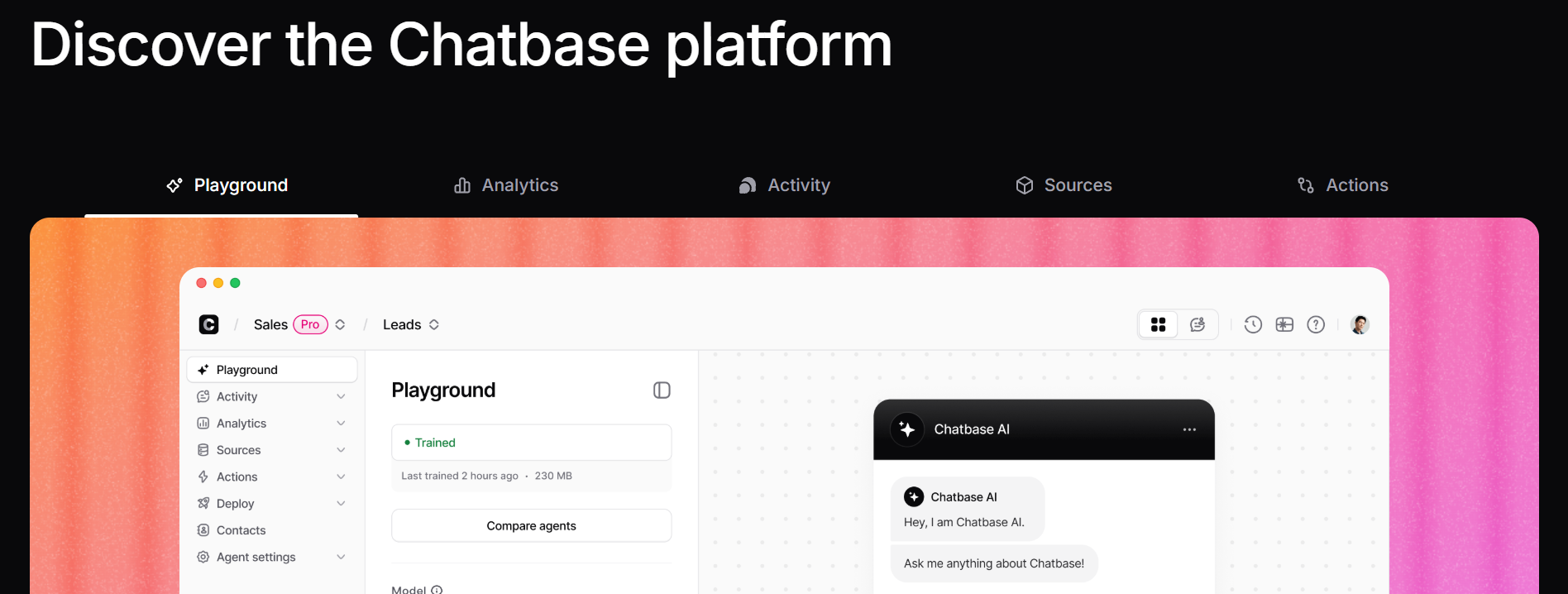
Chatbase enables businesses to deploy custom AI agents trained on their own content — answering customer questions 24/7 with the accuracy of a knowledgeable support team member, across website, WhatsApp, Messenger, Instagram, and Slack — without writing a single line of code.
Key Features and Platform Capabilities
Chatbase’s feature set in 2026 extends well beyond the basic chatbot-on-your-website premise that defined early iterations of the platform. The combination of multi-model AI flexibility, multi-channel deployment, AI Actions, and continuous learning tools creates a genuinely capable AI customer operations platform. Here is a comprehensive breakdown of every major capability.
AI Model Selection: 15+ Models from 6 Providers
- OpenAI Models (GPT-5.2 and predecessors): GPT-5.2 is OpenAI’s most capable model in 2026 — recommended for agents that need strong reasoning, nuanced question handling, and high-quality natural language responses. Higher capability comes at higher per-message cost relative to lighter models in the Chatbase lineup.
- Anthropic Claude (Claude Opus 4.6): Claude Opus 4.6 is Anthropic’s frontier reasoning model — particularly strong for complex multi-turn conversations, long document comprehension, and responses that require nuanced judgment about appropriate scope and boundaries. Excellent for agents handling sensitive customer inquiries where tone and accuracy are paramount.
- Google Gemini 3 Pro: Google’s latest model brings multimodal capability and strong reasoning to Chatbase — particularly relevant for agents deployed in contexts where image understanding or multilingual capability is a priority alongside text-based Q&A.
- xAI Grok 4: xAI’s Grok 4 model is available for Chatbase deployments — an option for businesses that prefer xAI’s approach or need to diversify beyond OpenAI/Anthropic/Google for vendor relationship or cost reasons.
- Moonshot AI Kimi K2 and DeepSeek: Cost-efficient model options for high-volume agents where budget optimization matters more than maximum reasoning quality — particularly relevant for large-scale FAQ bots where most queries are predictable and don’t require frontier model capability.
- Per-Agent Model Selection: Every Chatbase agent can be configured with a different model — enabling a sophisticated deployment strategy where a high-stakes sales agent uses GPT-5.2 for maximum quality while a simple FAQ bot uses DeepSeek for cost efficiency, all managed under the same Chatbase account.
Knowledge Sources: Training Your Agent on Your Content
- Website Crawling (1-Click): Enter your URL and Chatbase automatically crawls your website, following internal links and indexing your content into the agent’s knowledge base. This is the fastest path to training an agent on existing content — most small-business websites are fully indexed in under 5 minutes.
- Document Upload (PDF, DOCX, TXT, CSV): Upload your support documentation, product manuals, policy documents, FAQ sheets, and any structured content in standard document formats — Chatbase processes and indexes the content automatically.
- Notion Pages: Connect Chatbase directly to Notion databases and pages — automatically pulling structured knowledge from the workspace documentation that many businesses already maintain, enabling agents to answer questions from internal knowledge bases without duplication.
- Q&A Pairs (Custom FAQs): Add custom question-and-answer pairs directly to the knowledge base — enabling precise control over specific queries that the AI should handle with exact answers rather than AI-generated responses from document content.
- Auto-Retraining: On higher plans, Chatbase automatically re-crawls and retrains on updated content at configurable intervals — keeping the agent’s knowledge current as your website, documentation, and product information evolves without manual intervention.
- Text Content (Direct Entry): Enter free-form text content directly into the knowledge base for content that doesn’t exist in document or URL form — adding specific product knowledge, company policies, or contextual information as plain text entries.
AI Actions: Beyond Q&A to Real Task Automation
- Lead Capture Forms: Configure the agent to collect visitor name, email, phone, and custom fields during conversations — automatically capturing leads that would otherwise bounce without conversion, and delivering them to your CRM or email via Zapier integration.
- Appointment Booking: Connect the agent to calendar booking systems via AI Actions — enabling visitors to book demos, consultations, or appointments directly within the chatbot conversation without leaving the page or visiting a separate booking link.
- Order Status Lookups: For e-commerce deployments, configure AI Actions to query your order management system for real-time order status — enabling customers to get live delivery updates through the chatbot rather than email or a separate order tracking page.
- API Calls to External Systems: AI Actions supports custom API calls to any system with a REST API — enabling Chatbase agents to interact with CRMs, ticketing systems, ERP platforms, and custom business applications as part of a conversation workflow.
- Escalation to Human Agent: Configure automatic escalation triggers — when the AI agent reaches a query it can’t resolve confidently, or when specific keywords are detected (complaints, refunds, legal queries), the conversation routes to a human agent with full context preserved.
Customization and Brand Control
- Custom Instructions and Persona: Define your agent’s name, communication tone, response style, language, and specific behavioral boundaries — configuring it to match your brand voice and customer service standards rather than responding as a generic AI assistant.
- Custom Restrictions: Specify what topics the agent should refuse to address, what competitive products it shouldn’t compare against, and what confidential information it should never reveal — creating guardrails that keep the agent on-brand and on-topic.
- Widget Design Customization: Customize the chat widget’s color scheme, icon, header text, and initial greeting message — matching the visual design of your website to make the embedded chatbot feel like a native product feature rather than a third-party tool.
- Custom Domain (Add-On): Deploy Chatbase on your own custom domain for full white-label embedding — removing Chatbase branding from client-facing deployments. Custom domains are available as an add-on at $59/month.
- White-Label for Agencies: Marketing agencies and SaaS platforms building chatbot features for clients use Chatbase’s white-label capabilities to present the AI agent as a native product feature — removing all Chatbase branding from the customer-facing interface.
- Language Support: Chatbase agents respond in the visitor’s language automatically — the underlying AI models handle multilingual conversation natively, making the platform suitable for international customer bases without maintaining separate language-specific bots.
Integrations: Connecting Chatbase to Your Stack
- Zapier Integration: Connect Chatbase to 6,000+ apps via Zapier — sending lead data to HubSpot, creating support tickets in Zendesk, logging conversations to Google Sheets, or triggering any Zapier-supported action from chatbot conversation events.
- WordPress Plugin: Native WordPress integration for one-click deployment on WordPress websites — without requiring manual script embedding or developer involvement.
- Shopify Integration: E-commerce deployment on Shopify stores with product knowledge training from Shopify catalog data — enabling AI agents to answer product-specific questions, compare items, and guide purchase decisions.
- Slack Integration: Deploy Chatbase as a Slack app for internal team use — enabling teams to query the agent within Slack for internal documentation lookups, HR policy questions, and internal FAQ management.
- WhatsApp, Messenger, Instagram: Deploy the same trained agent across messaging platforms — reaching customers on the social channels they already use without rebuilding agent logic for each platform separately.
- REST API: Full API access on higher plans — enabling custom integrations with any platform, embedded AI agent functionality within proprietary software products, and programmatic agent management for developer-built applications.
- Email Integration: Deploy the agent as an email auto-responder — training it on common email inquiry patterns to draft or send automated responses for high-volume inbound email queries.
Analytics, Chat Logs, and Continuous Improvement
- Full Chat Log Review: Every conversation is stored and reviewable — enabling supervisors and business owners to see exactly what questions customers are asking, how the agent is responding, and where the agent is falling short or succeeding.
- Improve Answer Feature: From any chat log, click “Improve Answer” on any response the agent got wrong or handled poorly — directly correcting the response and adding the corrected Q&A pair to the agent’s training, making the agent more accurate for future similar queries.
- Analytics Dashboard: Message volume, conversation completion rates, most common queries, agent escalation rates, and satisfaction signals — available on mid and higher plans for data-driven optimization of agent performance and knowledge base coverage.
- Auto-Retraining (Higher Plans): Scheduled automatic retraining from updated source content ensures the agent’s knowledge stays current as your website and documentation evolves — critical for e-commerce product catalogs, software documentation, and frequently updated policy content.

Chatbase’s AI Actions, RAG-powered knowledge training, multi-channel deployment, and continuous Improve Answer learning create a customer support automation platform that improves with every conversation — handling FAQ responses, lead capture, appointment booking, and order lookups simultaneously across website, WhatsApp, and Messenger.
Pricing, Plans, and Cost Considerations
Chatbase uses a freemium tiered pricing model with monthly message credits as the core usage metric. Understanding the credit system is essential for accurately estimating monthly costs — particularly for deployments expected to handle significant conversation volumes.
Chatbase Pricing Breakdown for 2026
| Plan | Price | Best For | Key Details |
|---|---|---|---|
| Free | $0/month | Testing and proof of concept | Limited monthly message credits, restricted character input, basic features. Free agents deleted after 14 days of inactivity — suitable for evaluation, not production deployment |
| Hobby | ~$19/month | Single-bot small business, first production deployment | Entry-level paid plan — limited to 1 agent, basic integrations, limited monthly credits. Reasonable starting point for single use-case bots; watch for overage costs at higher traffic |
| Standard | ~$99/month | Growing small businesses, multiple agents | More agents, higher monthly message credits, Zapier integration, analytics dashboard. The recommended tier for businesses with consistent daily chat volume |
| Pro | ~$299/month | Mid-size businesses, high-volume support | Higher credit allocation, API access, advanced AI Actions, auto-retraining, priority support. Required for businesses running multiple production bots at meaningful volume |
| Enterprise | Custom pricing | Large organizations, agencies, regulated industries | Custom credit limits, dedicated account management, SOC 2 compliance verification, custom data residency, SLA guarantees, white-label branding removal |
| Extra AI Agents Add-On | $7–$25/agent/month | Adding specialized agents beyond plan limit | Per-agent monthly fee for adding agents beyond the plan’s included count. Enables building specialized agents for different product lines, audiences, or channels |
| Extra Message Credits | $14–$20 per 1,000 credits | Overage coverage for traffic spikes | Credits consumed per user message and model response — active bots hit limits faster as traffic grows. Plan for seasonal spikes or risk chatbot going offline at peak periods |
| Custom Domain Add-On | $59/month | White-label agency deployments | Full custom domain deployment for removing Chatbase branding from client-facing chatbots — required for agency white-label use cases |
Pricing model explained: Chatbase’s credit system charges per user message and per model response — meaning each back-and-forth exchange in a conversation consumes two credits. A bot handling 500 conversations per month of 4 exchanges each consumes 4,000 credits. Understanding this math before selecting a plan prevents the scenario where a bot hits its credit limit mid-month during a product launch or promotional campaign. The Hobby plan at $19/month is described by independent reviewers as “reasonable for a single small-business bot” — but “tricky to scale” as traffic grows, with per-unit overage costs adding up during busy periods.
Pro tip: Before committing to a paid plan, estimate your expected monthly conversation volume and multiply by average conversation length (exchanges per conversation) to get your credit requirement. If you’re deploying a customer support bot for a business getting 200 support inquiries daily and conversations average 6 messages, you need approximately 1,200 credits/day or 36,000 credits/month — factor this against plan limits before selecting your tier. Higher-volume deployments are often better served by the Pro plan’s credit allocation than purchasing overages on a Standard plan.
Free vs. Paid: When to Upgrade
- Stay on Free when: You’re evaluating Chatbase’s training quality and interface before any production commitment. The free plan is useful for testing whether your knowledge base produces quality responses before investing in a paid subscription.
- Move to Hobby (~$19/month) when: You have a single use case that needs a live production bot — a basic customer FAQ bot, a support deflection layer, or a lead capture widget on a low-to-medium traffic website.
- Move to Standard (~$99/month) when: You need Zapier integration for CRM connection, analytics to monitor performance, multiple agents for different use cases, or significantly higher message volume than the Hobby plan provides.
- Move to Pro (~$299/month) when: API access is required for custom integrations, auto-retraining is needed for frequently updated content, you need advanced AI Actions for booking and order management, or you’re running multiple high-volume production bots.
- Engage Enterprise when: SOC 2 compliance verification, custom data residency, dedicated account management, SLA guarantees, or white-label branding removal are organizational requirements.
Comparisons: Chatbase vs. Competitors in 2026
The no-code AI chatbot builder market has matured significantly by 2026, with multiple strong competitors targeting the same small-to-mid-business audience. Chatbase’s differentiation is clearest in AI model flexibility and speed to deployment — though competitors have specific strengths worth understanding before selecting a platform.
Chatbase vs. CustomGPT, Botpress, SiteGPT, and Intercom
| Chatbase 2026 | CustomGPT | Botpress | SiteGPT | Intercom | |
|---|---|---|---|---|---|
| Entry Price | ~$19/month | ~$99/month | Free (open source) / paid cloud | ~$49/month | ~$74/month |
| AI Model Selection | 15+ models from 6 providers | OpenAI only | OpenAI + Anthropic | OpenAI primary | Proprietary Fin AI |
| No-Code Setup Time | Minutes (1-click crawl) | Minutes | Hours (visual builder) | Minutes | Hours (full platform) |
| Visual Flow Builder | Limited | Limited | Yes (core strength) | Limited | Yes |
| Multi-Channel Deployment | Website, WhatsApp, Messenger, Instagram, Slack, Email | Website, API | Extensive | Website primary | Extensive |
| RAG Knowledge Training | Yes (URL, PDF, DOCX, Notion) | Yes | Yes | Yes | Yes |
| Helpdesk Integration | Limited (via Zapier) | Limited | Yes | Limited | Yes (native) |
| Human Handoff | Yes (escalation trigger) | Limited | Yes | Yes | Yes (native) |
| White-Label Option | Yes (custom domain add-on) | Yes | Yes (self-hosted) | Limited | No |
| Free Plan | Yes (with inactivity limit) | No | Yes (open source) | No | No |
| Best For | Speed-to-deployment, model flexibility, SMBs, agencies | Premium single-bot deployment with strong citation features | Complex conversational workflows, developer teams | Website-focused FAQ and support bots | Full customer support platform with ticketing |
Chatbase’s edge: Chatbase is the fastest path from “no chatbot” to “working AI agent on your website” among all competing platforms — the 1-click website crawl and intuitive training interface enable non-technical users to deploy a capable FAQ and support bot in under 30 minutes. The 15+ model selection from 6 providers is unmatched by any competitor, enabling cost and quality optimization that single-provider platforms cannot offer. The $19/month Hobby plan entry point is the lowest among serious competitors (CustomGPT starts at $99/month, SiteGPT at $49/month). Chatbase’s primary weakness relative to Botpress and Intercom is the absence of a visual conversation flow builder — complex multi-step conversational logic and helpdesk workflow integration require external tools or workarounds that Botpress handles natively. For teams that need visual flow-building for complex support workflows, Botpress is the stronger technical choice. For teams that need a comprehensive customer support platform with ticketing, Intercom is the full-platform choice. For the majority of small-to-mid-size businesses that want a capable AI FAQ and lead-capture bot deployed quickly at an accessible price — Chatbase is the market leader.
Getting Started: Step-by-Step Guide for New Chatbase Users
Chatbase is genuinely one of the fastest no-code platforms to move from signup to first working agent — the 1-click website crawl and intuitive training interface mean most users have a functional bot ready for testing within 15–30 minutes of creating an account.
Step-by-Step Guide for New Chatbase Users
- Create an Account and Start with the Free Plan:
- Visit chatbase.co and create a free account — the free plan provides enough access to build a test agent and evaluate response quality before committing to a paid subscription.
- Name your first agent and give it a persona description — define what it’s for (“Customer support for [Your Business], answering questions about products and policies”) to set the behavioral context for the AI model.
- Select your AI model — if you’re unsure, start with the default model for evaluation; you can switch to a different model (GPT-5.2, Claude Opus 4.6, etc.) once you’ve validated the knowledge base quality and have a clearer sense of the cost-quality tradeoff appropriate for your use case.
- Train Your Agent on Your Content:
- Click “Add Data Source” and enter your website URL for 1-click crawling — Chatbase indexes your site content automatically. For most small business websites, this completes in 2–10 minutes depending on site size.
- Upload any PDF, DOCX, or TXT documents that contain important knowledge not covered on your website — support documentation, return policies, technical manuals, product specifications.
- Add custom Q&A pairs for specific questions you know customers frequently ask — questions where the exact wording of the answer matters more than an AI-generated paraphrase.
- Test the agent in the Chatbase preview window before deploying — ask the questions you expect real customers to ask, and note any responses that miss the mark for improvement in step 4.
- Customize the Agent’s Persona and Restrictions:
- Write specific instructions for your agent’s persona — define its name, communication style (formal vs. casual), language preferences, and what it should never do (discuss competitors, reveal pricing without directing to sales, answer questions outside your knowledge base).
- Set escalation triggers — specify what types of questions or sentiment signals should trigger a human handoff, and where that handoff should route (email, support ticket system, live chat platform).
- Customize the chat widget design — match your brand colors, set the initial greeting message, and configure whether the widget appears as a button, bubble, or full embedded panel on your website.
- Review Responses and Improve Before Launch:
- Use the preview window to systematically test the 20–30 most common questions you receive from customers — for each response that falls short, use the “Improve Answer” feature to correct it directly, building a curated Q&A layer on top of your document-based knowledge.
- Specifically test edge cases — questions at the boundary of your agent’s knowledge, sensitive topics it should deflect, competitor references it should handle diplomatically. Fix these before deploying to customers.
- If responses are inconsistent or too verbose, adjust the system prompt instructions to specify response length, format, and certainty handling (“If you’re not sure, say so and offer to connect the customer with a human”).
- Deploy and Monitor Performance:
- Copy the embed code from Chatbase and add it to your website — or use the native WordPress plugin for one-click deployment without touching code. For WhatsApp, Messenger, and Instagram deployment, follow the platform-specific connection guides in the Chatbase integrations section.
- Review chat logs daily for the first two weeks of deployment — this period generates the most valuable training feedback as real customer queries reveal gaps in knowledge coverage and response quality that test queries missed.
- Set up Zapier integration on Standard plans and above to route lead data and escalation events to your CRM, email system, or support ticketing platform — ensuring the chatbot’s outputs connect to your existing business workflows.
Tips for Getting the Most from Chatbase
- Update your knowledge base whenever you update your website — if Chatbase is trained on outdated pricing, discontinued products, or changed policies, it will confidently give customers wrong information. Schedule regular knowledge base reviews or enable auto-retraining on plans that offer it.
- Build multiple specialized agents rather than one general-purpose agent — a sales-focused agent trained on product comparison content performs better than a combined sales+support agent trained on everything. Use the per-agent model optimization to put your highest-quality (and highest-cost) model on the highest-stakes agent.
- Monitor your credit consumption weekly in the first month — active bots consume credits faster than inactive test bots, and hitting your monthly limit causes the chatbot to stop responding mid-month. If you’re approaching limits consistently, upgrade plans before hitting the cap rather than after.
- Add the Chatbase chat widget to your highest-exit pages — pricing pages, checkout abandonment pages, and contact pages are where visitors most often need a question answered to proceed. Chatbase’s conversion impact is highest at these friction points.
- For lead capture, configure the agent to ask for visitor contact information early in conversations where there’s high buying intent (demo requests, pricing questions, product comparison queries) — proactively capturing leads rather than waiting for visitors to find and fill a form.
Advanced Use Cases and Expert Analysis
For SaaS customer success teams, e-commerce support operations, marketing agencies building client chatbots, and small businesses replacing their first support hire, Chatbase’s 2026 feature depth enables genuinely impactful deployment scenarios that go well beyond the simple FAQ bot that early versions of the platform supported.
Expert Reviews and Real-World Use Cases
- SaaS Customer Support Deflection: SaaS companies with growing customer bases use Chatbase agents trained on their help documentation to handle the 60–70% of support tickets that are answered directly in existing docs. By deploying the agent on their help center and app dashboard, common “how do I” and “where is” questions are resolved without human involvement — reducing support team ticket volume and allowing human agents to focus on complex issues. Chatbase’s “Improve Answer” loop accelerates accuracy improvement as the team identifies and corrects gaps from real ticket patterns.
- E-Commerce FAQ and Purchase Guidance: Online retailers with large product catalogs use Chatbase agents trained on product descriptions, sizing guides, return policies, and shipping information to reduce pre-purchase abandonment and post-purchase support load simultaneously. The agent answers “Does this come in size X?” and “What’s the return policy for international orders?” 24/7 without staffing costs, while the AI Actions integration pushes identified leads and abandoned cart conversations to the CRM for follow-up.
- Marketing Agency White-Label Chatbot Service: Digital marketing agencies use Chatbase as the backend for a white-label chatbot service offered to their SMB clients — building branded, client-trained chatbots on the agency’s Chatbase account and embedding them on client websites. The per-agent pricing model and custom domain add-on enable a scalable agency revenue stream from AI chatbot deployment without proprietary AI development costs.
- Real Estate Lead Qualification: Real estate agencies use Chatbase to handle the initial qualification of website visitors — training the agent on property listings, neighborhood information, and FAQs, while configuring AI Actions to capture visitor contact details and preferred property criteria for human agent follow-up. The agent qualifies intent and collects contact information 24/7, ensuring no inbound lead is lost to after-hours non-response.
- Internal Knowledge Management: Companies with large employee bases use Chatbase deployed on Slack for internal HR and operations Q&A — training the agent on employee handbook content, IT support documentation, and operational procedures. This reduces repetitive internal questions to HR and IT teams while giving employees instant answers to common queries without waiting for a human response.
Independent expert assessment: Chatbase earns consistent “recommended” ratings from independent review platforms in 2026. Fritz.ai describes it as “one of the fastest ways to get a working support bot live if you’re a small or mid-size business.” Max-productive.ai calls it “one of the most powerful AI-first chatbot builders available in 2026” with “unmatched” AI model flexibility. The consensus across 400+ independently verified user reviews identifies three strongest attributes: ease of setup (“very easy, you upload content, train the bot, and embed it”), multi-model flexibility (“no other tool lets you choose like this”), and the Improve Answer learning loop (“the agent gets measurably better over time with actual use”). The most consistently cited limitation is the credit system’s unpredictability during high-traffic periods and the absence of a native visual flow builder for complex multi-step conversation logic.
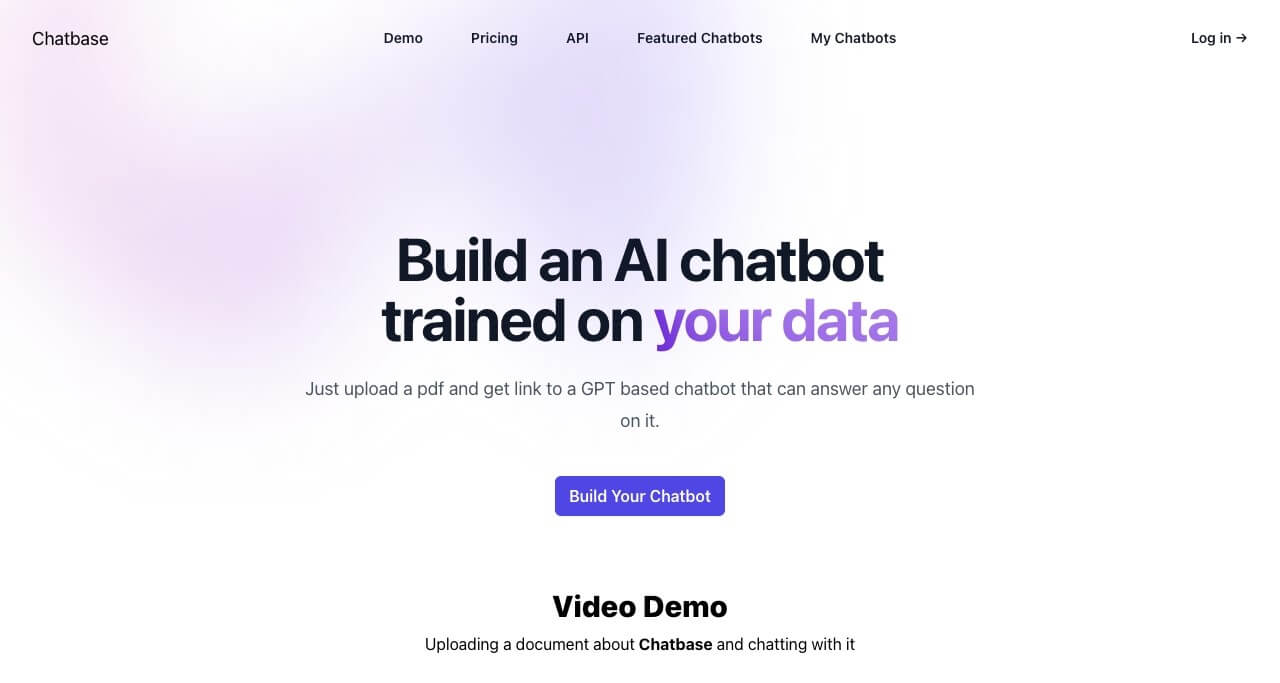
Chatbase’s 15+ AI model selection, RAG-powered knowledge training, AI Actions for booking and lead capture, multi-channel deployment, and Improve Answer continuous learning make it the most capable and flexible no-code AI chatbot builder for businesses deploying customer support automation in 2026.
Potential Limitations and Honest Considerations
Chatbase is a strong platform for most business chatbot use cases, but there are real limitations that matter for specific requirements:
- Credit System Can Be Expensive at Scale: The per-message credit consumption model creates cost uncertainty during high-traffic periods. A bot handling 1,000+ conversations daily at 5+ messages each will burn through credits rapidly — and overage charges at $14–$20 per 1,000 credits add up quickly during product launches, promotional campaigns, or viral traffic events. Businesses with highly variable or high-volume traffic should model worst-case monthly credit consumption before selecting a plan tier.
- No Native Visual Conversation Flow Builder: Complex multi-step conversational logic — where the bot needs to guide users through a decision tree, collect structured data in a specific sequence, or handle conditional branching based on user responses — is significantly harder to build in Chatbase than in purpose-built conversation flow platforms like Botpress. Chatbase works excellently for natural language Q&A; it requires workarounds for structured conversational workflows.
- Limited Native Helpdesk Integration: Chatbase doesn’t integrate natively with helpdesk platforms like Zendesk, Freshdesk, or HubSpot Service Hub — integration requires Zapier as an intermediary, which adds complexity and potential reliability risks. Businesses with established helpdesk stacks who need tight ticket routing, agent assistance, and unified inbox functionality should evaluate Intercom Fin or Zendesk’s own AI features as alternatives.
- Free Agent Deletion After 14 Days Inactivity: Free plan agents are deleted after 14 days of inactivity — a limitation that makes the free plan unsuitable for low-traffic testing scenarios where the agent might not receive queries for extended periods. Build your evaluation quickly and actively during the free period rather than setting it up and returning weeks later.
- AI Hallucination Risk Outside Knowledge Base: While Chatbase’s RAG architecture significantly reduces hallucination compared to general AI assistants, the risk isn’t eliminated — particularly for edge cases where the training content is thin or ambiguous. Review chat logs carefully and add explicit “I don’t know” instructions for topics where incorrect confident responses would be harmful (medical, legal, financial advice).
- Pricing Jumps Between Tiers: The jump from Hobby (~$19/month) to Standard (~$99/month) is a significant step — businesses that outgrow the Hobby plan’s credit limits but don’t need Standard’s full feature set may find the upgrade feels abrupt. Independent reviewers specifically flag this tier gap as a pain point for businesses in the growth phase between small startup and established SME.
Future Outlook and Real-World Applications
Chatbase is positioned at the center of the AI customer support automation market’s most active growth period — as the cost and capability of frontier AI models rapidly improve and businesses increasingly recognize that 60–80% of standard customer support queries can be resolved by a well-trained AI agent without human involvement. The platform’s multi-model flexibility gives it a structural advantage as this market evolves: when a new frontier model from OpenAI, Anthropic, or Google offers better price-performance than the current default, Chatbase customers can switch without platform migration.
Use Cases Across Business Sizes and Industries
- The Solo Founder Who Can’t Afford a Support Hire: Pre-revenue and early-stage founders use Chatbase’s Hobby plan as their first “support team member” — handling the FAQ and documentation queries that would otherwise require founder time or a contractor, enabling more sales and building time as the company grows.
- The E-Commerce Operator Reducing Cart Abandonment: Online retailers deploy Chatbase on product pages and checkout flows to handle the last-mile questions that prevent purchase completion — size availability, shipping timeline, return policy clarity — converting visitors who would otherwise abandon to customers who complete.
- The SaaS Team Scaling Without Proportional Support Headcount: Growing SaaS companies use Chatbase to maintain support quality during rapid user growth — training the agent on their help center and using it to deflect 60–70% of standard tickets, enabling support team capacity to scale 2–3x without proportional hiring.
- The Agency Building a Recurring Revenue Service: Marketing and web development agencies build Chatbase-powered chatbot services into monthly retainers — creating a recurring revenue stream from ongoing AI agent maintenance, content updates, and performance optimization for their SMB client base.
- The Enterprise Team Adding AI to Existing Channels: Enterprise companies use Chatbase’s WhatsApp and Messenger deployment for customer-facing AI support in markets where those channels are primary communication methods — particularly relevant for Latin America, Southeast Asia, and Middle East markets where WhatsApp is the dominant customer communication channel.
Expert prediction: Chatbase’s trajectory in 2026 is toward deeper integration with business operations platforms (CRMs, ERPs, ticketing systems), more sophisticated AI Actions that enable agents to genuinely execute transactions rather than just collect data for human follow-up, and continued model diversity that keeps customers on the cutting edge of AI quality without platform migration. The platform’s free-to-paid conversion pathway and intuitive training interface have made it the entry point for AI chatbot adoption for thousands of businesses making their first AI deployment — and its growth will continue as AI chatbot adoption moves from early-adopter status to standard small-business infrastructure expectation, similar to how email marketing tools became universal in the 2010s.
Conclusion
Chatbase 2026 delivers the most accessible, fastest-to-deploy, and most AI model-flexible no-code chatbot builder available for businesses entering AI customer support automation — with 15+ models from 6 providers (including GPT-5.2 and Claude Opus 4.6), 1-click website crawling and RAG-powered knowledge training, multi-channel deployment across website, WhatsApp, Messenger, Instagram, Slack, and Email, AI Actions for appointment booking and lead capture, a continuous Improve Answer learning loop, and paid plans starting at approximately $19/month with a genuine free plan for evaluation. The credit-based pricing creates cost unpredictability at high traffic volumes, the absence of a native visual flow builder limits complex conversation design, and native helpdesk integration requires Zapier as an intermediary — all real considerations for specific deployment scenarios. But for the majority of small-to-mid-size businesses looking to deploy their first AI support agent, the marketing agency building white-label chatbot services for clients, the SaaS founder who needs to handle support volume without proportional headcount growth, and the e-commerce operator who wants 24/7 customer-facing AI on their highest-friction pages — Chatbase is the fastest, most flexible, and most cost-accessible path from “no chatbot” to “live AI agent in production” available in 2026.
Ready to deploy your own AI customer support agent trained on your business data? Get started with Chatbase today:
👉 Open Chatbase Account: https://worldoftech.space/chatbase
👉 Our YouTube Channel: https://www.youtube.com/@world_tech79
👉 Our Facebook Fanpage: https://www.facebook.com/profile.php?id=61576258059614
👉 Our X (Twitter): https://x.com/worldoftech79