
Sitting through back-to-back meetings, sales calls and interviews while trying to type usable notes at the same time is a losing game — you either miss the conversation or you miss the details. Plaud Note Pro is built to remove that trade-off entirely. It’s a credit-card-sized, self-contained AI voice recorder that clips or magnetically sticks to your phone, captures in-person conversations and phone calls automatically, and turns the raw audio into structured transcripts, summaries and action items inside the Plaud app. Backed by a company that says it serves over 2 million professionals worldwide, Plaud has grown from a niche recorder brand into what it now calls the world’s No. 1 AI note-taking company, with a 4.9/5 App Store rating from roughly 16,000 reviews and a 4.6/5 score on G2.
This 2026 review walks through what the $189 Plaud Note Pro actually does well, where its subscription plans start to add up, how it stacks up against software-only tools like Otter.ai and cheaper wearables like Bee, and who genuinely benefits from carrying a dedicated recording device instead of just using their phone.
Plaud Note Pro Review 2026: The AI Note Taker Built for a Full Day of Conversations
Overview and Background
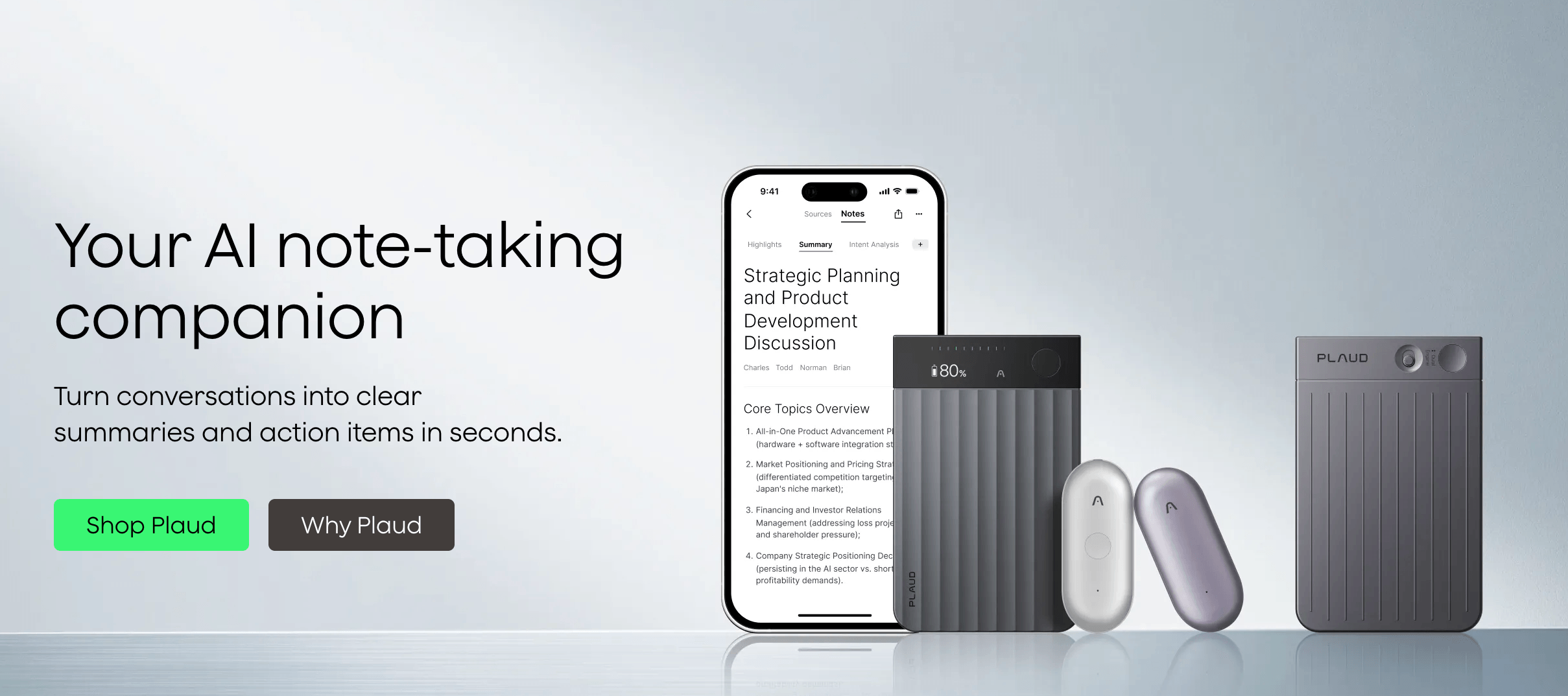
Plaud Inc. is the company behind the Plaud Note, Plaud Note Pro, Plaud NotePin and Plaud NotePin S — a lineup of dedicated AI voice recorders that pair with a companion app rather than relying on a phone’s built-in microphone. The Note Pro, launched as the flagship of the range, is a 0.12-inch-thin, 1.06-ounce card that magnetically attaches to the back of a phone (with an included magnetic ring for non-MagSafe phones) or sits flat on a table during in-person meetings. Instead of a manual on/off toggle, it uses smart dual-mode recording that automatically detects whether you’re on a phone call or in a room full of people, and switches capture modes accordingly.
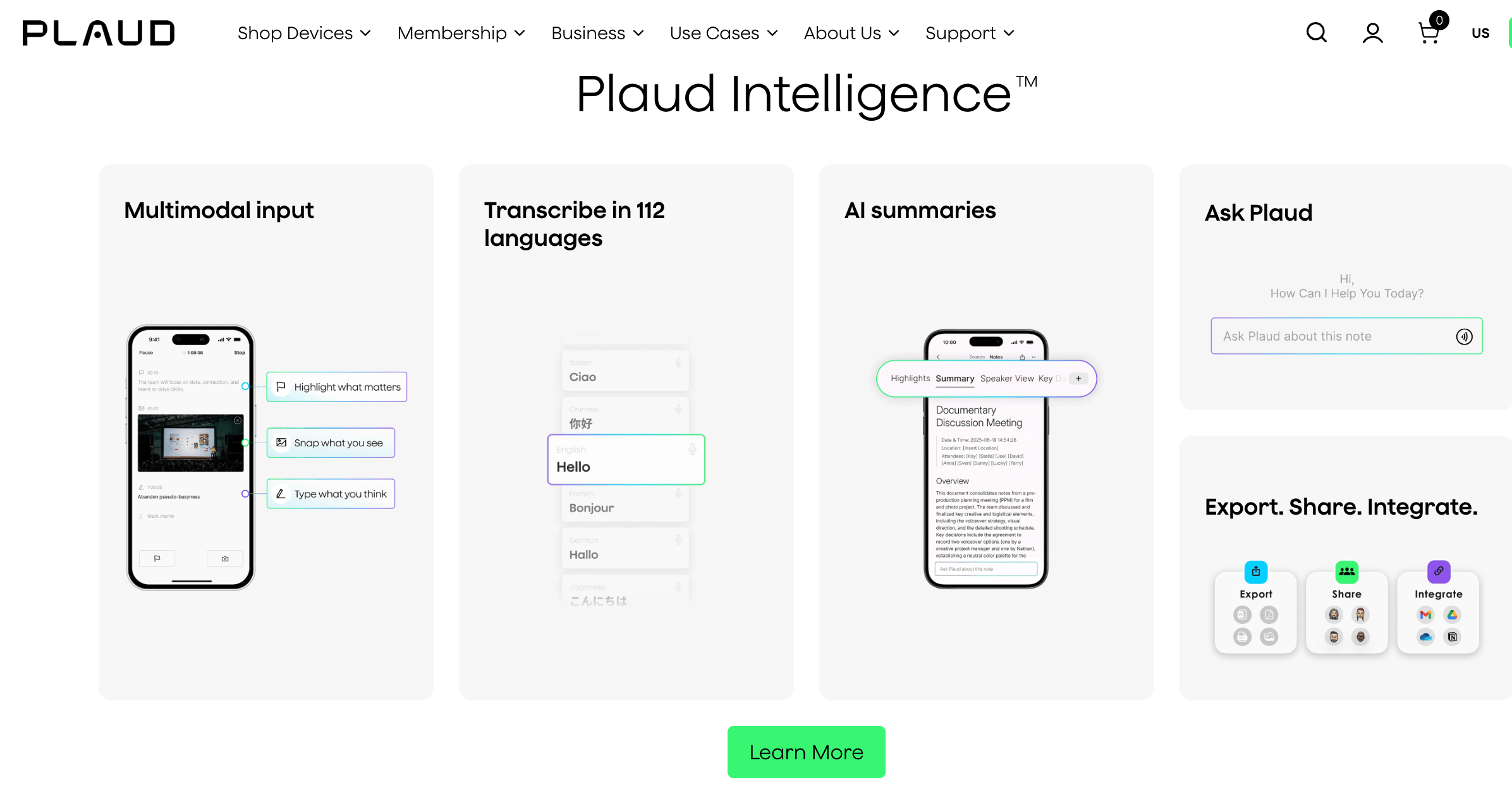
Once a recording is captured, it syncs to the Plaud app (mobile, desktop, and web), where Plaud’s AI layer — branded Plaud Intelligence — handles transcription in 112 languages with speaker labels, generates structured summaries from more than 10,000 templates, and lets you query your own conversation history through a feature called Ask Plaud. Every device ships with a free 300-minutes-per-month Starter Plan, so the hardware works out of the box without forcing an immediate subscription decision.
The Note Pro sits at the top of a four-device lineup. The original Plaud Note ($159) offers a similar card form factor with a smaller 2-microphone array and a manual mode toggle. The Plaud NotePin ($159) and NotePin S ($179) trade the card shape for a wearable pin designed for hands-free, all-day in-person capture rather than phone-call recording. The Note Pro is positioned as the option for professionals who need both call and in-room coverage from a single device, with the longest battery life and widest pickup range in the family.
Why Plaud Note Pro Stands Out in 2026
Dedicated hardware beats a phone app: Recording with a phone means unlocking it, opening an app, and hoping no notification interrupts the session. Plaud’s one long-press to start recording removes every one of those steps, and because it’s a standalone device, a phone call or app switch never stops the capture mid-conversation.
Genuinely long battery life: The Note Pro’s 500mAh battery delivers up to 30 hours of continuous recording in Enhance mode (full 16.4-foot pickup range) or up to 50 hours in Endurance mode with a slightly tighter 9.8-foot range. For most professionals that’s a full work week between charges rather than a nightly ritual.
Room-filling audio pickup: Four MEMS microphones plus a dedicated VPU (voice pickup unit) with AI beamforming let the Note Pro clearly capture voices up to 16.4 feet away — noticeably better than the two-microphone setup on the standard Plaud Note and enough to cover a mid-sized conference room from one spot on the table.
Smart dual-mode recording: A built-in sensor detects whether the device is lying flat (in-person mode) or attached vertically to a phone (call mode) and switches automatically, so you’re not manually toggling settings mid-meeting the way you would with the original Plaud Note.
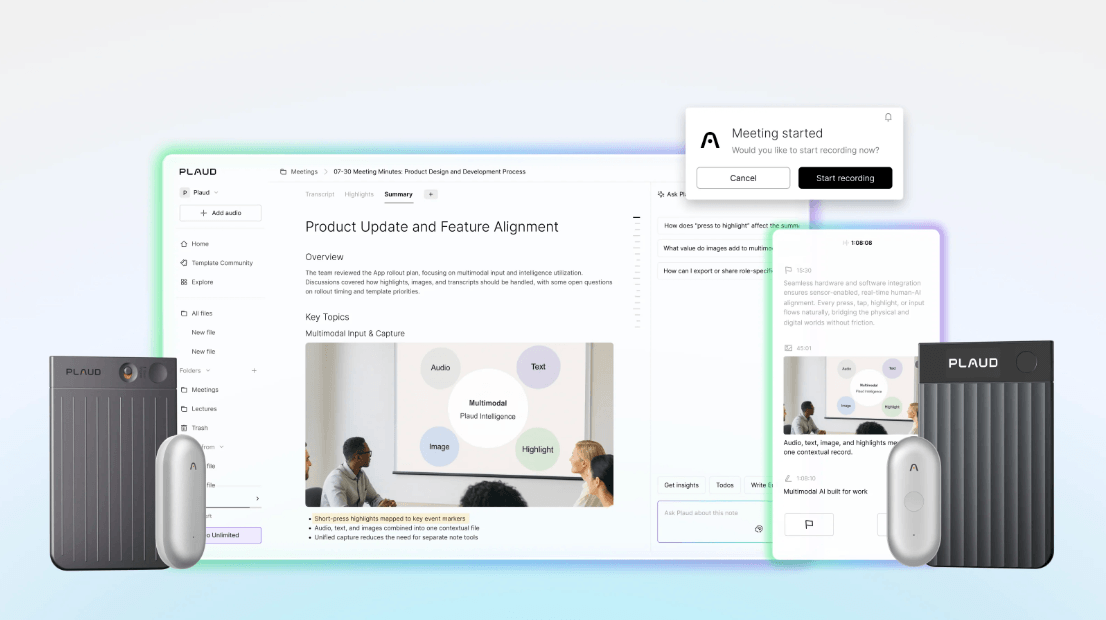
Multimodal context, not just audio: Beyond recording, the Plaud app lets you snap photos of whiteboards or slides, type notes, and press to highlight a moment in real time — all of which feed into the same AI summary, so the final output reflects more than what was simply said out loud.
Ask Plaud for recall across meetings: Rather than scrolling back through old transcripts, Ask Plaud answers natural-language questions grounded in your own recorded history, with references back to the original audio — useful for anyone who needs to recall a commitment from a meeting three weeks ago without re-reading it.
Compliance built for regulated industries: Plaud states its systems are ISO 27001, ISO 27701, GDPR, SOC 2, HIPAA and EN 18031 compliant, and that recordings are never sold or used to train AI models — a meaningful detail for lawyers, clinicians and consultants handling sensitive conversations.
Key Features and Technology
Plaud Note Pro’s value comes from the combination of hardware built specifically for capture and a cloud AI layer (Plaud Intelligence) built specifically for turning that audio into usable output. Here’s what matters most in day-to-day use.
Hardware and Design
At 3.37 x 2.13 x 0.12 inches and 1.06 ounces, the Note Pro is genuinely credit-card sized, and multiple independent reviewers note it disappears once it’s stuck to the back of a phone. It carries 64GB of onboard storage, connects over BLE 5.4 and Wi-Fi, and adds an AMOLED InstantView display (a first for the Note line) that shows recording status at a glance instead of relying on an LED. It also supports Apple’s Find My network, so a misplaced device can be located the same way as AirPods.
Physically, Plaud replaced the original Note’s toggle switch with a proper button: a long press starts or stops recording, and a short press marks a highlight moment that later surfaces prominently in the AI summary. Independent hands-on reviewers who tested the device over multiple months describe the build quality as solid rather than flimsy despite the ultra-thin profile, and note the ripple-textured back panel helps it grip against a phone case instead of sliding around.
Transcription and AI Summaries
Transcripts are generated in 112 languages with automatic speaker labeling and custom vocabulary glossaries for fields like medicine, law and finance, so industry-specific terms are transcribed correctly instead of mangled. Summaries draw from more than 10,000 official and community templates, or you can describe (or photograph) the format you want and Plaud will build a reusable custom template. Multiple summaries can also be generated from the same recording — one for decisions, another for action items — without overwriting the original.
Ask Plaud and Integrations
Ask Plaud lets you query across your entire recorded history in natural language, with every answer traceable back to the specific audio it’s grounded in — Plaud markets this as hallucination-resistant because responses cite sources rather than generating free-form answers. For developers and teams building custom workflows, Plaud also ships a Device SDK, a public API, and an MCP server that connects transcripts and summaries directly to tools like Claude, letting captured conversations feed into other AI workflows automatically.
Pricing, Plans, and Package Structure
The Plaud Note Pro device costs $189 one-time and includes a magnetic case, magnetic ring, charging cable, and the free Starter Plan (300 transcription minutes per month, no credit card required). Beyond that, Plaud Intelligence is sold as a separate subscription with three consumer tiers plus a Team tier for businesses. Multi-unit purchases also unlock volume discounts starting at 3% off for 3–4 devices and scaling up to 11% off for 51–100 devices, which is relevant for anyone buying for a sales team or clinic.
| Plan | Price | What It Is | Best For |
|---|---|---|---|
| Note Pro (device) | $189 one-time | Hardware + free 300 min/mo Starter Plan | Anyone starting out |
| Pro Plan | $99.99/yr ($8.33/mo) or $17.99/mo billed monthly | 1,200 transcription minutes/month, custom templates, Ask Plaud | Regular meeting-goers |
| Unlimited Plan | $239.99/yr ($19.99/mo) or $29.99/mo billed monthly | Unlimited transcription (capped at 24 hrs/day per account) | Daily power users |
| Team Plan | From ~$20–25/user/mo billed annually (approximate) | Shared workspace, centralized billing, DPA, priority support | Teams and businesses |
How Plaud Note Pro Compares to Alternatives
| Factor | Plaud Note Pro | Otter.ai | Bee Pioneer Edition |
|---|---|---|---|
| Hardware cost | $189 (one-time) | None — software only | ~$50 (approximate, budget wearable) |
| Free tier | 300 min/mo, no cap per session | 300 min/mo, 30-min cap per conversation | Included, no subscription required |
| Paid plan (approx.) | $8.33/mo annual — 1,200 min/mo | $8.33/mo annual — 1,200 min/mo | No subscription tier at launch |
| In-person capture | Dedicated 4-mic array, 16.4 ft pickup | Relies on phone/laptop mic | Wearable, always-on lifelogging style |
| Phone call recording | Yes, automatic dual-mode detection | Primarily online meeting bots (Zoom/Teams/Meet) | Not designed for this |
| Compliance | ISO 27001/27701, GDPR, SOC 2, HIPAA, EN 18031 | SOC 2 on higher tiers; HIPAA on Enterprise | Limited public compliance documentation |
| Best for | A single always-with-you device for calls and rooms | Teams already living inside Zoom/Teams/Meet | Budget-conscious, casual daily capture |
Plaud Note Pro vs. Otter.ai: Otter is a strong, mature product, but it’s built primarily around joining online meetings as a bot — it doesn’t have a hardware answer for the in-person conversations, client visits, or hallway discussions that never touch a laptop. Plaud’s dedicated device covers both cases from one piece of hardware, at the cost of an upfront device purchase Otter doesn’t require. Reviewers also note Otter’s Pro tier was quietly reduced from 6,000 to 1,200 minutes without a price change, which narrows the practical gap between the two products’ paid tiers.
Plaud Note Pro vs. Bee Pioneer Edition: Bee is a genuinely inexpensive way to try passive AI capture, and it needs no ongoing subscription for basic use. But it’s a far more limited device — casual reviewers describe it as good for dipping a toe into the category rather than a professional-grade tool, and it lacks the studio-grade microphone array, dual-mode call detection, and compliance documentation that make the Note Pro viable for regulated industries like healthcare and law.
Pros and Cons
What Users Love
Real time saved on admin: The most repeated theme across owner reviews on Plaud’s own site and third-party coverage is that post-meeting cleanup simply disappears — no manual note-taking, no chasing action items from memory.
Support quality: Multiple Trustpilot reviewers specifically call out fast, helpful, patient customer support during onboarding and purchase — a category where hardware startups often struggle.
Transcript and summary quality: Independent testers consistently describe transcripts as clean and summaries as genuinely useful, even in noisy, multi-speaker settings like conference rooms with people talking over each other.
Build quality and form factor: Hands-on reviewers repeatedly praise how thin and unobtrusive the device is once attached to a phone — “light, but not cheap” is a common characterization, and the AMOLED display and physical button are seen as real upgrades over the original Note.
Broad recognition: The Note Pro has picked up a Forbes Vetted 2026 Best AI Wearable nod and an iF Design Award, alongside coverage from The Verge, Wired, and TechRadar — a reasonable signal of product-market fit beyond marketing claims.
Limitations Worth Knowing
The subscription math is the real cost: The $189 device is the entry fee, not the bill. Independent reviewers calculate that daily users typically land on the Pro Plan, pushing the realistic first-year cost closer to $270–290 once the device and a year of subscription are combined.
Consent is on you: A wearable or table-top recorder doesn’t announce itself the way a meeting bot does. Plaud’s own FAQ recommends a quick verbal heads-up before recording, and buyers are responsible for knowing local one-party vs. two-party consent laws — this is a real practical friction that a phone app doesn’t fully solve either, but is worth flagging clearly.
Pricing changes without warning: A minority of Trustpilot reviewers describe frustration over unclear pricing communication before purchase, and Plaud’s own support responses acknowledge the feedback and point to per-minute processing costs as the reason paid tiers exist at all.
Cloud dependency for AI features: The transcription and summarization run in Plaud’s cloud, not on-device, so features like Ask Plaud and AI summaries require an internet connection and depend on Plaud’s servers — a meaningful consideration for anyone who wants a fully offline note-taking workflow.
Team pricing is in flux: Reporting on Plaud’s Team plan indicates launch pricing may rise after promotional windows close, so businesses evaluating Plaud for multiple seats should confirm current numbers directly with Plaud sales rather than relying on older published figures.
Who Should Use Plaud Note Pro
Sales professionals and consultants: Anyone whose job is a string of client calls and site visits benefits directly from automatic dual-mode recording and follow-up summaries generated without opening a laptop.
Lawyers and clinicians: The combination of HIPAA compliance, custom vocabulary glossaries for legal and medical terminology, and a “never trained on” data policy make the Note Pro a credible option for professionals handling sensitive conversations.
Executives and managers running frequent meetings: For anyone in three or more meetings a week, the time saved on writing up notes and tracking decisions tends to justify both the device and the Pro subscription fairly quickly.
Journalists, researchers, and educators: Interview transcription with speaker labels, and searchable lecture or seminar capture, are strong fits for the core feature set — and the 112-language support helps for multilingual interview work.
Who should look elsewhere: Casual users who record only occasionally will likely be well served by the free Starter Plan alone, or by a much cheaper wearable like Bee, rather than paying $189 upfront. Teams already fully embedded in Zoom or Teams with no in-person meeting need may get more value from a software-only tool like Otter.ai. And anyone who wants a fully offline, no-cloud recording workflow should look elsewhere, since Plaud’s AI features depend on its servers.
Getting Started: Step by Step
- Unbox and charge fully. Charge the Note Pro completely before first use — it takes about 2 hours via USB-C — and attach the included magnetic ring to your phone case if it isn’t MagSafe-compatible.
- Download the Plaud app and register. Install the Plaud app (iOS, Android, desktop, or web) and pair the device over Bluetooth. Your free 300-minute Starter Plan activates automatically — no credit card required.
- Give a quick consent heads-up. Before recording anyone else, give a brief verbal notice (“mind if I use my AI note-taker to catch the details?”) — check local consent laws if you’re unsure, since they vary by state and country.
- Record with a single long press. One long press starts recording; a short press marks a highlight moment for the AI to prioritize in the summary. The device auto-detects whether you’re on a call or in a room and switches modes on its own.
- Review the transcript and summary. Once synced, open the recording in the app to review the auto-generated transcript, pick or customize a summary template, and use Ask Plaud if you need to pull a specific detail back out.
- Right-size your subscription. Track your monthly minutes for the first few weeks on the free Starter Plan, then upgrade to Pro or Unlimited once you have a real sense of your recording volume rather than guessing upfront.
Tips for Getting Maximum Value
Set up two or three custom summary templates early — one for internal meetings, one for client calls, one for interviews — so every recording produces a summary in the exact format you’ll actually use instead of a generic default. Use the short-press highlight feature liberally during a conversation; it costs nothing and meaningfully improves which points the AI summary prioritizes. If you’re a heavy user, switch to Endurance mode for all-day conferences where you don’t need the full 16.4-foot pickup range, since it nearly doubles battery life. Keep a habit of the one-line consent statement before recording new contacts — it’s a small courtesy that avoids awkward moments later. And before committing to an annual plan, run your actual minutes for a month on the free Starter tier so you’re upgrading based on real usage rather than the marketing page’s estimate.
Future Outlook and Final Assessment
The AI note-taking hardware category has consolidated quickly through 2026 — Meta’s acquisition of Limitless removed one high-profile pendant competitor from the market entirely, while software-only tools like Otter continue expanding their own AI agent features. Against that backdrop, Plaud has positioned itself as the company willing to own both the hardware and the AI layer end-to-end, backing that bet with real compliance credentials (HIPAA, SOC 2, GDPR) that matter for its stated push into healthcare, legal and enterprise use cases. The MCP integration and public API also suggest Plaud is trying to become infrastructure other AI tools plug into, not just a standalone gadget.
The honest caveats remain real: the true cost of ownership is closer to $270–290 in year one once a realistic subscription tier is added, consent is entirely the user’s responsibility, and the AI features depend on Plaud’s cloud rather than working offline. Still, within those boundaries, the Note Pro’s combination of long battery life, wide microphone pickup, automatic call/meeting detection and genuinely capable summarization puts it at or near the front of the AI hardware note-taking category in 2026.
Conclusion
Plaud Note Pro isn’t trying to be a cheaper Otter or a novelty wearable — it’s trying to be the one device that reliably captures every conversation you have, whether it’s a phone call, a boardroom, or a hallway chat, and then does the tedious part of turning that audio into something usable. It largely delivers on that promise, backed by real independent praise for transcript quality, battery life and support, and by compliance credentials that matter for regulated professions. The subscription cost and consent responsibility are real considerations, not footnotes, so go in with realistic expectations about total first-year cost. For anyone whose day is genuinely built around conversations, Plaud Note Pro is one of the most complete AI note-taking devices available right now.
Ready to stop taking notes and start listening?
Explore more honest reviews, tutorials and tech comparisons to find the right gear for the way you work, travel and live — at World Of Tech, where we make everything easy.
👉 Shop Plaud Note Pro: https://worldoftech.space/plaud
👉 Our YouTube Channel: youtube.com/@world_tech79
👉 Our Facebook Fanpage: Facebook
👉 Our X (Twitter): @worldoftech79
Pricing, specifications and policy details in this review were verified against plaud.ai and independent review sources (including Trustpilot, G2, App Store ratings and hands-on reviewer testing) as of August 2026. AI hardware, subscription pricing and promotions change frequently, so confirm current details on the official site before purchasing. Competitor prices are approximate and subject to change.