
The Netherlands is losing its safety net. From 1 January 2027, the salderingsregeling (net-metering scheme) that let solar owners offset every kWh they exported against every kWh they imported disappears for good, and surplus solar power sent back to the grid will suddenly be worth far less than the power you buy. That single regulatory change has turned “should I get a home battery” from a nice-to-have question into a financial one almost overnight, and it’s exactly the gap Jackery is trying to fill with its plug-in SolarVault 3 series.
Jackery built its name on portable power stations for camping and blackouts, but the SolarVault 3 Pro Max AC is a different animal: a stackable, wall-socket home battery you can install yourself in about ten minutes, no electrician required for the base 800W tier. It promises to retrofit onto an existing solar install, store cheap or self-generated power, and quietly shave your electricity bill without a single hole drilled in the wall. This 2026 review walks through what the SolarVault 3 Pro Max AC actually does, what it costs on nl.jackery.com right now, how it stacks up against Anker and Zendure’s plug-in batteries, and who should — and shouldn’t — buy one.
Jackery SolarVault 3 Pro Max AC Review 2026: A Plug-In Battery Built for the End of Net Metering
Overview and Background
Jackery was founded in California in 2012 and has spent more than a decade in portable power, claiming over 7 million units sold worldwide as of early 2026 (based on 2025 global sales volume data from Frost & Sullivan). The SolarVault 3 series, launched across 2026, is the company’s push into a newer category: AC-coupled, plug-in home batteries that sit alongside an existing rooftop or balcony solar system rather than replacing it. On the Dutch storefront (nl.jackery.com), the SolarVault 3 Pro Max AC is positioned as the “Topkeuze” (top choice) for the Netherlands specifically, which tells you Jackery is building this model around the Dutch net-metering phase-out rather than treating it as an afterthought for the EU market.
Unlike the SolarVault 3 Pro and Pro Max, which include DC solar (PV) input ports so panels can charge the battery directly, the Pro Max AC drops PV input entirely and works purely through its AC socket. That makes it the simplest variant to retrofit: it plugs into a regular Schuko outlet, taps power from your existing solar inverter’s AC output (or from the grid during cheap hours), and releases it again when electricity is expensive or the sun isn’t shining. The base unit starts at 2.52kWh and 25.5±0.5kg, and scales by clipping on up to five BP2500 expansion packs (2.52kWh each) for a maximum single-unit capacity of 15.12kWh — or up to 45.36kWh if you wirelessly link three Pro Max AC units in parallel.
The SolarVault 3 Pro Max AC plugs into a standard socket and stacks with BP2500 packs for more capacity.
Why the SolarVault 3 Pro Max AC Stands Out in 2026
Genuinely plug-and-play retrofit: Jackery quotes a roughly 10-minute self-install for the base 800W tier — plug into a grounded socket, pair the smart meter, connect the app, done. For households that already have solar panels and an inverter but no battery, this sidesteps the cost and hassle of rewiring that a hardwired hybrid system demands.
Modular capacity that grows with you: Starting small (2.52kWh) and adding BP2500 packs one at a time as budget or need allows is a real advantage over batteries sold only as a fixed-size box. You’re not forced to guess your final capacity on day one.
AI-driven Smart Mode via Jackery Ark AI EMS 2.0: The recently-updated energy management system learns household consumption patterns, solar generation, and live electricity prices, then automatically schedules charge and discharge cycles. In four operating modes — self-consumption, tariff mode, custom schedule, and Smart AI mode — most owners will run it hands-off after initial setup.
Dynamic tariff support: The system pulls real-time electricity prices from major European platforms and can automatically charge when power is cheapest and discharge when it’s most expensive — a meaningful feature for the growing share of Dutch households switching to dynamic energy contracts.
Layered fire safety for an indoor-adjacent product: Real-time temperature monitoring across key circuits, an automatic pressure relief valve, and a built-in aerosol fire-suppression module that activates if internal temperatures cross a critical threshold. Jackery cites over 100 protection mechanisms and 1,000+ reliability tests, which matters more here than on a portable power station, since this device is designed to sit in a garage, hallway, or balcony for years, permanently connected to mains power.
Broad third-party smart-home compatibility: Beyond Jackery’s own P1 smart meter, the system works with Shelly (Pro EM-50, Pro 3EM), HomeWizard P1 Meter, Homey Energy Dongle, Everhome, and Home Assistant via HACS. That’s a wider compatibility list than several competitors, which matters for Dutch buyers who already have a smart meter ecosystem in place.
A long warranty on a category that’s still maturing: 10 years of warranty coverage and a 15-year designed lifespan is competitive for 2026’s plug-in battery market, and gives buyers some confidence that Jackery intends to support the SolarVault 3 line for the long haul rather than abandoning it after a generation or two.
Key Features and Technology
Underneath the plug-and-play pitch is a genuinely specced piece of hardware. Here’s what’s actually inside the box, and how it behaves in daily use.
Battery Chemistry and Power Delivery
Each SolarVault 3 unit and BP2500 expansion pack uses LiFePO4 (LFP) cells rated at 2,520Wh and 60.6Ah, a chemistry chosen across the industry for its thermal stability rather than the higher energy density of NMC cells. The Pro Max AC’s inverter handles up to 3,680W of AC input from the grid and up to 2,500W of continuous AC output once expansion packs are attached (800W is the default out-of-the-box figure through a shared socket; reaching 2,500W requires a dedicated circuit installed by a certified electrician, per Dutch electrical code). A bypass mode pushes up to 3,680W through for short peak loads like a tumble dryer, and the whole system switches to battery power in under 20 milliseconds if the grid drops out — fast enough that most connected electronics won’t notice the interruption.
App Control and Operating Modes
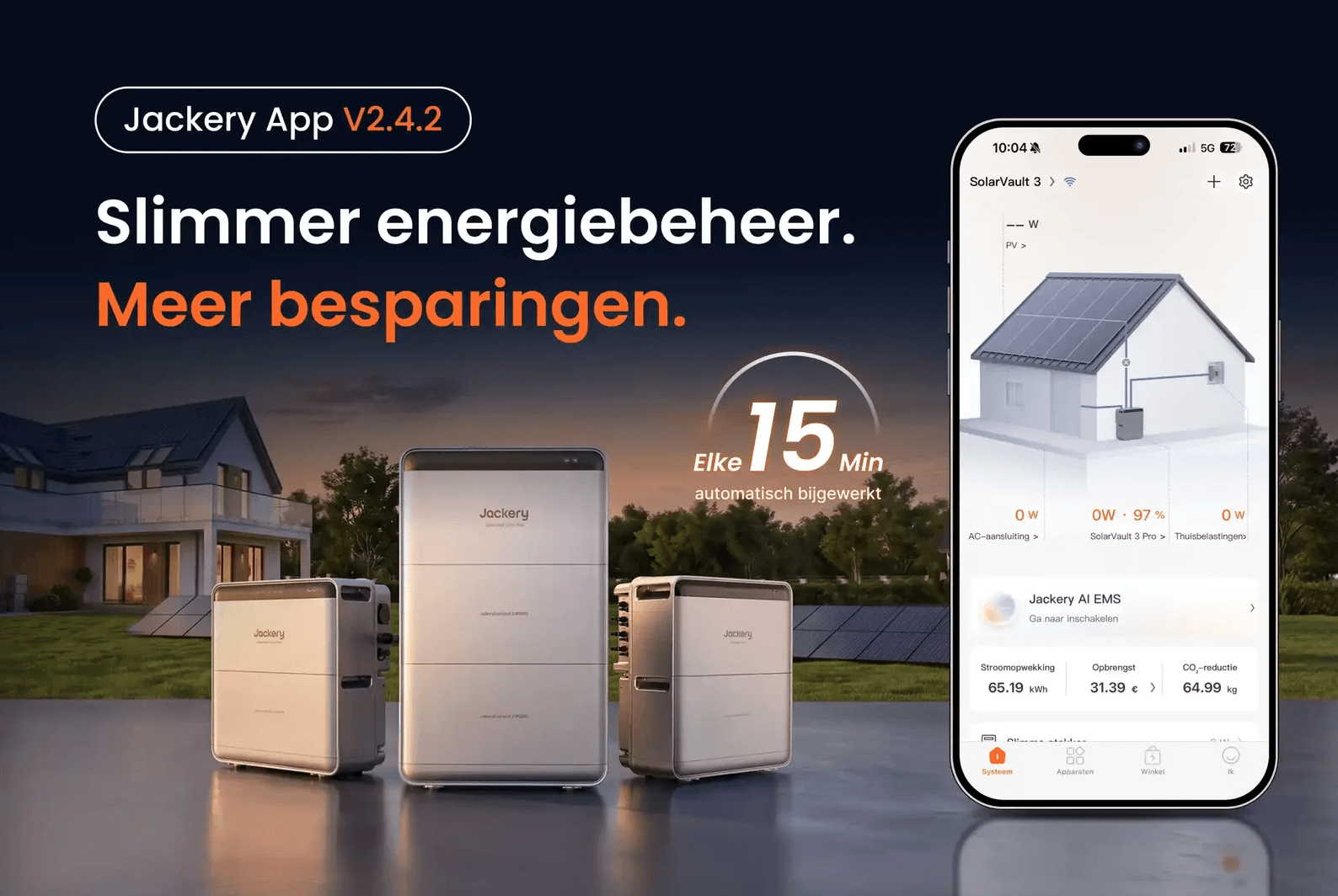
The Jackery App (note: this is a separate app from “Jackery Home,” and the two aren’t compatible with each other) gives real-time visibility into charge state, power flow, and consumption, plus manual control if you’d rather not hand scheduling over to the AI. Self-consumption mode requires a smart meter and prioritizes using your own solar generation first; tariff mode needs no smart meter and simply charges during cheap hours; custom mode lets you set your own schedule; and Smart AI mode requires a smart meter and continuously adjusts based on learned usage and forecasted prices. After 10 minutes of inactivity the system drops into an energy-saving standby state to cut its own parasitic draw, with an optional ultra-power-saving mode for even lower stand-by consumption.
Connectivity and Smart-Home Integration
Wi-Fi and Bluetooth cover most installs, but the inclusion of a physical Ethernet (RJ45) port is a genuinely useful touch for garages, basements, or thick-walled Dutch rowhouses where Wi-Fi signal is unreliable — a wired connection keeps the system talking to the app without dropouts. On the smart-meter side, the SolarVault 3 works with Jackery’s own P1/TIC/D0 reader as well as Shelly, HomeWizard, and Homey Energy Dongle hardware, and integrates with Home Assistant through the HACS community store for users who want it inside a broader smart-home setup.
Pricing, Plans, and Package Structure
Jackery sells the SolarVault 3 series as hardware bundles rather than subscriptions, and nl.jackery.com is currently running a “Herfstdeals” autumn promotion (verified live on the site) with discounts of up to 51% on select configurations, plus a free P1 smart meter (worth €69) with SolarVault 3 Pro Max AC purchases. All prices below are current, incl. 21% Dutch VAT, and include free shipping, a 30-day money-back window, and the 10-year warranty.
| Product | Price (sale / list) | What It Is | Best For |
|---|---|---|---|
| SolarVault 3 Pro | €729 / €1,149 | 2.52kWh, AC + DC (PV) input | Households wiring the battery directly to solar panels |
| SolarVault 3 Pro Max | €1,089 / €1,389 | 2.52kWh, higher AC power + DC (PV) input | Mixed AC + solar setups needing more output power |
| SolarVault 3 Pro Max AC (Starter) | €789 / €1,269 | 2.52kWh, AC-only retrofit, no PV input | Pure plug-in retrofit onto an existing solar inverter |
| Pro Max AC + 1x BP2500 (5.04kWh) — “Topkeuze NL” | €1,398 / €2,078 | Host unit + 1 expansion pack | Average 2-4 person Dutch household with solar |
| Pro Max AC + 3x BP2500 (10.08kWh) — “Premium” | €2,616 / €3,696 | Host unit + 3 expansion packs | Larger homes, high evening/night consumption |
| BP2500 expansion pack (standalone) | €609 / €809 | +2.52kWh capacity (up to 5 per host) | Scaling up an existing system later |
How the SolarVault 3 Pro Max AC Compares to Alternatives
The Dutch plug-in home battery market has gotten crowded fast, largely because of the same net-metering deadline driving Jackery’s marketing push. Anker SOLIX and Zendure are the two names buyers compare most often against Jackery.
| Factor | Jackery SolarVault 3 Pro Max AC | Anker SOLIX Solarbank 3 E2700 Pro | Zendure SolarFlow 2400 AC+ |
|---|---|---|---|
| Starting price (approx.) | €789 (sale) | ~€1,099–1,199 (approximate, retailer-dependent) | ~€849–1,089 (approximate) |
| Base capacity | 2.52 kWh | 2.688 kWh | 2.4 kWh |
| Max expandable capacity | Up to 45.36 kWh (3 units in parallel) | Up to 16.128 kWh (single unit, 5 packs) | Up to 16.8 kWh |
| Max socket output (dedicated circuit) | 2,500 W (800 W standard socket) | 1,200 W (800 W standard socket) | 2,400 W (dedicated circuit) |
| Direct PV (solar panel) input | No (AC-only; Pro/Pro Max variants add PV input) | Yes, 4 MPPT channels, up to 3,600 W | Via separate PV Hub, works with most micro-inverters |
| Fire safety | Temp monitoring + built-in aerosol suppression, IP65 | LFP chemistry, IP65-rated enclosure | LFP chemistry, built-in heating for cold storage |
| Warranty | 10 years / 15-year design life | 10 years, ~6,000 cycles | 10 years, ~6,000 cycles |
| Best for | Existing solar owners who want a fast AC-only retrofit and room to scale big | Buyers who want direct panel input and Anker’s ecosystem/app polish | Budget-focused buyers wanting deep Shelly/smart-meter integration |
Jackery vs. Anker SOLIX Solarbank 3 E2700 Pro: Anker’s Solarbank line has built a strong reputation on app polish and its Anker Intelligence forecasting engine, and it wins if you want direct solar panel input built into the same box. But on raw output, the SolarVault 3 Pro Max AC’s 2,500W dedicated-circuit ceiling beats the Solarbank 3 Pro’s 1,200W by a wide margin, and Jackery’s parallel-unit expansion path (up to 45.36kWh) dwarfs Anker’s single-unit 16.128kWh ceiling for households planning to go big.
Jackery vs. Zendure SolarFlow 2400 AC+: Zendure is the budget-conscious, tinkerer-friendly option, with tight Shelly and Home Assistant integration and the lowest entry price of the three when discounted. It’s a reasonable starting point for a single small balcony or rooftop system, but its 2.4kWh base capacity and lower expansion ceiling (16.8kWh) mean larger households will outgrow it faster than they’d outgrow the SolarVault 3 line. Note that competitor prices above are approximate, gathered from Dutch retail and comparison sources rather than each brand’s own list price, and change frequently — always confirm current figures before buying.
Pros and Cons
What Users Love
Installation simplicity: Reviewers on Jackery’s own SolarVault 3 Pro Max AC product page repeatedly single out how easy setup was, describing it as plug-and-play with no electrician needed for the base configuration, and several mention pairing it with a HomeWizard or Fox smart plug without issues.
Effective self-consumption results: Multiple owners report near-zero grid draw days after adding expansion packs, and one owner running a stacked 10kWh setup described getting through most evenings and nights on battery power alone after letting the system “learn” household usage patterns for a couple of weeks.
Build quality and design: The compact, stacking form factor draws consistent praise for looking tidy in a garage, cellar, or hallway rather than like exposed industrial equipment, and the unit picked up 2026 Muse, A’Design, and Green Good Design awards.
Responsive EU support team: Jackery’s EU customer service (hello.eu@jackery.com) actively replies to reviews on the product page, including detailed, specific responses to technical complaints rather than generic copy-paste replies — a pattern that also shows up in the brand’s broader 4-star Trustpilot rating (roughly 970 reviews on the main jackery.com Trustpilot profile as of late 2026, with a separate UK storefront profile carrying its own set of reviews).
Limitations Worth Knowing
The app trails the hardware: This is the most consistent complaint across reviews, including on Jackery’s own site: hardware quality gets praised while the companion app gets flagged as needing better stability and clearer graphs. One reviewer noted they could not configure the Pro Max AC to charge only from solar rather than a mix of solar and (more expensive) night-time grid power — a real gap in charge-source control.
Smart meter installation isn’t optional, and that’s not obvious upfront: A German reviewer flagged that the requirement to install the smart meter first — before anything else works — wasn’t made clear enough in the setup instructions, leading them to initially think the unit was faulty.
800W is a soft ceiling for most buyers: Reaching the full 2,500W output requires professional installation on a dedicated circuit, registered with the grid operator per Dutch regulation — an added cost and step that changes the “no electrician needed” pitch for anyone who wants more than baseline output.
Parallel expansion beyond one unit is still rolling out: The headline 45.36kWh figure depends on linking three Pro Max AC host units wirelessly, and Jackery’s own FAQ notes this parallel-operation feature is “coming soon” rather than fully live for every buyer today — worth confirming before you plan a system around it.

The Jackery App tracks real-time power flow and lets you switch between self-consumption, tariff, custom, and Smart AI modes.
Who Should Use the SolarVault 3 Pro Max AC
Existing solar-panel owners facing the 2027 net-metering cutoff: If you already have rooftop or balcony panels feeding an inverter and no battery, this is precisely the retrofit scenario Jackery built the AC-only variant for — no rewiring of your PV system required.
Renters and apartment dwellers: Because it’s a plug-in appliance rather than a hardwired installation, tenants who can’t modify a property’s electrical system can still add battery storage, provided the landlord is fine with a permanently plugged-in device.
Households switching to dynamic electricity tariffs: Tariff mode and Smart AI mode both directly exploit hour-by-hour price swings, so anyone already on (or considering) a dynamic contract gets more concrete value from the automation than someone on a flat-rate plan.
Larger households planning to scale up over time: The five-pack, multi-unit expansion path makes this a sensible starting point for families who expect their storage needs to grow — start with one host and a pack, add more later without replacing anything.
Who should look elsewhere: Anyone wanting to connect solar panels directly into the battery via DC input should buy the standard SolarVault 3 Pro or Pro Max instead of the AC-only version. Buyers chasing the absolute lowest entry price with only modest capacity needs may find Zendure’s SolarFlow 2400 AC+ cheaper to start with. And anyone who wants a fully hardwired, whole-home hybrid inverter system with three-phase support should look at a professionally installed system rather than any plug-in battery, since the SolarVault 3 series (like its plug-in competitors) is a single-phase, socket-based product by design.
Getting Started: Step by Step
- Confirm which SolarVault 3 model fits your setup. If you need to plug solar panels directly into the battery, choose the Pro or Pro Max (both have DC/PV input). If you already have a solar inverter and just want to add storage after it, the AC-only Pro Max AC reviewed here is the simpler, cheaper option.
- Size your capacity before ordering. Use Jackery’s online Thuisbatterij Calculator or estimate your typical evening/overnight consumption in kWh, then pick a starter unit plus however many BP2500 packs get you close to that figure — remembering you can always add more packs later.
- Order the P1 smart meter alongside it (or take the free promo unit). Self-consumption mode and Smart AI mode both require a smart meter to function, so don’t skip this step assuming it’s optional accessory — without it, those two modes simply won’t work.
- Plug in, pair the smart meter, and connect the app. Plug the host unit into a grounded (Schuko) socket, connect the P1 reader to your digital meter’s P1 port, then pair everything in the Jackery App over Bluetooth or Wi-Fi. Jackery quotes roughly 10 minutes for this whole process.
- Choose your operating mode. Start with self-consumption mode to prioritize your own solar generation, or switch to Smart AI mode once you’re comfortable letting the system learn your patterns and act automatically. If you’re on a dynamic tariff, tariff mode is worth testing early.
- If you want more than 800W output, book a certified electrician. Reaching the full 2,500W ceiling requires a dedicated circuit installed and registered per Dutch electrical regulations — budget for this separately if baseline output won’t cover your peak loads (ovens, dryers, etc.).
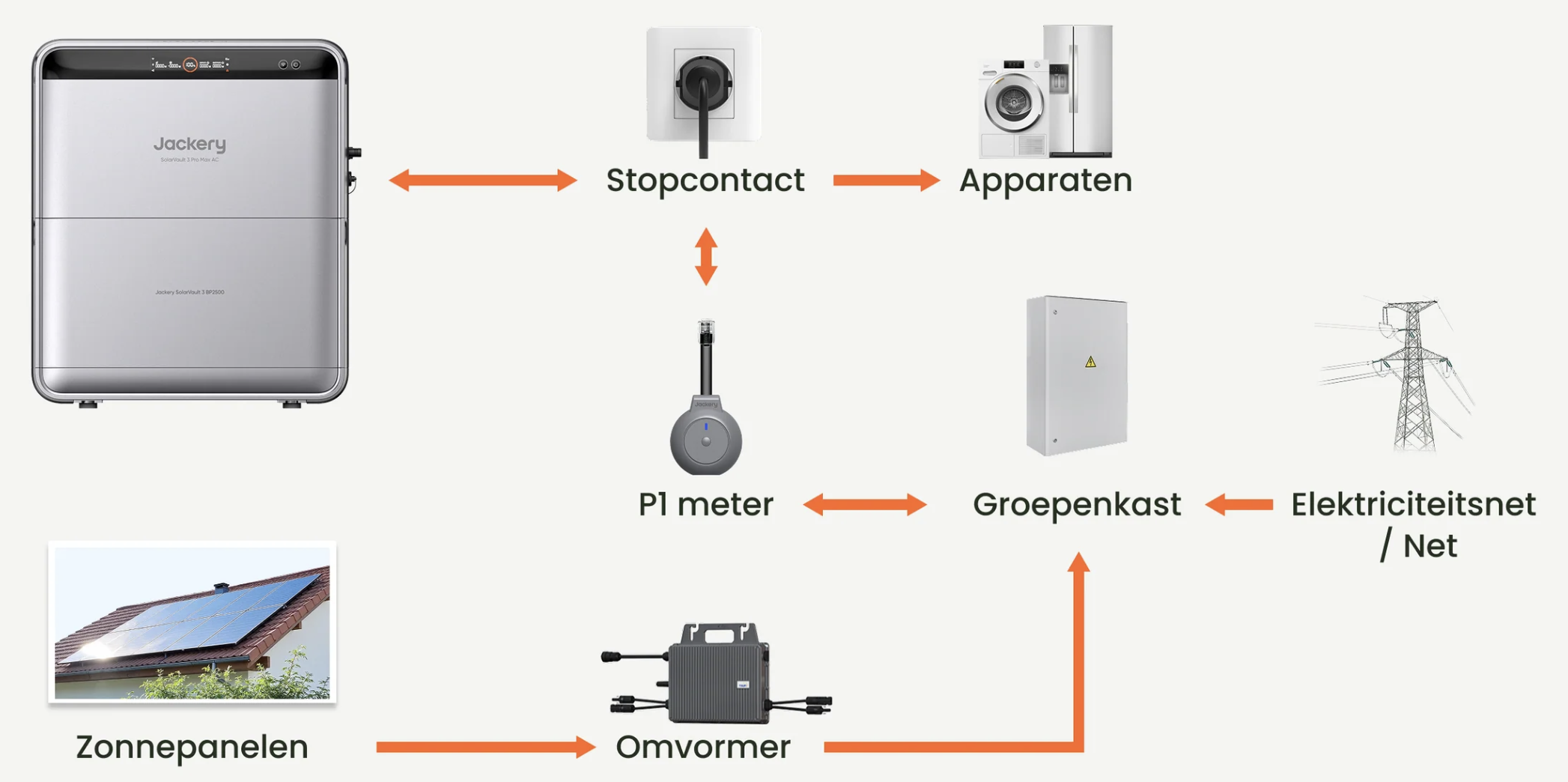
Stacking BP2500 packs lets owners scale from 2.52kWh up to 15.12kWh on a single host unit.
Tips for Getting Maximum Value
Install the free P1 smart meter first, even if you’re tempted to skip it — self-consumption and Smart AI modes simply won’t unlock without one, and it’s the single feature that turns this from a manually-scheduled battery into a genuinely automated one. Give Smart AI mode two to three weeks to learn your household’s actual usage pattern before judging its performance; early results are often mediocre purely because it hasn’t gathered enough data yet. If you’re on (or considering) a dynamic electricity contract, pair tariff mode with your provider’s price API rather than relying solely on solar timing — the biggest savings on a Dutch dynamic contract usually come from shifting consumption to genuinely cheap overnight hours, not just from solar self-use. Buy your expansion capacity in one bundle rather than piecemeal if you already know your target kWh, since bundle pricing during sales periods tends to beat buying a starter unit plus standalone BP2500 packs later. And if your household’s peak loads regularly exceed 800W (ovens, dryers, electric showers), budget for the electrician-installed dedicated circuit upgrade to 2,500W from the outset rather than discovering the limitation after installation.
Future Outlook and Final Assessment
The Dutch plug-in home battery category is about to get a lot more crowded and a lot more important at the same time. With salderingsregeling ending on 1 January 2027, every household with solar panels and no storage is staring down a sudden drop in the value of exported power, and plug-in batteries like the SolarVault 3 series are positioned as the low-friction fix — no permit process, no rewiring, no waiting months for an installer’s schedule. Jackery’s decision to launch a dedicated “Topkeuze Nederland” configuration, discount it aggressively during autumn sales, and throw in a free smart meter all point to a company treating this market shift as a genuine growth opportunity rather than a side note.
The honest caveats: the app still lags the hardware in polish, the widely-advertised 45.36kWh multi-unit parallel configuration is still rolling out rather than universally available today, and reaching the full 2,500W output requires an added electrician cost that complicates the “no professional needed” pitch. Competitors like Anker and Zendure are pushing hard on the same category with their own app ecosystems and integrated PV input options. But on raw expandability, output power at the top end, and an aggressive current price during the Herfstdeals promotion, the SolarVault 3 Pro Max AC is a genuinely strong pick for the specific job it’s built for: retrofitting storage onto an existing Dutch solar setup before the net-metering deadline hits.
Conclusion
Jackery isn’t trying to replace a full hybrid solar installation with the SolarVault 3 Pro Max AC — it’s trying to give existing solar owners a fast, no-permit way to start storing power before the Netherlands’ net-metering scheme disappears in 2027. On that specific job, it delivers: a genuinely simple plug-and-play setup, real expandability from 2.52kWh up to a multi-unit 45.36kWh ceiling, solid fire safety for a device meant to live indoors long-term, and a 10-year warranty that signals real confidence in the hardware. It rewards buyers who install the smart meter properly, give the AI mode time to learn, and budget separately for a dedicated circuit if they want the full 2,500W output — and it’s not the right fit for anyone who needs direct solar panel input built into the battery itself, which is what the Pro and Pro Max variants exist for. For solar households racing the 2027 deadline, though, few plug-in options currently match its combination of price, expansion headroom, and output power.
Ready to beat the 2027 net-metering deadline?
Explore more honest reviews, tutorials and tech comparisons to find the right gear for the way you work, travel and live — at World Of Tech, where we make everything easy.
👉 Shop Jackery SolarVault 3 Pro Max AC: https://worldoftech.space/jackerynl
👉 Our YouTube Channel: youtube.com/@world_tech79
👉 Our Facebook Fanpage: Facebook
👉 Our X (Twitter): @worldoftech79
Pricing, specifications and policy details in this review were verified against nl.jackery.com as of September 2026, with independent context from Trustpilot and retailer listings for Anker SOLIX and Zendure. Jackery’s Herfstdeals promotional pricing, the free P1 meter offer, and the multi-unit parallel-expansion feature are time-limited or in phased rollout and may change — confirm current details on the official site before purchasing. Competitor prices are approximate and subject to change.