
Most aftermarket dash cams solve one problem and create another: they record your drive, but they also stick out from your windshield like an obvious accessory, tangle a cable down your A-pillar, and scream “this car has been modified” to anyone who glances inside. FITCAMX takes a different approach. Instead of a universal windshield-mount camera, it builds a separate, vehicle-specific mold for each car it supports — over 50 brands and hundreds of individual models — so the camera clips onto your factory rearview mirror mount and disappears into a housing shaped like it came from the factory. No visible wires, no A-pillar disassembly, and in most cases no fuse-box splicing for the front camera at all.
This review anchors on FITCAMX’s Toyota-compatible line — covering Camry, RAV4, Corolla, C-HR, Sienna, Prius, Tacoma, Tundra, 4Runner and Highlander — because it’s the brand’s highest-review-count product, with 450 on-site customer reviews and pricing that runs from $168 for a single 4K front camera up to $268 for a dual 4K front-and-rear setup. But the same design, technology and trade-offs apply across FITCAMX’s entire catalog, whichever of the 50+ supported brands you drive. This 2026 review walks through how the hidden-mirror design and plug-and-play installation actually work, the full resolution and pricing lineup, how FITCAMX stacks up against Toyota’s own factory-installed dash cam and rivals like Vantrue, the genuine pros and cons reported by owners, and exactly who should — and shouldn’t — buy in.
FITCAMX Dash Cam Review 2026: The OEM-Style Hidden Camera Built for 50+ Car Brands
Overview and Background
FITCAMX is a China-founded dash cam manufacturer (2015) that has built its entire business around one idea: an integrated, OEM-style camera that mounts in place of your factory rearview mirror cover instead of clipping onto your windshield. According to the brand’s own company history, it developed over 300 vehicle-specific molds and partnered with more than 5,000 automotive modification shops across China by 2016, then introduced the industry’s first plug-and-play Y-cable in 2018 — a cable that lets the front camera draw power from the car’s existing wiring (commonly the ACC sensor harness) instead of requiring a professional to splice into the fuse box. FITCAMX registered its trademark in the US and Europe in 2019, opened Western Amazon storefronts, and launched its global direct-to-consumer site, fitcamx.com, in 2020. Camera resolution moved from 1080P to 1440P and 4K in 2021, and by 2022 the company had developed over 200 additional custom molds to cover left-hand and right-hand-drive markets internationally.
Today FITCAMX says it serves customers in more than 70 countries and reports 98.5% satisfied customers and five-star reviews, along with more than 500 recommendations from tech reviewers — figures the brand self-reports on its About page rather than figures independently audited, so treat them as directional rather than verified. What is independently checkable is the on-site review volume for individual product lines: the Toyota-compatible camera alone carries 450 customer reviews, with 89% rating it five stars, 10% four stars, and the remaining 1% split across lower ratings. Independent coverage backs this up in outline: a hands-on review at The Gadgeteer tested a Ford-fit unit and praised the OEM look and straightforward install, and Amazon-sourced aggregator listings for RAM- and Polestar-fit models show 4.5-out-of-5 ratings across 200+ reviews each — solid, if not spotless, third-party sentiment for a niche automotive accessory brand.
The core product concept is straightforward. FITCAMX’s front camera is molded to replace your car’s factory rearview mirror back-cover, so from outside the car it looks like a slightly larger, more angular version of the stock mirror housing rather than an aftermarket add-on. Power typically routes through a hidden Y-cable connected behind the mirror (often via the ACC sensor harness), so there’s no cable running down the windshield or A-pillar for the front camera. The optional rear camera, where included, hardwires back to the front unit rather than needing its own separate power source. Because the housing is vehicle-specific, FITCAMX asks buyers to specify their exact model — and, for some vehicles, submit a photo of their existing mirror cover — before the order ships.
Why FITCAMX Stands Out in 2026
A genuinely OEM-style hidden design: This is FITCAMX’s entire reason for existing. The camera is a 1:1 restoration of the original rearview mirror back-cover shape, so it doesn’t block your sight line and doesn’t announce itself to a smash-and-grab thief the way a windshield-mounted box does. Reviewers consistently describe it as “looking like it came with the car” — the single most repeated phrase across owner feedback on the site and in independent write-ups.
True plug-and-play power for the front camera: FITCAMX’s Y-cable draws power from the car’s existing wiring (commonly the ACC sensor harness on newer models), meaning most owners install the front camera themselves in around 15–20 minutes with no fuse-box splicing, no professional installer and no cutting into factory wiring. That’s a meaningfully lower barrier than most hardwired dash cam installs.
Resolution options up to true 4K on both cameras: Buyers choose between a 4K-only front camera, a 2K front/1080P rear dual setup, or a full 4K front/1080P rear dual setup, all built on a Novatek chip with an f/1.6 front aperture. Independent reviewers rank the video quality among the sharper options they’ve tested, with license plates legible at several car-lengths’ distance in daylight footage.
Enormous vehicle-specific compatibility: FITCAMX maintains dedicated product lines for more than 50 car brands — from mainstream marques like Toyota, Honda, Ford, Hyundai and Volkswagen to specialty and luxury brands including Porsche, Bentley, Rolls-Royce, McLaren and Tesla — with distinct molds for different model years and trims within each brand. Few competitors match that breadth of made-to-fit coverage.
Built-in WiFi and a genuinely global app: Every FITCAMX camera includes 2.4GHz WiFi for downloading footage straight to a phone (no mobile data needed) via an iOS/Android app that supports over a dozen languages, from English and Spanish to Korean, Thai and Turkish — a detail that matters for a brand selling into 70+ countries.
G-sensor protection and loop recording as standard: Every tier includes automatic collision detection that locks the relevant footage file so it can’t be overwritten, plus standard loop recording that manages storage automatically (up to a 256GB card). Parking-mode collision recording is available as an add-on hardwire kit for owners who want protection while the car is off.
A decade of R&D and a genuine track record: Founded in 2015 and iterating on vehicle-specific molds since, FITCAMX isn’t a drop-shipped marketplace brand assembled overnight. It has a documented product history, a registered US/EU trademark, a 12-month warranty backed by a written policy, and a review base in the hundreds for individual product lines — the kind of longevity that’s rare in the crowded aftermarket dash cam space.
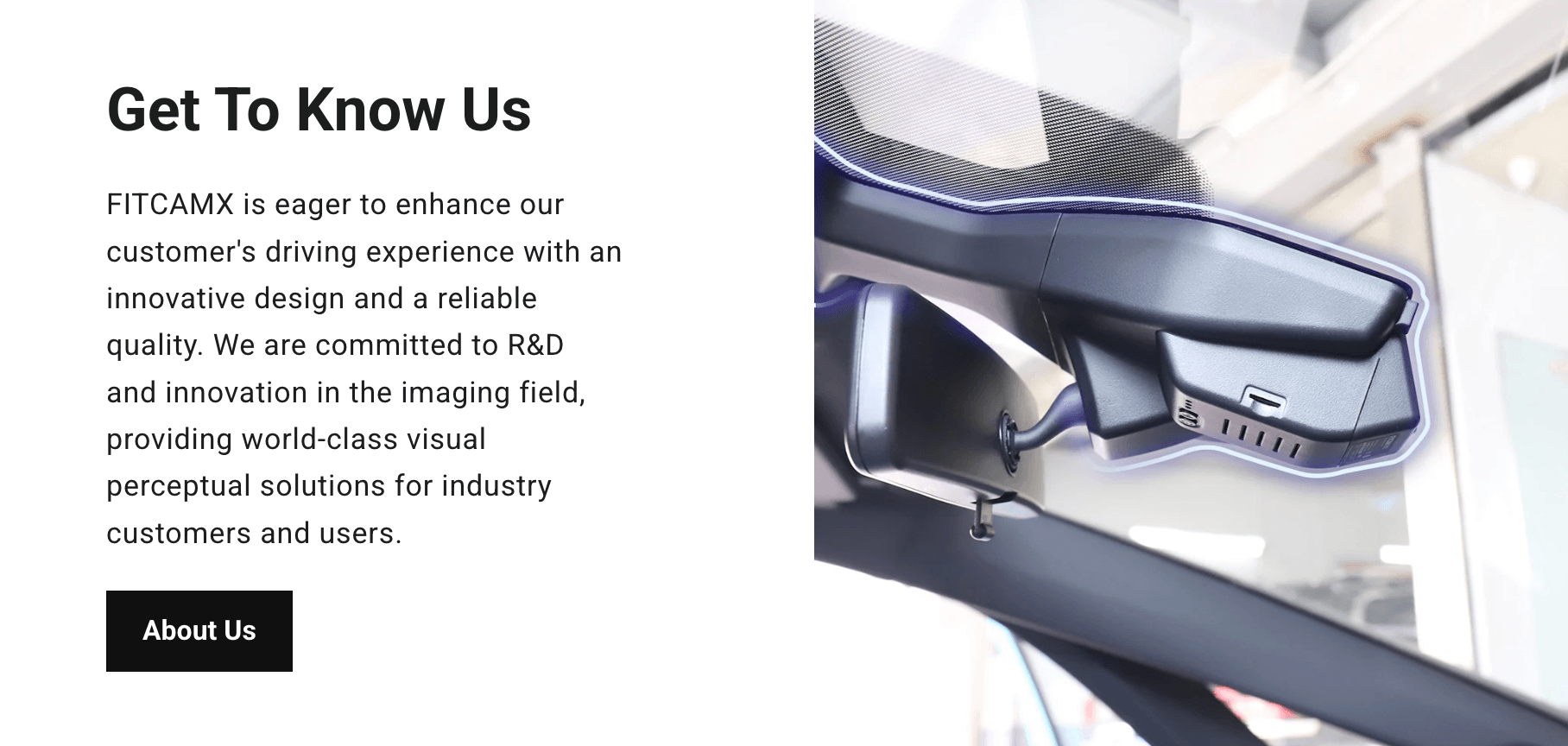
FITCAMX’s front camera is molded to match the factory rearview mirror housing, so it blends in rather than standing out as an aftermarket accessory.
Key Features and Technology
FITCAMX’s product lineup is broad — dozens of vehicle-specific pages — but every one of them is built on the same technical foundation. Here’s how it breaks down.
OEM Hidden Mirror Design and Installation
The front camera replaces your factory rearview mirror back-cover with a matching molded housing, so it sits flush and doesn’t obstruct your view of the road. Power for the front camera runs through a concealed Y-cable, most commonly tapping the Adaptive Cruise Control (ACC) sensor harness on supported models, which means no visible wiring and — for the front camera — no need to remove the A-pillar trim or splice into the fuse box. The rear camera, on dual-cam kits, is hardwired from the front unit rather than drawing its own separate power feed, and cannot be purchased or installed as a standalone accessory.
Resolution Tiers: 4K Single, 2K Dual, 4K Dual
Every vehicle line ships in three configurations. The entry 4K-front-only tier records at true 2160P with a 160-degree wide-angle lens and f/1.6 aperture. The 2K dual-cam tier drops the front camera to 1440P but adds a 1080P rear camera with a 140-degree field of view and f/2.0 aperture. The top 4K dual-cam tier keeps the front at full 2160P while adding the same 1080P rear camera, paired with a larger 128GB card. All three tiers record at 30 FPS, support WDR (wide dynamic range) for better handling of harsh light and shadow, and accept memory cards up to 256GB.
WiFi, Mobile App and Multi-Language Support
A built-in 2.4GHz WiFi radio lets the FITCAMX app (iOS and Android) connect directly to the camera to preview, download and share footage without burning mobile data — useful for pulling a clip immediately after an incident. The app interface supports a long list of languages, including English, Chinese, Japanese, Russian, Ukrainian, German, Italian, Spanish, French, Korean, Thai, Turkish, Polish and Czech, reflecting the brand’s genuinely global customer base rather than a US-only afterthought.
G-Sensor, Loop Recording and Parking Mode
A G-sensor automatically detects sudden collisions or hard braking and locks the corresponding video file so ordinary loop recording can’t overwrite it — standard protection for insurance disputes. Loop recording itself auto-overwrites the oldest footage once the card fills, and the camera powers on and off automatically with the vehicle’s ignition. Parking-mode collision recording (footage triggered by an impact while parked, not continuous recording) requires a separate hardwired fuse-box or OBD cable kit, sold as an accessory rather than bundled in the base price.
Build Quality and Operating Range
FITCAMX states its cameras undergo automotive-grade high- and low-temperature testing, with a rated operating range of −20°C to 60°C — wide enough for most climates a passenger car would realistically see. The included kit covers the essentials: the camera unit, a memory card pre-installed at the selected capacity, an SD card reader, a plastic pry tool for panel removal, and a printed manual.
Pricing, Plans, and Package Structure
FITCAMX sells as a one-time hardware purchase — there’s no subscription — with pricing structured around resolution tier rather than plan level. Using the Toyota-compatible line as the reference point (prices vary by a small amount across the 50+ supported brands and by mold complexity within Toyota’s own sub-models, such as Tacoma or older Corolla trims running slightly higher), current live pricing from fitcamx.com breaks down as follows.
| Configuration | Price (USD) | What It Is | Best For |
|---|---|---|---|
| 4K Front-Only Cam | $168–$189.99 | Single 2160P front camera, no wiring, 64GB card | Budget-conscious buyers who mainly want sharp forward footage |
| 2K Dual Cam (Front + Rear) | $198–$221.99 | 1440P front + 1080P hardwired rear, 64GB card | Drivers who want full front-and-rear coverage on a mid budget |
| 4K Dual Cam (Front + Rear) | $248–$269.99 | 2160P front + 1080P hardwired rear, 128GB card | Buyers who want maximum resolution on both cameras |
| CPL Anti-Glare Filter | $23.99 each (front or rear) | Circular polarizing lens filter to cut windshield glare | Drivers in sunny climates or with heavy dash reflection |
| Fuse Box Hardwire Kit | $38–$39 | Enables true parking-mode collision recording | Owners who want protection while the car is parked |
| OBD Cable Kit | $29.99 | Alternative parking-mode power source via OBD port | Owners who prefer not to open the fuse box |
How FITCAMX Compares to Alternatives
| Factor | FITCAMX | Toyota Factory Integrated Dash Cam | Vantrue M2 (Mirror-Style) |
|---|---|---|---|
| Mounting style | Replaces mirror back-cover, vehicle-specific mold | Factory-integrated at time of manufacture or dealer install | Clips over existing mirror, universal fit |
| Max front resolution | 2160P (4K) | ~1080P (varies by generation) | 1080P |
| Entry price | $168–$189.99 (front only) | ~$355 unit + harness, ~$300–$600 installed | ~$249.99 (approximate) |
| Installation | Self-install, ~15–20 min, no wiring for front cam | Dealer installation required | Self-install, hangs off existing mirror |
| Fits any car it’s used on | No — molded per exact model/trim | No — Toyota vehicles only | Yes — universal mirror clip |
| App / software | Multi-language phone app, WiFi transfer | Toyota smartphone app / PC tool | On-device touchscreen; app reported clunky by reviewers |
| Best for | Discreet OEM look at a mid-range price | Buyers who want factory-backed integration and don’t mind the premium | Buyers who switch cars often and want a portable mirror cam |
vs. Toyota’s own factory-integrated dash cam: Toyota sells a genuine OEM dash cam option (part number PT949-03210-C0) with an MSRP around $355 for the unit plus roughly $40 for the wiring harness, and dealer-reported installed pricing runs $300–$600 depending on the model and dealer. It has the advantage of true factory backing, but owner complaints on Toyota forums cite middling video quality and MSRP well above budget aftermarket picks. FITCAMX undercuts that price by roughly half even at its top 4K dual-cam tier, while matching or exceeding the resolution, at the cost of not being a Toyota-branded, dealer-warrantied part.
vs. Vantrue’s mirror-style cameras: Vantrue’s M2 clips onto your existing rearview mirror rather than replacing its housing, so it works across many vehicles instead of one — but reviewers have flagged its touchscreen interface as “clunky” and note the design doesn’t achieve the same disappear-into-the-dash look, since the mirror itself becomes a visible 12-inch display. FITCAMX trades that universality for a cleaner factory appearance and, on the Toyota line at least, a similar or lower price at the 4K tier.
vs. generic windshield-mount dash cams (Vantrue N-series, budget brands): A basic windshield-mount camera from Vantrue or a similar budget brand can start well under $100, and some (like the N4) pack in features FITCAMX doesn’t offer at the same price, such as three-channel recording or built-in GPS. What you give up is the discreet factory look — these cameras are visibly stuck to the glass and need their own cable run. If a clean, hidden install matters more to you than raw feature count or absolute lowest price, FITCAMX’s category is the better fit; if you want the cheapest possible functional dash cam and don’t care how it looks, a generic windshield unit wins on price alone.
Pros and Cons
What Users Love
It genuinely looks factory-installed: The single most repeated phrase across the 450 on-site Toyota reviews and independent write-ups is that the camera “looks like it came with the car” — several owners specifically call out that it’s a better fit and finish than the original mirror housing they removed.
Installation is easier than expected: Multiple reviewers report finishing the front-camera install in 15–20 minutes with no professional help, thanks to the plug-and-play Y-cable and included pry tool — a low bar to clear for a camera that looks this integrated.
Video and image quality hold up under scrutiny: Independent testers on forums like ipcamtalk specifically praise footage sharpness at both 1440P and 2160P, noting license plates stay legible several cars away and rear-camera footage at 1080P is clear enough to identify drivers and passengers in adjacent vehicles.
Customer service earns real praise for edge cases: One detailed on-site review describes FITCAMX proactively holding a shipment during the customer’s vacation and delivering it precisely when they returned — a level of white-glove handling not typical of budget dash cam brands.
Broad vehicle coverage means most drivers can find their fit: With molds for 50+ brands and hundreds of individual models and trims, FITCAMX covers a far wider range of vehicles than most OEM-style competitors, including specialty brands like Porsche, McLaren and Rolls-Royce that few aftermarket dash cam makers bother supporting.
Meaningfully cheaper than the factory-installed alternative: At $168–$269.99 depending on configuration, FITCAMX’s Toyota line runs roughly 40–55% below the $300–$600 typical cost of Toyota’s own dealer-installed factory dash cam, while matching or beating its resolution.
Limitations Worth Knowing
A recurring long-term reliability complaint: One detailed on-site review reports the camera’s internal clock battery (a small lithium cell, not a swappable coin cell) failed after roughly two years — just past the 12-month warranty window — causing the date/time stamp on recordings to drift unless the camera is reconnected to the app before every drive. That’s a real, documented failure pattern worth knowing about rather than a one-off.
Customer support responsiveness is inconsistent: The same review describes slow response times and templated, link-only replies from support for a non-standard issue — a contrast to the proactive service other reviewers praise for straightforward requests like shipment timing.
Parking mode isn’t included by default: Unlike some dash cams that bundle a parking-mode cable in the box, FITCAMX sells the fuse-box hardwire kit ($38–$39) and OBD cable kit ($29.99) as separate accessories, adding to the effective total cost for anyone who wants full protection while the car is parked.
Rear camera can’t be added later: If you buy the front-only tier and later decide you want rear coverage, you can’t simply add a rear camera — you’d need to purchase a full dual-cam kit, which is a meaningfully less flexible upgrade path than modular dash cam systems.
Return and replacement rules have real friction: FITCAMX’s refund policy requires photo evidence of correct fuse-box or Y-cable wiring before it will process a “won’t power on” return, and non-quality-related returns place shipping cost on the buyer. Read the return policy before buying if you’re not confident in your own installation.
Standard delivery takes longer than a same-week Amazon order: Because units are made-to-order and vehicle-specific, FITCAMX quotes 1–3 business days of processing plus 8–12 business days of standard shipping — noticeably slower than grabbing a generic windshield dash cam off a marketplace shelf.
Who Should Use FITCAMX
Owners who want their dash cam to look factory-installed: If a visible windshield-mounted box bothers you aesthetically, or you simply don’t want your car to look modified, FITCAMX’s entire value proposition is built for you. This is the group that benefits most.
Rideshare and delivery drivers: A discreet camera that doesn’t advertise itself to passengers, combined with G-sensor collision protection and optional parking mode, suits drivers who want documentation without an intrusive-looking setup in the cabin.
Buyers cross-shopping their factory-installed dash cam option: If your dealer quoted $300–$600 for a factory-integrated camera, FITCAMX’s Toyota-line pricing of $168–$269.99 for comparable or better resolution is worth comparing before you commit to the OEM part.
Owners of less mainstream or specialty vehicles: Because FITCAMX has built molds for niche and luxury brands — Porsche, Bentley, Rolls-Royce, McLaren and others — it can serve drivers that most OEM-style dash cam competitors simply don’t support.
Who should look elsewhere: Drivers who switch cars frequently or drive a rental/company car should look at a universal windshield or mirror-clip camera instead, since FITCAMX’s mold only fits the one vehicle it was ordered for. Anyone who wants parking-mode protection bundled in from day one without an extra accessory purchase, or who needs same-week delivery, may also be better served by a mainstream windshield-mount brand.

The FITCAMX mobile app connects over WiFi to preview, download and share footage — no mobile data or SD card removal required.
Getting Started: Step by Step
- Confirm your exact model, year and trim. Find your vehicle’s dedicated FITCAMX collection page and select the precise model-year and trim variant listed (for example, “RAV4 Model A, without vents” vs. “Model B, with vents”) — ordering the wrong variant means the mold won’t fit cleanly.
- Choose your resolution tier. Pick the 4K front-only camera if budget and simplicity matter most, the 2K dual-cam kit for balanced front-and-rear coverage, or the 4K dual-cam kit if you want maximum resolution on both cameras and don’t mind the extra $80–$100.
- Add parking mode if you want it. Decide upfront whether you want the fuse-box hardwire kit or OBD cable kit for parking-mode protection — it’s much easier to install alongside the main camera than to retrofit later.
- Respond promptly to any fitment request. If FITCAMX emails asking for a photo of your current mirror cover to confirm the correct mold, reply quickly — this step protects both your shipping timeline and fitment accuracy.
- Install using the included tools. Use the provided plastic pry tool to remove your factory mirror cover, connect the Y-cable (commonly to the ACC sensor harness), and clip the new FITCAMX housing into place. Most owners complete the front camera in 15–20 minutes; the rear camera and any hardwire kit add extra time routing cable through interior trim.
- Pair the app and test before you need it. Connect the FITCAMX app over WiFi, confirm footage is recording and date/time-stamping correctly, and do a test download so you know the process before an actual incident makes it urgent.
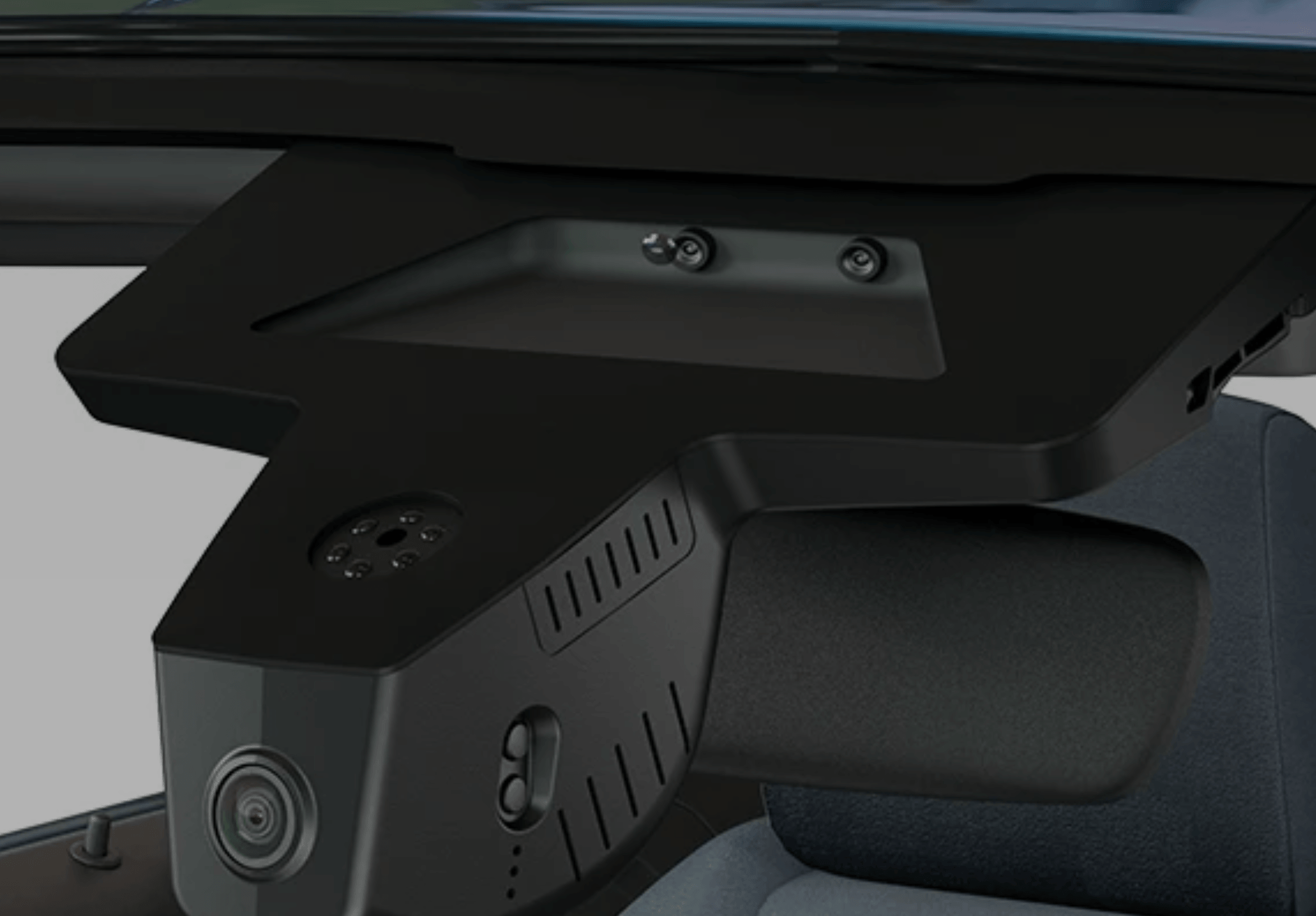
FITCAMX’s plug-and-play Y-cable lets most owners install the front camera themselves in 15–20 minutes, with no fuse-box splicing required.
Tips for Getting Maximum Value
Reconnect the FITCAMX app to your camera every few drives rather than only when something goes wrong — this keeps the date/time stamp accurate and is a simple habit that sidesteps the clock-drift issue some long-term owners have reported. If you drive in a bright, glare-heavy climate, the $23.99 CPL filter is a low-cost add that noticeably improves footage clarity through the windshield. Budget the fuse-box or OBD hardwire kit into your initial order rather than treating it as a future upgrade, since it’s genuinely easier to route that cable while the mirror cover and interior trim are already open for the main install. Keep your order confirmation and any photos you sent for fitment verification, since FITCAMX’s return and warranty process asks for documentation like wiring photos if a “won’t power on” issue comes up. And because these are made-to-order, vehicle-specific products, order a few weeks ahead of when you actually need the camera rather than the week before a road trip — the 1–3 day processing plus 8–12 day shipping window adds up to roughly two weeks in the best case.
Future Outlook and Final Assessment
The dash cam market is bifurcating in a useful way for buyers: cheap, feature-dense universal cameras keep getting more capable, while automakers increasingly offer their own factory-integrated options at premium prices. FITCAMX occupies the space between those two extremes — a specialist that has spent a decade building vehicle-specific molds so an aftermarket camera can look as clean as a factory part, without the dealer-installed markup. With 200+ custom molds added for international left- and right-hand-drive markets since 2022 and a resolution lineup that already reaches true 4K on both cameras, the brand’s trajectory suggests it will keep chasing broader vehicle coverage and sharper imaging rather than pivoting toward a generic, one-size-fits-all product.
The honest caveats remain real: a documented long-term reliability report around the internal clock battery, support responsiveness that varies by issue type, parking mode sold as an add-on rather than included, and a fitment process that puts real responsibility on the buyer to order the correct variant. None of these are dealbreakers for most shoppers, but they’re worth weighing against the genuine strengths — a factory-matched appearance, straightforward self-installation, sharp 4K footage, and a price that undercuts Toyota’s own factory dash cam by roughly half.
Conclusion
FITCAMX isn’t trying to be the cheapest or the most feature-packed dash cam on the market — it’s trying to be the one that doesn’t look like a dash cam at all, and on that specific job it delivers. By molding a camera to replace your factory mirror housing, routing power through a plug-and-play cable instead of a fuse-box splice, and backing it with true 4K resolution and a decade of vehicle-specific engineering, FITCAMX removes the biggest aesthetic objection buyers have to aftermarket dash cams. It’s not the right call for anyone who switches vehicles often, wants parking mode bundled in by default, or needs same-week delivery — and the documented long-term reliability report is worth knowing before you buy. But for the growing number of drivers who want genuine collision documentation without an obvious aftermarket box on their windshield, confirm your exact model, budget for the accessories you actually need, and FITCAMX delivers one of the cleanest-looking dash cam installs available today.
Ready for a dash cam that looks like it came with the car?
Explore more honest reviews, tutorials and tech comparisons to find the right gear for the way you work, travel and live — at World Of Tech, where we make everything easy.
👉 Shop FITCAMX: https://worldoftech.space/fitcamx
👉 Our YouTube Channel: youtube.com/@world_tech79
👉 Our Facebook Fanpage: Facebook
👉 Our X (Twitter): @worldoftech79
Pricing, specifications and policy details in this review were verified against fitcamx.com and independent review sources (including The Gadgeteer, ipcamtalk, and Amazon-sourced aggregator ratings) as of September 2026. Dash cam pricing and availability vary by vehicle model and change frequently, so confirm current details on the official site before purchasing. Competitor prices are approximate and subject to change.