
Roaming bills and airport SIM kiosks are two of travel’s most reliable annoyances, and a growing number of apps promise to replace both. Dingo is one of the newest. It’s a single app from the Prague-based company VAN CZ s.r.o. that bundles two things most travelers otherwise buy separately: data-only eSIMs and low-cost international calling on prepaid credit. eSIM plans start from about $2 per GB for a single country, $3 per GB for a region and $4 per GB for an international plan, while calls to popular destinations start from roughly $0.02 to $0.05 per minute, with calls between Dingo users free. The service is registered with the Czech Telecommunications Office, markets coverage in roughly 190 countries, and is built around one promise: no roaming fees, no contracts and no plastic SIM cards.
For tourists, digital nomads, business travelers and expats who call family back home, that pitch is easy to understand. But Dingo is also a young product with a very small public review footprint, an iOS-first app, data-only eSIMs and a handful of fine-print rules worth knowing before you top up. This 2026 review walks through what Dingo is, how its eSIM and calling services actually work, the latest published pricing, how it compares with Airalo and Saily, the genuine strengths and limitations, and who should (and shouldn’t) use it.
Dingo Review 2026: One App for Travel eSIMs and Cheap International Calls, Without Roaming Fees
Overview and Background
Dingo is a mobile app and web service operated by VAN CZ s.r.o., a company registered in Troja, Prague, in the Czech Republic. According to its published terms, it holds a certificate from the Czech Telecommunications Office for providing number-based interpersonal communication services, which is the regulatory basis for its calling product. Its second product, the eSIM service, is a resale model: the terms state that VAN CZ only sells eSIMs and is not itself a mobile network operator, with data delivered over partner roaming networks.
The app first appeared on the App Store under the name Dingo, with a version history that starts in late October 2025 and reaches version 1.0 in mid December 2025. That makes it roughly a year old as a public product, and its release cadence since then has been fast, with more than twenty updates listed. The App Store listing currently shows a 4+ age rating, a travel category placement and a requirement of iOS 18 or later, and the website’s download buttons point to the App Store.
The concept is straightforward. You install the app, verify your email with a one-time code, top up prepaid credit for calls, buy an eSIM data plan for where you’re going, and see both balances in one place. There is no monthly subscription and no contract. You pay for the data and minutes you actually buy, and prices are shown before you confirm. The Dingo team also publishes a blog and a help center, with support available through help@dingo.app.
Why Dingo Stands Out in 2026
Calls and eSIM in a single app: Most travelers juggle one app for data and another for calling. Dingo puts both under one login with one set of balances, so you can buy a data plan before you fly and top up call credit from the same screen. That simplicity is the core reason to consider it.
Entry pricing is genuinely low: Published starting prices of about $2 per GB for country plans, $3 per GB for regional plans and $4 per GB for international plans sit at the budget end of the travel eSIM market. Those are entry rates for the largest bundles, so the effective price of a small plan will be higher, but the starting point is competitive.
Very low call rates to popular countries: The calls page lists rates from about $0.02 per minute to Italy, $0.03 to France and Canada, $0.04 to the United States and the United Kingdom, and $0.05 to the Czech Republic. For people who regularly phone relatives abroad, those numbers are far below typical roaming or carrier international rates.
Free calls between Dingo users: The terms confirm that once you have an account, you can call any other Dingo user free of charge. If your family or team also installs the app, regular calls cost nothing beyond a data connection.
No contracts, no auto-roaming surprises: Everything is prepaid. Call credit is valid for one year and each top-up extends that validity by another year, while eSIM data is bought in fixed bundles with a stated validity. You can’t be billed for usage you didn’t pre-purchase, which removes the bill-shock risk that makes carrier roaming so stressful.
Instant eSIM setup: Dingo’s eSIM flow is a three step process: check that your phone supports eSIM, choose a country, regional or global plan, then follow the in-app guide to install and activate it. The company says it takes about a minute, and there is no physical SIM to collect or swap.
Hotspot and extendable plans: The FAQ confirms that Personal Hotspot works on a Dingo eSIM when your device and the local network support it, and rechargeable eSIMs can be extended with a new data package using the same eSIM. For nomads who tether a laptop or top up mid trip, that flexibility matters.
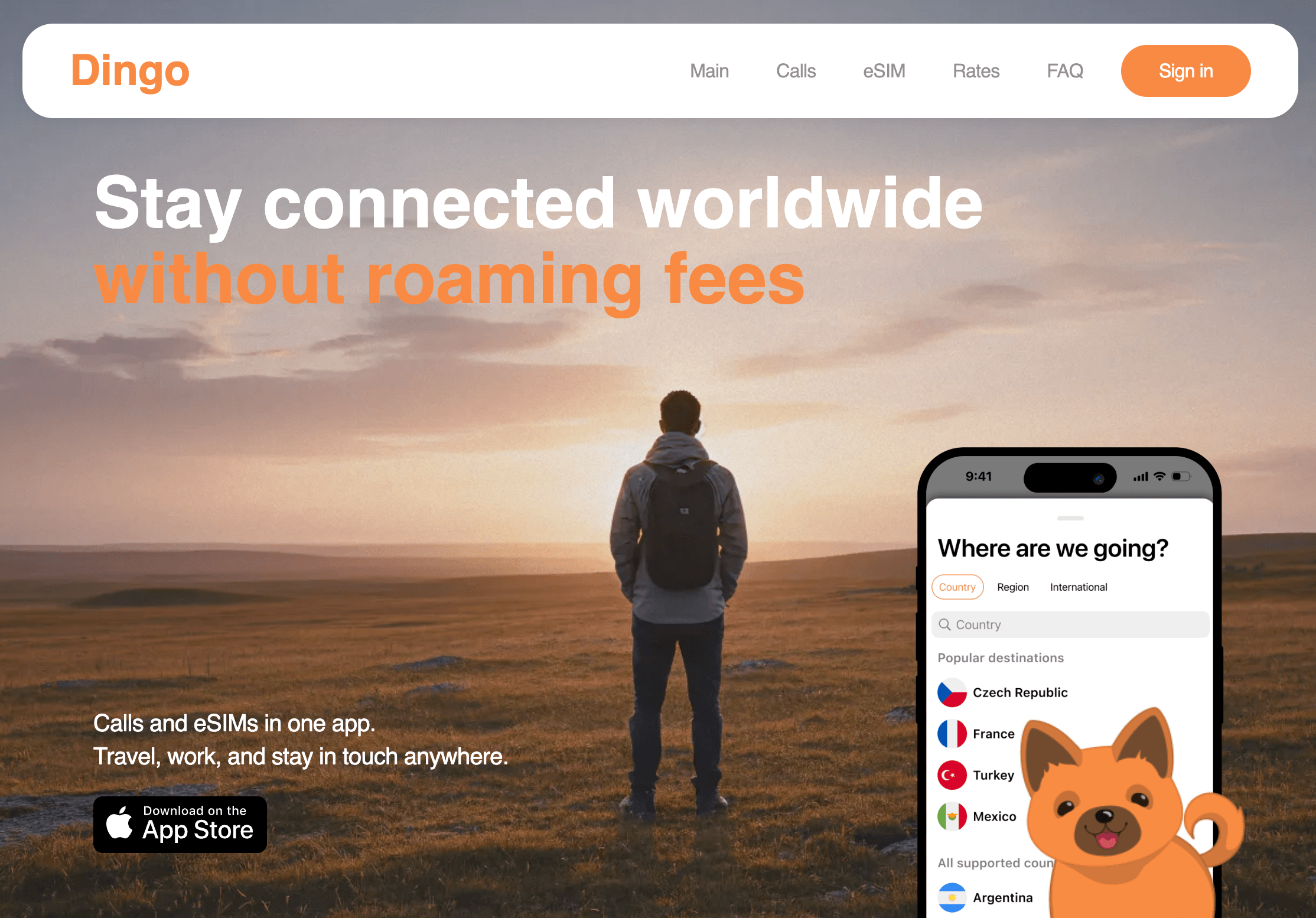
Dingo combines data-only eSIM plans and low-cost international calls in one app, with balances for both visible in a single place.
Key Features and Technology
Dingo’s product is small and focused, which is part of its appeal. Here is how the platform breaks down in practice.
Travel eSIM Plans: Country, Regional and International
Dingo sells data eSIMs in three formats. Country plans cover a single destination, and the site highlights examples such as the Czech Republic, Thailand and Vietnam. Regional plans cover Africa, Asia-Pacific, Europe, Latin America and North America. International plans are designed for multi-region trips. The website describes the network as working in 180 or more countries, the homepage says 190 or more, and the App Store description says more than 200, so the exact country count is not consistently stated. Always check your specific destination in the app before buying.
Because the eSIM is built into your phone, there is no plastic card and no waiting. You install it through the app, activate it with the in-app guide, and your phone connects to a partner network at your destination. Data sessions are billed in rounded 100 kilobyte increments, and the data volume and validity period are fixed when you purchase.
International Calling on Prepaid Credit
The calling side works on prepaid credit funded by card. You choose a destination, see the per-minute rate before you dial, and the app places the call over the internet to any mobile or landline number worldwide. The terms state that every started minute is charged, unsuccessful attempts that never connect are not charged, and a full history of calls with duration, unit price and total cost sits in your account. Text messages to mobile phones are also supported, billed per 160 simple characters, or per 70 characters when special characters are used.
Account, Top-Ups and Controls
Accounts are created with an email address and a verification code. Top-ups are made in the app with a Visa or Mastercard card, and you can enable an optional auto top-up that recharges your balance when a data plan ends. You can see your remaining data and call balance inside the app, view top-up history, and delete your account when you want to leave. Charges are stated inclusive of VAT, with US dollars as the default currency unless the point of sale shows otherwise.
Pricing, Plans, and Package Structure
Dingo has no subscription tiers. You pay for what you buy, in two separate streams: eSIM data bundles and prepaid call credit. The figures below come from Dingo’s own eSIM and calls pages as checked in October 2026. The site publishes entry prices (shown as “from” rates) rather than a full public plan catalogue, so exact bundle sizes, validity periods and final prices appear inside the app or checkout for your chosen destination before you pay.
| Product | Price (USD) | What It Is | Best For |
|---|---|---|---|
| Country eSIM | From $2 per GB | Data-only eSIM for a single destination such as Thailand, Vietnam or the Czech Republic | Short trips to one country |
| Regional eSIM | From $3 per GB | Data-only eSIM covering a region: Africa, Asia-Pacific, Europe, Latin America or North America | Multi-country trips within one region |
| International eSIM | From $4 per GB | Data-only eSIM for global, multi-region travel | Frequent travelers and nomads |
| Calls (popular routes) | From $0.02 to $0.05 per minute | Prepaid calls: Italy from $0.02, France and Canada from $0.03, US and UK from $0.04, Czech Republic from $0.05, India from $0.07 | Calling family and friends abroad |
| Calls (premium routes) | From $0.24 to $0.33 per minute | Higher-cost destinations such as the UAE (from $0.24) and Saudi Arabia (from $0.33) | Occasional calls to costly countries |
| Dingo-to-Dingo calls | Free | Calls between registered Dingo users, over your internet connection | Families and teams who all use the app |
| SMS | Rate shown in app | Text messages to mobile phones, billed per 160 characters (70 with special characters) | Occasional verification and short messages |
How Dingo Compares to Alternatives
The travel eSIM market is crowded, and the best-known names are Airalo and Saily. Both are data-only eSIM specialists, so the comparison below focuses on where Dingo differs. Competitor figures are approximate, based on published 10 GB, 30 day plan snapshots from late summer 2026, and are subject to change.
| Factor | Dingo | Airalo | Saily |
|---|---|---|---|
| Entry data price | From $2 per GB (country plans) | About $3.10 per GB (10 GB plan, approx.) | About $3.60 per GB (10 GB plan, approx.) |
| Built-in calling | Yes, prepaid calls from $0.02 per minute | No, data only | No, data only |
| Local phone number | No (data-only eSIM) | No | No |
| Hotspot | Yes, if device and network allow | Yes | Yes |
| App platform | iOS (App Store listing) | iOS and Android | iOS and Android |
| Independent track record | Young product, very few public ratings | Large, established user base | Established, backed by a major security brand |
| Best for | Travelers who also want cheap calls in one app | Broad plan variety and wide coverage | Data-first travelers who value a big brand |
Dingo vs. Airalo: Airalo has the larger catalogue, the longer track record and apps for both iOS and Android. Dingo’s advantage is the built-in calling product and lower entry prices on its country plans. If you only need data and want the most established option, Airalo is the safer default. If you also make regular international calls, Dingo’s all-in-one approach saves you a second app.
Dingo vs. Saily: Saily is a polished, data-focused eSIM app with strong brand backing, and its plans tend to be priced higher per GB. Dingo undercuts it on entry price and adds calling, but it can’t match Saily’s maturity or review volume. The trade is a lower price and extra features against a thinner track record.
Dingo vs. unlimited eSIMs like Holafly: Unlimited plans from providers such as Holafly cost far more, at roughly $74 for a 30 day plan in recent snapshots, and typically cap hotspot use. Dingo’s pay per GB model suits light and moderate users better, while heavy streamers and tetherers may still prefer an unlimited plan.
Pros and Cons
What Users Love
Everything in one place: Data and calls living in a single app, with real time balances, is the feature that makes Dingo feel different from a plain eSIM reseller. It cuts down on apps, logins and top-up screens.
Low entry prices: Starting prices of $2, $3 and $4 per GB for country, regional and international plans are attractive, and the per-minute call rates to many popular countries are among the lowest you’ll see for app-based calling.
Prepaid control: There are no contracts and no bills for usage you didn’t buy. Prices are shown before checkout, credit stays valid for a year and extends with each top-up, and an optional auto top-up is there if you want it.
Fast, plastic-free setup: Installing an eSIM through a guided in-app flow in about a minute is a real convenience compared with queuing for a SIM card after a long flight.
Transparent legal footing: The terms name the operating company, its Prague address and its Czech Telecommunications Office certificate, and they explain refund, withdrawal and charging rules in plain terms. That is more disclosure than many small travel apps offer.
Free Dingo-to-Dingo calling: If the people you call regularly install the app, those conversations cost nothing beyond data, which is a strong incentive for families and small teams to adopt it together.
Limitations Worth Knowing
Very thin independent reviews: At the time of this review, the App Store listing showed a 5.0 rating from a single rating, and we could not find a Trustpilot profile for dingo.app. There simply isn’t enough public feedback to judge reliability, support quality or refund handling at scale. Treat any perfect rating with caution, and start with a small purchase.
Data-only eSIM, no phone number: The FAQ is explicit that Dingo eSIM is for mobile data only and does not include a number for calls or SMS. If you need to receive normal calls or SMS verification codes on a local number, you’ll need a different solution.
iOS-first availability: The terms describe the app as built for Apple iOS devices, the App Store listing requires iOS 18 or later, and the website only offers an App Store download. We could not confirm an Android app, so Android users should verify before planning around it.
Inconsistent coverage claims: The website says 180 or more countries, the homepage says 190 or more, and the App Store says more than 200. These are self-reported figures, and Dingo states it does not guarantee coverage indoors or in remote areas. Confirm your exact destination in the app.
Strict expiry and refund rules: Unused data is forfeited when the plan expires and is not refunded. If you start using an eSIM within the 14 day withdrawal period, you lose the right to withdraw. Refunds are available if an eSIM cannot be activated, and any remaining call credit can only be refunded to Visa or Mastercard cards.
Calls are not a phone line replacement: The terms say the app does not support emergency calls and blocks premium and special rate numbers. Call quality also depends on your internet connection, which Dingo can’t control. Card payment is limited to Visa and Mastercard, and top-ups ask for name, address and country of tax residence.
Who Should Use Dingo
International travelers on short trips: If you want a quick, cheap data plan for one country and don’t want to hunt for a SIM kiosk, the country plans from about $2 per GB are a good fit.
Expats and families who call abroad: Anyone who phones relatives in another country every week will appreciate the low per-minute rates and free calls to other Dingo users.
Digital nomads and remote workers: International and regional plans, extendable eSIMs and hotspot support make Dingo a useful backup or secondary data source while moving between countries.
Budget conscious backpackers: Prepaid credit and bundles with no contract keep spending predictable, which matters on long, low budget trips.
Business travelers with iPhones: For a short assignment abroad, one app for data and cheap calls back to the office is convenient, as long as you keep your regular number active for verification codes.
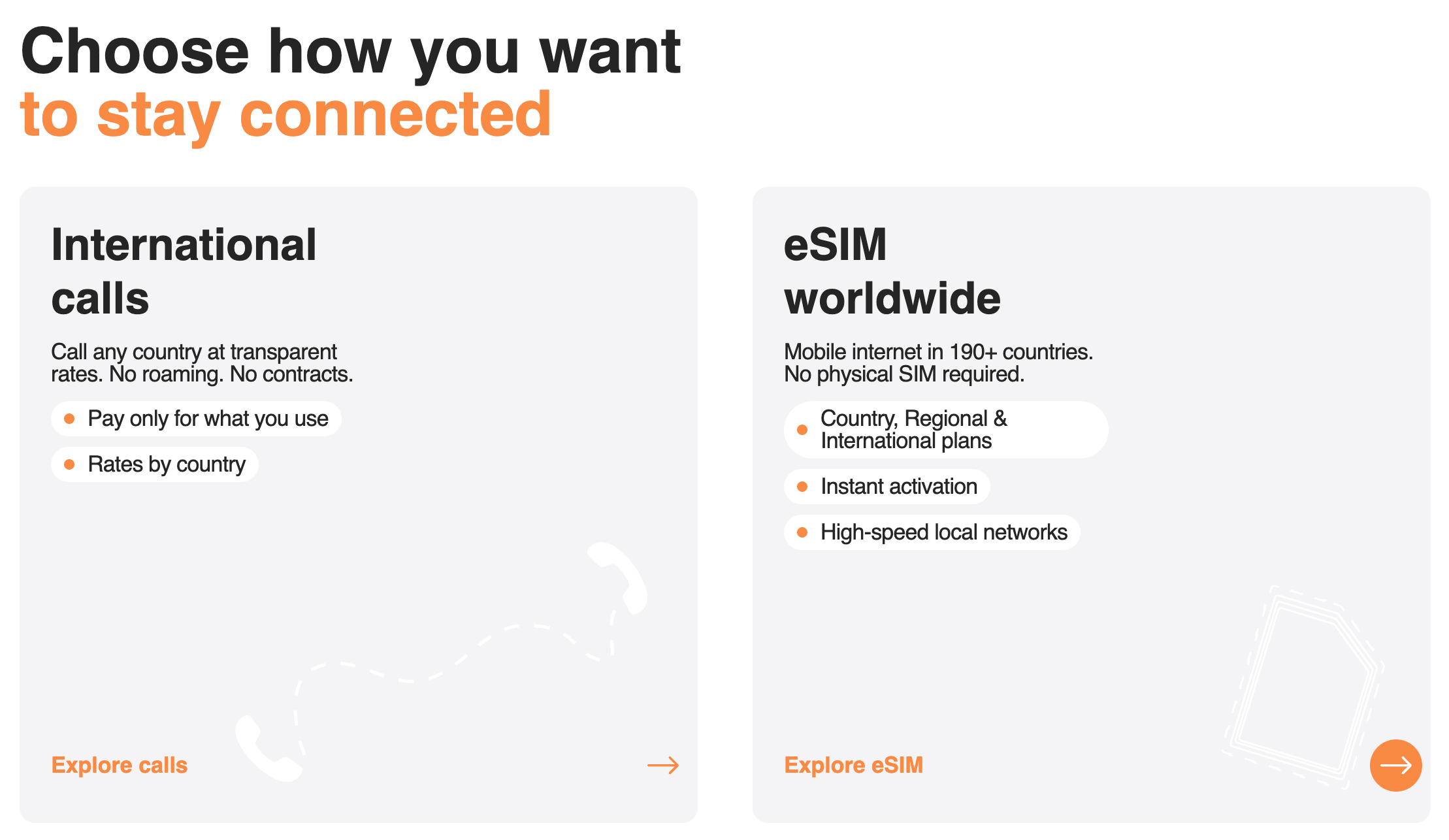
Dingo is built for travelers, nomads and expats who want mobile data and cheap international calling without roaming fees.
Who should look elsewhere: Android-only users who can’t confirm an app, anyone who needs a local number for calls and SMS, heavy streamers who want truly unlimited data, and travelers who prefer a provider with a long public track record and thousands of reviews. If you want maximum reassurance, an established name such as Airalo or Saily may suit you better, at least until Dingo builds a bigger body of independent feedback.
Getting Started: Step by Step
- Check your device. Make sure your iPhone supports eSIM and runs iOS 18 or later, and that it is carrier unlocked so it can accept a travel eSIM.
- Install the app and sign in. Download Dingo from the App Store, enter your email, and type the verification code you receive to create your account.
- Choose your plan. Pick a country, regional or international eSIM, and compare the in-app bundle size, validity and price for your destination before paying.
- Buy and install the eSIM. Pay by Visa or Mastercard and follow the in-app guide to add the eSIM to your phone. Do this on Wi-Fi before you travel.
- Activate on arrival. Switch on the eSIM and enable data roaming for it when you land. If it doesn’t connect, check the APN settings in the installation instructions.
- Top up calls when needed. Add prepaid credit, check the per-minute rate for your destination, and place calls from the app. Remember to keep an eye on plan expiry.
Tips for Getting Maximum Value
Buy and install your eSIM before you leave home, while you still have reliable Wi-Fi, and only switch it on when you land so the validity clock starts when you need it. Compare the in-app price for the exact bundle you need, because the cheapest per-GB rates apply to larger bundles, and choose a regional plan if your route crosses several neighboring countries. Use Wi-Fi calling or Dingo-to-Dingo calls whenever possible to save credit, convince your regular contacts to install the app so calls between you cost nothing, keep your home SIM active for banking codes and incoming calls, and enable auto top-up only if you are comfortable with automatic recharges. Finally, use up any remaining data before the plan expires and don’t leave a balance sitting unused for a year, since inactive eSIM accounts can be invalidated without a refund.
Future Outlook and Final Assessment
Dingo’s direction is promising. The release history shows rapid iteration, the product combines two services that travelers genuinely need, and its pricing is aggressive for a young brand. The main questions are about scale: whether coverage claims hold up consistently across countries, whether customer support copes as the user base grows, and whether an Android app arrives to widen the audience. The sparse public review record means those questions can’t be answered from outside yet.
In the meantime, the sensible approach is to treat Dingo as a promising, low cost option to test with a small purchase rather than a mission critical tool for a long, high stakes trip. If it works for your route and your phone, the savings and convenience are real. If it doesn’t, the prepaid structure limits your downside, and you can always fall back on an established provider.
Conclusion
Dingo is a young but well-structured travel connectivity app that brings data eSIMs and low-cost international calling together under one roof, with entry prices from $2 per GB and calls from $0.02 per minute on popular routes. It’s honest about its limits in its own terms, transparent about its operating company and simple to start using, but it lacks the independent reviews and platform breadth of larger rivals. For iPhone users who travel often and call abroad, it is well worth a small trial, and we’d recommend checking the latest prices on the official site before you buy.
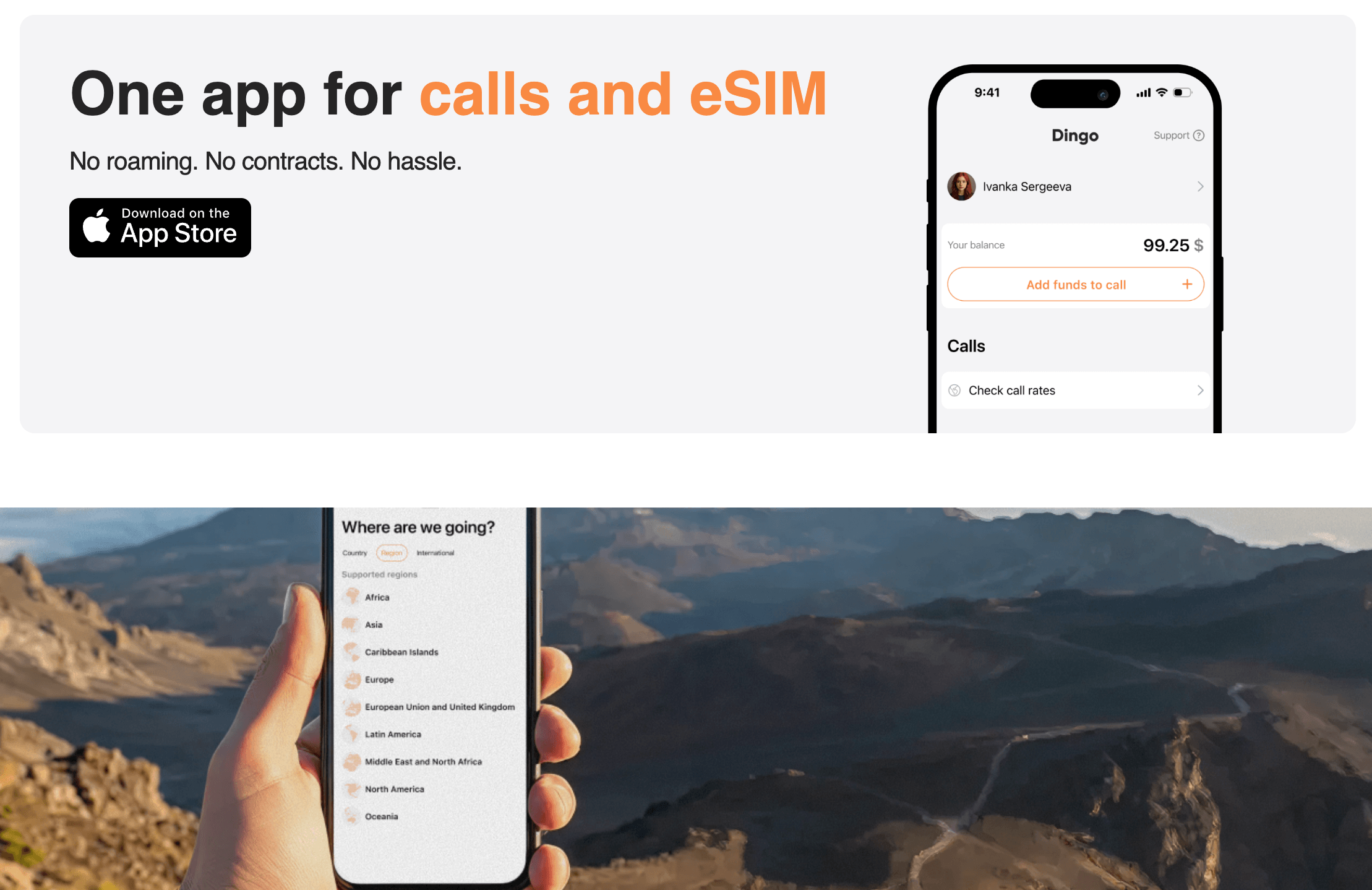
Dingo’s pitch is simple: calls and eSIM in one app, with no roaming fees and no contracts.
Ready to stay connected abroad without paying roaming fees?
Explore more honest reviews, tutorials and tech comparisons to find the right gear for the way you work, travel and live, at World Of Tech, where we make everything easy.
👉 Try Dingo: https://worldoftech.space/dingo
👉 Our YouTube Channel: youtube.com/@world_tech79
👉 Our Facebook Fanpage: Facebook
👉 Our X (Twitter): @worldoftech79
Pricing, specifications and policy details in this review were verified against dingo.app (including its eSIM, calls and terms pages), the App Store listing and independent review sources as of October 2026. Travel eSIM and calling pricing and features change frequently, so confirm current details on the official site before purchasing. Competitor prices are approximate and subject to change.