
If your business answers the same customer questions over and over, you already know how much time it quietly drains: the “where’s my order,” the “how do I reset my password,” the “do you ship to my country.” Chatbase was built to hand that entire category of work to an AI agent trained on your own content. You feed it your website, help docs, PDFs and FAQs; it builds a ChatGPT-style agent that answers customer questions in your words, captures leads, books meetings, and even performs real tasks like checking an order or processing a refund — all with no code and, often, in about fifteen minutes. It’s now used by more than 10,000 businesses worldwide, from small startups to names like IHG, Miele and National Grid, and it stands apart from most rivals with an unusually wide choice of 35+ AI models from seven providers rather than locking you into one.
But Chatbase isn’t magic, and a fair look reveals real trade-offs. Its credit-based pricing is easy to misread and gets expensive as you scale, the free and entry tiers are deliberately small, there’s no visual flow builder for scripted conversations, and its customer-support reputation is genuinely mixed. This 2026 review walks through everything that matters before you commit — what Chatbase actually is, the model flexibility that sets it apart, the full feature set including the new Voice agents, the real pricing and credit math, head-to-head comparisons against Intercom’s Fin and Botpress, the honest pros and cons drawn from hundreds of user reviews, and exactly who should (and shouldn’t) build on it.
Chatbase Review 2026: The No-Code AI Agent That Turns Your Content Into 24/7 Customer Support
Overview and Background
Chatbase is a no-code AI agent platform for customer support. The core idea is simple but powerful: instead of building traditional chatbot flows by hand, you train an AI agent on your own business data and let it hold real conversations. You provide the raw material — website URLs, PDFs, documents, Q&A pairs or Notion pages — and Chatbase turns it into a conversational agent that answers customer questions accurately, captures leads, and can take actions inside your systems. Think of it as building your own “ChatGPT for your business,” deployable across your website, WhatsApp, Slack, Messenger, Instagram and email without writing a line of code.
The company was founded on February 4, 2023 by Yasser Elsaid, a York University computer science graduate who had interned at Meta, Tesla and BlackBerry. Chatbase was one of the very first “chat with your data” products to reach the market. It launched to just 16 Twitter followers, went viral almost immediately, and grew fast: it reportedly reached $1 million in annual recurring revenue within five months, and has since scaled to serve more than 10,000 businesses across 80+ countries — including IHG, Miele, National Grid and Noon — generating an estimated $5–8M in ARR. Remarkably, all of this has been achieved bootstrapped, with no external venture funding.
What separates Chatbase from the flood of AI chatbot builders is its position as an agent platform rather than a simple FAQ widget. It is SOC 2 Type II certified and GDPR compliant, connects to CRMs and helpdesks like Zendesk, Salesforce, HubSpot and Shopify, and in 2026 it expanded from text-only chat into voice, adding a Voice AI agent that answers inbound phone calls on the same knowledge base. It ships with genuine enterprise-grade security, an active weekly release cadence, and a promise that your data is never used to train underlying AI models.
Why Chatbase Stands Out in 2026
Unmatched AI model flexibility: This is Chatbase’s defining advantage. While most chatbot builders lock you into a single provider, Chatbase offers 35+ models from seven providers — including OpenAI’s GPT-5.2, Anthropic’s Claude Opus 4.6, Google’s Gemini 3 Pro, xAI’s Grok 4, Moonshot AI’s Kimi K2, plus DeepSeek, Meta and Mistral models. You can test different models against your own content and pick the one that answers best, or balance quality against cost. No direct rival offers this breadth.
Genuinely fast, no-code setup: The most consistent praise across every review site is how quickly you get live. Paste your website URL, let it crawl, upload a few documents, and you can have a working agent answering questions in roughly fifteen minutes — with no technical skills required. For small teams without engineering resources, that time-to-value is the whole appeal.
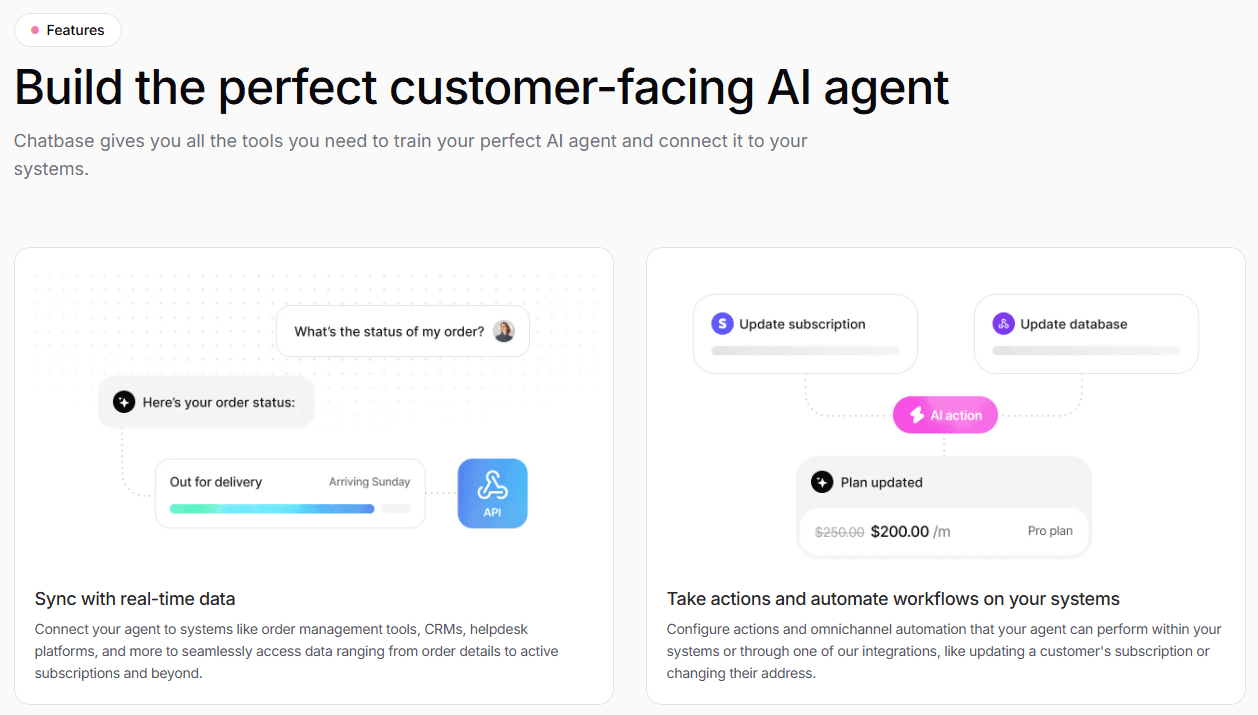
AI Actions turn it into more than Q&A: Chatbase goes beyond answering questions. Through AI Actions, an agent can book appointments via Calendly, look up billing in Stripe, check order status in Shopify, create a Zendesk ticket, send a Slack alert, update a subscription or capture a lead — real task automation triggered inside a conversation, not just a static help article.
One agent across every channel: The same trained agent deploys to your website widget, WhatsApp, Facebook Messenger, Instagram, Slack, email and Shopify. For businesses serving international or messaging-first audiences — WhatsApp-heavy markets especially — that unified reach from a single configuration is a major operational win.
Now voice, not just chat: In May 2026 Chatbase launched Chatbase Voice, extending the platform from the browser to the phone line. A voice agent answers inbound calls instantly through a Twilio integration, holds a real-time conversation in 95+ languages, and inherits the same knowledge base, actions and escalation logic as the chat agent — one playbook instead of two.
A real “Improve Answer” feedback loop: A standout practical feature lets you review past conversations, spot where the agent went wrong, and edit or suggest a better answer directly in the dashboard. Combined with auto-retraining and confidence scoring, it means the agent measurably gets sharper over time as you correct it — rather than staying frozen at launch quality.
Enterprise-grade security at mid-tier pricing: Chatbase is SOC 2 Type II certified and GDPR compliant, with AES-256 encryption, SSO (added January 2026), domain allowlisting, rate limiting, role-based access controls and AI guardrails that refuse off-topic or unauthorized requests — and it doesn’t use your data to train models. Getting that compliance posture without an enterprise-only contract is unusual in this category.
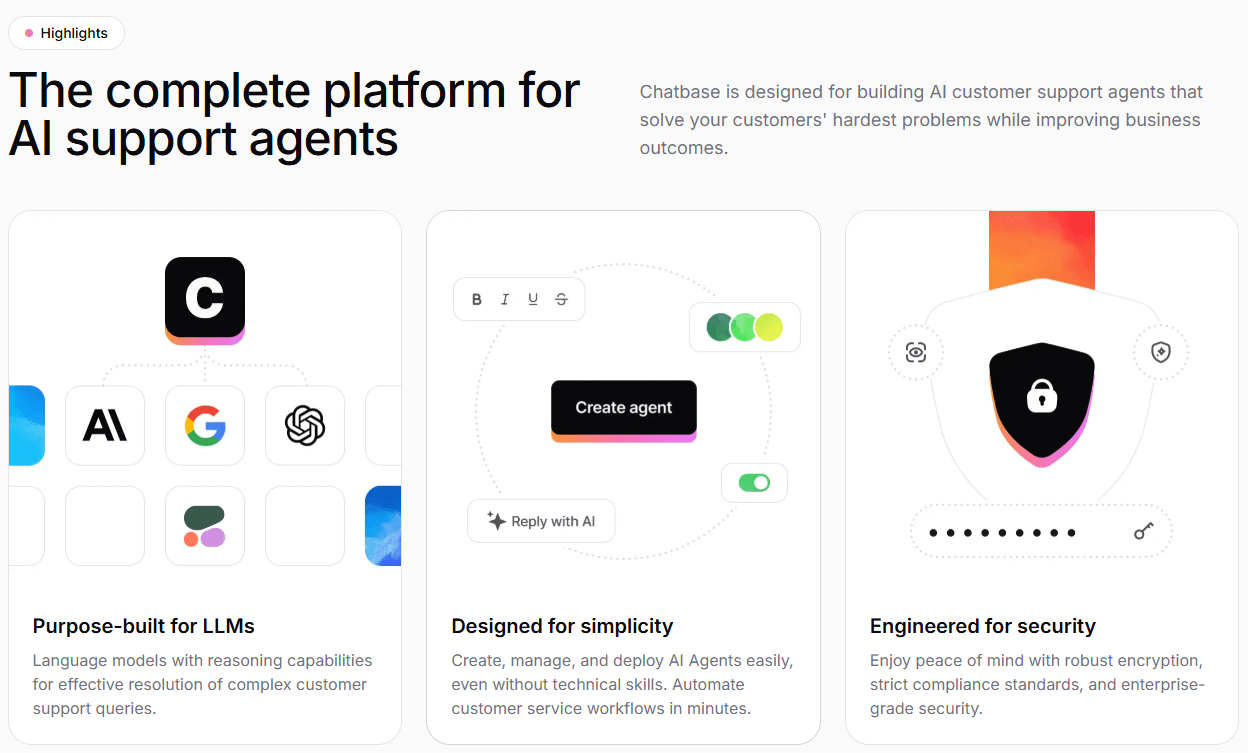
Chatbase trains an AI agent on your website, docs and FAQs, then deploys it across chat, voice, WhatsApp and email — with a choice of 35+ AI models most rivals can’t match.
Key Features and Technology
Chatbase packs a lot into a deliberately simple interface. Here’s how the platform actually breaks down into its core pillars.
Multi-Model AI Engine (35+ Models, 7 Providers)
The heart of Chatbase is its model roster. You can power an agent with advanced OpenAI, Anthropic, Gemini, DeepSeek, Meta, Moonshot AI or Mistral models and switch between them per agent. The catch, and it’s an important one, is that model choice directly affects your credit consumption (more on this in Pricing). Economy models cost 1 credit per response, while premium models like Claude Opus can cost 5 credits each — so the “best” model is a balance of answer quality and budget. A multi-model architecture also underpins Voice, routing each part of a spoken query to the model best suited for it.
Train on Your Own Data — Six Source Types
You build an agent’s knowledge by feeding it your content: crawl a full website by URL, upload PDFs, DOC/DOCX, TXT or CSV files, paste plain text, add manual Q&A pairs, or connect a Notion workspace. Newer additions let you ingest Zendesk and Salesforce support tickets as training data too. There’s a platform ceiling of roughly 33 million characters per agent, but in practice the MB-based storage limit of your plan is the real constraint — training content caps range from 400 KB on Free to 40 MB on Pro, so very large documentation sets can hit limits.
AI Actions, Integrations and Human Handoff
AI Actions are what move Chatbase from “answer engine” toward “agent.” They let the bot execute operations — schedule via Calendly, pull invoices from Stripe, track orders in Shopify, create helpdesk tickets, notify Slack, capture lead details or update account information. Native integrations span Zendesk, Salesforce, Intercom, HubSpot, Zoho Desk, Freshdesk, Help Scout, Gorgias, Stripe, Shopify, Twilio, Slack, WhatsApp, Messenger, Instagram, Calendly, WordPress and Zapier, plus a REST API for custom builds. When the agent can’t resolve something, it can escalate to a live human agent via live chat — a capability that has matured meaningfully over the past year. The number of Actions available per agent scales with your plan (5 on Hobby up to 12 on Pro).
Omnichannel Deployment and Voice
A single agent configuration deploys everywhere: an embeddable website widget, WhatsApp, Messenger, Instagram, Slack, email and a Shopify app (in the Shopify App Store since January 2026). Chatbase Voice, launched in May 2026, adds inbound phone support through Twilio — calls are answered with no wait time, the agent is tuned for spoken conversation rather than reading a screen, and it can perform the same actions mid-call (pulling a Stripe invoice, checking a Shopify order, or handing off to a live agent). Voice runs in 95+ languages, and chat responds in 80+ languages with automatic language detection; the chat UI itself is localized in 40+ languages including right-to-left support for Arabic and Hebrew.
Analytics, “Improve Answer” and Security
Chatbase provides conversation-level analytics with satisfaction ratings, topic clustering, missed-question detection and per-response confidence scoring, and the Pro plan adds source suggestions that flag gaps in your knowledge base. The Improve Answer feature closes the loop, letting you correct responses and retrain. On security, the platform layers SOC 2 Type II, GDPR compliance, AES-256 encryption, SSO, domain allowlisting, rate limiting and role-based access controls, with AI guardrails designed to prevent misinformation and off-topic replies — and, importantly, your data is not used to train any AI model.
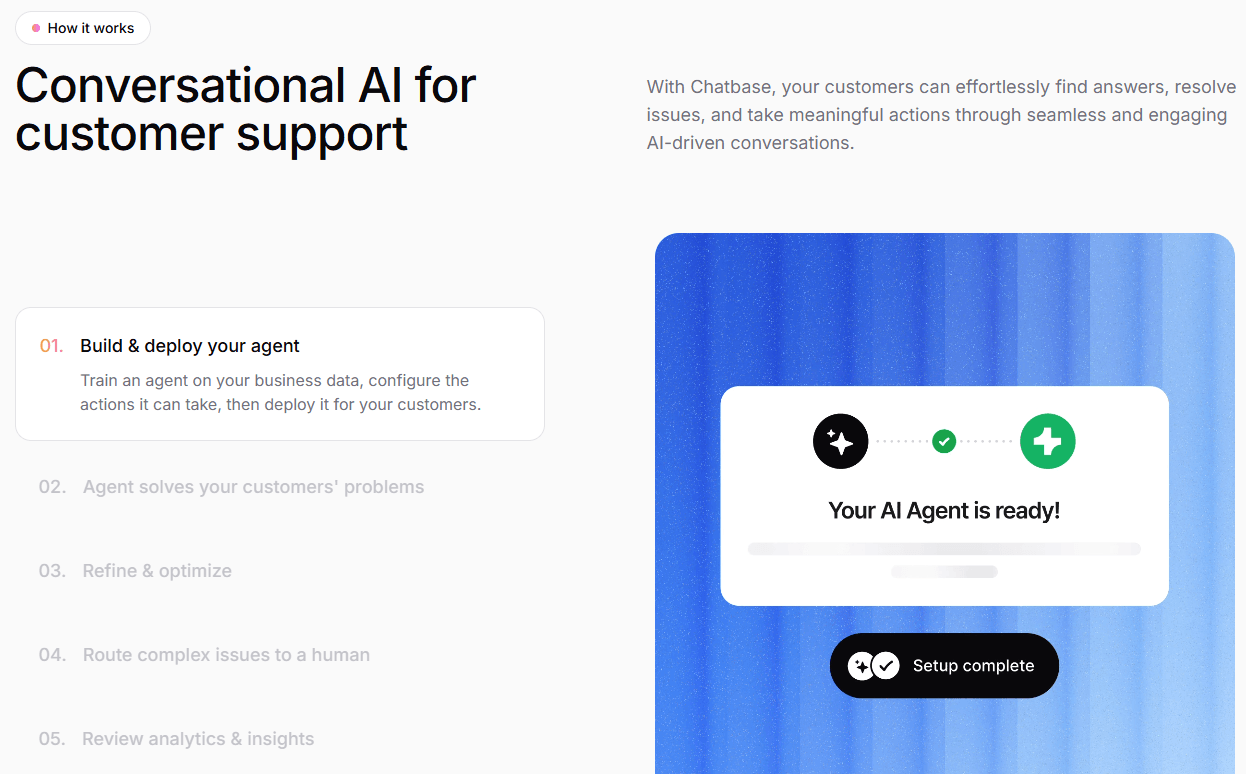
AI Actions move Chatbase beyond simple Q&A — an agent can book meetings, pull invoices, track orders and create tickets right inside a conversation.
Pricing, Plans, and Package Structure
Chatbase uses a tiered subscription with a message-credit model layered on top. There are four public plans plus a custom Enterprise tier, and every AI response consumes credits from your monthly allowance. Annual billing saves roughly 20% (about two months free). The headline prices are simple; the credit math and add-ons are where the real cost lives, so the figures below should be treated as a starting point — always confirm the live numbers on the official pricing page, as this platform updates its plans frequently.
| Plan | Price (USD) | What You Get | Best For |
|---|---|---|---|
| Free | $0 | 50 credits/mo, 1 agent, 400 KB training, limited models (agents deleted after 14 days idle) | Testing and quick proof-of-concept |
| Hobby | $40/mo ($32 annual) | 500 credits, advanced models, 5 AI Actions, 10 MB training, 2 seats, API access, basic analytics | Solo founders and small FAQ bots |
| Standard | $150/mo ($120 annual) | 4,000 credits, 2 agents, 3 seats, 8 AI Actions, voice/telephony, outbound campaigns, auto-retrain | Growing production support |
| Pro | $500/mo ($400 annual) | 15,000 credits, 3 agents, 5+ seats, 40 MB training, 12 AI Actions, source suggestions, priority support | Higher-volume mid-market teams |
| Enterprise | Custom | SSO, custom domain, SLAs, dedicated success manager, branding removal included, higher limits | Large orgs and agencies |
| Remove branding (add-on) | ~$39–99/mo (approx.) | Removes the “Powered by Chatbase” badge (varies by tier) | Client-facing / white-label needs |
| Extra credits (auto-recharge) | ~$40 per 1,000 (approx.) | Non-expiring top-up when credits run out | Erratic or spiky traffic |
| Extra AI agents | ~$7/agent/mo (approx.) | Additional specialized agents beyond your plan’s cap | Multi-department deployments |
How Chatbase Compares to Alternatives
| Factor | Chatbase | Intercom (Fin) | Botpress |
|---|---|---|---|
| Core approach | No-code, train-on-your-data AI agent | AI agent + full helpdesk suite | Developer flow-builder + AI |
| AI model choice | 35+ models, 7 providers | Single proprietary agent (Fin) | Multiple LLMs / bring-your-own |
| Pricing model | Subscription + message credits | Per-outcome (~$0.99/resolution) + seats | Usage-based (AI credits), no per-seat |
| Entry price (approx.) | $0 free / from $40/mo | ~$29/seat + $0.99/resolution | Free tier + pay-as-you-go usage |
| Setup effort | ~15 min, no code | Under an hour, more configuration | Longer, more technical |
| Flow control | LLM-driven, no visual builder | Workflows builder on higher plans | Full visual builder + custom code |
| Best for | Fast SMB AI support layer | All-in-one helpdesk at scale | Technical teams needing deep logic |
vs. Intercom (Fin): Intercom — which renamed its corporate entity to Fin in 2026 and is in the process of being acquired by Salesforce — is the enterprise incumbent. Its Fin AI Agent uses outcome-based pricing at roughly $0.99 per resolution and comes bundled with a full helpdesk (shared inbox, ticketing, 450+ integrations). It’s a more complete customer-service platform, but it runs on a single proprietary model, costs scale directly with resolution volume, and it’s heavier to adopt. Chatbase counters with model flexibility, a genuine free tier, faster setup and lower entry pricing — at the cost of Intercom’s depth and unified inbox.
vs. Botpress: Botpress is the developer’s choice. It offers a full visual flow builder, custom logic, persistent memory and usage-based pricing with no per-seat cost, making it powerful for complex, multi-step automation where you want granular control. The trade-off is that it demands more technical ownership and a longer build. Chatbase is the opposite philosophy: minimal setup, LLM-driven answers, no flow diagramming. If you have engineers and need deterministic journeys, Botpress wins; if you want a smart agent live this afternoon, Chatbase does.
vs. Tidio, CustomGPT and the flat-rate crowd: Tidio (with its Lyro AI) suits live-chat-led e-commerce teams; CustomGPT offers a similar “train on your data” approach; and tools like Crisp or FastBots compete on flat, predictable pricing. Chatbase’s differentiators against all of them are its model breadth and its balance of no-code speed with real AI Actions. If your priority is a perfectly forecastable monthly bill, a flat-rate competitor may fit better; if it’s flexibility and rapid deployment, Chatbase is hard to beat.
Pros and Cons
What Users Love
Effortless setup and a friendly interface: The most repeated praise across Capterra and G2 is how fast and painless it is to get a working bot. Reviewers with no AI background describe pasting a website link, watching it scan the whole site, and having a natural, ChatGPT-style agent answering questions within minutes — perfect for small teams and agencies.
Model flexibility no rival matches: Being able to choose from 35+ models across seven providers, and test which one answers your content best, is a genuine and frequently cited advantage. Users like not being locked into a single AI vendor and being able to trade cost against quality themselves.
Training on your own data just works: The web scraper and multi-format uploads earn strong marks. One reviewer scraped roughly 60 articles about their business and turned the bot into an effective sales associate; others praise its ability to summarize large document sets and surface the right information quickly.
The analytics and Improve Answer loop: Teams value the analytics dashboard for spotting trends, top queries and conversation gaps, and use the Improve Answer feature to correct responses so the agent gets more accurate over time. It’s a practical, hands-on way to raise quality week over week.
Broad integrations and real automation: The multi-channel reach (WhatsApp praised repeatedly for international audiences), Zapier and API connectivity, and AI Actions that book, look up and route are recurring favorites — the bot does more than answer, it does tasks.
Strong value at the entry level: For validating an AI-support idea, reviewers consider the free plan and Hobby tier a low-risk way in, and many report deflecting a large share of routine questions automatically — a clear efficiency win for the price when volumes are modest.
Limitations Worth Knowing
Credit pricing is complex and scales expensively: This is the number-one gripe. The message-credit system makes cost prediction hard because consumption varies by model, and heavy usage — especially on premium models — burns through allowances fast. Several users feel the price is steep for the credits included, and effective costs balloon once add-ons are factored in.
Add-on fees add up: Removing the “Powered by Chatbase” badge is a separate paid add-on that frustrates many buyers, and extra credits, extra agents and (on some tiers) custom domains stack on top. The gap between the advertised price and a real, brandless production deployment can be significant.
No visual flow builder: Everything is LLM-driven, so there’s no click-to-build designer for scripted, deterministic conversation paths. For teams that need tightly controlled journeys — regulated flows, precise branching — this is a real limitation, and one where Botpress or Voiceflow pull ahead.
Occasional hallucinations: A recurring theme in reviews is the bot confidently generating answers — or even fabricated URLs on your own domain — that aren’t in the training data. It’s manageable with a clean knowledge base and the Improve Answer tool, but it means you can’t fully “set and forget” a customer-facing agent.
Mixed customer-support reputation: The ratings split tells the story: Chatbase scores well on G2 and Capterra (around 4.3–4.5/5) for usability, but holds just 2.1/5 on Trustpilot, where complaints cluster around slow or unresponsive support, billing problems, and denied refunds. Satisfied users tend to review on software sites while frustrated ones head to Trustpilot — but the support and billing criticism is consistent enough to take seriously.
Data limits and thin customization: Training-content caps (from 400 KB up to 40 MB) can be tight for large documentation libraries, and reviewers note limited widget customization — including complaints about not being able to change the widget’s background color, and responses that can run long on mobile. Free-plan agents are also deleted after 14 days of inactivity, so it’s a sandbox, not a durable free tier.
Who Should Use Chatbase
Small and mid-sized businesses wanting fast AI support: This is Chatbase’s sweet spot. If your answers already live in help docs, product pages and FAQs, and you want a smart self-serve layer live quickly without hiring engineers, Chatbase delivers real value at accessible pricing. It shines at deflecting repeat questions like pricing, setup, account access and policy checks.
Marketing and sales teams focused on lead capture: Beyond support, the agent can qualify leads, capture contact details and book meetings, letting a human team step in only when a prospect is genuinely ready. Teams report faster response times and less time lost to top-of-funnel qualification.
Companies on Zendesk, Salesforce or Shopify: If you already run one of these systems, Chatbase works well as an AI front-end that answers first, takes actions, and escalates cleanly — adding intelligence without ripping out your existing stack.
International and messaging-first businesses: With responses in 80+ languages, chat UI localized in 40+ (including RTL), and strong WhatsApp, Messenger and Instagram deployment, Chatbase is a natural fit for teams serving global or messaging-heavy audiences. The new Voice agent extends that to inbound phone support in 95+ languages.
Who should look elsewhere: If you need a visual flow builder for deterministic, scripted journeys, have a very large knowledge base that will exceed content limits, require rock-solid predictable flat-rate billing, or run a support operation that leans heavily on live human agents, Chatbase’s LLM-driven, credit-metered model may frustrate you. In those cases, Botpress or Voiceflow (control and custom logic), Intercom’s Fin (outcome pricing and a full helpdesk), or flat-rate tools like Crisp, Tidio or FastBots are likely the better fit — and anyone deploying a high-stakes, customer-facing agent should go in clear-eyed about hallucination risk and the credit economics.
One trained agent, many channels: Chatbase deploys the same knowledge base to website chat, WhatsApp, Slack, email and — as of 2026 — inbound phone calls.
Getting Started: Step by Step
- Sign up and create your first agent. Start on the free plan — no credit card required. Create a new AI agent and give it a clear purpose (support, sales, internal knowledge base). You can spin up one agent and refine from there.
- Add your data sources. Point it at your website URL to crawl your pages, then upload PDFs, DOC/DOCX, TXT or CSV files, paste plain text, add manual Q&A pairs, or connect Notion. The cleaner and less contradictory your sources, the better the answers — prune outdated content before you train.
- Pick your AI model. Choose from the 35+ available models and test a few against real questions. Remember the credit trade-off: economy models cost 1 credit per response, premium models up to 5. Match the model to your quality needs and your budget.
- Configure actions, personality and escalation. Set the agent’s tone and custom instructions, connect AI Actions (Calendly, Stripe, Shopify, lead capture, ticket creation), and define when it should hand off to a human. Set how often it auto-retrains as your content changes.
- Test and improve. Run realistic questions through it, then use the Improve Answer feature to correct anything wrong and retrain. A short round of testing and correction meaningfully lifts real-world accuracy and reduces hallucinations before customers ever see it.
- Deploy across channels and monitor. Embed the widget on your site (or install the Shopify/WordPress integration), connect WhatsApp, Messenger, Slack or email, and go live. Then watch the analytics dashboard weekly for missed questions and gaps, and keep refining.
Tips for Getting Maximum Value
Treat model choice as a budgeting decision, not just a quality one — for high-volume, straightforward support, an economy model at 1 credit per response stretches your plan far further than a premium model at 5, and you can reserve the pricier models for a specialized agent that handles complex queries. Keep your knowledge base clean and curated; contradictory or stale content is the main driver of wrong answers, so prune ruthlessly and lean on the Improve Answer tool to fix mistakes as they surface. Review the analytics dashboard weekly to catch missed questions and add the gaps to your training data. Set a sensible human-escalation threshold so sensitive, high-stakes or genuinely complex issues reach a person rather than getting a confident-but-wrong AI reply. Crucially, calculate your true effective cost before committing — plan price plus branding removal plus likely credit overages — and pay annually to capture the roughly 20% discount. And start small: validate on Free or Hobby, prove the deflection rate, then upgrade to Standard for real production use once the value is clear.
Future Outlook and Final Assessment
The AI customer-support market in 2026 is consolidating around agentic platforms, and Chatbase is a clear early mover. The May 2026 launch of Chatbase Voice — unifying chat, voice, email and messaging on one agent configuration — signals where the whole category is heading: away from single-channel bots and toward one AI agent that meets customers wherever they reach out. Combined with an active weekly release cadence (SSO, voice input, agent duplication, 40+ language UI, Zendesk and Salesforce ticket ingestion), Chatbase is evolving quickly and betting on the agentic approach becoming the default for support.
The honest caveats remain. The credit-based pricing is genuinely hard to forecast and gets expensive at scale, the add-on fees frustrate buyers, there’s no visual flow builder, hallucinations require active management, and the customer-support and billing reputation — reflected in that 2.1/5 Trustpilot score against strong G2 and Capterra ratings — is the platform’s weakest point. Competition is intensifying from Intercom’s Fin, Botpress, Tidio’s Lyro and others. But within its lane, Chatbase remains one of the fastest, most flexible ways to stand up a capable AI support agent in 2026 — and its model breadth is still a real edge.
Conclusion
Chatbase isn’t trying to be the deepest, most customizable support platform on the market — it’s trying to get a capable AI agent trained on your content and answering customers as fast as possible, and at that job it’s genuinely excellent. By combining no-code training, an unmatched choice of 35+ AI models, real task-performing Actions, omnichannel deployment and now voice, it removes most of the friction between “we have documentation” and “our customers get instant, accurate answers.” It rewards a clean knowledge base, sensible model choices and a little ongoing coaching, and it’s not the right call for teams needing deterministic flows, very large content libraries or perfectly predictable flat billing. But for the fast-moving reality of small and mid-sized support and sales teams, few tools deliver more, more quickly. Confirm the current pricing and run the credit math for your own volume, and Chatbase can take the most repetitive part of customer support off your plate and make it genuinely easy.
Ready to turn your content into a 24/7 AI support agent?
Explore more honest reviews, tutorials and tech comparisons to find the right gear for the way you work, build and grow — at World Of Tech, where we make everything easy.
👉 Try Chatbase: https://worldoftech.space/chatbase
👉 Our YouTube Channel: youtube.com/@world_tech79
👉 Our Facebook Fanpage: Facebook
👉 Our X (Twitter): @worldoftech79
Pricing, specifications and feature details in this review were verified against chatbase.co and independent review sources (including G2, Capterra and Trustpilot) as of July 2026. AI software pricing, credit allowances and features change frequently, so confirm current details on the official site before purchasing. Competitor prices are approximate and subject to change.