
Web scraping has quietly become the backbone of modern price intelligence, AI training pipelines, and social media management — but the moment a project scales past a handful of requests, most teams run straight into IP bans, CAPTCHAs, and unreliable proxy pools. Novada positions itself as an all-in-one answer to that problem: a residential proxy network spanning 195+ countries bundled with scraper APIs, a web unblocker, and ready-made datasets, all sitting behind a single credit balance.
In this review we dig into what Novada actually offers, how its pricing stacks up against established players like Bright Data and Oxylabs, what real users on Trustpilot say about the day-to-day experience, and who is likely to get the most value from the platform in 2026. We pulled figures directly from Novada’s public pricing pages, cross-referenced them against independent pricing trackers for its main competitors, and read through the available Trustpilot review history — including both the praise and the complaints — rather than relying solely on the company’s own marketing copy.
Novada Review 2026: Is This Proxy and Web Scraping Platform Worth It?
Overview
Novada is a data collection platform built by Novada Labs GmbH that combines two product families under one dashboard: a proxy network (residential, mobile, rotating and static ISP, and datacenter IPs) and a scraping toolkit (Scraper API, SERP API, Browser API, Web Unblocker, and a video data API). The company also sells pre-collected datasets for AI training and RAG pipelines, and offers a free Novada MCP connector so AI agents can pull live web data through the same infrastructure.
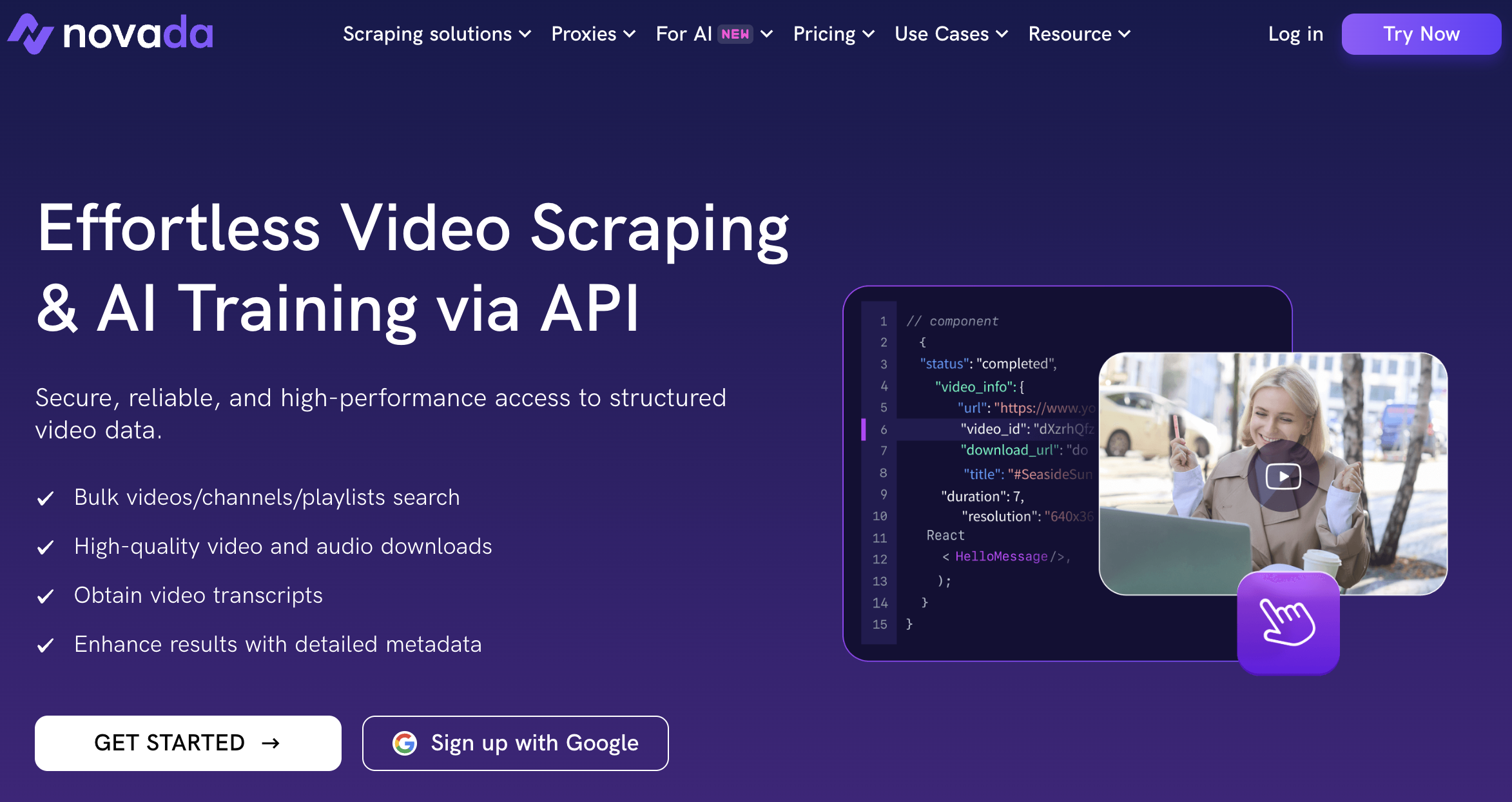
The homepage leads with a $10-for-10GB new-user offer on residential proxies, and the sign-up flow supports Google authentication with no credit card required. Novada also runs dedicated scraper endpoints for Google, Amazon, ChatGPT, Perplexity, Walmart, TikTok, LinkedIn, Instagram, YouTube, Bing, and Shein, rather than requiring the customer to build parsing logic from a raw proxy connection.
The pitch is consolidation: instead of juggling a proxy vendor, a CAPTCHA-solving service, and a separate dataset provider, Novada wants to be the single credit balance that covers all three. The company states its network covers 195+ countries with 100M+ residential IPs, and claims it is chosen by 8,000+ enterprises globally, though that figure is self-reported and we could not independently verify it against a third-party source.
Independent trust signals: Novada holds a 4.4–4.6 out of 5 TrustScore on Trustpilot, but that figure is built on a small sample — around 14–15 reviews as of this writing, compared to the hundreds or thousands major competitors have accumulated. Within that small sample, feedback is genuinely mixed: several reviewers praised speed, stability, and support (one specifically named a helpful support agent), while at least two reviews flagged real friction — one reporting that advertised city- and ASN-level targeting only delivered random country-level IPs, and another reporting slow proxy speed and support delays that were later resolved after the customer escalated publicly.
Compliance and Trust & Safety
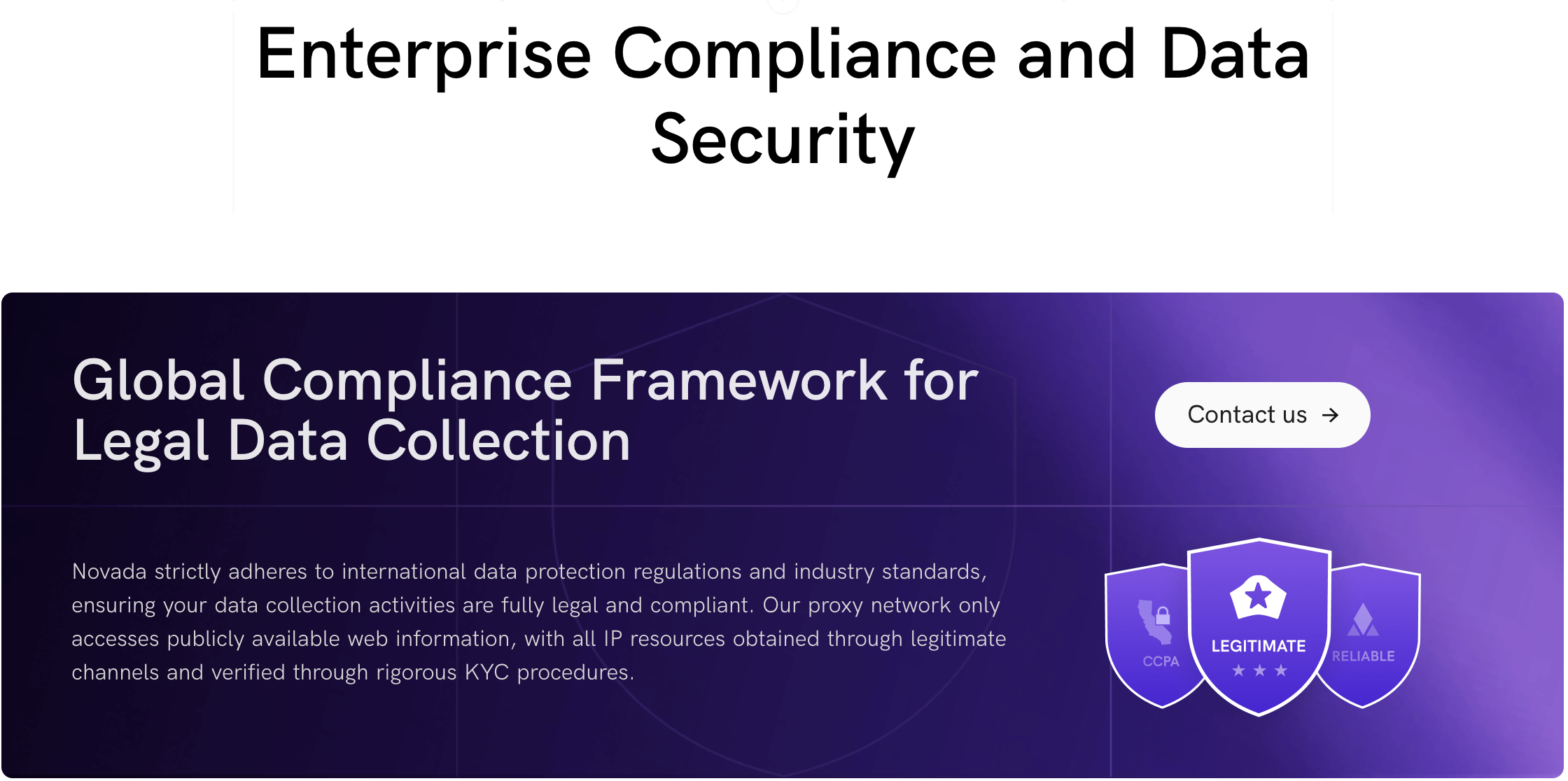
Novada publishes a dedicated Trust & Safety page alongside standard legal documentation — a Privacy Policy, Terms of Service, Acceptable Use Policy, Data Processing Addendum, Service Level Agreement, and Refund Policy. The company states its residential IP resources are sourced through what it describes as rigorous KYC procedures with user consent, and frames its data collection scope as limited to publicly available web information. For regulated industries, it’s still worth requesting the underlying DPA and SLA directly rather than relying on marketing copy alone.
 Novada’s dashboard brings proxies, scraper tools, and datasets under one shared credit balance.
Why Novada Stands Out
Genuinely competitive entry pricing. Novada advertises residential proxies from $0.85/GB, with a new-user promo of $10 for 10GB. That undercuts the pay-as-you-go rate of most large incumbents by a wide margin — Bright Data and Oxylabs both list residential pay-as-you-go pricing around $8/GB before any commitment discount.
One credit balance across every tool. Rather than maintaining separate accounts and separate minimum spends for proxies, a scraper API, and a browser automation tool, Novada pools usage into a single balance. For teams that mix proxy traffic with occasional scraper-API calls, this removes a real operational headache.
Built-in AI/agent tooling. The free Novada MCP integration lets AI agents query live web data (search results, e-commerce pages, structured datasets) through the Model Context Protocol without custom scraping code — a feature most legacy proxy vendors have not shipped yet.
Broad session flexibility. Session lengths run from 1 to 120 minutes, letting the same pool serve both short, stealthy scraping bursts and longer account-management workflows that need a sticky IP — Novada frames this as “dual session mode.”
No credit card required to start. The sign-up flow (including Google sign-up) does not gate the trial behind a card, which lowers the barrier for developers who just want to test success rates against their specific target sites first.
Responsive to negative feedback. Public Trustpilot replies from the Novada team show the company actively responding to complaints — including a slow-speed complaint that was resolved and updated by the original reviewer.
Compliance framing. Novada publishes a Trust & Safety page and states its residential IPs are obtained through KYC-verified, consent-based channels aligned with GDPR and CCPA. As with any proxy network, this is worth independently confirming for regulated use cases rather than taking at face value.
Key Features
Novada’s feature set splits cleanly into three layers: raw proxy infrastructure for teams that want to manage their own request logic, higher-level scraping APIs for teams that want structured output without building parsers, and finished datasets for teams that don’t want to run any collection pipeline at all.
Proxy Network
Rotating residential, mobile (3G/4G/5G), rotating ISP, and rotating datacenter proxies cover use cases from stealth scraping to high-volume, low-latency access. Static ISP and dedicated datacenter proxies are available for workloads that need a fixed IP, and a dedicated IPv6 residential option targets anti-bot systems that specifically watch for IPv6 gaps. Novada quotes 99.9% uptime and sub-0.5-second average response times across the residential pool, with the US, UK, France, Brazil, and Canada called out as some of the largest regional pools.
Rotating ISP proxies sit between residential and datacenter tiers: they combine ASN-registered IP addresses with datacenter-grade speed, offering up to six-hour sticky sessions for workflows that need more stability than a fully rotating pool without paying residential rates for every request. Dedicated datacenter proxies are billed per IP rather than per GB, which can work out considerably cheaper for high-bandwidth, low-sensitivity tasks like bulk uptime monitoring.
Scraper API and SERP API
The Scraper API returns structured data from search engines, e-commerce sites, and social platforms without the caller managing proxy rotation or anti-bot logic directly. The SERP API is a dedicated endpoint for Google, Bing, and Yahoo results, including ads and AI Overview data, priced per successful result rather than per GB.
Web Unblocker and Browser API
Web Unblocker automatically handles CAPTCHA-solving and JavaScript rendering to reach pages that block simple proxy traffic, billed per 1,000 successful results. The Browser API offers a hosted, managed browser session that simulates real user interaction for multi-step workflows like login flows or infinite-scroll pages, billed per GB of session data.
Datasets, Video Data API and Novada MCP
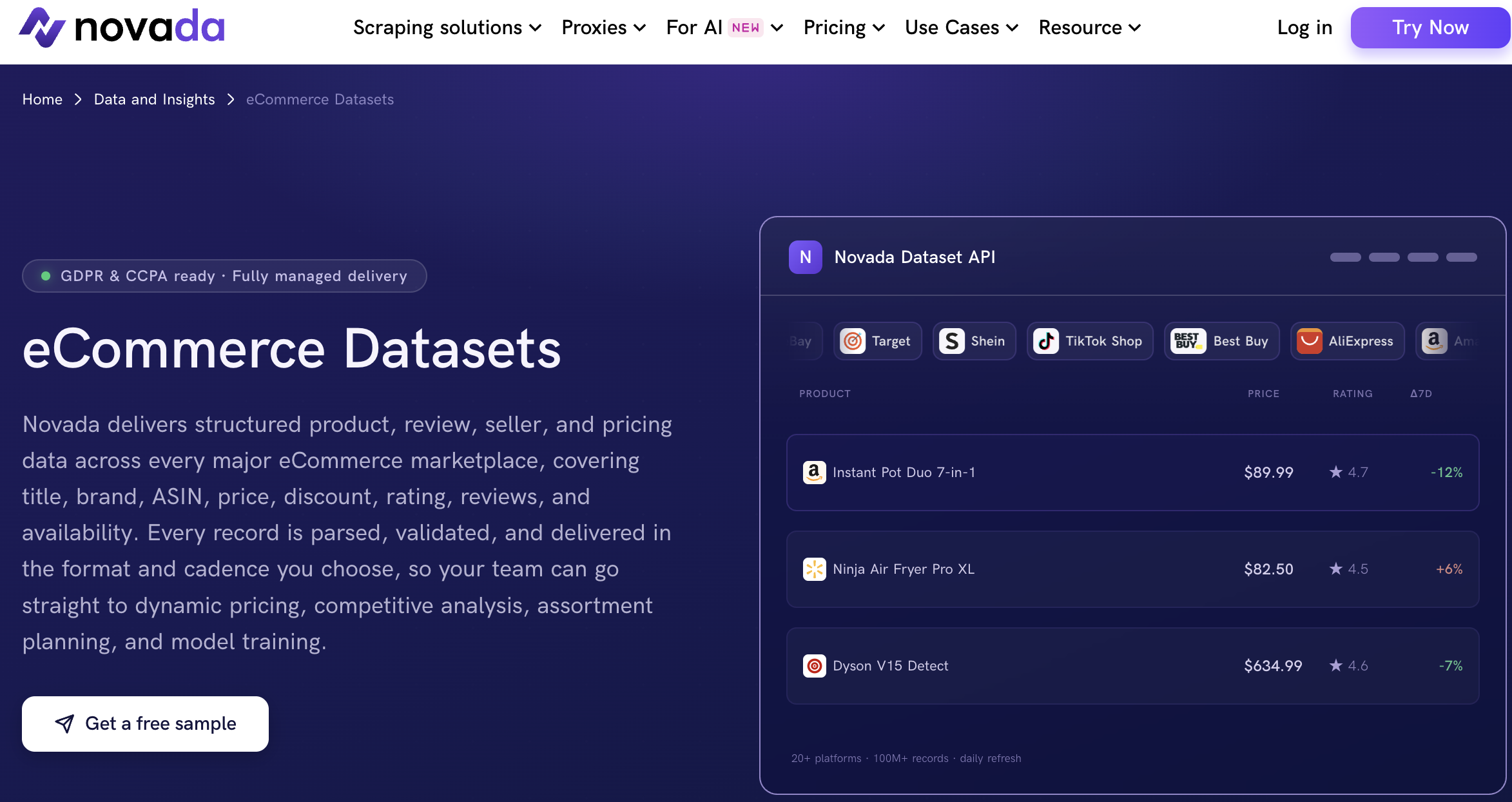
For teams that don’t want to run scraping infrastructure at all, Novada sells pre-collected datasets across e-commerce, social media, LinkedIn, image, and text categories, plus a video data API with integrated cloud storage and a stated 95% success rate. The free Novada MCP server plugs Novada’s search, unblocking, and scraping capabilities directly into AI agent workflows with a one-line integration — a low-risk way to test the underlying infrastructure before committing budget to paid products.
Novada’s proxy coverage spans 195+ countries, with the US, UK, and Brazil among the largest IP pools.
Pricing
Pricing below is current as of September 4, 2026, pulled directly from Novada’s public pricing pages. Enterprise and volume-discounted rates require contacting Novada’s sales/account manager team and were not published — treat these figures as pay-as-you-go entry rates and confirm current pricing before purchasing. Unlike some competitors that gate every product behind its own minimum monthly spend, Novada draws from a single shared credit balance across the entire product line, so a developer testing residential proxies one week and the SERP API the next doesn’t need to juggle separate top-ups.
| Plan / Product | Starting Price | Notes |
|---|---|---|
| Residential Proxies | From $0.85/GB | New-user offer: $10 for 10GB; unlimited concurrency |
| Mobile Proxies | From $1.50/GB | 2M+ real 3G/4G/5G mobile IPs |
| Rotating ISP Proxies | From $0.65/GB | Up to 6-hour sticky sessions |
| Rotating Datacenter Proxies | From $0.50/GB | 190+ countries, quoted sub-1ms latency |
| Static ISP Proxies | From $1.18/IP | Dedicated, fixed-IP billing |
| Dedicated Datacenter Proxies | From $0.72/IP | Exclusive, non-shared IPs |
| Scraper API / SERP API | From $0.90/1k results | Pay per successful result |
| Web Unblocker | From $1/1k results | Auto CAPTCHA and JS rendering |
| Browser API | From $4/GB | Managed cloud browser sessions |
| Novada MCP | Free | AI agent access, one-line integration |
How Novada Compares
Bright Data and Oxylabs figures below are pulled from their public pricing pages and third-party pricing trackers current as of mid-2026. Both offer steep committed-plan discounts that bring effective per-GB cost down at scale, so this comparison is most relevant to smaller or early-stage projects using pay-as-you-go rates.
| Feature | Novada | Bright Data | Oxylabs |
|---|---|---|---|
| Residential proxy PAYG | From $0.85/GB | ~$8/GB | ~$8/GB |
| Free trial, no card | Yes | Trial credits only | Sales-arranged |
| Claimed residential IP pool | 100M+ | 72M+ | 100M+ |
| Unified credit across products | Yes | Product-specific plans | Product-specific plans |
| Independent review volume | Thin (~15 Trustpilot reviews) | Large, well-established | Large, well-established |
| Native MCP/AI-agent connector | Yes, free | No standalone free MCP | No standalone free MCP |
The gap in independent review volume is the one line item in that table that price alone can’t close. Bright Data and Oxylabs have both been in the market long enough to accumulate large, diverse review bases across Trustpilot, G2, and Capterra, which makes their strengths and weaknesses relatively well documented. Novada’s cost advantage is real and verifiable from its own pricing pages, but buyers evaluating it for anything mission-critical should weigh that against a still-developing public track record — the kind of gap that only closes with time and volume, not with a lower price tag.
 Novada’s pay-as-you-go entry rate undercuts Bright Data and Oxylabs by a wide margin at small-to-mid volumes.
Community Feedback
Because Novada is a comparatively newer brand, community sentiment is still thin — there isn’t yet a large, multi-year public track record the way there is for Bright Data or Oxylabs. The available signal comes mostly from the ~14-15 Trustpilot reviews and the company’s own responses to them. On the positive side, reviewers have specifically praised proxy speed and stability once issues were resolved, budget-friendly pricing for social media and reputation management use cases, and helpful individual support staff. On the negative side, the two most substantive complaints — mismatched city/ASN targeting and initial support delays — both drew direct, public responses from the Novada team rather than being ignored, which is a reasonable signal even if it doesn’t fully offset the underlying issues.
None of this amounts to a large enough sample to draw firm conclusions the way you could for a decade-old proxy provider. It’s worth treating Novada’s independent reputation as a work in progress: promising early signals, genuine unresolved friction points, and not yet enough volume to know which pattern will dominate as the review base grows.
Pros & Cons
Pros
- Residential proxy pricing roughly 8-9x cheaper on paper than large incumbents at the pay-as-you-go entry tier
- One shared credit balance across proxies, scraper tools, and Browser API simplifies billing
- No-credit-card free trial with Google sign-up lowers the barrier to testing against real target sites
- Free Novada MCP connector is a genuine head start for teams building AI agents that need live web data
- Broad product range (proxies, scraper API, unblocker, browser automation, datasets) under one vendor
- Company visibly responds to negative Trustpilot reviews and has resolved at least one documented support issue
Cons
- Independent review coverage is thin — ~15 Trustpilot reviews, not yet enough volume for strong statistical confidence
- At least one review alleges city/ASN-level targeting doesn’t work as advertised, delivering only country-level random IPs
- A separate review reported proxy speed issues and an initially unresolved support ticket (later fixed after escalation)
- “Chosen by 8,000+ enterprises” and other headline stats are self-reported, not independently corroborated
- As a comparatively newer brand, it lacks the multi-year enterprise compliance track record of Bright Data or Oxylabs
Who Should Use It
Novada is best suited to startups, solo developers, small agencies, and growth-stage teams that need residential or rotating proxy access without committing to the four-figure monthly minimums that Bright Data and Oxylabs often require to reach competitive per-GB rates. It’s also a reasonable pick for AI/agent builders who want a free MCP endpoint for live web access, and for e-commerce sellers or market-research teams who need localized pricing data but don’t have the volume to justify an enterprise contract. Anyone running a series of small, exploratory scraping projects where cost-per-experiment matters more than a long-term vendor relationship will likely find the pay-as-you-go model easier to justify than a committed plan elsewhere.
Large enterprises with strict, audited compliance requirements, or teams that need a vendor with years of public track record and dedicated account management history, may still lean toward a more established incumbent — at least until Novada builds a larger independent review base and a longer public compliance history to point to. Social media managers running multiple regional accounts may also find the mix of sticky sessions and mobile IPs useful for keeping account activity looking geographically consistent, though they should weigh that against the geo-targeting complaint noted above.
Getting Started
- Create your account. Register with email or Google sign-in — no credit card is required, so you can evaluate risk-free.
- Claim the new-user offer. Activate the $10-for-10GB residential proxy promotion from the dashboard.
- Pick your first product. Choose residential proxies, Scraper API, SERP API, or Web Unblocker based on your most urgent use case.
- Run a real test. Generate credentials and test against your actual target site, checking geo-targeting accuracy if city/ASN precision matters.
- Integrate using the documentation. Review the code samples for your programming language to wire it into your existing stack.
- Monitor and scale deliberately. Track usage against your credit balance and only move to a committed plan once your volume stabilizes.
Tips for Maximum Value
Pro tip: Test city- and ASN-level targeting explicitly against your specific target sites during the free trial, before running any real volume — given the mixed feedback on precision targeting, this protects your budget from a mismatch discovered after you’ve scaled up spend.
Use short sticky sessions (1-10 minutes) for stealth scraping and longer sessions (up to 120 minutes) only for workflows that genuinely need session continuity, such as account management. Route lightweight, unprotected requests through the cheaper rotating datacenter proxies and reserve residential IPs for sites with heavier bot detection — mixing tiers by task can meaningfully cut blended cost per GB. For search-heavy workflows like rank tracking, the SERP API’s per-result pricing is usually more predictable than proxying raw search requests yourself.
If you hit a support issue, don’t hesitate to escalate publicly — Novada’s team has shown it responds to and resolves flagged tickets faster once they go public on Trustpilot. Set up usage alerts early so a runaway script doesn’t burn through your credit balance unnoticed, and watch blended cost per successful request rather than just the headline per-GB rate, since retries on blocked pages can quietly inflate real spend. Finally, evaluate the free Novada MCP connector before building custom scraping glue code for any AI agent or RAG pipeline — it costs nothing to test and may remove the need for bespoke integration work entirely.
Future Outlook
The proxy and web-data market is consolidating around two axes: price competition at the small-to-mid volume tier, and AI-agent integration through protocols like MCP. Novada is positioned reasonably well on both fronts — its pay-as-you-go pricing undercuts legacy players significantly, and its free MCP connector arrived ahead of many established competitors. As more AI agents and RAG pipelines need live, structured web access rather than relying on stale training data, vendors that make that access a one-line integration rather than a custom scraping project stand to capture a growing share of that demand.
The company’s biggest near-term challenge is building a larger, more diverse independent review base and demonstrating consistent geo-targeting accuracy at scale — the newer a proxy brand is, the more scrutiny its precision claims deserve, since there hasn’t been enough public usage yet to stress-test them. If Novada can close that trust gap while holding its price advantage, it’s well placed to keep taking share from higher-priced incumbents through 2026 and beyond. Buyers evaluating it today are effectively trading a lower, more established review count for meaningfully lower cost — a trade that makes sense for smaller, budget-conscious projects but warrants more due diligence for mission-critical enterprise pipelines.
Bottom Line: Novada delivers a genuinely competitive, all-in-one proxy and scraping platform at a fraction of the pay-as-you-go price of Bright Data or Oxylabs, backed by a free AI-agent MCP connector that few competitors currently match. The trade-off is a still-thin independent review base and at least one unverified complaint about geo-targeting precision — both worth testing directly during the no-card free trial before committing production volume.
Conclusion
For teams that need reliable proxy access and scraping tools without the enterprise-scale minimum spend of legacy vendors, Novada is one of the more compelling options on the market in 2026. Its pricing undercuts the biggest names by a wide margin, its product range covers most data-collection scenarios under a single credit balance, and its free MCP integration gives it a real edge for AI-agent builders.
The main asterisk is trust signal volume: with roughly 15 public reviews so far, prospective buyers should run their own trial against real target sites — particularly if precise city- or ASN-level targeting is a hard requirement — before scaling up spend. None of the caveats in this review are dealbreakers on their own; they’re simply the kind of due-diligence checkpoints that make sense for any newer vendor promising incumbent-beating pricing. Given the no-card free trial and the $10-for-10GB offer, the cost of running that due diligence yourself is close to zero, which makes Novada an easy platform to test even if you ultimately decide to stick with a more established provider for production workloads.
Ready to stop losing money on unreliable proxies?
Explore more honest reviews, tutorials and tech comparisons to find the right gear for the way you work, travel and live — at World Of Tech, where we make everything easy.
👉 Try Novada: https://worldoftech.space/novada
👉 Our YouTube Channel: youtube.com/@world_tech79
👉 Our Facebook Fanpage: Facebook
👉 Our X (Twitter): @worldoftech79
Pricing, specifications and policy details in this review were verified against novada.com and independent review/pricing sources (including Trustpilot and third-party pricing trackers) as of September 2026. Novada’s residential proxy rate is advertised as a starting price, and enterprise/volume tiers are not published as a fixed table, so confirm current pricing on the official site before purchasing. Competitor prices are approximate and subject to change.